
Over 80 percent of American businesses report customer frustration due to unclear signage. Effective directional signs do much more than point the way. They shape the first impression visitors have of your brand and help people feel confident moving through your space. Discover practical facts about directional signage and learn how thoughtful design can set your business apart from the competition.
Table of Contents
- Defining Directional Signage And Common Myths
- Major Types Of Directional Signage Solutions
- How Directional Signs Improve User Experience
- Legal, Safety, And Accessibility Requirements In The U.S.
- Common Design Mistakes And How To Avoid Them
Key Takeaways
| Point | Details |
|---|---|
| Directional signage is essential for navigation | It serves as a visual communication tool that helps people navigate complex environments efficiently. |
| Design standards vary globally | Directional signage lacks uniformity, often influenced by local regulations and cultural contexts. |
| User-centered design improves accessibility | Incorporating features that enhance readability and usability fosters inclusivity for all users. |
| Avoid common design mistakes | Prioritize clarity and simplicity to ensure effective communication and navigation support in signage design. |
Defining Directional Signage and Common Myths
Directional signage represents a sophisticated system of visual communication designed to guide people through physical spaces efficiently. These signs do more than simply point the way – they serve as critical navigational tools in complex environments like airports, hospitals, campuses, and commercial buildings. Historically rooted in Roman milestones, directional signage has dramatically evolved from basic wayfinding markers to intricate communication systems.
Contrary to popular belief, directional signs are not uniform across different regions. Design standards can vary significantly between countries and contexts, challenging the myth of universal sign language. While the Vienna Convention on Road Signs and Signals provides general guidelines, specific details like size, color, and precise design remain flexible. The core purpose remains consistent: reducing confusion and improving spatial navigation for users.
The complexity of directional signage extends beyond simple arrows. These visual indicators can include compass roses, symbolic markers, and intricate orientation tools that help people understand spatial relationships. Some signs serve decorative purposes while simultaneously providing functional guidance, transforming mundane wayfinding into an art form of communication.
Pro tip: When designing directional signage, prioritize clarity, consistency, and intuitive design to ensure users can navigate spaces effortlessly.
Major Types of Directional Signage Solutions
Directional signage encompasses a diverse range of solutions designed to guide, inform, and orient people within various environments. Building-mounted sign systems represent a critical category, including awnings, canopy signs, projecting signs, wall signs, and window displays. These versatile solutions serve multiple purposes from exterior branding to interior wayfinding, helping businesses communicate effectively with their audience.
In complex environments like campuses, large commercial complexes, and public spaces, wayfinding systems typically incorporate multiple sign types. Comprehensive signage solutions include primary, secondary, and supporting signs such as identity markers, directional arrows, regulatory indicators, and informational displays. Wayfinding signage systems strategically employ monument signs, destination markers, and intuitive navigation tools to help people understand their spatial context and movement options.
Digital technologies have revolutionized directional signage, introducing dynamic digital displays, interactive touchscreens, and adaptive messaging systems. These modern solutions offer unprecedented flexibility, allowing real-time updates, multilingual support, and interactive navigation experiences. From traditional building-mounted signs to cutting-edge digital displays, directional signage continues to evolve, transforming how people interact with and understand physical spaces.
To clarify the various directional signage options, here is a comparison of traditional and digital signage solutions:
| Solution Type | Key Features | Typical Environments |
|---|---|---|
| Traditional Signage | Fixed messages, non-digital materials | Campuses, offices, hospitals |
| Digital Signage | Interactive, adaptable, real-time updates | Airports, malls, transit hubs |
Pro tip: When designing a directional signage system, consider the specific needs of your environment and create a cohesive, intuitive visual language that guides users seamlessly.
How Directional Signs Improve User Experience
Accessible directional signage dramatically enhances navigation by providing clear, intuitive visual information that supports independent movement for all users. These signs go beyond simple wayfinding, creating an inclusive environment that reduces cognitive strain and helps people confidently move through complex spaces. By integrating thoughtful design principles, directional signs transform potentially confusing environments into easily navigable landscapes.
Research demonstrates that well-designed signage significantly reduces user stress and improves overall spatial understanding. Cognitive load reduction happens through strategic sign placement, clear typography, and intuitive visual hierarchies. Wayfinding research reveals that effective signs not only guide people physically but also create positive psychological experiences by minimizing confusion and providing a sense of control in unfamiliar environments.

The most impactful directional signs consider diverse user needs, incorporating features like high-contrast colors, readable fonts, universal symbols, and accommodations for individuals with visual or mobility challenges. These comprehensive design approaches ensure that signage serves multiple purposes: navigation, safety, accessibility, and user comfort. By prioritizing clarity and inclusivity, directional signs become powerful tools for creating welcoming, user-friendly spaces that feel intuitive and supportive.
Pro tip: Conduct user testing with diverse individuals to validate your directional signage design and ensure it truly meets the navigation needs of all potential users.
Legal, Safety, and Accessibility Requirements in the U.S.
ADA sign standards establish critical legal requirements for directional signage across the United States, ensuring equitable access for individuals with disabilities. These comprehensive regulations mandate specific design elements that guarantee public spaces remain navigable and inclusive for everyone, regardless of physical abilities. The Americans with Disabilities Act provides a robust framework that goes beyond mere compliance, fundamentally reshaping how businesses and organizations approach visual communication.
The legal requirements encompass multiple critical dimensions of signage design. Accessibility guidelines specify precise technical standards including tactile letter heights, braille translation, color contrast ratios, and mounting heights that enable independent navigation. These regulations apply universally to permanent interior and exterior signs identifying rooms, exits, emergency features, and transit areas. Organizations must ensure their signs not only provide directional information but also meet stringent federal accessibility standards that protect the rights of individuals with visual, mobility, and cognitive challenges.
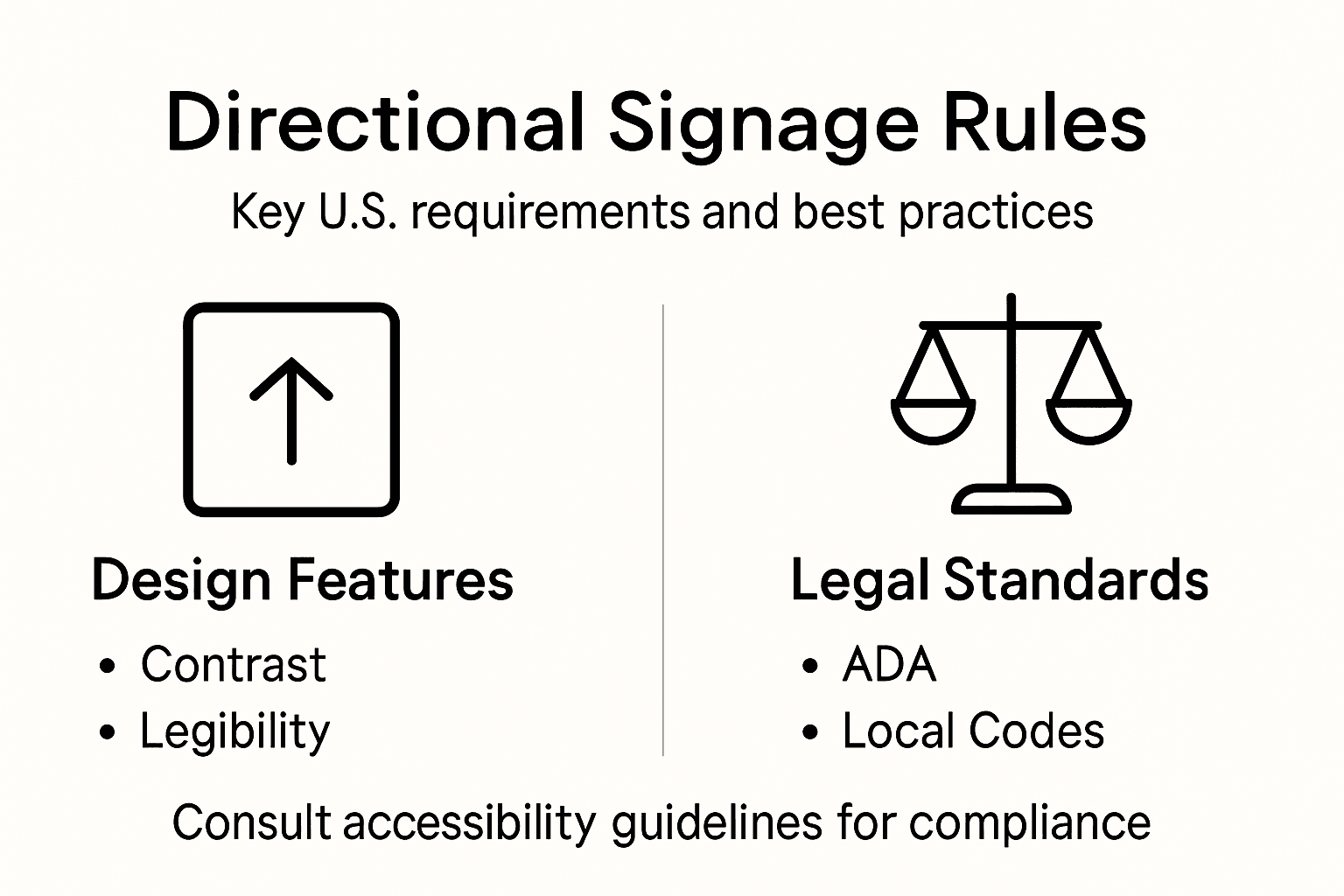
Here’s a summary of critical ADA requirements for accessible directional signage in the US:
| Requirement Area | ADA Standard Example | Purpose |
|---|---|---|
| Tactile Features | Raised letters and braille | Aids visually impaired users |
| Color Contrast | High contrast text/background | Improves readability |
| Mounting Height | 48-60 inches from floor | Ensures easy reach/visibility |
Beyond federal mandates, many local jurisdictions implement additional accessibility requirements that complement national standards. These regulations reflect a broader commitment to creating barrier free environments that support universal design principles. By integrating thoughtful signage solutions that prioritize clarity, contrast, and comprehensibility, businesses can transform legal compliance from a bureaucratic obligation into a meaningful opportunity to demonstrate social responsibility and customer care.
Pro tip: Consult with an accessibility specialist to conduct a comprehensive sign audit and ensure your directional signage fully meets both federal and local legal requirements.
Common Design Mistakes and How to Avoid Them
Sign design effectiveness requires understanding and avoiding critical visual communication errors that can undermine directional signage performance. The most fundamental mistakes often stem from overlooking core design principles that ensure clear, intuitive navigation. Designers must recognize that a sign is more than just text on a surface – it’s a strategic communication tool that guides human behavior and perception.
Common pitfalls in directional signage design include poor readability, insufficient visual contrast, and overcrowded information layouts. Legibility standards demand careful font selection, appropriate sizing, and high contrast between text and background. Many organizations inadvertently create confusing signs by cramming too much information into limited space, using complex fonts, or selecting color combinations that strain visual comprehension. Strategic design means prioritizing clarity over complexity, ensuring that critical directional information can be understood quickly and effortlessly.
Universal design principles are crucial in avoiding signage mistakes. Inclusive signage design demands consideration of diverse user perspectives, including individuals with visual, cognitive, or mobility challenges. This means creating signs with consistent symbols, logical placement, and accommodations that support independent navigation. Successful directional signage transcends mere visual communication – it becomes an empathetic tool that helps all users feel confident and supported in their environment.
Pro tip: Conduct regular user testing with diverse individuals to validate your signage design and identify potential comprehension barriers before finalizing implementation.
Elevate Your Space with Expert Directional Signage Solutions
Directional signage plays a crucial role in guiding visitors effortlessly while enhancing accessibility and compliance. Whether you face challenges with unclear navigation or need signs that meet ADA standards, your signage must prioritize clarity, consistency, and inclusivity. At Custom Signs Today, we specialize in crafting custom-made directional signs that transform complex spaces into welcoming, easy-to-navigate environments.
Explore our versatile range of signage options tailored for your unique setting by visiting our Uncategorized category. Take the first step to reduce confusion, improve user experience, and ensure legal compliance with high-quality, durable signs designed just for you. Don’t wait to create signage that truly guides and supports every visitor—contact us now through Custom Signs Today to request your free quote and start your journey toward better wayfinding today.
Frequently Asked Questions
What is directional signage?
Directional signage is a system of visual communication designed to guide people through physical spaces efficiently, enhancing navigation in complex environments like airports, hospitals, and campuses.
Why is directional signage important?
Directional signage is important because it reduces confusion, improves spatial navigation, and creates an inclusive environment, allowing individuals to move independently and confidently through unfamiliar spaces.
What are the common types of directional signage solutions?
Common types of directional signage solutions include building-mounted signs, wayfinding systems, digital displays, and interactive touchscreens, each tailored to meet the navigation needs of specific environments.
How does ADA impact directional signage design?
The Americans with Disabilities Act (ADA) establishes important legal requirements for directional signage, including specifications for tactile features, color contrast, and mounting height, to ensure accessibility for individuals with disabilities.