
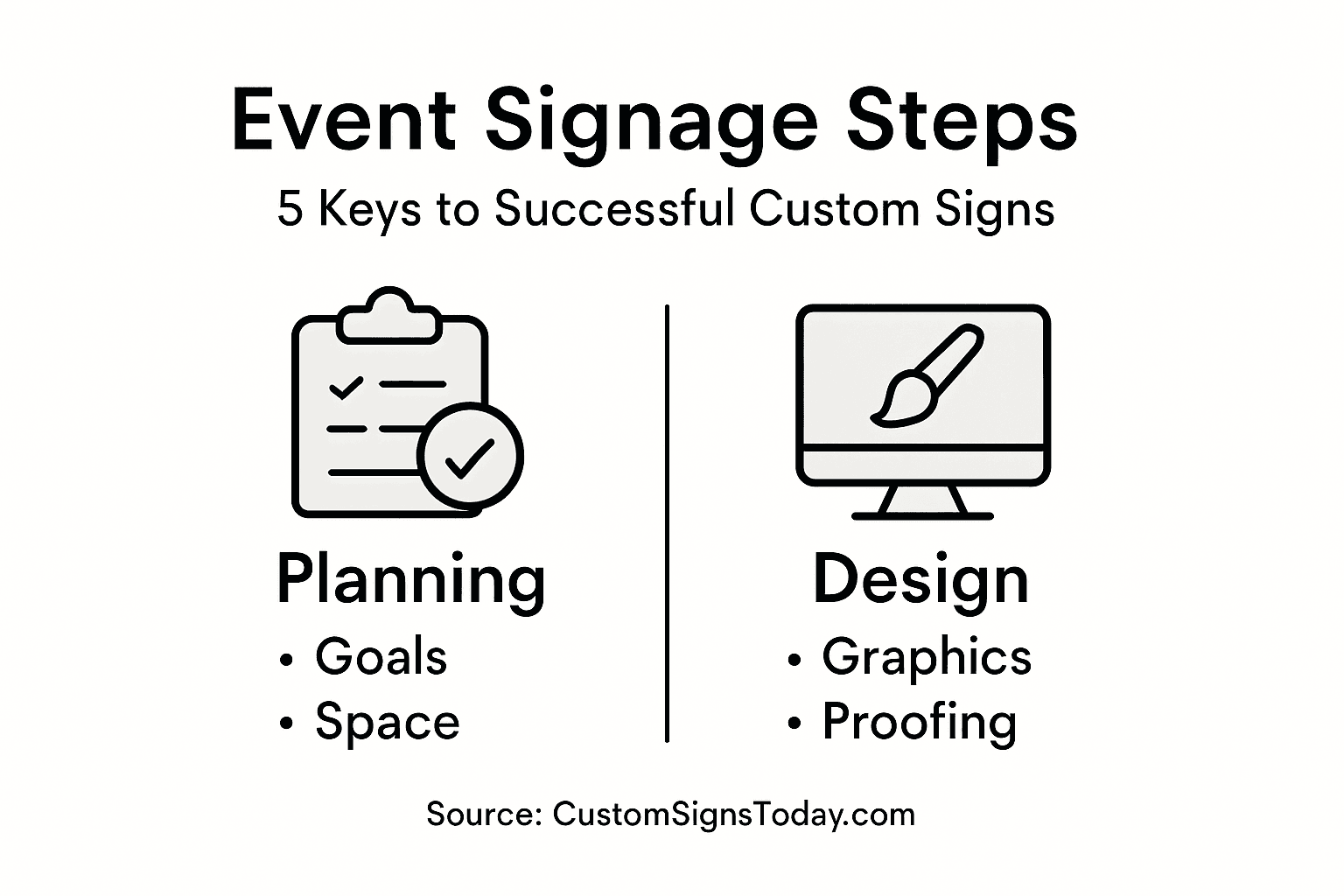
Every event planner knows the frustration when guests struggle to find their way or miss key event messages. Clear and customized signage is more than decoration—it is your frontline for effective communication and professional branding. As American corporate events become larger and more complex, effective signage transforms attendee experience by guiding guests, amplifying your brand presence, and ensuring that every detail aligns with your event goals. This guide walks you through the crucial steps for creating signage that supports your strategy and enhances every interaction.
Table of Contents
- Step 1: Define Event Goals And Signage Needs
- Step 2: Select Materials And Sign Types
- Step 3: Design Impactful Custom Graphics
- Step 4: Submit Orders And Review Proofs
- Step 5: Install And Inspect Final Signage
Quick Summary
| Actionable Insight | Explanation |
|---|---|
| 1. Define clear event goals | Establishing specific objectives will guide your signage strategy and enhance communication during the event. |
| 2. Select appropriate materials | Choose materials suited for the event type, ensuring readability, durability, and alignment with your branding. |
| 3. Design compelling graphics | Create visually striking graphics that communicate your message effectively and enhance attendee engagement. |
| 4. Conduct thorough proof reviews | Meticulously check all proofs for accuracy in text, color, and layout to avoid production errors. |
| 5. Properly install and inspect signage | Ensure signs are installed correctly and inspected for visibility and stability to maximize their impact. |
Step 1: Define event goals and signage needs
Successfully customizing signs for an event starts with crystal-clear goal setting. Your signage strategy must align precisely with your event’s core objectives and communication needs.
To define your event goals and signage requirements, you’ll want to start by conducting a comprehensive needs assessment process. This involves several critical steps:
- Identify the primary purpose of your event
- Determine your target audience
- Outline specific communication objectives
- Evaluate the physical event space and layout
Meeting and event planners understand that signage isn’t just decorative – it’s a strategic communication tool. Effective signage transforms attendee experience by providing clear direction, reinforcing event branding, and guiding participant interactions.
The right signage can turn a good event into an exceptional, memorable experience.
When defining your signage needs, consider these key aspects:
- Event Type: Corporate conference, wedding, trade show, or community gathering
- Audience Demographics: Age range, professional background, expectations
- Venue Characteristics: Indoor vs outdoor, space limitations, lighting conditions
- Branding Requirements: Color schemes, logo placement, messaging tone
By meticulously planning your signage strategy, you’ll create a cohesive visual communication system that supports your event’s goals and enhances attendee engagement.
Pro tip: Always create a signage mockup or digital prototype before final production to ensure your design meets all event communication objectives.
Step 2: Select materials and sign types
Choosing the right materials and sign types is crucial for creating effective and impactful event signage. Your selections will directly influence how well your communication strategy reaches and guides event attendees.
When selecting sign materials, consider accessibility and durability standards that ensure your signage is both functional and inclusive. Different events require unique approaches to materials and sign types:
- Outdoor events: Weather-resistant materials like aluminum or treated plastics
- Corporate conferences: Professional-grade vinyl or acrylic signs
- Trade shows: Lightweight, portable display materials
- Temporary events: Recyclable or reusable signage options
Material selection involves balancing multiple factors, including:
- Visual clarity and readability
- Environmental conditions
- Budget constraints
- Branding requirements
- Ease of installation
The right sign material communicates your message effectively while reflecting your event’s professional standards.
Event signage typically falls into several key categories:
- Directional signs: Guide attendees through venue spaces
- Informational signs: Provide key details about schedules or rules
- Branding signs: Reinforce event identity and visual messaging
- Regulatory signs: Communicate important guidelines or restrictions
Consider the specific requirements of your event space and audience when making your selections. Some materials offer better visibility, while others provide enhanced durability or sustainability.

Here’s a quick comparison of common sign materials and their ideal event applications:
| Material Type | Best For | Durability | Professional Appearance |
|---|---|---|---|
| Aluminum | Outdoor festivals | Highly weatherproof | Modern and sleek |
| Vinyl | Corporate conferences | Moderate, indoor use | Clean and versatile |
| Acrylic | Business meetings | Strong, indoor only | High-end look |
| Treated Plastic | Trade shows | Flexible, weatherproof | Lightweight and bright |
| Recyclable Fiber | Temporary events | Low, eco-friendly | Simple and functional |
Pro tip: Request material samples and create small prototypes to test visibility and durability before committing to full event signage production.
Step 3: Design impactful custom graphics
Creating visually compelling graphics is the heart of memorable event signage. Your design will communicate your event’s essence and guide attendees through their experience.
When developing graphics, understand the core principles of visual communication that transform ordinary signs into powerful messaging tools. Effective event graphics require strategic planning across multiple design dimensions:
- Color psychology and emotional impact
- Brand consistency and visual identity
- Typography and readability
- Scalability across different sign types
Graphic design for events demands precision and creativity. Consider these critical design elements:
- Establish a clear visual hierarchy
- Select fonts that reflect event tone
- Create a cohesive color palette
- Ensure high contrast for readability
- Incorporate your event or brand logo strategically
Great event graphics tell a story before a single word is read.
Your design approach should balance aesthetic appeal with practical communication. Key graphic types include:
The following table summarizes key signage categories and their primary business impacts:
| Sign Category | Main Function | Attendee Impact |
|---|---|---|
| Directional | Wayfinding/navigation | Smooth venue flow |
| Informational | Event details/rules | Reduced confusion |
| Branding | Identity reinforcement | Heightened brand recognition |
| Regulatory | Safety/compliance | Increased attendee security |
- Directional graphics: Clear, intuitive navigation symbols
- Informational graphics: Concise data presentation
- Branding graphics: Logos and visual identity markers
- Motivational graphics: Inspiring messages or event themes
Remember that graphics are more than decoration. They are your silent communicators, guiding and engaging attendees throughout the event experience.
Pro tip: Create a digital mockup of your graphics in various sizes and lighting conditions to ensure consistent visual impact across different sign applications.
Step 4: Submit orders and review proofs
Finalizing your event signage requires a meticulous approach to ordering and proof review. Your attention to detail during this stage ensures that your graphics translate perfectly from design to physical signage.
Understanding the critical review process for event materials is essential for achieving professional results. Before submitting your final order, implement a comprehensive review strategy:
- Check spelling and grammar meticulously
- Verify exact color matching
- Confirm dimensions and scale
- Ensure logo and branding elements are accurate
- Review typography and text alignment
Order submission requires systematic documentation. Follow these crucial steps:
- Compile all design files and specifications
- Create a detailed order request form
- Include precise technical requirements
- Specify material and printing preferences
- Set clear delivery deadlines
Precision in proof review prevents costly production mistakes.
When reviewing proofs, consider these key evaluation criteria:
- Visual accuracy: Does the proof match your original design?
- Color fidelity: Are colors true to your brand standards?
- Resolution and clarity: Will graphics look crisp at full size?
- Material representation: Do samples reflect intended finish?
Remember that professional sign providers typically provide digital and physical proof options. Carefully examine both to ensure complete satisfaction.
Pro tip: Request multiple proof formats and review them in different lighting conditions to guarantee your signage will look perfect during the actual event.
Step 5: Install and inspect final signage
With your custom signs ready, the critical phases of installation and final inspection will determine your event’s visual success. Proper placement and thorough examination ensure your signage delivers maximum impact.
Understanding sign installation safety and compliance is essential for professional results. Your installation process should follow a systematic approach:
- Survey the venue layout beforehand
- Identify optimal mounting locations
- Ensure clear visibility from multiple angles
- Check for potential obstructions
- Verify structural integrity of mounting surfaces
Sign installation requires strategic planning. Follow these key steps:
- Gather necessary installation tools
- Mark precise mounting points
- Level and align signs carefully
- Secure signs using appropriate fasteners
- Test stability and positioning
Precision during installation prevents potential communication failures.
When inspecting your installed signage, evaluate these critical aspects:
- Alignment: Are signs perfectly straight and level?
- Visibility: Can attendees read signs from expected distances?
- Lighting: Are signs readable under various lighting conditions?
- Weather resistance: Can signs withstand potential environmental factors?
Careful installation and rigorous inspection transform your design concepts into powerful event communication tools.
Pro tip: Take high-resolution photos of installed signs to document placement and provide a reference for future event planning.
Elevate Your Event Signage With Custom Solutions That Impress
Planning flawless event signage means addressing challenges like aligning your goals with effective materials and standout graphics. From choosing durable weather-resistant signs to designing impactful visuals that keep attendees engaged, these key steps can make or break your event experience. If you want professional-grade signs that perfectly match your event’s unique needs, our expertise at Uncategorized – can help turn your vision into reality.
Don’t let signage uncertainties hold back your event’s success. Visit Custom Signs Today now to explore our full range of custom options including banners, decals, and directional signs crafted for lasting impact. Take control of your event’s communication and order your personalized signage today to ensure flawless installation and unforgettable attendee engagement.
Frequently Asked Questions
How do I define the goals for my event signage?
To define the goals for your event signage, start by identifying the primary purpose of your event and understanding your target audience. Outline specific communication objectives and evaluate the event space layout to ensure your signage aligns with your overall event goals.
What materials should I consider for outdoor event signage?
For outdoor event signage, choose weather-resistant materials such as aluminum or treated plastics to ensure durability against environmental conditions. Always prioritize accessibility and visibility to enhance the attendee experience.
How can I create impactful graphics for my event signs?
To create impactful graphics, focus on establishing a clear visual hierarchy and using a cohesive color palette that reflects your branding. Ensure that fonts are readable and incorporate logos strategically to enhance brand recognition.
What steps should I take before submitting my signage order?
Before submitting your signage order, meticulously check spelling and grammar, verify color matching, and confirm dimensions. Review typography and ensure all branding elements are accurate to prevent production errors.
How can I ensure proper installation of my event signage?
To ensure proper installation, survey the venue layout to identify optimal mounting locations and check for visibility from multiple angles. Use necessary tools for secure placement and test the stability of the signs after installation to maintain effective communication throughout the event.
Recommended
- Why Custom Event Signs: Complete Guide for Businesses –
- How to Design Event Signage for Maximum Impact –
- Guide to Outdoor Event Signage: Create Effective Signs –
- Best Outdoor Event Signage – Expert Comparison 2025 –
- Guide to successful Instagram – for restaurant owners – Instant Backdrops
- Festival Gutschein – Gutscheinvorlage gemeinsamer Festivalbesuch – Herzensprojekt Manufaktur