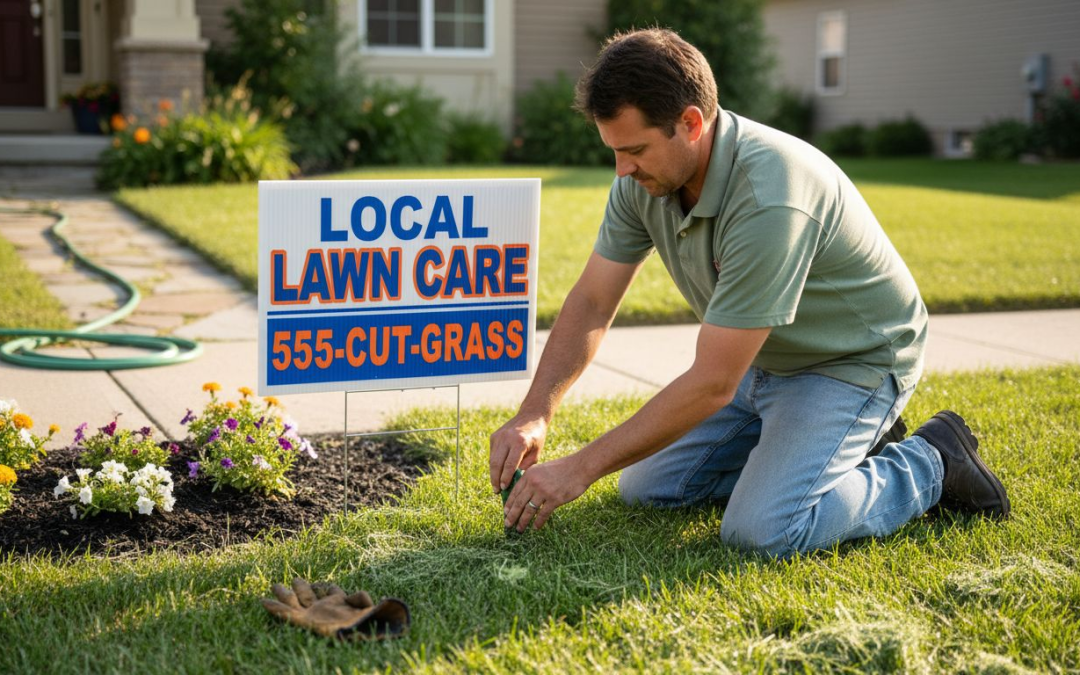
Over 60 percent of American consumers notice yard signs when making local buying decisions. For small business owners in the United States, a well placed and thoughtfully designed sign can mean the difference between being overlooked and gaining new customers. With so many options available, understanding the basics of impactful yard signage helps your business stand out and ensures your message reaches the community quickly and clearly.
Table of Contents
- 1. Choose High-Contrast Colors For Maximum Readability
- 2. Select Durable, Weather-Resistant Materials
- 3. Use Clear, Bold Fonts That Stand Out
- 4. Keep Messaging Short And Action-Oriented
- 5. Include Contact Information For Easy Follow-Up
- 6. Place Yard Signs Strategically For Best Results
- 7. Refresh And Maintain Signs Regularly
Quick Summary
| Key Message | Explanation |
|---|---|
| 1. Use High-Contrast Colors | Choose color combinations with a minimum contrast ratio of 4.5:1 to enhance readability. This makes your sign easily visible and comprehensible. |
| 2. Select Durable Materials | Opt for weather-resistant materials like treated aluminum or high-density plastics to withstand outdoor conditions and maintain sign quality. |
| 3. Keep Messaging Short | Limit your message to 5-7 impactful words. Focus on clear calls to action that can be read at a glance. |
| 4. Include Clear Contact Information | Make contact details prominent yet simple, using large fonts and one or two methods. Consider a QR code for quick access. |
| 5. Strategically Place Signs | Position your sign in high-traffic areas after verifying local regulations. This maximizes visibility and engagement with potential customers. |
1. Choose High-Contrast Colors for Maximum Readability
Your yard sign is a powerful visual communication tool, and color contrast is its secret weapon for grabbing attention and ensuring readability. When potential customers drive or walk by, you want your message to leap out and be instantly understood.
According to Web Content Accessibility Guidelines, effective signage requires a minimum contrast ratio of 4.5:1 for normal text. This means selecting color combinations that create sharp, clear visual separation between your background and text.
Practically speaking, this translates to pairing dark text on light backgrounds or light text on dark backgrounds. Think black text on white, dark blue on bright yellow, or white text on deep navy. These combinations ensure your sign remains readable from a distance and under varying light conditions like bright sunlight or overcast days.
The goal is immediate comprehension. A well-designed sign with high-contrast colors can communicate your business message in less than three seconds a key window for catching a potential customer’s attention. Color contrast research confirms that good contrast improves text legibility for all viewers, including those with visual impairments.
Pro tip: Test your sign’s color contrast using online accessibility checkers to ensure maximum readability before printing your final design.
2. Select Durable, Weather-Resistant Materials
Your yard sign is a marketing investment that must withstand the unpredictable elements of outdoor environments. Choosing materials that can resist sun, rain, wind, and temperature fluctuations is crucial for maintaining your sign’s professional appearance and message clarity.
According to government sign guidelines, high-density overlays, metal, and weather-resistant plastics offer superior durability for outdoor signage. These materials protect your sign from UV rays that can fade colors, moisture that can cause warping, and physical wear from environmental stress.
When selecting materials, consider your local climate conditions. In regions with intense sunlight, UV-resistant substrates prevent color degradation. For areas with high humidity or frequent rainfall, waterproof materials like treated aluminum or synthetic polymers will prevent warping and maintain structural integrity.
The USDA Forest Service fabrication guide emphasizes balancing durability, graphic clarity, and cost. Digital prints on weatherproof substrates like porcelain enamel or treated polycarbonate can provide long lasting visibility while resisting environmental challenges.
Pro tip: Invest in a protective laminate or coating that adds an extra layer of weather resistance and extends your yard sign’s lifespan.
3. Use Clear, Bold Fonts That Stand Out
Your yard sign’s typography is the silent communicator that determines whether potential customers will notice and understand your message from a distance. Selecting the right font can mean the difference between attracting attention and being overlooked.
Accessible typography standards recommend using sans-serif fonts with high stroke contrast that maintain clarity at a distance. Fonts like Arial and Helvetica excel at delivering crisp, readable messages that catch the eye of passing traffic or pedestrians.
The U.S. Department of the Interior’s signage guidelines emphasize using bold font weights with substantial letter thickness. This approach ensures your text remains legible even when viewed from several feet away. Think thick strokes, clean lines, and minimal decorative elements that might compromise readability.
Practically speaking, this means avoiding overly stylized or thin fonts. Choose typefaces that are simple, direct, and bold enough to be comprehended in a split second. Your goal is instant communication a font that speaks clearly and confidently about your business.
Consider testing your font choice by viewing your design from different distances and angles. A font that looks good up close might become illegible when viewed from a car or across a street.
Pro tip: Print a mock-up of your sign and take it outside to test readability from various distances and lighting conditions.
4. Keep Messaging Short and Action-Oriented
Your yard sign has mere seconds to communicate a compelling message to potential customers passing by at varying speeds. Crafting a concise message that instantly captures attention is an art form that can dramatically improve your marketing effectiveness.
Lawn sign research demonstrates that brevity is the key to maximizing visual impact. Your message should be distilled to its most essential elements a clear call to action that can be read and understood in a split second.
Effective yard signs follow a simple rule: less is more. Aim for five to seven words that communicate your core value proposition or key action. Instead of explaining every detail about your business, focus on a single compelling statement that makes viewers want to learn more.
Campaign messaging guides highlight the importance of straightforward communication. Think of your sign as a billboard for your business a quick snapshot that sparks interest and prompts further engagement.
Practical examples might include action-oriented phrases like Free Estimate Today Call Now or Solve Your Plumbing Problems Here. These messages are direct, clear, and create an immediate sense of urgency that motivates potential customers to take the next step.
Remember that viewers might be driving past your sign or walking quickly. Your message needs to be comprehensible at a glance, with each word working hard to capture attention and generate interest.
Pro tip: Test your sign message with strangers by showing it for only 3 seconds and asking what they remember.
5. Include Contact Information for Easy Follow-Up
A yard sign that captures attention is only half the battle. The other half is making it ridiculously simple for potential customers to reach out and connect with your business.
Signage guidelines emphasize the critical importance of incorporating contact details in a way that is both prominent and unobtrusive. Your goal is to create a clear pathway for interested viewers to take the next step.
When adding contact information, prioritize readability and simplicity. Choose one or two primary contact methods such as a phone number, website, or primary social media handle. Avoid cluttering your sign with multiple contact options that can overwhelm or confuse potential customers.
Campaign messaging experts recommend using large, legible fonts for contact details. Place this information in a consistent location typically the bottom corner of your sign where it is easily visible but does not compete with your main message.
Consider using a QR code for digital businesses or those wanting to drive web traffic. This modern approach allows quick smartphone scanning and can lead viewers directly to a landing page, contact form, or special promotion.
Remember that your contact information should be a subtle invitation not a distraction. It should complement your main message and provide a clear next step for interested potential customers.
Pro tip: Use a memorable or trackable phone number or website URL that can help you directly measure the yard sign’s marketing effectiveness.
6. Place Yard Signs Strategically for Best Results
Your yard sign’s location can make or break its marketing effectiveness. Choosing the right spot is about understanding visibility psychology and local traffic patterns.
Lawn sign research reveals that strategic placement is crucial for maximizing audience engagement. The goal is to position your sign where it captures the most eyeballs without crossing legal boundaries.
Prioritize high-traffic areas near busy intersections, sidewalks, and main streets. However, always verify local ordinances first. Some municipalities have specific regulations about sign placement distance from roadways or property lines. A prime location balances maximum visibility with legal compliance.
Campaign placement strategies suggest considering multiple factors when selecting sign locations. Look for spots with clear sightlines where vehicles slow down such as near stop signs, traffic lights, or in residential neighborhoods with consistent foot and vehicle traffic.
Think about your target audience’s movement patterns. A sign for a local plumbing business might perform better near home improvement stores. A restaurant sign could benefit from placement near complementary businesses or high pedestrian areas.
Avoid locations with visual clutter or competing signage. Your goal is to stand out and create an instant connection with potential customers passing by.
Pro tip: Drive or walk your proposed sign locations at different times of day to understand exact visibility and traffic flow conditions.
7. Refresh and Maintain Signs Regularly
A worn out yard sign speaks volumes about your business and not in a good way. Regular maintenance transforms your sign from a potential eyesore into a powerful marketing tool that continues to attract potential customers.
Sign maintenance guidelines emphasize the critical importance of routine upkeep. Weather exposure can quickly degrade sign quality, causing colors to fade, materials to warp, and messages to become illegible.
Develop a quarterly maintenance schedule that includes cleaning, inspection, and potential replacement. Look for signs of wear such as fading colors, peeling graphics, rust on metal signs, or structural damage from wind or sun exposure. These small issues can quickly escalate and diminish your sign’s professional appearance.
Municipal signal associations recommend periodic inspections to address potential damage early. Consider these maintenance steps: gentle cleaning with appropriate materials, checking mounting hardware, and protecting signs from direct sunlight when possible.
Think of your yard sign as a dynamic marketing asset that requires ongoing attention. A well maintained sign reflects the same level of care and professionalism you bring to your core business.
Pro tip: Take a photo of your sign every six months to objectively track its condition and determine when replacement becomes necessary.
Below is a comprehensive table summarizing the key components and strategies for designing effective yard signs as discussed in the article.
| Aspect | Description |
|---|---|
| High-Contrast Colors | Use colors with a minimum contrast ratio of 4.5:1; select combinations like black on white or light on dark for readability. |
| Durable Materials | Incorporate materials such as high-density overlays and treated aluminum to resist weather elements and maintain sign integrity in outdoor environments. |
| Clear Typography | Utilize sans-serif, bold, and high-contrast fonts like Arial or Helvetica, ensuring legibility from various distances. |
| Concise Messaging | Limit text to 5–7 words, focusing on compelling calls-to-action. Examples include “Free Estimate Today” or “Call Now.” |
| Contact Information | Include primary methods such as a phone number or website; consider QR codes for efficiency and ease of access. |
| Strategic Placement | Position signs in high-traffic areas like near stop signs or intersections, and comply with local regulations regarding placement. |
| Regular Maintenance | Schedule periodic inspection and cleaning to maintain professional appearance; use weather-resistant coatings to extend sign lifespan. |
This table concisely captures practical advice provided in the guide to help businesses create impactful and durable yard signs.
Enhance Your Business Visibility with Custom Yard Signs
Struggling to make your message stand out with yard signs that fade or go unnoticed? The key tips for yard signs highlight challenges like choosing high-contrast colors, using durable materials, and crafting short, action-oriented messages. These steps are essential for capturing attention quickly and driving customer engagement. At Custom Signs Today, we understand these pain points and deliver custom yard signs designed to solve them. Our signs use bold fonts, weather-resistant substrates, and strategic design choices that ensure your business message is clear and lasting.
Ready to boost your local presence and make every yard sign count? Explore our versatile signage options in the Uncategorized category and discover how our expert team can create tailored solutions to meet your unique needs. Don’t wait for signs to lose their impact act now and visit Custom Signs Today to request your free quote and start turning passerby attention into loyal customers.
Frequently Asked Questions
How can I choose high-contrast colors for my yard sign?
To choose high-contrast colors for your yard sign, pair dark text on light backgrounds or light text on dark backgrounds. For example, opt for black text on white or white text on navy to ensure readability from a distance.
What materials should I use for a weather-resistant yard sign?
Select durable and weather-resistant materials like high-density overlays, metal, or treated plastics for your yard sign. These materials will maintain their appearance and message clarity despite exposure to sun, rain, or wind.
What font styles work best for yard signs?
Use clear, bold sans-serif fonts like Arial or Helvetica that maintain clarity from a distance. Ensure the font has strong stroke contrast and test its readability by viewing it from various distances to confirm it can be read easily at a glance.
How do I craft a catchy message for my yard sign?
Keep your message short and action-oriented, ideally between five to seven words. Focus on a single compelling statement, such as “Free Estimate Today,” to grab attention and prompt potential customers to take action.
Where should I place my yard signs for maximum visibility?
Position your yard signs in high-traffic areas like busy intersections or sidewalks while adhering to local regulations. Look for spots that allow clear sightlines, ensuring your sign can be noticed easily by passing pedestrians or vehicles.
How often should I maintain my yard sign?
Plan to maintain your yard sign at least quarterly to keep it in good condition. Inspect for wear, clean it as needed, and replace any damaged components to ensure it continues to reflect your business’s professionalism.