
Standing out in a crowded California retail market demands more than just a great product or convenient location. With so many businesses competing for attention, your signage acts as your silent ambassador, shaping how customers view your brand before they ever walk in. Well-crafted signs not only spark curiosity but also serve as a critical marketing tool that drives customer attraction and repeat visits. Discover how strategic signage choices can change the way people see and approach your store.
Table of Contents
- Defining Signage As A Customer Magnet
- Popular Business Sign Types And Uses
- Design Elements That Capture Attention
- Location, Placement, And Visibility Tips
- Legal, Compliance, And ADA Signage In California
- Common Signage Mistakes Businesses Make
Key Takeaways
| Point | Details |
|---|---|
| Signage as a Marketing Tool | Your storefront sign acts as a silent salesperson, significantly influencing customer perceptions and driving foot traffic. |
| Design Matters | Use high contrast colors, proper typography, and clear messaging to ensure visibility and quick comprehension by passersby. |
| Location is Crucial | Position signs at eye level and consider customer traffic patterns to maximize visibility and effectiveness. |
| Compliance is Essential | Ensure your signage meets ADA and California Building Code requirements to avoid legal consequences and foster inclusivity. |
Defining Signage As A Customer Magnet
Your storefront sign is not merely a label or directional marker. It’s a communication channel that shapes how potential customers perceive your business before they ever step through the door. Think of signage as your silent salesperson, working 24 hours a day to influence purchasing decisions and drive foot traffic to your location. When designed and positioned strategically, signs function as critical marketing tools that activate emotional responses and behavioral actions in passersby. For retail business owners in California, this distinction matters significantly. Your competitors have signage. The question is whether yours actually compels people to stop, look, and enter your store.
Signage operates through three distinct mechanisms that drive customer attraction. First, it captures attention in a crowded visual environment where your storefront competes with dozens of other businesses for notice. A well-designed sign cuts through that noise with color, contrast, and strategic messaging that makes your business impossible to ignore. Second, signage communicates your value proposition instantly. Within the three to five seconds a passerby glances at your storefront, your sign must answer a fundamental question: “Why should I come in here?” Whether you’re advertising same-day alterations, organic produce, or personalized coaching, your signage needs to articulate what makes you different. Third, and perhaps most powerfully, signage establishes credibility and professionalism. A high-quality, professionally designed sign signals that you take your business seriously. Conversely, faded, poorly maintained, or amateurish signage sends the opposite message. Research shows that clear and attractive signage significantly shapes customer perceptions before any interaction occurs, making it one of the most influential marketing channels available to local retailers.
What makes signage particularly effective for small to medium-sized businesses is its cost efficiency relative to other marketing channels. Unlike paid advertising that stops the moment you stop paying, a quality custom sign works continuously, generating impressions every single day. Your investment creates a perpetual marketing asset. This is why many California retail owners treat signage as a foundational element of their marketing strategy rather than an afterthought. Whether you need an eye-catching window display sign, a directional banner, or a vehicle wrap that turns your delivery van into a mobile advertisement, the underlying principle remains consistent: your signage must attract, communicate, and convert. Dynamic and engaging signage creates store attractiveness that keeps foot traffic flowing toward your location rather than toward competing businesses down the street.
Pro tip: Audit your current signage through a customer’s eyes by walking past your storefront during different times of day and noticing whether your signs remain visible and readable in all lighting conditions, then prioritize improvements to any signs that fade or become illegible as daylight changes.
Popular Business Sign Types And Uses
Not all signs work the same way. A banner that attracts customers walking through a shopping center behaves differently than a window decal designed to inform people already at your storefront. The type of sign you choose directly impacts how effectively it reaches your target audience and drives foot traffic. Understanding the distinct purposes and strengths of different sign categories helps you allocate your budget wisely and maximize visibility where it matters most. For California retail owners, this means matching the right sign type to your specific location, customer behavior, and marketing goals.
Outdoor signs form your business’s first line of defense against invisibility. Monument signs anchored permanently at street level create lasting impressions and help customers locate your business from a distance. Storefront signs mounted directly on your building facade demand immediate attention from passersby and communicate your brand identity at a glance. Banners positioned outside seasonal promotions or sales, capturing urgency and driving immediate action. Vehicle wraps transform company trucks and cars into mobile billboards that reach hundreds of potential customers daily as you move through your community. A-frame sidewalk signs sit on public sidewalks and speak directly to foot traffic flowing past your location, making them ideal for announcing daily specials or time-limited offers. Various sign types serve distinct marketing functions, and selecting the right combination creates a cohesive customer attraction strategy that works across multiple touchpoints.

Here’s a comparison of key business sign types and their primary uses:
| Sign Type | Ideal Location | Main Purpose | Business Impact |
|---|---|---|---|
| Monument Sign | Street level entrance | Long-range visibility | Helps locate your business |
| Storefront Sign | Building facade | Brand identity | Draws attention from sidewalk |
| Banner | Outside, near entrance | Promote sales/events | Drives urgency for action |
| Vehicle Wrap | Company vehicles/roads | Mobile advertising | Expands audience reach |
| A-Frame Sidewalk | Public sidewalk | Highlight daily offers | Attracts passing foot traffic |
Indoor signage works a different magic. Window displays and interior posters guide customers through your store while reinforcing your brand messaging and highlighting featured products. Point-of-sale signs positioned at checkout counters encourage impulse purchases in those final moments before transaction. Wayfinding signage directs customers through larger retail spaces, reducing frustration and improving their shopping experience. Digital display screens create dynamic visual content that captures attention more effectively than static designs, especially in high-traffic areas like waiting rooms or entryways. Directional signs inside shopping centers or multi-tenant buildings ensure customers find your specific location without confusion. Wall-mounted lettering and custom acrylic signs establish professional credibility in office or retail environments. The material selection matters considerably here. Vinyl, wooden, and acrylic materials each offer distinct advantages depending on your environment, durability needs, and aesthetic goals. For instance, vinyl holds up remarkably well in California’s intense sun and salt air near coastal locations, while acrylic provides a premium look for upscale retail environments. Understanding these distinctions prevents costly mistakes like choosing materials that deteriorate prematurely or fail to align with your brand positioning.
Your complete signage ecosystem should work together as an integrated system rather than isolated pieces. A storefront customer might first notice your outdoor monument sign from the street, then read your window display when they get closer, enter through glass doors with your logo decal, and finally see interior signage that directs them to specific departments or current promotions. Each sign type serves a distinct purpose in that customer journey, creating multiple opportunities to reinforce your message and build confidence in their decision to visit. Seven practical examples of custom signage demonstrate how businesses across different industries leverage specific sign types to achieve measurable results. The key is intentional selection based on customer behavior patterns in your location, your budget constraints, and the specific actions you want to encourage at each stage of the customer experience.
Pro tip: Prioritize your outdoor signage first, as this is where most customers make their initial decision to enter your store, then allocate remaining budget to indoor signs that support the purchasing journey once they’re inside.
Design Elements That Capture Attention
A person walking past your storefront has roughly three seconds to notice your sign before their attention shifts elsewhere. In that narrow window, specific design choices determine whether they pause, read, and enter your store, or continue walking toward a competitor. You cannot rely on luck or hope that people will naturally gravitate toward your business. Instead, you need to deliberately engineer your signage using proven design principles that command attention in a crowded visual environment. For California retail owners operating in busy shopping districts or high-traffic areas, this becomes even more critical. Your sign competes against dozens of visual distractions, from neighboring storefronts to natural scenery to digital screens. The design elements you select either overcome that competition or fade into the background.
Color contrast stands as the single most powerful attention-capturing tool in signage design. When your sign features dramatically different colors, the human eye simply cannot ignore it. A bright yellow background with deep navy blue text creates immediate visual tension that pulls attention forward. High contrast combinations work because they exploit how human vision processes information, triggering automatic noticing before conscious thought even enters the picture. Beyond color, high contrast and scale shifts prove critical in effectively capturing viewer attention. This means if your sign includes both large and small elements, the variation creates visual interest that maintains engagement longer than uniform sizing would. Typography also plays a starring role. Your font choice communicates professionalism, trustworthiness, and brand personality before anyone reads a single word. A serif font conveys tradition and stability. A modern sans serif suggests forward thinking and professionalism. Overly decorative or difficult-to-read fonts frustrate viewers and damage credibility instantly. Size matters too. Your headline text needs to be readable from the distance at which most customers will encounter your sign. If someone cannot read your message from across the parking lot or down the street, the sign fails its primary function regardless of how aesthetically pleasing it appears up close.
Placement and environmental context amplify these design elements exponentially. A beautifully designed sign positioned where customers cannot easily see it accomplishes nothing. Visual factors including sign size, placement at decision points, and overall environmental context directly enhance sign noticeability and effectiveness. This means considering sight lines, lighting conditions at different times of day, and what draws the eye naturally in your specific location. A sign at eye level typically captures more attention than one mounted too high or too low. Signs positioned at entry points where customers are already making decisions about whether to enter catch people at the precise moment they are mentally receptive. Lighting deserves special attention in California’s intense sun. A sign that glows brilliantly at noon might become nearly invisible in late afternoon shadows if not positioned thoughtfully. Matte finishes work better in direct sunlight, while glossy finishes attract light and can create glare. The background also matters considerably. A sign that blends visually with your storefront facade gets lost, while one that contrasts with its surroundings jumps forward in the viewer’s visual hierarchy. Consider what is literally behind your sign and design accordingly. An ornate background demands simpler signage, while a plain background allows more complex designs to shine.
Message clarity determines whether captured attention converts to action. A stunning design means nothing if the viewer cannot quickly understand what you offer. Limit your message to the absolute essentials. Your business name, your primary service or product category, and maybe a single action phrase like “Open Today” or “Walk-ins Welcome” typically suffice. Overstuffed signs with too many words, too many colors, and competing visual elements confuse viewers and generate decision paralysis rather than action. Persuasive language combined with attractive and authoritative design elements significantly influences customer behavior and engagement. This means your message should speak directly to customer benefits rather than simply stating what you do. Instead of “Italian Restaurant,” try “Fresh Pasta Nightly.” Instead of “Tax Services,” try “Quick Refunds Guaranteed.” The second version in each pair creates emotional resonance and answers the unspoken question in a potential customer’s mind: “Why should I visit this business?”
Below is a summary of essential design factors that increase signage effectiveness:
| Design Element | Why It Matters | Tips for Success |
|---|---|---|
| Color Contrast | Grabs customer attention | Use dramatic color pairings |
| Typography | Conveys professionalism | Choose readable, brand-appropriate fonts |
| Placement | Ensures sign is noticed | Position at eye level, visible angles |
| Message Clarity | Drives customer action | Keep the message short and impactful |
Pro tip: Test your sign design by photographing it from the distance and angle where most customers will first encounter it, then assess whether the color contrast, typography, and message remain clear and compelling in that actual viewing context rather than relying solely on close-up evaluations.
Location, Placement, And Visibility Tips
The most beautifully designed sign accomplishes nothing if positioned where customers cannot see it. Location represents the foundational decision that determines whether your signage investment generates returns or sits invisibly on your storefront. Think of sign placement as real estate within real estate. Your storefront occupies physical space, and within that space, certain positions command exponentially more attention than others. A sign at eye level catches people walking by. A sign mounted twenty feet high might be missed entirely by pedestrians focused on store windows at their natural sight line. For retail owners in California, this principle becomes even more critical in competitive shopping districts where dozens of businesses vie for the same customer attention. Your sign placement must answer a simple question: from the angles and distances where most potential customers will encounter it, is my sign visible and readable?
Customer traffic patterns dictate optimal placement strategy. Before installing any permanent signage, spend time observing your location. Where do customers naturally look when approaching your storefront? What routes do they take through parking lots or along sidewalks? Do they approach from the left or right? Do they come from vehicle traffic or foot traffic? A sign positioned perfectly for drivers passing at highway speeds becomes useless for pedestrians walking past slowly. Conversely, a sign optimized for eye level pedestrian contact misses drivers in cars. The solution involves layered signage that communicates across multiple approach angles and distances. Street-level monument signs catch drivers from far away. Building-mounted signs address pedestrians and approaching traffic. Window displays guide people already at your entrance. Retail sign placement strategies require understanding these distinct customer journey stages and positioning signage accordingly. Height matters significantly. Signs positioned between five and seven feet off the ground align with average human eye level, creating natural visual engagement. Signs mounted too high get missed by people focused on their immediate surroundings. Signs placed too low blend into the visual clutter at ground level.
Visibility extends beyond simple line of sight. Your sign must remain visible across varying light conditions, weather situations, and environmental contexts. California’s intense sunshine creates challenges that many business owners underestimate. A sign that glows vibrantly under overcast skies can become completely washed out in direct afternoon sun. Glossy finishes create glare problems that make text impossible to read from certain angles. Matte finishes eliminate glare but require higher contrast between background and text colors to maintain readability. Weather resistance matters equally. Salt air near coastal California locations degrades materials quickly. Extreme temperature fluctuations inland cause expansion and contraction that damage weaker materials. Wind exposure in certain areas demands secure, stable installation. Night visibility presents another consideration entirely. Does your sign need to attract evening customers? Then lighting becomes mandatory. Backlit signs, spotlights, or internally illuminated designs ensure your message remains visible after sunset. Placement relative to other visual elements determines whether your sign stands out or gets absorbed into surrounding clutter. A sign next to a brightly colored storefront disappears through color competition. Position it against a contrasting background and it commands immediate attention. Trees, power lines, and architectural features can either frame your sign beautifully or obscure it entirely. Walk around your location at different times observing what naturally draws the eye and what gets missed.
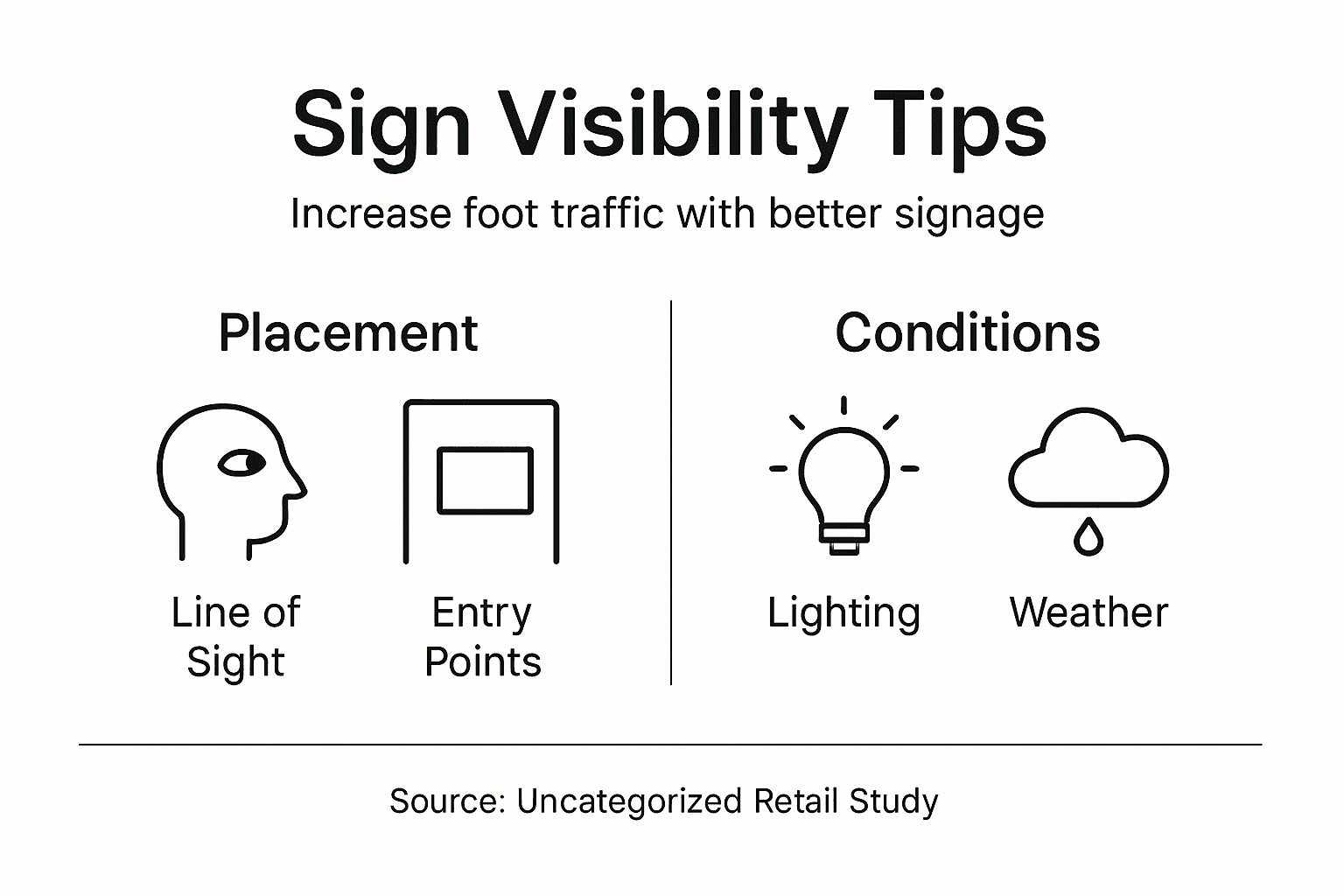
Decision point placement creates conversion opportunities that passive visibility cannot achieve. Customers make psychological decisions at specific moments. When they reach your storefront entrance, they decide whether to enter. Position directional signage or informational signs at these decision points where receptiveness peaks. A sign at your door stating “Open” or “Walk-ins Welcome” catches people at the exact moment they are deciding whether to approach. Interior signs positioned at checkout counters capture attention when customers are already committed and mentally prepared to act. Signs at parking lot entrances guide people toward your location before they become frustrated searching. Signs on nearby buildings or structures with excellent sightlines create awareness from greater distances. The principle remains consistent: position your signage where customers are actively making decisions relevant to your business rather than expecting them to seek out your message.
Pro tip: Document your signage visibility by photographing your storefront from every approach angle and distance at multiple times of day, creating a visual audit that reveals blind spots and lighting issues you might otherwise miss from your daily perspective.
Legal, Compliance, And ADA Signage in California
Your signage must serve purposes beyond marketing and visibility. California law requires that your signage meet accessibility standards established by the Americans with Disabilities Act and California Building Code regulations. These requirements are not optional suggestions or best practice recommendations. They are legal mandates that carry real consequences for non-compliance, including fines, lawsuits, and forced alterations. For retail business owners, understanding these obligations prevents costly mistakes and ensures your signage welcomes all customers equally. The intersection of marketing effectiveness and legal compliance creates an opportunity to design signage that attracts customers while respecting accessibility rights. This is not a conflict between objectives but rather a framework that strengthens your overall signage strategy.
ADA signage requirements focus on ensuring that people with disabilities can access and understand your business location and services. One of the most critical requirements involves accessible signage for permanent rooms and spaces. If your business includes restrooms, exits, parking areas, or other designated spaces, you must provide compliant signage identifying these locations. California Building Code requirements specify detailed accessibility standards for signage design, including specifications about character size, contrast, mounting height, and tactile elements. Character size must be proportional to the viewing distance. A sign viewable from fifty feet away requires larger lettering than one read from five feet. Contrast between text and background must achieve sufficient visual distinction to be readable for people with low vision. The requirement specifies a contrast ratio of at least 70 percent, measured as the difference between the lighter and darker colors. White text on black background exceeds this requirement easily. Light gray text on white background fails the requirement entirely. Mounting height matters significantly. Signs must be mounted between forty eight and sixty inches from the floor when measured to the centerline of the lettering. This positioning ensures they sit within the visual range of people in wheelchairs while remaining visible to standing customers. Too low and it gets obscured by merchandise or people. Too high and wheelchair users cannot read it.
Tactile signage requirements present an additional layer of compliance that many business owners overlook until problems emerge. Braille text must accompany signs identifying permanent rooms or spaces. You cannot simply add Braille translation to decorative signage. The Braille must appear on durable material mounted adjacent to the visual signage, positioned for people to read by touch without the need for adhesives or handheld devices. This means specific signs at entrances, restrooms, and exits require Braille accompaniment. Many business owners discover this requirement only when accessibility advocates or city inspectors identify violations. The good news is that planning for accessibility from the beginning costs far less than retrofitting signage after installation. Interior signage requirements differ slightly from exterior requirements. Exit signs must be clearly marked and remain illuminated. Directional signage showing accessible routes must not mislead people with disabilities into dead ends or unsafe paths. Accessible parking signage must meet specific specifications including the International Symbol of Accessibility displayed prominently and permanently.
Color and contrast become even more important in California’s intense lighting conditions. A sign that meets minimum contrast requirements indoors may become illegible in direct California sunlight due to glare and reflections. Choose materials that resist glare, avoid glossy finishes on accessible signage, and position signage to minimize shadow and light interference. Consider your specific location. Coastal areas with salt air may require materials resistant to corrosion. Inland areas with temperature extremes need materials that handle expansion and contraction without deterioration. Mountain communities with heavy weather patterns demand durable installation and weather resistant materials. The California Building Code recognizes these geographic variations and allows designers to implement solutions appropriate to specific environments while maintaining accessibility standards. Working with a signage provider experienced in California compliance requirements ensures your signs meet all obligations while maintaining marketing effectiveness. The investment in proper accessible signage demonstrates commitment to inclusive customer service, reduces legal vulnerability, and ensures your business serves the widest possible customer base.
Pro tip: Request ADA compliance verification from your signage provider before installation and maintain documentation of compliance specifications for each sign, creating a record that protects your business if accessibility questions arise in the future.
Common Signage Mistakes Businesses Make
Watching other businesses fail with their signage gives you valuable insight into what not to do. Many California retail owners repeat the same costly mistakes, watching their signage investments underperform or even damage their brand reputation. The difference between signage that attracts customers and signage that repels them often comes down to avoiding predictable errors that diminish visibility, credibility, and effectiveness. Understanding these mistakes before you implement them positions your business to spend signage dollars wisely and maximize foot traffic impact. You do not need to learn these lessons through painful experience. Learning from others’ failures costs you nothing but awareness.
Overloading your sign with too much information represents the most common mistake retail owners make. A sign crammed with multiple messages, competing fonts, dozens of colors, and lengthy descriptions overwhelms viewers and accomplishes nothing except confusion. Your storefront sign has approximately three to five seconds to communicate with a passing customer. In that brief window, attempting to convey your full list of services, special promotions, warranty information, and contact details guarantees that potential customers will move on before reading any of it. The solution involves brutal prioritization. Your sign should communicate one primary message. Your business name. Your core service or product category. Maybe a single compelling benefit or current promotion. Everything else gets cut. Additional information belongs on your website, business cards, or interior signage where customers have already decided to engage with your business. Poor visibility and information overload reduce a sign’s marketing effectiveness significantly. The strongest signs make one clear statement and make it impossible to miss.
Poor contrast and readability sabotage your signage investment silently and thoroughly. Many business owners choose colors they find aesthetically pleasing without considering readability. Light gray text on white background looks sophisticated to your designer’s eye but becomes completely illegible to customers at viewing distance. Dark blue text on dark purple background creates the same problem. The solution requires measuring contrast ratios and testing readability from the actual distances where customers will encounter your sign. Take a photograph from across the parking lot or down the street and assess whether the text remains clear and readable in that real world context. Consistency in branding compounds readability problems. Inconsistent branding, poor readability due to low contrast, and outdated signage damage professionalism and customer perception. If your storefront sign uses completely different colors, fonts, and messaging than your interior signage, your window displays, and your vehicle wraps, you create confusion rather than reinforcement. Customers should immediately recognize your brand across every touchpoint. Consistent visual identity builds familiarity and trust.
Neglecting maintenance turns even excellent signage into a liability that damages your business reputation. A sign with faded colors, peeling paint, broken lighting, or visible damage communicates that your business does not care about details or customer experience. Maintenance costs money, but failing to maintain signage costs far more in lost customers and damaged credibility. California’s intense sun, salt air in coastal areas, and temperature fluctuations inland all degrade signage materials rapidly without proper maintenance. Schedule regular inspections of all signage. Check for color fading, material deterioration, loose mounting hardware, and lighting function. Address problems immediately. A small repair completed quickly prevents major damage that requires full sign replacement. Outdated signage creates the same problem. If your sign reflects fashion trends from fifteen years ago, customers perceive your business as outdated regardless of the quality of your actual products or services. Your signage should feel current and professional. When trends shift, update your signage before customers begin questioning your relevance. The investment in maintaining and updating signage protects your brand investment and keeps customers flowing through your doors.
Placement mistakes often eliminate all the value from otherwise excellent sign design. A beautiful, readable, high contrast sign placed where customers cannot see it accomplishes nothing. Signs mounted too high, hidden behind tree branches, obscured by other buildings, or positioned at angles that miss primary customer traffic patterns fail regardless of their aesthetic quality. Before installing permanent signage, spend time observing where customers naturally look and from which angles they approach your business. Test sign placement with temporary alternatives when possible. Walk your storefront from every angle and distance to verify visibility. This investment in placement verification prevents expensive reinstallation later.
Pro tip: Create a simple signage audit by photographing your storefront and all signage from multiple distances and angles, then objectively assess whether each sign meets your contrast, readability, and messaging standards without letting familiarity bias cloud your judgment.
Transform Your Storefront Into a Customer Magnet Today
If you want to overcome the common challenges of poor signage visibility and ineffective messaging discussed in this article, it is time to invest in custom solutions tailored to your business needs. Whether you need high-contrast storefront signs, eye-catching banners, or vehicle wraps that expand your reach, partnering with experts who understand the power of visual communication is essential. The key to boosting foot traffic lies in signage that attracts attention, communicates clearly, and reflects your brand professionalism.
Unlock the full potential of your business signage with professional craftsmanship and durable materials from Uncategorized –. At CustomSignsToday.us, we specialize in creating custom signs designed to increase your store’s appeal and customer engagement. Don’t wait for another potential customer to walk past unnoticed. Contact us now for a free quote and start turning your storefront into a powerful marketing asset that drives consistent foot traffic and grows your business.
Frequently Asked Questions
How does signage attract customers?
Signage attracts customers by capturing attention in a crowded visual environment and clearly communicating your value proposition within seconds. It serves as a silent salesperson that can drive foot traffic by presenting compelling messages that resonate with potential customers.
What types of signs are most effective for boosting foot traffic?
Different types of signs serve distinct purposes. Outdoor signs like monument signs improve visibility from a distance, while A-frame sidewalk signs attract pedestrian traffic with immediate calls to action. Vehicle wraps act as mobile advertisements, and window displays engage customers who are already near your storefront.
What design elements should I focus on to make my signs more effective?
Key design elements include high color contrast to grab attention, legible typography that conveys professionalism, and clear, concise messaging that communicates your main selling points. Placement is also crucial; signs should be positioned at eye level and in areas where customers are likely to notice them.
How can I ensure my signage is compliant with legal requirements?
To ensure compliance with legal requirements, especially for accessibility, familiarize yourself with the Americans with Disabilities Act (ADA) and local building codes. Focus on appropriate character sizes, contrast ratios, and tactile elements, and consider working with signage providers knowledgeable in these regulations.