

Every property listing in a busy United States city comes with a set of safety requirements that can feel overwhelming for real estate agents. Navigating a patchwork of federal and local rules, it is easy to confuse decorative signs with the legally mandated symbols that protect visitors, workers, and your business. Understanding OSHA guidelines for safety signs helps ensure compliance while enhancing your property’s professional image and visibility.
Table of Contents
- Safety Signs Defined And Common Misconceptions
- Categories Of Safety Signs: Danger, Caution, Instruction
- OSHA Regulations And Local Compliance Standards
- Design Features And Placement Best Practices
- Legal Exposure And Common Mistakes With Safety Signs
Key Takeaways
| Point | Details |
|---|---|
| Safety Sign Importance | Safety signs are mandatory tools for regulatory compliance and accident prevention in workplaces, not merely decorative elements. |
| Categories of Signs | There are three main categories of safety signs: Danger, Caution, and Instruction, each conveying specific levels of risk and required actions. |
| OSHA Compliance | Real estate professionals must adhere to OSHA regulations and local standards to ensure proper safety communication and avoid legal repercussions. |
| Design and Placement | Effective safety signs should feature high-contrast colors, clear typography, and strategic placement to optimize visibility and understanding. |
Safety Signs Defined and Common Misconceptions
Safety signs represent critical visual communication tools designed to convey important regulatory and hazard information quickly and effectively in professional environments. Real estate agents must understand these signs go far beyond simple decorative elements – they are legally mandated visual instructions that can prevent accidents and ensure workplace compliance.
Under OSHA guidelines, safety signs are standardized visual symbols with specific requirements for color, shape, and content. Hazard symbols communicate precise dangers including risks associated with chemicals, potential physical threats, and mandatory protective actions. These pictograms are strategically designed to be instantly recognizable across diverse workplace settings.
Common misconceptions about safety signs include:
- Believing safety signs are optional decorative elements
- Assuming all warning symbols mean the same thing
- Thinking pictograms are universally understood without context
- Overlooking the legal requirement for proper signage
Professional sign design requires understanding nuanced regulatory standards. Hazard communication standards mandate specific visual elements like consistent color schemes, geometric shapes, and universally comprehensible symbols that transcend language barriers.
Pro tip: Always consult local building codes and OSHA guidelines when selecting safety signage to ensure full regulatory compliance.
Categories of Safety Signs: Danger, Caution, Instruction
Safety signs in professional environments are strategically classified into three critical categories that help communicate potential risks and necessary actions. Safety sign categories guide hazard recognition and provide essential visual communication for workplace safety protocols.
The three primary categories of safety signs include:
- Danger Signs: Indicate imminent high-risk situations with potential for severe injury or death
- Caution Signs: Warn about potential hazards or unsafe practices that could lead to minor injuries
- Instruction Signs: Communicate specific procedures, protective actions, and mandatory safety behaviors
Under OSHA regulations, these sign categories are designed to provide immediate visual communication that transcends language barriers. Hazard communication standards mandate precise visual elements to ensure workers can quickly understand potential workplace risks.
Real estate professionals must understand these sign categories to maintain safe environments and comply with regulatory requirements. Each sign type uses specific color schemes, geometric shapes, and universally comprehensible symbols to convey critical safety information effectively.

Here’s a quick comparison of the three main safety sign categories and their role in workplace safety:
| Sign Category | Typical Colors | Main Purpose |
|---|---|---|
| Danger | Red, black, white | Highlight immediate, severe risks |
| Caution | Yellow, black | Draw attention to possible hazards |
| Instruction | Green, white | Direct required actions or behaviors |
Pro tip: Conduct regular safety sign audits to ensure all signage accurately reflects current workplace hazards and follows OSHA classification guidelines.
OSHA Regulations and Local Compliance Standards
Real estate professionals must navigate a complex landscape of safety sign regulations that blend federal requirements with local standards. Hazard communication standards establish critical guidelines for workplace safety signage that realtors must understand and implement across diverse property environments.
The key components of OSHA safety sign compliance include:
- Specific pictogram requirements for hazard communication
- Standardized signal words indicating risk levels
- Clear hazard statements communicating potential dangers
- Consistent color coding and visual design elements
- Mandatory placement and visibility standards
Under the Hazard Communication Standard (29 CFR 1910.1200), employers have specific responsibilities for safety signage. OSHA workplace safety guidelines mandate that businesses provide comprehensive visual communication to protect workers and visitors from potential risks.
Local jurisdictions often supplement federal regulations with additional safety requirements. Real estate professionals must conduct thorough research to ensure their properties meet both national OSHA standards and specific state or municipal safety sign regulations.
Pro tip: Consult with local building inspectors and safety compliance experts to develop a comprehensive safety signage strategy that exceeds minimum regulatory requirements.
Design Features and Placement Best Practices
Safety sign design requires strategic planning and precise execution to ensure maximum effectiveness and regulatory compliance. Safety sign placement techniques are critical for communicating potential risks and preventing workplace accidents across various property environments.
Key design elements for effective safety signage include:
- High-contrast color schemes that enhance visibility
- Clear, legible typography with appropriate font sizes
- Universally recognizable symbols and pictograms
- Durable materials resistant to environmental conditions
- Consistent visual language across all warning signs
Strategic sign placement is equally crucial for real estate professionals. Warning sign research demonstrates that optimal positioning involves understanding human visual perception and traffic flow patterns. Signs must be positioned at eye level, in high-visibility areas, and near potential hazard zones to maximize comprehension and compliance.
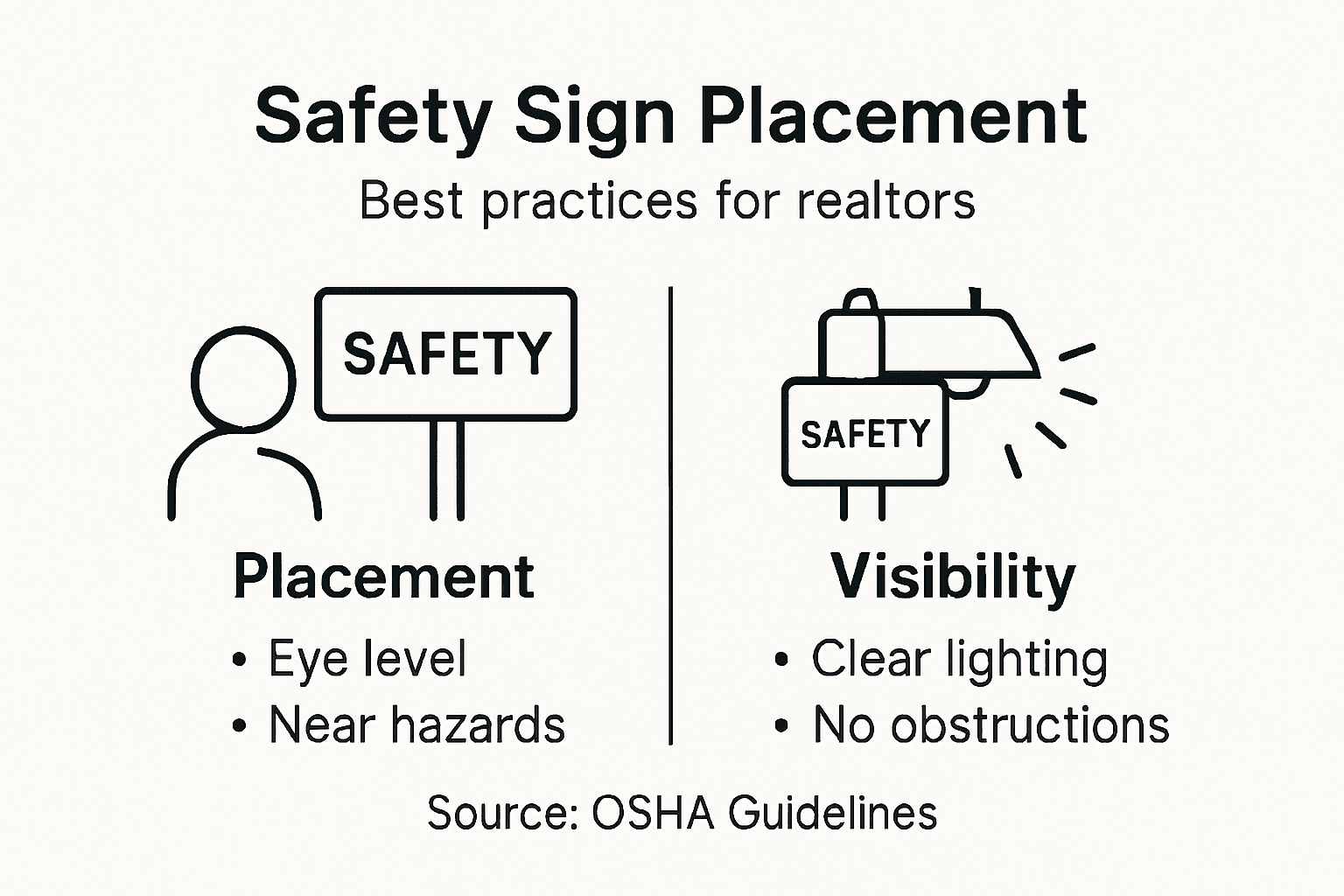
Real estate agents should prioritize sign visibility by considering factors such as lighting conditions, potential obstructions, and the specific context of each property environment. Regularly assessing and updating safety signage ensures continued effectiveness and adherence to evolving safety standards.
Consider these important design and placement factors to optimize safety sign effectiveness:
| Design Feature | Impact on Safety | Placement Best Practice |
|---|---|---|
| High-contrast colors | Ensures visibility | Near hazards, eye-level |
| Clear typography | Prevents misreading | Avoid visual obstructions |
| Durable materials | Maintains integrity over time | Protected from weather |
Pro tip: Conduct periodic walk-through assessments to evaluate the clarity, positioning, and condition of safety signs, making adjustments as needed to maintain optimal visibility and compliance.
Legal Exposure and Common Mistakes With Safety Signs
Real estate professionals face significant legal risks when mismanaging safety signage. OSHA compliance requirements expose businesses to potential fines and liability if safety sign regulations are not meticulously followed, making comprehensive understanding crucial for risk management.
Common safety sign mistakes that increase legal vulnerability include:
- Failing to update signs reflecting current hazards
- Ignoring sign visibility and legibility standards
- Using incorrect pictograms or color coding
- Inadequate employee training on sign meanings
- Neglecting regular maintenance of safety signage
Signage fatigue represents a critical legal risk where employees become desensitized to warning signs. Safety sign management research demonstrates that repeated exposure without context can lead to accidental non-compliance and increased workplace accident potential.
Proactive risk mitigation requires real estate professionals to implement systematic safety sign management protocols. This includes regular audits, employee training, and maintaining clear, up-to-date visual communication that meets both federal and local regulatory standards.
Pro tip: Develop a comprehensive safety sign tracking system that documents sign placement, condition, and periodic review to demonstrate proactive compliance and reduce potential legal exposure.
Ensure Your Properties Meet Safety Compliance with Custom Signage Solutions
Navigating the complex landscape of safety signs and OSHA regulations can be overwhelming for real estate professionals. This article highlights key challenges such as understanding danger, caution, and instruction sign categories, maintaining proper placement and design, and minimizing legal risks through updated and visible signage. If you want to eliminate the uncertainty and protect your properties and clients, bespoke visual communication is essential.

Discover how custom signage tailored to OSHA standards can help you convey critical safety messages effectively. At Custom Signs Today, we specialize in producing durable, high-quality safety signs designed to meet both federal and local compliance requirements. Don’t wait until legal exposure or accidental hazards occur. Take control now and request a free quote to upgrade your safety signage and ensure your real estate listings present a professional, compliant image.
Frequently Asked Questions
What are the main categories of safety signs?
The main categories of safety signs are Danger Signs, Caution Signs, and Instruction Signs. Danger Signs indicate high-risk situations that could lead to severe injury or death, Caution Signs warn about potential hazards, and Instruction Signs communicate specific safety procedures and mandatory actions.
Why are safety signs important for real estate professionals?
Safety signs are legally mandated visual instructions that help prevent accidents and ensure workplace compliance. They communicate critical hazard information and regulatory requirements, making them essential for maintaining safe environments in properties.
What are common misconceptions about safety signs?
Common misconceptions include believing that safety signs are optional, assuming all warning symbols mean the same thing, thinking pictograms are universally understood without context, and overlooking the legal requirements for proper signage.
How can real estate agents ensure compliance with safety sign regulations?
Real estate agents can ensure compliance by understanding OSHA regulations and local standards, conducting regular safety sign audits, and consulting local building inspectors to make sure signage reflects current hazards and meets regulatory requirements.