TL;DR:
- Pop up banners are lightweight, portable displays that can be assembled in under two minutes, making them highly effective for event marketing. They come in various types, such as retractable, full display stands, and tabletop versions, suitable for different venues and needs. Proper design, strategic placement, and careful handling maximize their visibility and return on investment.
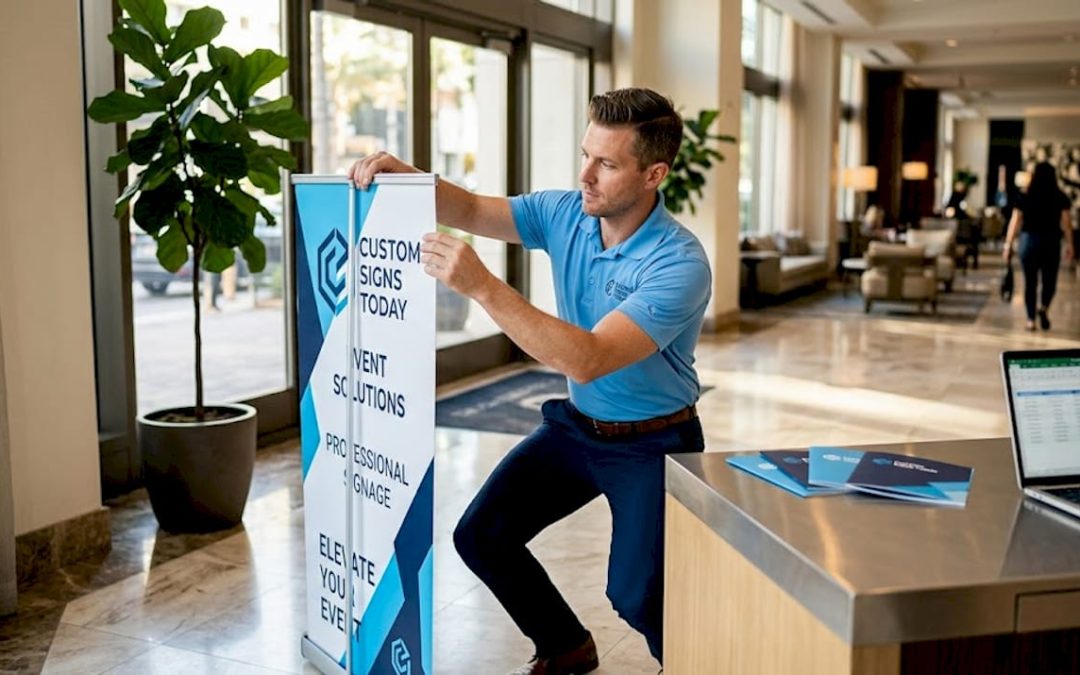
Pop up banners are one of the most misunderstood tools in event marketing. Most people picture something bulky, complicated to set up, and reserved for big-budget trade show booths. The reality is almost the opposite. A pop up banner is a lightweight, portable display that goes from carrying case to fully assembled promotional sign in under two minutes. Whether you’re a solo entrepreneur at a local fair or a marketing team running a national conference, understanding what pop up banners are and how to use them well can make a visible difference in how your brand shows up.
Table of Contents
- Key Takeaways
- What are pop up banners and how do they work
- Types of pop up banners
- Benefits of pop up banners for events and promotions
- Pop up banner design ideas that actually work
- How to use pop up banners effectively
- My honest take on pop up banners after years in signage
- Get custom pop up banners built for your brand
- FAQ
Key Takeaways
| Point | Details |
|---|---|
| Pop up banners are portable displays | They assemble in minutes from a compact base and retractable graphic unit, requiring no tools. |
| Multiple types exist for different needs | Retractable, full pop up frame, and tabletop versions each suit different venues and audiences. |
| Design directly affects results | Bold fonts, high contrast, and minimal text dramatically increase readability from a distance. |
| Placement determines visibility | Positioning near entryways and high-traffic zones maximizes how many people actually see your message. |
| Reusability makes them cost-effective | A single well-made banner can serve dozens of events, reducing long-term marketing spend. |
What are pop up banners and how do they work
At their core, pop up banners are freestanding display signs built for temporary use at events, retail settings, trade shows, and promotional spaces. The structure has three basic components: a weighted base that holds everything upright, a printed graphic that stores inside the base, and a support pole or frame that extends to hold the graphic taut and visible.
The graphic itself is typically printed on vinyl or polyester fabric. Both materials offer different advantages depending on whether your display will be indoors or outdoors, in bright light or low light. Vinyl tends to be more affordable and prints vivid colors. Polyester fabric has a softer, premium appearance that works especially well under stage or booth lighting.
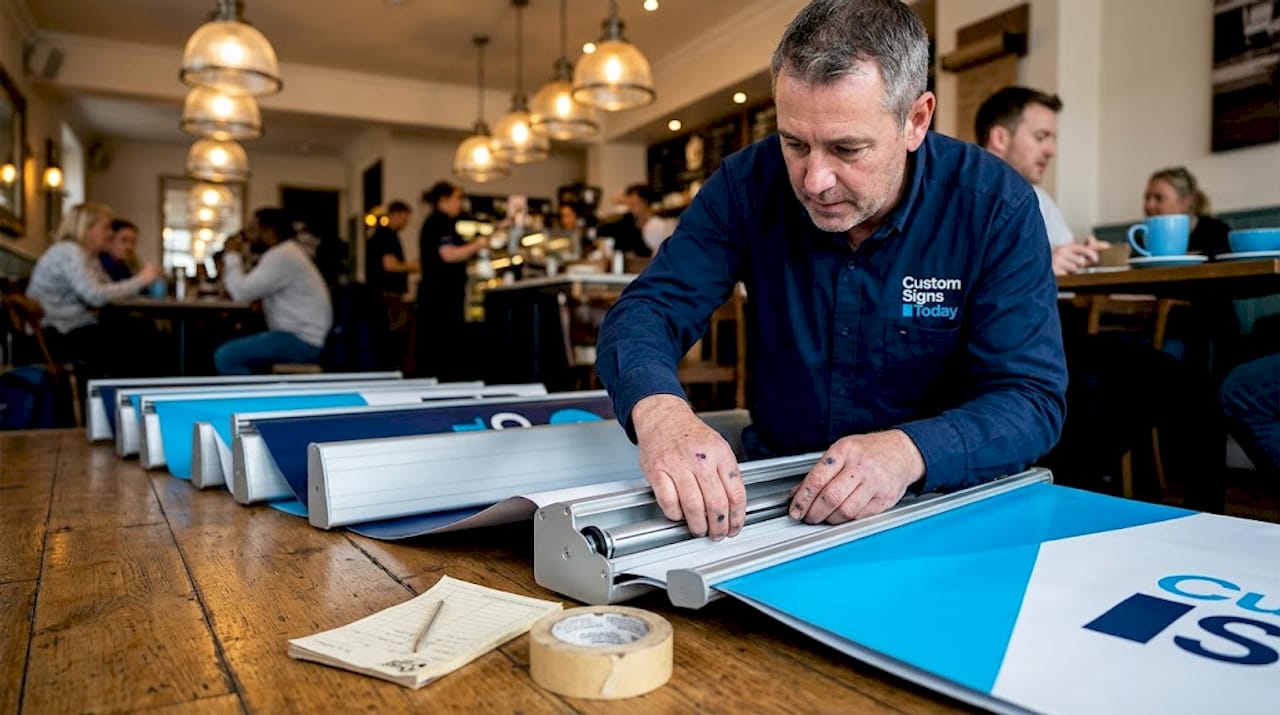
Setup is genuinely fast. Pop up stands reduce setup time and staffing needs compared to traditional booth structures. Most retractable models take one person less than 90 seconds to deploy. That speed matters when you’re coordinating a booth setup at 6 a.m. before doors open.
Here’s what separates pop up banners from flat, non-retractable banners or traditional signage:
- Self-supporting structure: No wall mounting, no hanging hardware, no rigging required.
- Compact storage: The graphic retracts directly into the base, protecting it from creases and dust.
- Portability: Most standard pop up banners weigh between 6 and 12 pounds and come with a shoulder carry bag.
- Size range: Common widths run from 24 inches to 60 inches. Heights typically fall between 60 and 90 inches, though tabletop versions are considerably smaller.
- Reusability: Reused multiple times, pop up banners make a cost-effective investment compared to single-use signage like foam boards or flyers.
The combination of these features is what makes pop up banners such a practical choice compared to permanent or semi-permanent signage options.
Types of pop up banners
Knowing the differences between types helps you match the right banner to your venue size, message complexity, and transport needs. The three main categories are retractable banners, full pop up display stands, and tabletop pop up banners.
| Type | Best for | Key feature | Typical size |
|---|---|---|---|
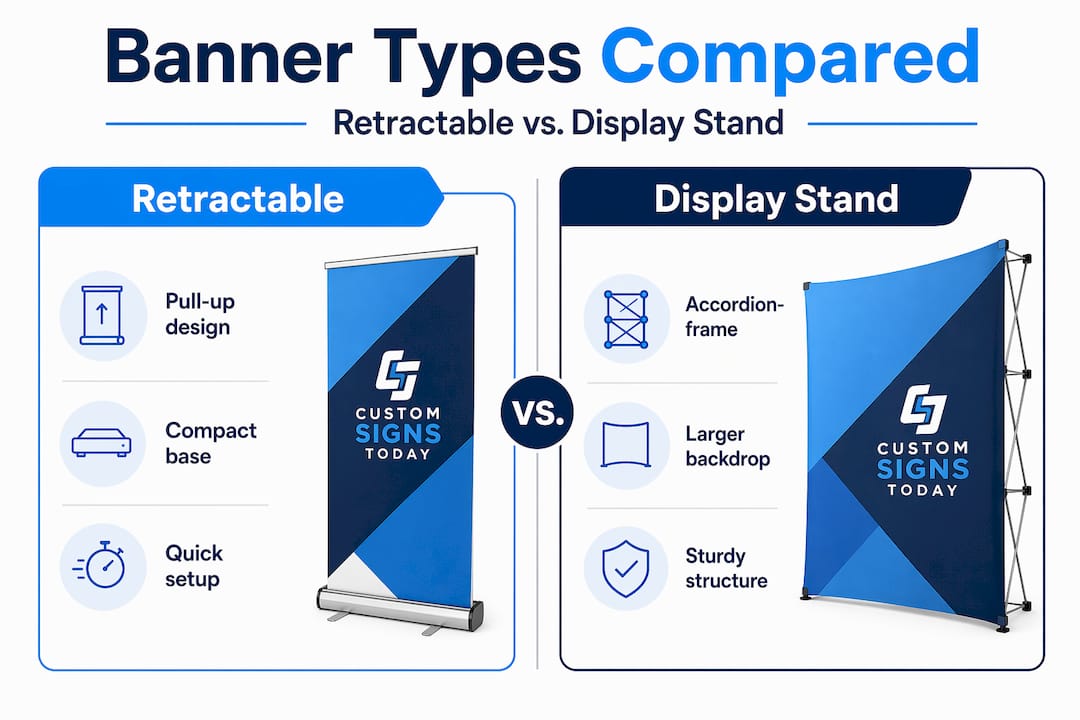
| Retractable (pull-up) | Trade shows, retail, lobbies | Graphic retracts into base for fast setup | 33"–47" wide, 60"–90" tall |
| Pop up display stand | Large booths, backdrops, stage displays | Expanding frame creates a wide display wall | 8–20 feet wide |
| Tabletop pop up | Small events, counters, registration tables | Compact and fully self-contained | 12"–24" wide |
Retractable banners are by far the most common. Also known as retractable banners, they protect the graphic inside the base between uses and allow quick installation and removal. You pull the graphic up, click the support pole into place, and you’re done. These are the banners you see at airport check-in lines, pharmacy counters, and conference registration desks.
Pop up display stands are a different product entirely. These use an expanding accordion-style frame that unfolds to create a wide backdrop. They’re heavier and take a bit more time to assemble, but they create a far more dramatic visual presence. Think of the full-width branded backdrops behind speakers at corporate events or the sweeping displays at trade show booths.
Tabletop pop up banners work on the same retractable principle as standard pull-up banners, just scaled down. They sit directly on a table or counter surface, which makes them ideal for registration areas, product display tables, or small retail counters where floor space is limited but you still want clear branded messaging in front of customers.
Benefits of pop up banners for events and promotions
Pop up banners punch well above their weight when it comes to marketing return. Here’s why businesses keep coming back to them.
- High visual impact: A well-designed pop up stand creates a strong first impression that builds trust and credibility at exhibitions. Visitors are drawn to professional, clear displays before they ever speak to your team.
- Fast setup and teardown: Most retractable models are ready in under two minutes. You don’t need a crew or specialized tools.
- Easy transport: Carrying bags with shoulder straps make pop up banners as manageable as luggage. You can bring three or four of them on a flight without checking extra cargo.
- Durability and reuse: Businesses that invest in quality banners can use them across dozens of events, spreading the cost over a long marketing lifecycle.
- Budget-friendly entry point: Compared to custom booth builds or permanent window graphics, pop up banners offer professional presence at a fraction of the cost.
- Versatility: The same banner works at a trade show on Tuesday and a community fair on Saturday. Nothing about the format limits you to one type of event.
Pro Tip: Order two or three banners with slightly different messages rather than a single banner. This lets you A/B test which call to action or visual approach generates more engagement from event to event.
Pop up banners for events are particularly valuable because they define your space before anyone walks over. A well-placed banner tells attendees who you are and what you offer from across the room, doing lead qualification before any conversation starts.
Pop up banner design ideas that actually work
Great design is the difference between a banner people notice and one they ignore. These steps will help you create something that earns attention rather than blends into the background.
-
Lead with one clear message. Your banner should communicate a single idea: your brand name, your offer, or your differentiator. Trying to include everything dilutes everything. If a stranger can’t read your main message in three seconds from ten feet away, your design needs editing.
-
Use high-contrast color combinations. Bold fonts and high-contrast colors maximize readability from a distance. Dark text on a light background or a vivid color block behind white text both work reliably. Avoid mid-tone combinations where text and background compete.
-
Make your logo prominent but not dominant. Your logo earns recognition, but your value statement earns interest. Place the logo at eye level or at the top of the banner, but let your message have the most visual real estate.
-
Limit your text. Three to five lines of copy is a ceiling, not a target. Headlines, subheads, and a single contact detail or URL is the ideal structure. Every word you remove increases the readability of every word that stays.
-
Think about the viewing environment. A banner at an outdoor farmers market competes with sunlight, movement, and noise. A banner in a hotel conference room sits in controlled lighting. Your color choices and contrast levels should reflect where the banner will actually live.
-
Use print-ready, high-resolution graphics. Low-resolution images look fine on a screen but print blurry at banner size. Submit files at 150 DPI at full print size, minimum.
Pro Tip: Always proof your design printed at actual scale before placing a full order. What looks balanced on a laptop screen can feel overcrowded when stretched to 6 feet tall.
How to use pop up banners effectively
Even the best-designed banner underperforms if it’s placed wrong, set up carelessly, or stored badly. These practices apply whether you’re a first-time exhibitor or a seasoned event marketer.
- Position for traffic flow: Place banners near high-traffic areas such as entryways, main aisles, and seating areas. The goal is maximum exposure to foot traffic, not just proximity to your booth.
- Set up at eye level zones: The middle third of a standard retractable banner (roughly 40 to 60 inches from the floor) is where eyes naturally land. Put your most important message in that zone.
- Pair banners with other materials: A pop up banner paired with a table throw, printed brochures, and a small monitor creates a cohesive branded station. No single element carries the whole load.
- Transport carefully: Use the carrying case that comes with your banner. Rolling the graphic tightly and reinserting it into the base protects the printed surface from creases.
- Clean gently: Mild detergent and safe transport in protective cases preserves banner appearance and longevity. Avoid abrasive cloths or strong chemical cleaners on vinyl graphics.
- Store flat or in the base: Never leave a retractable banner partially extended in storage. Either fully retract it or store it fully assembled in a protected space.
Learning what a banner stand can do beyond simple display is also worth your time if you plan on attending multiple events in a year. Some banner stand systems allow graphic swaps, meaning you buy the hardware once and simply replace the printed insert for each campaign.
My honest take on pop up banners after years in signage
I’ve watched businesses spend thousands on elaborate booth structures while their messaging was confusing, their graphics were low-resolution, and nobody actually stopped to read them. Meanwhile, a well-placed retractable banner with a clean design and a clear offer outperformed the whole setup.
Pop up banners are consistently underestimated. People treat them as an afterthought, something you grab at the last minute when the rest of the booth is planned. That’s a mistake. In my experience, pop up banners are often the highest-visibility element in a booth because they’re vertical, they’re freestanding, and they’re positioned at exactly the height where people look when they’re scanning a room.
The biggest mistake I see businesses make is trying to put too much on them. A banner is not a brochure. It’s a billboard that happens to be portable. Treat it like one.
Materials have also improved significantly. Today’s fabric banners, when paired with dye-sublimation printing, produce photographic-quality output that simply wasn’t achievable at this price point five years ago. If you haven’t updated your banners recently, the quality jump alone might justify new printing. And if you’re trying to understand how customizable banners boost visibility, the short answer is they create brand consistency across every touchpoint at an event.
— Yossi
Get custom pop up banners built for your brand
If you’re ready to move from planning to printing, Customsignstoday has the experience and production capabilities to handle your full banner and signage needs from concept to delivery.
Customsignstoday specializes in custom banners and banner stands for businesses across Florida and beyond, from single retractable units to full trade show display packages. Every print is produced on durable, high-quality materials suited to your environment, whether that’s an indoor conference, an outdoor festival, or a retail storefront. The team also offers custom signage services that extend well beyond banners, so you can keep your branding consistent across your entire promotional presence. Request a free quote today and get expert guidance on sizing, materials, and design from a team that builds signage for a living.
FAQ
What are pop up banners used for?
Pop up banners are used to promote brands, products, or services at events, trade shows, retail locations, and conferences. They serve as portable, freestanding displays that attract attention and communicate key messages quickly.
How long does it take to set up a pop up banner?
Most retractable pop up banners assemble in under two minutes without any tools. You extend the graphic from the base, attach the support pole, and the banner is ready to display.
What materials are pop up banners made from?
Pop up banners are typically made from vinyl or polyester fabric. Vinyl is durable and cost-effective for short-term use, while fabric offers a premium appearance and is well-suited to indoor lighting.
What is the difference between a pop up banner and a roll up banner?
Pop up banners and roll up banners refer to the same product. Both terms describe a retractable banner where the graphic pulls up from a base unit and retracts back in for storage and transport.
How do I design an effective pop up banner?
Keep your message to one clear idea, use bold fonts with high-contrast colors, and limit your copy to three to five lines. Avoiding clutter and including only essential information increases viewer engagement significantly.