
TL;DR:
- Standardizing signage across multiple locations enhances brand consistency, reduces rework costs, and ensures compliance with safety standards. Implementing documented specifications, centralized workflows, and modular systems streamlines rollouts and maintains operational efficiency. Building a flexible yet precise signage system prevents visual drift and lowers long-term maintenance and rebrand expenses.
Sign standardization is the practice of applying documented rules for color, typography, materials, mounting height, and illumination across every sign your business deploys. When you standardize company signs, you protect brand equity, reduce production errors, and satisfy regulatory requirements simultaneously. Most business owners treat each new sign as a one-off project. That approach quietly destroys brand consistency and inflates costs at scale. The industry frameworks that prevent this, including ISO 7010 pictograms and ANSI Z535 safety standards, exist precisely because visual inconsistency carries real operational and legal consequences.
How does standardizing company signs improve brand consistency?
Standardized signage creates a uniform brand experience across every customer touchpoint, from your storefront to your fleet vehicles to your interior wayfinding. Without documented standards and approved templates, visual drift is inevitable. A fabricator in one city interprets your brand blue slightly differently than one in another city, and after ten locations, your brand looks like a franchise that lost control of its own identity.
The core elements that drive cohesion are specific and measurable:
- Color: Specify Pantone, CMYK, and RGB values for every sign type, not just “match the logo.”
- Typography: Define font families, weights, and minimum legible sizes for each sign category.
- Mounting height: Set exact heights for exterior identification signs, interior directories, and ADA-compliant plaques.
- Illumination: Specify LED color temperature and brightness levels to prevent one location from appearing dramatically brighter or warmer than another.
- Material specs: Define substrate, finish, and reflectivity standards so fabricators cannot substitute cheaper alternatives without your knowledge.
Standardizing across locations reduces guesswork and costly rework during rollouts. That matters because small inconsistencies in color, lighting, and mounting height accumulate and become expensive to fix when scaled across sites. A customer who visits your Dallas location and then your Denver location should feel the same brand confidence at both. Inconsistent signage signals operational disorder, even when your product or service is excellent.
Pro Tip: Create a one-page sign standards summary card for every vendor you work with. It should include color codes, approved fonts, and mounting specs. Vendors who receive clear production-ready specs deliver consistent results. Vendors who receive only design files improvise.
Architectural variability is the most underestimated challenge in multi-location signage. A standard monument sign design may need to adapt to a site with a grade change, a landlord restriction, or a local zoning setback. Effective brand guidelines communicate a brand’s character and give implementers the flexibility to adapt, ensuring cohesion beyond exact duplication. Good guidelines emphasize hierarchy and intent over fixed layouts to accommodate site-specific realities. That distinction separates brands that scale gracefully from brands that look different at every location.
What operational efficiencies and cost savings come from sign standardization?
Treating signage as a one-off project at each location is the single most expensive mistake multi-location businesses make. A standardized signage program functions as a control system that prevents endless revisions and costly rework through clear standards and centralized processes. Here is how that translates into measurable operational gains:
- Reduced rework. Production-ready specifications and quality checks prevent fabrication variability after design approval. Fabricators who receive complete specs produce correct signs the first time.
- Centralized maintenance planning. When every sign in your portfolio uses the same materials and hardware, you can schedule inspections and replacements on a predictable cycle rather than reacting to failures location by location.
- Modular content updates. Modular signage systems that separate hardware from message content reduce lifecycle costs and simplify updates during rebrands or relocations. You replace the face, not the entire structure.
- Vendor leverage. Standardized specs allow you to consolidate vendors and negotiate volume pricing. A fabricator producing the same sign type across 50 locations offers better pricing than one producing 50 unique custom orders.
- Faster rollouts. Centralizing project information and implementing standardized site surveys accelerates execution and protects profit margins. Consistent data across hundreds of sites removes the bottlenecks that delay openings.
Pro Tip: Build a “standardized core kit” for each location type in your portfolio. A core kit defines the exact signs required for a standard buildout, with approved specs for each. When a new location opens, the kit ships. No decisions, no delays, no substitutions.
Signage errors are cheap to create but expensive to remediate. Proactive planning through standardized infrastructure avoids operational problems that surface during inspections or rebrands. A sign that fails an ADA inspection or a fire code review does not just cost you the replacement sign. It costs you the inspection fee, the contractor visit, the delay, and potentially a fine.
How does standardization support compliance with regulations and safety standards?
Sign compliance is not optional, and the regulatory environment is more layered than most business owners realize. The table below summarizes the primary frameworks that govern commercial and safety signage in the United States and internationally.
| Standard | Scope | Key Requirement |
|---|---|---|
| ANSI Z535 | U.S. safety signage | Color-coded hazard levels, signal words, and symbol formats |
| OSHA 1910.145 | U.S. workplace safety | Accident prevention signs and tags in industrial environments |
| ISO 7010 | International pictograms | Standardized safety symbols recognized across languages |
| ADA Standards | U.S. accessibility | Braille, tactile characters, mounting heights, and contrast ratios |
| Local building codes | Jurisdiction-specific | Setbacks, illumination limits, size restrictions, and permit requirements |
ISO 7010 pictograms reduce misinterpretation and accelerate correct responses across multilingual workforces. Multinationals adopt ISO 7010 to lower risk during personnel transfers and reduce SKU count across countries. That SKU reduction alone delivers significant procurement savings for businesses operating across borders.
The compliance challenge for multi-location businesses is that no single standard covers every jurisdiction. A layered standard approach combines international baseline signs with jurisdictional overlays to reduce compliance risk. This blended method lowers comprehension errors while respecting local regulations. In practice, this means your core safety sign set follows ISO 7010 or ANSI Z535, and a jurisdiction-specific overlay adds or modifies signs where local codes require it.
Key compliance risks that standardization directly mitigates:
- ADA violations from incorrect mounting heights or missing tactile characters
- OSHA citations from missing or illegible safety signs in industrial areas
- Local permit violations from signs installed without approved dimensions or illumination specs
- Liability exposure when a safety sign fails to communicate a hazard clearly
For businesses in construction or high-risk environments, resources like construction site safety guidance reinforce why compliant, standardized safety signage is a legal and operational necessity, not a cosmetic choice.
What practical steps should businesses take to standardize their signs?
Implementing a standardized signage program requires more than a style guide. It requires a system with documented standards, defined workflows, and quality control at the fabrication stage.
Step 1: Audit your current sign portfolio. Photograph every sign type across every location. Catalog materials, dimensions, colors, and conditions. This baseline reveals where inconsistencies already exist and what your standardization effort needs to address first.

Step 2: Develop a sign standards document. This document specifies approved sign types, materials, finishes, color codes, fonts, and mounting requirements for each category. It is not a design file. It is a production specification that any qualified fabricator can execute without interpretation.
Step 3: Create an approval workflow. Every new sign, from a lobby directory to a parking lot marker, should pass through a defined review process before fabrication. This prevents unauthorized substitutions and catches errors before they become installed problems.
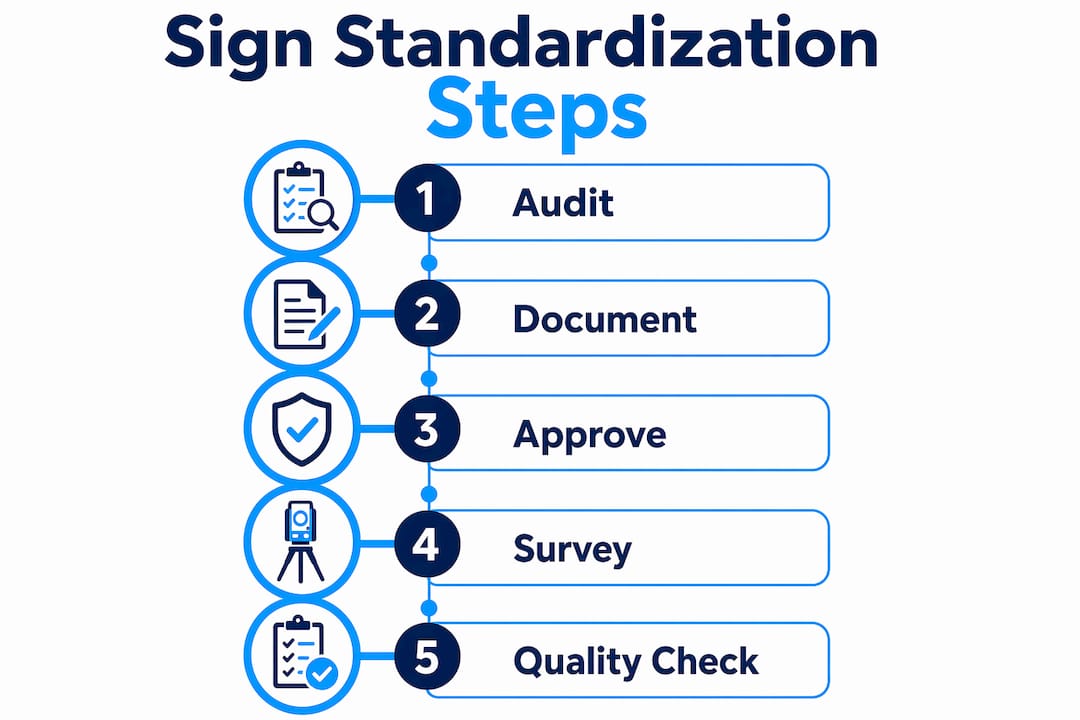
Step 4: Standardize your site survey process. Consistent site data across hundreds of locations accelerates execution and protects profit margins. A standardized survey form captures landlord restrictions, zoning setbacks, utility locations, and structural conditions in a format your fabricators and installers can act on immediately.
Step 5: Implement production-level quality checks. Design approval is not the finish line. Fabrication variability after design approval is a major source of inconsistency at scale. Require shop drawings, material samples, and pre-installation photos before any sign ships.
Pro Tip: Separate your signage standards into two tiers: non-negotiable brand elements (logo size, primary colors, font) and adaptable elements (mounting method, substrate material, illumination type). This gives vendors the flexibility to solve site-specific problems without compromising your brand identity.
The comparison below illustrates the difference between an ad hoc approach and a standardized program across key operational dimensions.
| Dimension | Ad hoc approach | Standardized program |
|---|---|---|
| Vendor management | Multiple vendors, inconsistent specs | Approved vendor list with shared standards |
| Error rate | High, discovered post-installation | Low, caught at spec and shop drawing stage |
| Rebrand cost | Full replacement at every location | Face change or content swap only |
| Compliance tracking | Reactive, per-location | Proactive, portfolio-wide |
| Rollout speed | Slow, custom decisions at each site | Fast, core kit deployed per location type |
For businesses building a smart signage strategy from the ground up, the investment in a documented program pays back within the first multi-location rollout.
Key takeaways
Standardizing company signs is the single most effective way to protect brand consistency, reduce operational costs, and maintain regulatory compliance across multiple locations.
| Point | Details |
|---|---|
| Brand consistency requires documented specs | Color codes, fonts, and mounting heights must be written, not assumed, to prevent visual drift. |
| Treat signage as infrastructure | Proactive maintenance planning and standardized materials reduce lifecycle costs and inspection failures. |
| Compliance is layered | Combine ISO 7010 or ANSI Z535 baselines with jurisdiction-specific overlays to cover all regulatory requirements. |
| Modular systems cut rebrand costs | Separating hardware from message content means you update faces, not full structures, during rebrands. |
| Quality control must reach fabrication | Production-ready specs and shop drawing approvals prevent inconsistencies that design files alone cannot catch. |
Why I think most businesses get signage standardization backwards
After working with businesses across retail, hospitality, and commercial real estate, the pattern I see most often is this: companies invest heavily in brand identity design and then hand fabricators a PDF logo and a color name. That is not a signage standard. That is a starting point for inconsistency.
The businesses that execute signage well treat their sign program the way a facilities team treats HVAC or electrical. They document it, inspect it, and budget for it on a cycle. They do not wait for a sign to fail or a rebrand to force the issue. They know what every sign in their portfolio is made of, when it was installed, and when it needs replacement.
The other mistake I see consistently is confusing flexibility with inconsistency. Effective brand guidelines prioritize hierarchy and interpretive freedom over rigid exact-replication manuals, because real-world sites never match the design studio assumption. A standard that cannot flex to a landlord restriction or a grade change is not a standard. It is a liability. The goal is cohesion, not cloning.
If you manage multiple locations and your signs do not look like they belong to the same company, the problem is almost never the fabricator. It is the absence of a system. Build the system first. The signs follow.
— Yossi
How Customsignstoday helps you build a consistent sign program
Customsignstoday specializes in custom signage solutions built for businesses that need consistency across locations. Whether you are standardizing exterior identification, updating interior directories, or rolling out fleet graphics, Customsignstoday delivers production-ready signs built to your exact specifications. Their face change signs service is particularly valuable for businesses updating existing sign structures during rebrands, replacing message content without full hardware replacement. For new construction or site buildouts, their site signs service covers compliant, durable exterior signage from permit to installation. Contact Customsignstoday for a free quote and start building a signage program that scales without losing control.
FAQ
Why does sign standardization matter for multi-location businesses?
Without standardized specs and centralized oversight, minor inconsistencies in color, mounting, and materials compound across locations, creating a fragmented brand experience and driving up correction costs. A documented signage program acts as a single source of truth for every vendor and installer in your network.
What is the difference between ISO 7010 and ANSI Z535?
ISO 7010 is an international standard defining pictogram-based safety signs recognized across languages and borders, while ANSI Z535 is a U.S. standard that uses color-coded hazard levels and signal words like “Danger” and “Warning.” Businesses operating in multiple countries typically use ISO 7010 as a baseline and layer ANSI Z535 requirements for U.S. facilities.
How do modular signage systems reduce costs?
Modular systems separate the structural hardware from the message panel, so content updates during a rebrand or relocation require only a face swap rather than full sign replacement. This approach minimizes wall repairs, reduces waste, and lowers the per-location cost of any future brand change.
What should a sign standards document include?
A sign standards document should specify approved sign types, Pantone and CMYK color codes, font families and sizes, substrate materials, finish types, mounting heights, illumination specs, and the approval workflow for new signs. Design files alone are not sufficient. Fabricators need production-level specifications to deliver consistent results.
How can a business start standardizing its signs without a full rebrand?
Start with an audit: photograph and catalog every existing sign type across all locations. Identify the highest-visibility inconsistencies first, typically exterior identification and safety signs, and write production specs for those categories. Roll out the standard to new locations immediately and address existing locations on a replacement cycle rather than all at once.