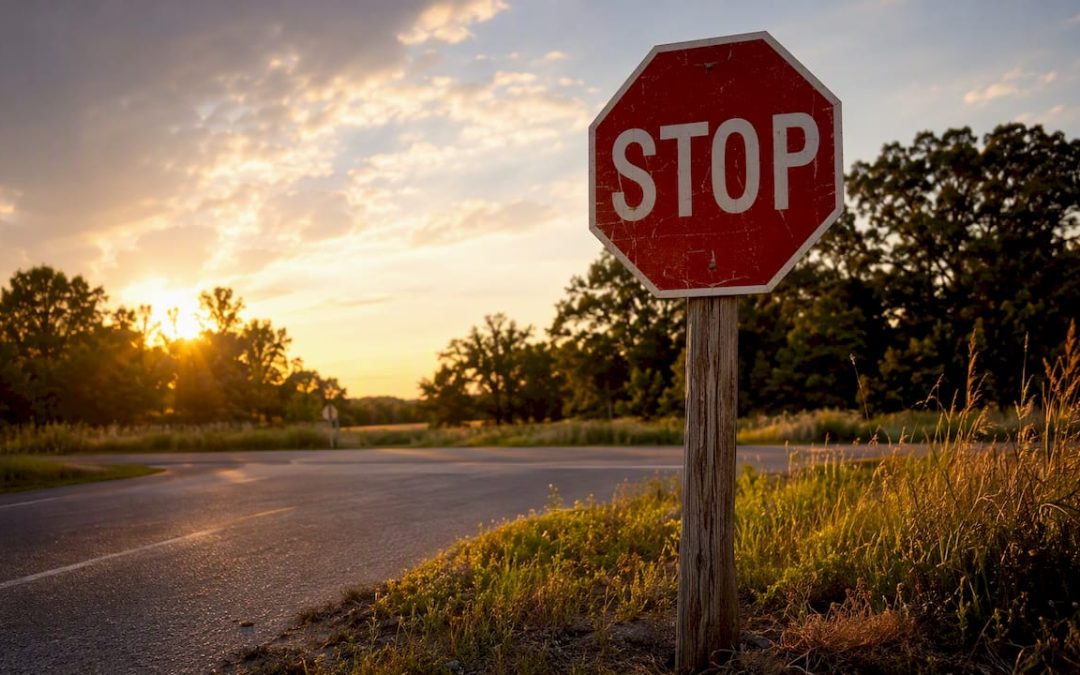
Regulatory signs control traffic. They tell you what the law requires at a specific location, and ignoring them isn’t a judgment call — it’s a traffic violation. The Manual on Uniform Traffic Control Devices (MUTCD), published by the Federal Highway Administration (FHWA), is the national standard that defines these signs and assigns each one an official code. The Stop sign (R1-1), Speed Limit sign (R2-1), and Do Not Enter sign (R5-1) are three of the most recognized examples. Every one of them falls under the regulatory sign category, and that category is what actually controls driver behavior on U.S. roads.
Key Takeaways
Regulatory signs are the class of traffic control device that legally controls driver behavior in the U.S., defined and standardized by the FHWA’s Manual on Uniform Traffic Control Devices.
| Point | Details |
|---|---|
| Regulatory signs control traffic | They carry legal force and tell drivers what the law requires at a specific location. |
| MUTCD is the national standard | The FHWA’s 11th Edition MUTCD defines every sign code, shape, and color used on U.S. roads. |
| Shape and color identify sign type | Red octagon means Stop; inverted triangle means Yield; white rectangle signals a regulatory sign. |
| Stop lines set the legal stop point | When a stop line is painted, that line — not the sign post — is where you must stop. |
| Customsignstoday produces custom signs | Businesses and contractors can order MUTCD-spec traffic and site signs built for outdoor durability. |
Table of Contents
- How U.S. traffic signs are classified under the MUTCD
- Common regulatory signs that control driver behavior
- How shapes and colors help you recognize regulatory signs fast
- Signs vs. traffic signals vs. pavement markings: what actually controls traffic
- Who decides to place regulatory signs, and when do they carry legal force?
- What drivers must do when they encounter regulatory signs
- Using the MUTCD as a primary source
- Why uniform signs matter more than most drivers realize
- Customsignstoday: professional signage built to spec
- Sources
How U.S. traffic signs are classified under the MUTCD
The MUTCD Part 1 defines a traffic control device as any sign, signal, marking, or device placed on or near a roadway to regulate, warn, or guide traffic. Signs are one class within that system, and they break into three functional groups:
- Regulatory signs give notice of traffic laws or required actions. Drivers must comply — these signs carry legal force.
- Warning signs alert road users to hazards or conditions ahead. They advise caution but don’t mandate a specific action the way regulatory signs do.
- Guide signs provide navigational information: route numbers, distances, destinations, and services.
The distinction matters because only regulatory signs literally control what you do. A warning sign tells you a sharp curve is coming; a regulatory sign tells you the speed limit through it. One informs; the other commands.
Signs are also distinct from traffic signals and pavement markings, which are separate classes of traffic control devices under the same MUTCD framework. All three work together, but they operate differently — more on that below.
Every state in the U.S. adopts the MUTCD as its legal standard, though some states publish supplements or state-specific versions that add requirements on top of the federal baseline. The current official document is the 11th Edition.
Common regulatory signs that control driver behavior
The table below lists the key regulatory signs drivers encounter daily, with their MUTCD R-series codes drawn from the FHWA standard sign figures.
| Sign Name | MUTCD Code | What It Controls | Required Driver Action |
|---|---|---|---|
| Stop | R1-1 | Right-of-way at intersections | Come to a full stop; yield to cross traffic and pedestrians |
| Yield | R1-2 | Right-of-way without full stop required | Slow down; stop only if traffic or pedestrians are present |
| Speed Limit | R2-series | Maximum (or minimum) lawful speed | Drive at or below the posted speed |
| Do Not Enter | R5-1 | Wrong-way entry to a roadway | Do not proceed; turn around |
| One Way | R6-series | Direction of travel on a one-way road | Travel only in the indicated direction |
| No Turn on Red | R10-11 | Turn prohibition at a signal | Do not turn on red at that intersection |
| No Left Turn | R3-2 | Specific turn prohibition | Do not turn left at that location |
| Lane-Use Control | R4-series | Which lanes are open, closed, or turn-only | Follow the lane assignment shown |
For a deeper look at how these signs compare to warning signs and what each one legally requires, the regulatory sign guide at Customsignstoday breaks it down with clear examples.
How shapes and colors help you recognize regulatory signs fast
Learning the color and shape system is a more reliable strategy than memorizing every individual sign. The visual cues work even when you can’t read the legend at highway speed.
Colors and what they signal:
- Red — reserved for Stop, Yield, and prohibition signs (No Turn, Do Not Enter). Red means stop or don’t.
- White background — the standard background for regulatory signs. If the sign is white with black or red text, it’s almost certainly regulatory.
- Yellow — warning signs. A yellow diamond ahead means a hazard or change in road conditions.
- Green — guide signs: highway markers, exit signs, distance signs.
- Orange — temporary traffic control, including work zones. Orange signs carry the same legal weight as permanent ones.
Shapes and what they mean:
- Octagon — Stop only. No other sign uses this shape.
- Inverted triangle (point down) — Yield only.
- Rectangle (vertical) — most regulatory signs, including speed limits and turn prohibitions.
- Rectangle (horizontal) — guide signs like One Way.
- Diamond — warning signs exclusively.
The traffic signs meaning and safety overview at Customsignstoday covers how these color standards apply in construction zones specifically, where orange takes over from white as the dominant regulatory background.
Pro Tip: If you see a red octagon, stop — even if the intersection looks clear. The shape alone is the legal cue, and it’s visible long before you can read the word “STOP.”
Signs vs. traffic signals vs. pavement markings: what actually controls traffic
All three are traffic control devices under the MUTCD, but they work in fundamentally different ways.
| Device Type | How It Works | Primary Function | Example |
|---|---|---|---|
| Regulatory sign | Static word or symbol message | Sets a rule or law at a location | Stop sign, Speed Limit sign |
| Traffic signal | Electrically operated, time-based indications | Separates conflicting movements in time | Red/yellow/green signal head |
| Pavement marking | Surface-applied lines, symbols, or words | Guides lane position and supplements signs | Stop line, lane divider, crosswalk |
The key operational difference: a sign sets a rule that applies continuously at a location. A signal, as MUTCD Part 4 explains, controls traffic by separating conflicting movements in time — green means go now, red means wait. That temporal separation is what makes signals effective at busy intersections where a static sign alone can’t manage the flow.
Pavement markings reinforce both. The white stop line painted at an intersection tells you exactly where to stop when the sign or signal requires it — and that line, not the sign post itself, is the legal stopping point when one is present.
A traffic signal is controlled by a signal controller, a device that runs timing plans and responds to sensors or manual inputs. The signal controller is what “controls” the signal; the signal then controls drivers.
Who decides to place regulatory signs, and when do they carry legal force?
Regulatory signs don’t go up because someone thinks they’d be useful. The MUTCD Chapter 2A requires that signs be used only where justified by an engineering study or established engineering judgment. The authority to install them sits with road managers — state DOTs, county highway departments, and municipal public works agencies — each responsible for the roads under their jurisdiction.
A few key points about how this works in practice:
- Engineering warrants are the criteria a location must meet before a sign is installed. For a Stop sign, that might include sight-distance limitations, crash history, or traffic volume thresholds.
- Sign clutter is a real problem. Chapter 2A explicitly warns against overuse. Too many signs reduce compliance because drivers start ignoring them.
- Legal force comes from state and local law aligning with the MUTCD placement. A properly installed, MUTCD-compliant regulatory sign is legally enforceable. A sign placed without engineering justification may face challenges in court.
- State adoption varies. Some states adopt the MUTCD verbatim; others add supplements. The 11th Edition is the current federal standard, and states are working through their adoption timelines.
Pro Tip: If you spot a missing or damaged regulatory sign on a public road, report it to your local public works department or state DOT. A missing Stop sign is a safety hazard, and agencies are required to respond.
Work-zone signs follow the same MUTCD framework but use orange backgrounds. For a practical breakdown of temporary signage rules, the guide to temporary signage for business owners explains how MUTCD requirements apply when construction affects traffic flow. Construction project managers dealing with sign and barrier coordination can also find useful context in this expert overview of construction delays and site controls.
What drivers must do when they encounter regulatory signs
The legal obligation is straightforward: comply. Here’s how that plays out for the most common signs:
- Stop sign (R1-1): Come to a complete stop before the stop line. If there’s no stop line, stop before the crosswalk. If there’s no crosswalk, stop before entering the intersection. Proceed only when it’s safe and you have the right-of-way.
- Yield sign (R1-2): Slow down and be prepared to stop. You must yield to vehicles and pedestrians in or approaching the intersection. If the way is clear, you may proceed without stopping.
- Speed limit sign (R2-series): Drive at or below the posted speed shown on the sign. In adverse conditions — rain, fog, ice — the safe speed may be lower than the posted limit even if the sign hasn’t changed.
- Do Not Enter (R5-1): Do not proceed in that direction under any circumstances. This sign typically appears at the exit end of one-way roads or freeway ramps.
- No Turn on Red (R10-11): At a red signal, do not turn in the prohibited direction. This applies even when the turn looks physically possible and traffic seems clear.
- Lane-use control signs (R4-series): Follow the lane assignment. If a lane shows a red X, it is closed. If it shows a green arrow, it is open for your direction of travel.
- Temporary signs in work zones: Orange regulatory signs carry the same legal obligation as permanent white ones. Fines for violations in active work zones are often doubled under state law.
The stop line is the legal stopping point when one is marked. Stopping past the line — even by a foot — is a violation, and it can put you in the path of crossing traffic or pedestrians.
Using the MUTCD as a primary source
The MUTCD is a public document, freely available at mutcd.fhwa.dot.gov. You don’t need to be a traffic engineer to use it. Here’s what the manual actually says about what makes a traffic control device work.
The MUTCD lists five basic requirements for any effective traffic control device:
Every regulatory sign is designed against those five criteria. The octagon shape of the Stop sign commands attention before you read a word. The red color conveys prohibition instantly. The single word “STOP” gives a clear, simple meaning with no ambiguity.
To look up a specific sign, use the R-series codes. R1 covers right-of-way signs (Stop, Yield), R2 covers speed regulation, R3 covers movement and turn restrictions, R4 covers lane use, and R5 covers exclusion signs like Do Not Enter. The full figures and legends are in the FHWA standard sign figures PDF, which shows the exact dimensions, colors, and legends for every standard sign.
For state-specific rules, search your state DOT’s website for its MUTCD supplement or traffic control device manual. Most states publish these as free PDFs.
Why uniform signs matter more than most drivers realize
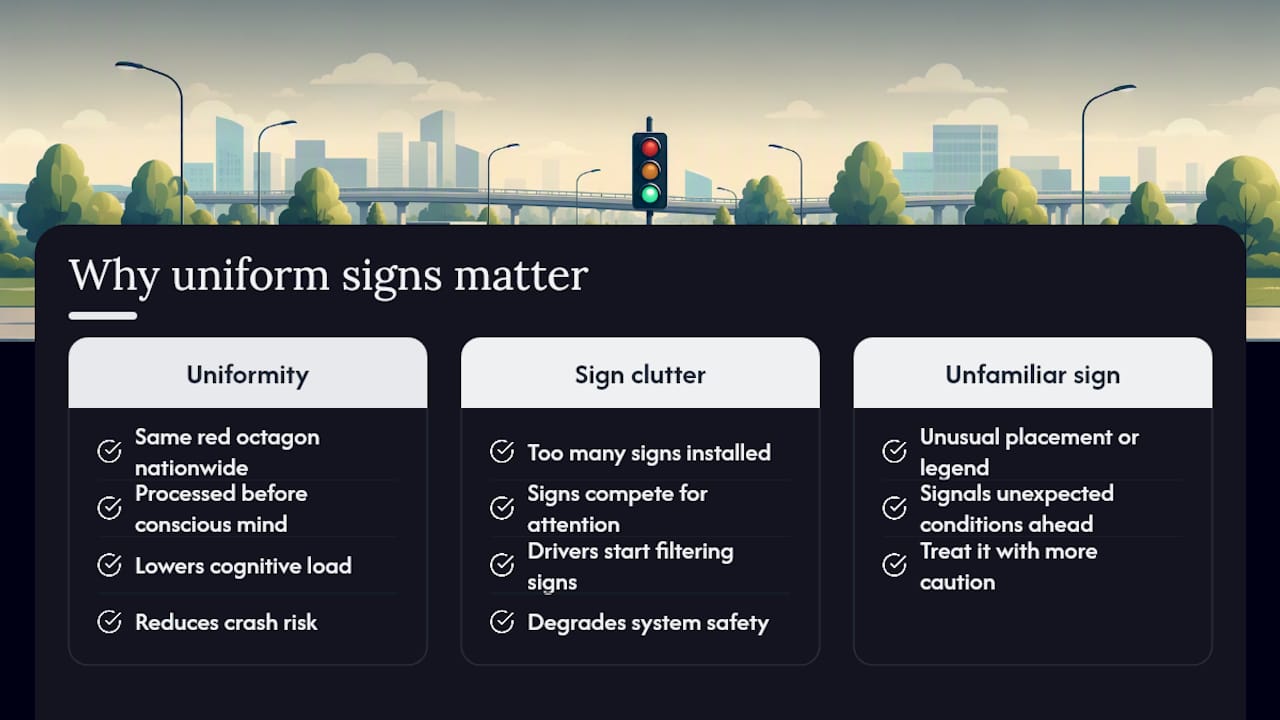
The MUTCD’s insistence on uniformity isn’t bureaucratic tidiness. It’s a safety mechanism. When every Stop sign in the country is the same red octagon with white lettering, your brain processes it before your conscious mind catches up. That automatic recognition is what makes the system work at 60 mph.
The Federal Register notice adopting the MUTCD 11th Edition specifically cites consistency across jurisdictions as a core rationale for the national standard. A driver moving from Florida to Oregon shouldn’t need to relearn the sign system. That predictability reduces cognitive load and, by extension, crash risk.
What most people underestimate is how much the system depends on restraint. A road manager who installs too many signs — even well-intentioned ones — degrades the system for everyone. When signs compete for attention, drivers start filtering them out, including the ones that matter. The MUTCD’s engineering-judgment requirement isn’t a bureaucratic hurdle; it’s a protection against the kind of sign clutter that makes roads less safe, not more.
The practical takeaway: when you encounter an unfamiliar or unusual sign, treat it with more caution than a familiar one, not less. Unusual placement or an unfamiliar legend is a signal that conditions ahead may not match your expectations.
Customsignstoday: professional signage built to spec
Need a sign that meets MUTCD specifications or matches a specific regulatory standard? Customsignstoday produces custom traffic and site signs for businesses, property managers, and contractors across the U.S., built from durable materials suitable for outdoor use in any weather.
Whether you need custom site signs for a construction project, parking lot regulatory signs, or directional signage for a private property, Customsignstoday handles the production from spec to finished product. The team works with clients to match the correct colors, shapes, and legends so your signs communicate clearly and hold up over time. Get a custom sign quote and see what the right sign costs for your specific need.
Sources
The sources below are the primary references for everything covered in this article. Each one is a free public document.
- Manual on Uniform Traffic Control Devices (MUTCD) — FHWA