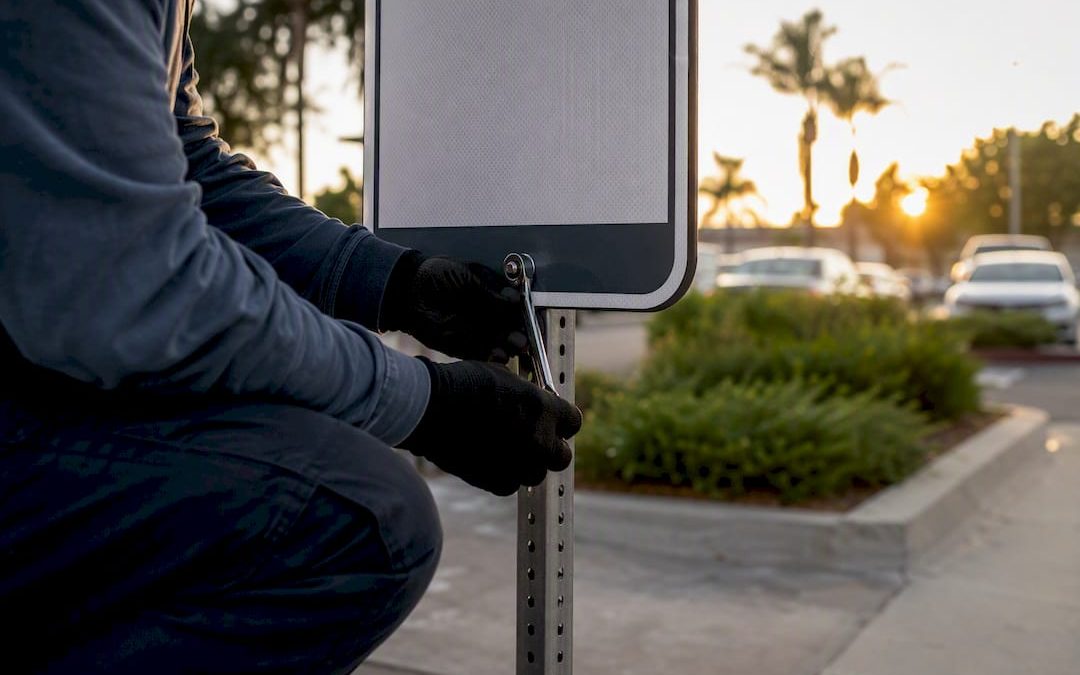
A regulatory sign is a custom sign a property owner installs to state enforceable on-site rules, and to give drivers legal notice before towing, clamping, or citing them for violations. It works because it puts visitors on notice: park here, not there, or your car gets towed at your expense. That notice is what turns “we’d prefer you didn’t park here” into something you can actually enforce.
If you manage a lot, retail plaza, or event site, three moves matter right now:
- Audit every vehicle entrance for existing signage, gaps, and outdated wording.
- Confirm your signs name the towing company, contact number, and terms clearly.
- Photograph and date each installed sign the day it goes up, before you ever need it.
Key Takeaways
Enforceable private signage requires specific wording, correct placement at every entrance, and durable materials, since notice is the legal foundation for towing and enforcement action.
| Point | Details |
|---|---|
| Signage is a contract, not decoration | Clear wording and towing contact info give you legal standing to enforce parking rules. |
| Minimum fields are non-negotiable | Private property notice, prohibited action, towing contact, and enforcement hours all need to appear. |
| Placement and legibility drive enforceability | Post signs at every entrance, use repeaters in large lots, and meet minimum letter-height standards. |
| Documentation protects you later | Photograph and date every sign install to support enforcement or dispute records. |
| Customsignstoday builds compliance-ready signs | Custom design, durable materials, and reusable templates support multi-site property portfolios. |
Table of Contents
- Why Private Regulatory Signs Matter for Legal Defensibility
- What Should a Regulatory Sign Say?
- Where Should Signs Go and What Materials Hold Up?
- Which Sign Types Do Most Properties Actually Need?
- How Do You Audit, Order, and Document Compliant Signs?
- What Is a Regulatory Sign in Driving on Public Roads?
- What Are Common Examples of Regulatory Traffic Signs?
- How Do Regulatory Signs Differ From Warning and Guide Signs?
- What Happens When Drivers Ignore Regulatory Signs?
- How Should Drivers Respond to Regulatory Signs?
- A Sign Maker’s View on Common Mistakes
- How Custom Signs Today Helps You Get Signage Right
- Where to Verify Jurisdictional Requirements
- Sources
Why Private Regulatory Signs Matter for Legal Defensibility
Signage is not decoration. It functions as the contract that gives you the standing to tow, clamp, or fine a violator, and courts and towing companies alike treat that notice as the foundation of the whole transaction. Without it, a private parking notice has no more legal weight than a sticky note, since it operates under contract law rather than government authority.
Poor signage creates real exposure. A vague “No Parking” sign with no towing company listed, no hours, and no contact number can void your right to tow under most state frameworks, and it can also open you up to liability claims from a driver whose car got hauled away without adequate warning. Property owners who rely on decorative or undersized signs often assume they are covered. Insurers and courts frequently view that kind of signage as misleading rather than protective, which raises the stakes rather than lowering them.
A few failure patterns show up again and again:
- Signs posted at only one of several entrances, leaving other approaches unmarked.
- Faded or sun-bleached text that no longer meets legibility thresholds.
- Wording that describes a rule but omits the enforcement mechanism (towing, fee, or fine).
Pro Tip: Keep a simple log with a photo, GPS location, and install date for every sign on your property. If a towing dispute ever lands in small claims court, that log is often the difference between a clean win and a costly settlement.
What Should a Regulatory Sign Say?
Enforceable signage needs specific fields, not general warnings. A code of practice for private-land parking enforcement outlines four sign categories, terms and conditions, warning or attention signs, repeater signs, and surface markings, and specifies that meaningful enforcement can only happen once those minimum requirements are met.
At minimum, your primary sign should include:
- A clear “private property” notice.
- The prohibited action (no parking, permit only, tow away zone).
- A towing warning stated plainly.
- The towing company’s name and phone number.
- Enforcement hours (24 hours or specific windows).
- Who enforces the rule (property management, security, or the towing operator).
Beyond the minimum, stronger signs add the maximum towing and storage fees where local law requires disclosure, instructions for retrieving a towed vehicle, and language addressing repeat violations.
Two templates you can adapt directly:
Tow-away parking restriction: “PRIVATE PROPERTY. UNAUTHORIZED VEHICLES WILL BE TOWED AT OWNER’S EXPENSE. 24-HOUR ENFORCEMENT. TOWING BY [Company Name], [Phone Number].”
Reserved or permit-only stall: “PERMIT PARKING ONLY. ALL OTHER VEHICLES SUBJECT TO TOWING WITHOUT WARNING. CONTACT [Property Management Phone] FOR PERMIT INFO.”
| Field | Why it matters |
|---|---|
| Towing company name & phone | Required for enforceability under most state towing statutes. |
| Enforcement hours | Clarifies when the restriction actually applies, day and night. |
| Prohibited action stated plainly | Removes ambiguity that a driver could dispute in court. |
| Who enforces | Tells drivers who to contact, reducing disputes on-site. |
Where Should Signs Go and What Materials Hold Up?
Placement determines whether a sign actually gives fair notice. Post a primary sign at every vehicle entrance, not just the main one, and use repeater signs throughout larger lots so drivers see the rule again near the stalls where it applies. Guidelines for parking signage on private property recommend mounting heights that keep text legible from a moving vehicle, generally between roughly four inches and six feet above grade depending on the sign type, with visibility maintained from a reasonable approach distance.
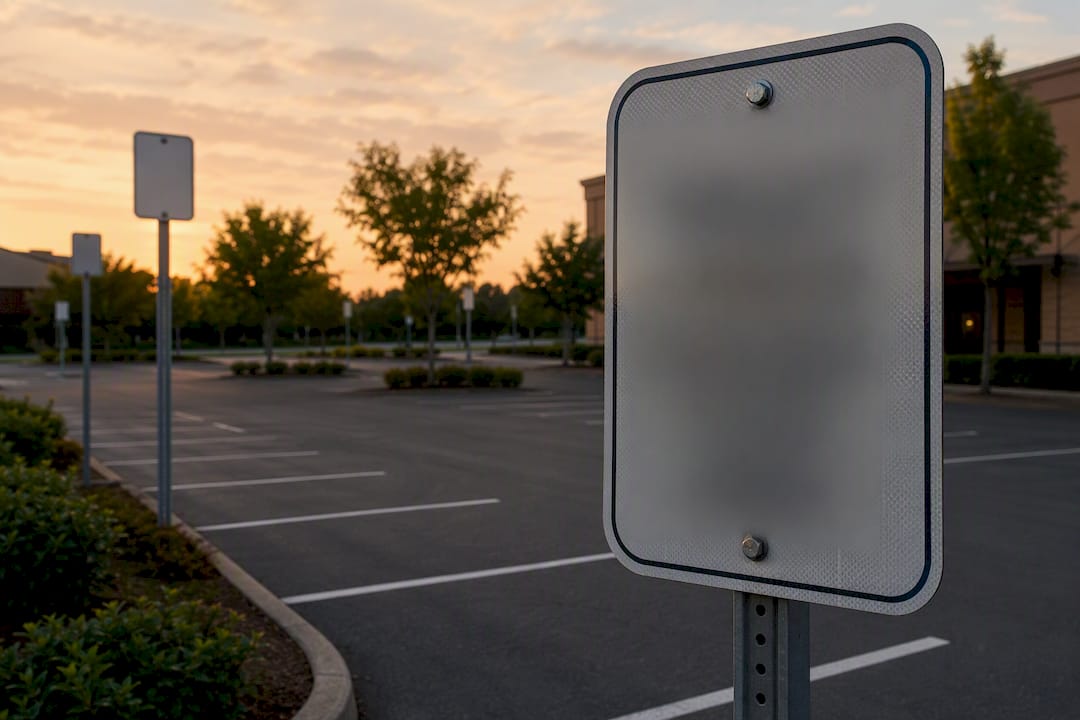
Legibility rules are not arbitrary. Some states set hard minimums, Pennsylvania, for example, requires primary restriction text at least 3 inches tall, secondary text at least 2 inches, and retroreflective or illuminated faces for signs enforced after dark. High contrast (dark text on light backgrounds, or the reverse) beats color for readability at a glance.
On materials, aluminum and high-density polyethylene substrates outlast PVC in direct sun and rain. Reflective sheeting rated for engineer-grade or higher reflectivity keeps signs readable under headlights, and UV-resistant inks stop color fade from becoming a legibility problem within a year or two. For high-traffic or vandal-prone sites, tamper-resistant hardware and anti-graffiti laminate add years to a sign’s working life. Choosing sign sizes for maximum visibility at your specific approach distances is worth doing before you finalize an order.
Pro Tip: Mount signs with clear sightlines, never behind landscaping, parked trucks, or seasonal decorations. A perfectly worded sign that is blocked six months a year gives you almost no legal protection.
Which Sign Types Do Most Properties Actually Need?
Most private lots need a handful of sign types, each doing a distinct job:
- Permit-only or authorized parking signs at entrances and reserved zones.
- Tow-away zone signs anywhere unauthorized vehicles face removal.
- Reserved stall signs at individual spaces (accessible parking, executive spots, tenant-assigned stalls).
- Loading zone signs at commercial delivery areas.
- Fire lane signs along access routes emergency vehicles need clear.
- On-site speed limit signs for internal roads, campuses, and large lots.
- No entry or private road notices at boundaries open to public confusion.
Placement location changes the wording: entry signs state overall property rules, while stall-level signs get specific (“Reserved for Unit 4B”). This entire category covers private-property enforcement signage only. Public-road traffic-control devices, the stop signs and speed-limit postings governed by state transportation departments, fall under a completely different regulatory framework and are not what this guide addresses.
How Do You Audit, Order, and Document Compliant Signs?
Getting signage right is a sequence, not a single purchase decision.
- Map every entrance and access point, including ones easy to overlook (rear service drives, secondary lots).
- Check state and municipal rules for minimum letter height, placement, and towing disclosure requirements.
- Draft exact wording using the checklist fields above.
- Take site measurements for mounting height, viewing distance, and existing post or wall conditions.
- Order custom signs sized and worded to match your audit.
- Install to legibility and mounting standards, confirming clear sightlines.
- Photograph and log each sign with date, GPS location, and file name tied to the property address.
Keep records organized by property and entrance, and retain them for as long as your state’s towing dispute window allows, often several years. Name photo files consistently (address, entrance number, install date) so you can retrieve proof quickly if a dispute lands in small claims court or with a towing company’s insurer.
Local and state rules vary significantly on letter height, reflectivity, and required disclosures. Confirm your jurisdiction’s specifics before enforcing anything, and talk to legal counsel if your enforcement policy involves unusual fees, immobilization, or repeat-offender clauses.
What Is a Regulatory Sign in Driving on Public Roads?
On public roads, a regulatory sign is a traffic control device that tells drivers what they are legally required to do or prohibited from doing, backed by state and local traffic law. This is a different category from the private-property signage covered above, but the two share a naming convention that causes real confusion when property owners search for guidance.
Public regulatory signs derive authority from state vehicle codes and the national framework that governs traffic devices on roads open to public travel. Violating one is a traffic offense, enforceable by police, not a private contract dispute settled between a property owner and a towing company.
The distinction matters mostly for vocabulary. When you are ordering signage for your parking lot, loading dock, or event grounds, you are in the private-property world this guide covers. Public-road regulatory signage follows an entirely separate design and approval process run by transportation authorities, not something a business owner commissions directly.
What Are Common Examples of Regulatory Traffic Signs?
Stop signs, yield signs, and speed limit postings are the most familiar examples on public roads, each one a command backed by state traffic law rather than a private property rule.
A stop sign requires a complete stop at a marked line or intersection. A yield sign requires slowing and giving right-of-way to other traffic before proceeding. Speed limit signs set a legal maximum (and sometimes minimum) for that stretch of road, enforceable by citation.
Other public examples include one-way signs, no-turn signs, and lane-use control signs, all falling under the same authority structure that governs stop and yield signs.
Property owners sometimes assume their on-site speed limit or stop signs fall under this same public framework, but they do not, unless a specific state statute extends that authority to private roads. Ohio is a notable example: state law allows owners of private roads in certain residential areas to post enforceable speed limits, but only when signage meets department specifications and an entrance sign tells drivers the limit carries the force of law. Absent that kind of statute, an on-site speed limit sign on private property is a house rule, not a public traffic law, even though the sign might look identical to one on a city street.
How Do Regulatory Signs Differ From Warning and Guide Signs?
Regulatory signs issue a command. Warning signs flag a hazard. Guide signs give directional information. That three-way split defines the entire public traffic sign system, and it matters because only one of the three carries direct legal force.
A regulatory sign (stop, yield, speed limit) creates a legal obligation, and ignoring it is a citable offense. A warning sign (curve ahead, pedestrian crossing, deer crossing) alerts a driver to a condition but does not itself create a legal command, though ignoring the underlying hazard can still lead to a citation for reckless or careless driving. A guide sign (exit numbers, mile markers, route shields) provides navigational information with no enforcement component at all.
This same three-way distinction shows up on private property, informally. A tow-away notice functions like a regulatory sign (it is the basis for enforcement action). A “watch for pedestrians” sign in a parking lot functions like a warning sign (it flags a hazard without creating an enforceable rule on its own). Property owners commissioning signage benefit from understanding which category each sign falls into, since regulatory-style wording needs the full checklist of enforcement fields, while warning-style signage is mostly about visibility and hazard communication.
What Happens When Drivers Ignore Regulatory Signs?
Ignoring a public regulatory sign carries direct legal consequences: a citation, fines, points on a driver’s license, and in serious cases, license suspension after repeated violations. A blown stop sign that causes a collision can also expose the driver to civil liability for damages, separate from the traffic citation itself.
The stakes scale with the offense. A minor speed limit violation might mean a modest fine. Running a stop sign in a school zone or causing an injury collision escalates quickly into criminal exposure in some states. Courts generally treat regulatory sign violations as evidence of negligence in civil suits, which is one reason insurance companies take citation history seriously when setting rates.
On private property, the consequence structure looks different but still carries weight. A driver who ignores a properly posted tow-away sign has no strong legal argument against the tow, since the sign provided fair notice under contract principles. That is precisely why getting the wording, placement, and documentation right protects property owners on the back end, when a driver disputes a towing charge or threatens legal action over a clamped vehicle.
How Should Drivers Respond to Regulatory Signs?
The correct response to any regulatory sign, public or private, is straightforward: comply immediately and fully, since the sign represents a legal or contractual obligation rather than a suggestion. A stop sign means a complete stop. A speed limit sign sets a hard ceiling. A tow-away notice on private property means finding another place to park.
Drivers who are uncertain whether a sign is regulatory, warning, or informational should default to the most cautious reading, since misreading a regulatory sign as merely advisory is one of the most common causes of citations and private disputes alike. If a sign’s wording is unclear or looks damaged or outdated, that is worth reporting to the property owner or local authority rather than ignoring the rule altogether.
For property owners and facility managers, this cuts both ways. Clear, well-placed, properly worded signage makes compliance easy for drivers acting in good faith, and it strengthens your position against the small minority who ignore posted rules anyway.
A Sign Maker’s View on Common Mistakes
Vague wording is the mistake seen most often, “Parking by permission only” with no towing contact, no hours, nothing enforceable. Undersized lettering and signs mounted where landscaping eventually blocks them run a close second.
Standard templates speed up approval, and sticking to a few standard sizes across a property makes future replacements simple rather than custom every time. Including a mounted proof photo with every order also catches placement problems before they become enforcement problems. One property management client rebuilt its entire signage set after a failed tow dispute, and the resulting standardized set eliminated repeat issues across a dozen sites.
How Custom Signs Today Helps You Get Signage Right
Ordering compliant signage does not need to be a guessing game, and it does not need a lawyer’s supervision to get right the first time. Customsignstoday designs and fabricates regulatory signage with compliance-oriented wording, durable materials rated for outdoor exposure, and installation guidance that keeps mounting height and sightlines correct from day one.

Every order can include recordable deliverables: dated production notes and mounted proof photos you can file alongside your own compliance log. If you manage multiple sites or a large lot with several entrances, Customsignstoday can build a standard custom sign template once and reuse it across every property, which keeps wording consistent and replacement costs predictable. Property managers ordering several sign types at once can also request a free wording review to catch missing fields, like a towing contact or enforcement hours, before production starts.
To request a quote, send over a basic site map showing entrance locations, your preferred wording (or a request for a review), and the quantities you need. From there, Customsignstoday handles sizing, material selection, and production so your signage holds up in court and in the weather.
Where to Verify Jurisdictional Requirements
Check your state’s vehicle code or municipal parking ordinance before enforcing towing or fees, since minimum letter height and disclosure rules vary by state.
- MUTCD guidance on private lots open to public travel
- California tow-away signage requirements under CVC 22658
- Pennsylvania private parking lot posting rules
Bookmark these pages and keep your own sign documentation on file for enforcement or dispute situations.
Sources
- MUTCD Standards for Private Parking Lots (Charleston)
- Signage guidelines for parking on private property (Queensland TMR)
- Code of Practice: Parking Enforcement on Private Land (New Zealand Consumer Protection)
- Section 4511.211 | Establishing speed limit on private road (Ohio)