
Exit signs, danger and fire-equipment signs, mandatory action/PPE signs, and accident prevention tags all fall under enforceable OSHA rules. The governing text lives in 29 CFR 1910.145 for general industry and 29 CFR 1926.200 for construction sites, with the ANSI Z535 series incorporated by reference for color and pictogram design. The rest of this guide breaks down what inspectors actually check and what to fix first.
TL;DR:
- Exit signs must have at least 6-inch tall letters with a minimum stroke width of 0.75 inches and remain continuously illuminated with backup power sources.
- Signage in construction sites must be visible at all times and removed or covered when hazards no longer exist, with compliance depending on the correct OSHA standards and ANSI Z535 design rules.
- Regular tests of backup illumination, including monthly logs, are essential because non-functional exit sign lighting is a frequent cause of citations.
- Sign colors and symbols must follow ANSI Z535 conventions, with bilingual or tactile signs used in diverse or accessible workplaces, and outdoor signs require durable materials suited to environmental exposure.
- Proper placement of signs at decision points, along egress routes, and near hazards, combined with thorough quarterly checklists, helps prevent common inspection failures like faded pictograms and dead batteries.
Table of Contents
- Types of Mandatory Workplace Safety Signs
- Legal Requirements: OSHA, CFR, and ANSI Standards
- Exit Signage: Placement, Sizing, and Visibility Rules
- Design Rules: Colors, Symbols, and Bilingual Requirements
- Tags vs. Signs, and the Compliance Walk-Through Checklist
- How Custom Signs Today Supports Compliance Projects
- Why Checklists Beat Memorized Rules
- Get Compliant Signage Without the Guesswork
- Sources
Types of Mandatory Workplace Safety Signs
OSHA sorts safety signage into distinct categories, and mixing them up is one of the fastest ways to draw a citation. Each category has a specific signal word, color scheme, and use case defined under 1910.145.
- Danger signs warn of an immediate hazard with a high probability of death or serious injury. Think exposed high-voltage panels, unguarded machinery pinch points, or confined spaces with atmospheric risk.
- Warning signs flag a hazard that could cause death or serious injury but with a lower probability than a Danger condition. A forklift crossing zone or a partially completed scaffold typically gets a Warning sign, not a Danger sign.
- Caution signs address hazards linked to minor or moderate injury. Wet floors, low overhead clearance, or a sharp edge on a loading dock fit here.
- Safety instruction and Notice signs communicate general information, like “Wear Eye Protection in This Area” or “Report All Injuries to Supervisor.”
- Fire equipment signs mark extinguishers, hose stations, and fire alarm pull stations so responders find them in seconds.
- Exit signs identify egress routes, and they carry the strictest design specs of any category.
- Mandatory action and PPE signs tell workers what protective equipment to use before entering an area, such as hard hat, hearing protection, or respirator requirements.
Pictograms matter as much as text. A warehouse with a workforce that speaks several languages benefits more from a symbol-based hard hat icon than from an English-only sentence. Text-heavy signs work fine for administrative notices, but anywhere speed of comprehension affects safety, the pictogram should carry the message on its own. A breakdown of the four main sign categories walks through how each one maps to real facility layouts.
Legal Requirements: OSHA, CFR, and ANSI Standards
The legal foundation for mandatory signage sits in two OSHA standards, and knowing which one applies to your site matters more than most managers realize.
29 CFR 1910.145 governs general industry: warehouses, manufacturing plants, offices, and most fixed facilities. It defines the color coding, signal word hierarchy, and format for accident prevention signs and tags.
29 CFR 1926.200 covers construction sites specifically. It requires signs to remain visible at all times when work is performed, and it mandates removing or covering signs and tags once the hazard they describe no longer exists. A “Trench Open” sign left up after backfilling isn’t just outdated, it’s a violation waiting to be written up.
Here’s the part many safety officers miss: OSHA doesn’t reinvent design rules from scratch. It incorporates the ANSI Z535 series by reference, meaning the color palettes, signal word definitions, and pictogram conventions in Z535 carry legal weight even though they’re published by a separate standards body. That incorporation is documented in the e-CFR, which hosts the enforceable text.
A few practical steps follow from this:
- Check whether your site falls under 1910 (general industry) or 1926 (construction), since some sites transition between the two during renovation projects.
- Confirm your signage vendor designs to current Z535 color and layout conventions, not a legacy palette from decades ago.
- Layer in local fire codes and NFPA life-safety requirements, which often add stricter illumination or spacing rules on top of federal minimums.
Exit Signage: Placement, Sizing, and Visibility Rules
Exit signs draw more inspection attention than almost any other sign category, largely because the specs are numeric and easy to measure with a tape measure during a walk-through.
- Letter height: Exit sign lettering must measure at least 6 inches tall, referenced under OSHA’s exit route provisions in 1910.37.
- Stroke width: Letters need a minimum stroke width of 0.75 inch, wide enough to read from a distance in smoke or dim light.
- Illumination: Exit signs require continuous illumination, either internally lit or externally lit with a reliable power source, plus a battery or photoluminescent backup that activates during a power failure.
- Directional arrows: Any point where an occupant might hesitate, like a hallway junction or a door that isn’t the nearest exit, needs a directional sign pointing toward the correct egress path.
Inspectors frequently test the backup illumination directly rather than taking your word for it. A sign that looks fine under normal lighting but fails the moment someone cuts power is a documented finding, not a gray area.
Pro Tip: Run a monthly illumination test on battery-backed exit signs and log the date, time, and result. A blank battery test log is treated the same as never testing at all.

Roughly half of egress-related citations trace back to something as simple as a burned-out lamp or a dead backup battery that nobody caught between annual fire drills.
Design Rules: Colors, Symbols, and Bilingual Requirements
Signal word and color pairing isn’t a style preference, it’s a compliance requirement drawn from ANSI Z535 and referenced through OSHA’s incorporation rules. Red belongs to Danger, orange to Warning, yellow to Caution, and blue to mandatory action notices. Using red “DANGER” panels for a low-severity hazard, like a minor tripping risk, actually works against you: workers start tuning out red signs when they see them attached to trivial issues, and the desensitization carries over to situations where DANGER means exactly what it says.
- Mandatory action symbols follow the blue circle convention, aligning with ISO 7010 pictograms recognized internationally.
- Pictogram-first designs beat text-heavy signs anywhere workforce language varies, since a hard hat icon needs no translation.
- Bilingual text panels help wherever a meaningful share of the crew speaks a language other than English as a primary language.
- Tactile and braille signage becomes necessary near accessible exits and restrooms under ADA guidance, and it needs to be ordered with raised characters, not just printed braille dots that wear down.
Material selection matters just as much as the graphics. A sign rated for indoor use won’t hold color or legibility on an exterior loading dock exposed to UV and rain for a full season. A guide on creating signage that maximizes compliance covers material choices suited to different environments.
Tags vs. Signs, and the Compliance Walk-Through Checklist
Tags and permanent signs serve different purposes, and confusing the two is a common paperwork mistake. Tags are meant for temporary, non-routine hazards, like a jammed conveyor awaiting repair or a wet paint area during a one-day job. Under 1926.200, tags must come down or get covered the moment the hazard is resolved. A permanent sign, by contrast, addresses a fixed, ongoing condition, like a live electrical panel that will always carry voltage.
The most common inspection findings tend to repeat across industries:
- Dim or nonfunctional exit illumination, often caught only when backup power gets tested.
- Overuse of the DANGER signal word on hazards that warrant Warning or Caution instead.
- Doors that resemble exits but aren’t labeled “NOT AN EXIT” or marked by function, like “STORAGE ROOM.”
- Faded, cracked, or peeling pictograms that have become illegible.
- Missing bilingual signage in facilities with a meaningful non-English-speaking workforce.
| Checklist item | What to verify |
|---|---|
| Placement | Signs sit at decision points, near hazards, and along egress paths |
| Legibility | Text and pictograms remain readable from normal viewing distance |
| Illumination | Exit signs pass a manual backup power test |
| Signal words | Danger, Warning, and Caution match actual hazard severity |
| Documentation | Testing logs cover the previous periods without gaps |
Running this checklist quarterly, rather than only before a scheduled inspection, catches fading pictograms and dead batteries long before an auditor does. A piece on identifying mandatory signs for business and event safety offers a companion walk-through for facilities that host public events alongside daily operations.
How Custom Signs Today Supports Compliance Projects
Signage solutions for businesses and individuals include banners, vehicle wraps, lettering, decals, and durable indoor and outdoor signs designed to hold up under real-world conditions. For safety and compliance work specifically, the practical sequence looks like an assessment of current signage gaps, ANSI-aligned design work, fabrication using materials rated for the site’s environment, and installation guidance so signs land at the right height and viewing angle.
A guide on identifying mandatory signs walks through the same categories covered here, tailored for facility walk-throughs.
Why Checklists Beat Memorized Rules
Most compliance advice stops at explaining the categories and citing the CFR sections, then leaves the reader to figure out implementation alone. That’s backwards. Safety officers don’t fail inspections because they don’t know what a Danger sign is. They fail because nobody logged the battery test, or because a storage closet next to the real exit never got labeled, or because the pictograms faded two summers ago and nobody noticed until an inspector did.
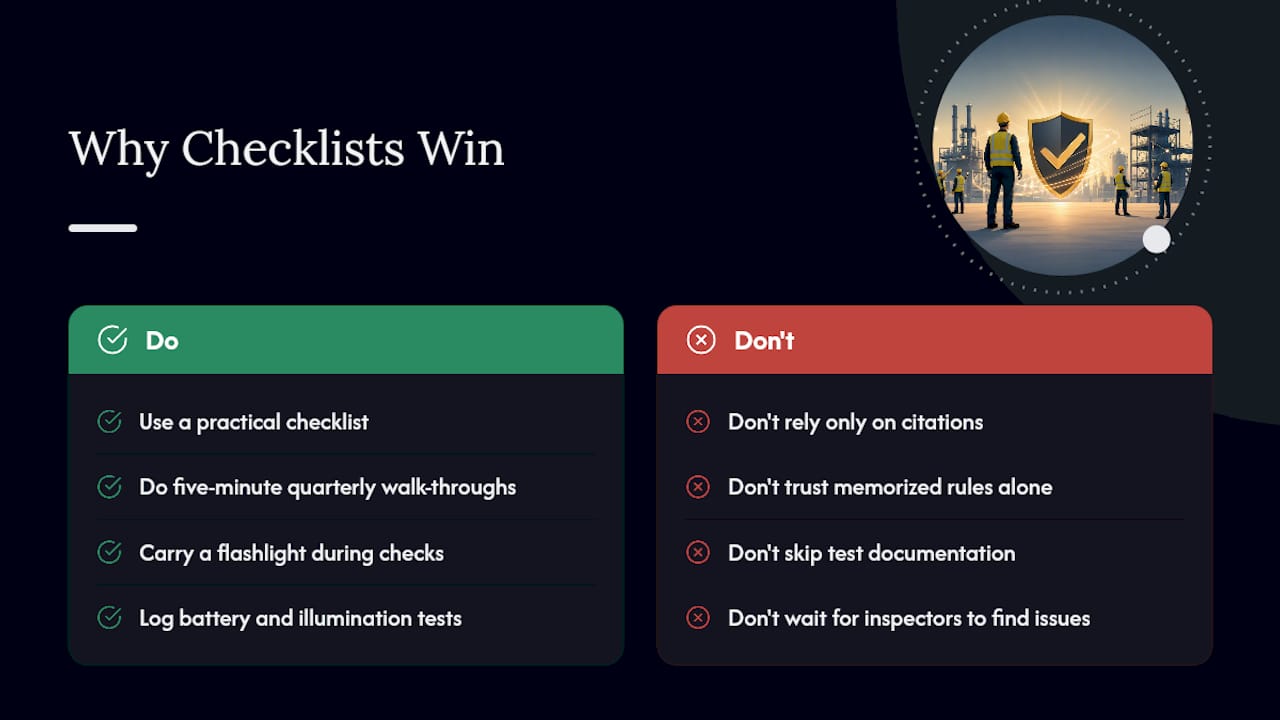
The regulatory citations matter, and knowing that ANSI Z535 gets incorporated by reference through the e-CFR is genuinely useful when you need to defend a design choice. But citations don’t catch a burned-out exit lamp. A five-minute quarterly walk-through, armed with a checklist and a flashlight, catches more violations than another read of 1910.145 ever will.
If there’s one place to start, it’s illumination testing and documentation. It’s the single most cited failure point, it’s the fastest to fix, and it’s the easiest to prove you’ve addressed when an inspector asks for records.
— Yossi
Get Compliant Signage Without the Guesswork
Reading the regulations tells you what’s required. Getting signs that actually meet ANSI Z535 specs, in materials rated for your site, installed at the correct height, is a separate job, and it’s the one Custom Signs Today handles directly rather than leaving to a generic print shop.

Compliant site signs built for outdoor exposure, high-traffic entry points, and inspection-ready durability are available, backed by a straightforward quote request process so you can know pricing and timelines before committing. If your last walk-through turned up faded pictograms, missing exit labels, or signal words that don’t match the hazard, request a free assessment and quote today.
Sources
- 1910.145 – Specifications for accident prevention signs and tags.
- e-CFR (Title 29) – electronic Code of Federal Regulations