
Over 60 percent of American shoppers say that clear signage directly influences where they choose to spend. For retail business owners, signs do more than show prices or mark aisles. Modern signage shapes each customer’s experience, driving engagement and reinforcing your brand at every turn. This guide unpacks common myths and uncovers how strategic visual solutions can help American stores stand out and connect authentically with customers.
Table of Contents
- Defining Retail Signage And Common Myths
- Major Types Of Retail Signage Solutions
- How Signage Drives Branding And Sales
- Legal And Accessibility Requirements For Signage
- Cost Implications And Common Pitfalls
Key Takeaways
| Point | Details |
|---|---|
| Effective Retail Signage | Retail signage is a crucial marketing tool that influences customer behavior and drives sales through strategic design. |
| Technology Integration | Modern signage solutions, especially digital, allow for real-time updates and interactive features that enhance customer engagement. |
| Accessibility Compliance | Adhering to legal accessibility standards is essential for inclusivity and can prevent costly penalties. |
| Cost Management | A comprehensive understanding of the total cost of signage, including hidden expenses, is vital for maximizing return on investment. |
Defining Retail Signage and Common Myths
Retail signage represents a sophisticated visual communication strategy designed to engage customers, provide information, and drive sales. Signage originated from complex historical communication practices that extend far beyond simple labeling, serving as critical interactive elements within retail environments. These visual communication tools do more than just identify products or spaces – they create experiences that guide consumer behavior and perception.
Modern retail signage encompasses multiple strategic types, each serving distinct purposes. Wayfinding signs help customers navigate store layouts, promotional signs highlight special offers or featured products, branding signs communicate company identity, and informational signs provide essential product details. These signs are carefully designed using principles of visual communication that consider color psychology, typography, placement, and consumer psychology to maximize their impact.
Contrary to popular misconceptions, retail signage is not merely decorative but a sophisticated marketing instrument. Common myths suggest signs are just passive background elements, when in reality they actively influence purchasing decisions. Technical design considerations play a crucial role in creating effective signage that communicates brand messaging and guides customer interactions. Professional retailers understand that every sign represents an opportunity to communicate value, create emotional connections, and strategically direct consumer attention.
Pro Tip: Invest time in analyzing your current signage from a customer’s perspective, considering readability, placement, and emotional impact rather than just aesthetic appearance.
Major Types of Retail Signage Solutions
Retail signage solutions have evolved dramatically, offering businesses sophisticated tools to communicate with customers. Digital signage technologies now encompass diverse electronic display systems that go far beyond traditional printed signs, providing dynamic and interactive communication channels. These solutions range from simple wall-mounted displays to complex networked multimedia systems designed to capture customer attention and drive engagement.
Commercial signage solutions can be broadly categorized into several strategic types. Informational signs help customers navigate store layouts, promotional signs highlight sales and special offers, directional signs guide customer traffic flow, and branding signs reinforce company identity. Modern retail displays come in consumer and commercial-grade options with significant technical differences, including variations in durability, display technology, and operational lifespan that impact their effectiveness and long-term value.
Technology has transformed retail signage from static displays to interactive, data-driven communication tools. Digital signage now integrates advanced features like real-time content updates, audience analytics, touch-screen interactions, and personalized messaging. These sophisticated systems allow retailers to dynamically adjust marketing messages, track customer engagement, and create more immersive shopping experiences that adapt to changing consumer behaviors and preferences.
Pro Tip: When selecting retail signage solutions, prioritize flexibility and scalability to ensure your visual communication strategy can evolve with emerging technologies and customer expectations.
Here’s a summary of major retail signage types and their strategic business roles:
| Signage Type | Primary Purpose | Business Impact |
|---|---|---|
| Wayfinding | Guide customer navigation | Improves shopper experience |
| Promotional | Highlight offers and sales | Drives impulse purchases |
| Branding | Communicate brand identity | Builds consumer loyalty |
| Informational | Provide product details | Reduces staff questions |
| Directional | Manage traffic flow | Increases operational flow |
How Signage Drives Branding and Sales
Signage research reveals profound connections between visual communication and consumer behavior, demonstrating that strategic sign design can significantly impact brand perception and purchasing decisions. Effective signage serves as a silent salesperson, communicating brand values, guiding customer interactions, and creating memorable visual experiences that extend beyond traditional marketing approaches. By carefully crafting visual messaging, businesses can transform simple signs into powerful brand storytelling tools that engage customers at critical decision-making moments.

Brand consistency emerges as a crucial element in signage strategy. Visual identity elements like color schemes, logos, and typography become powerful communication channels when integrated thoughtfully across different sign types. Academic studies highlight how well-designed signage enhances consumer trust and brand recognition, creating a cohesive narrative that reinforces brand messaging throughout the customer journey. This consistent visual communication helps businesses establish emotional connections, differentiate from competitors, and guide customers toward desired purchasing behaviors.
Modern retail environments leverage signage as a dynamic sales and engagement tool. Digital and interactive signs allow real-time content updates, personalized messaging, and data-driven insights that transform traditional static displays into intelligent marketing platforms. By integrating technology with strategic design, businesses can create adaptive signage solutions that respond to customer preferences, track engagement metrics, and continuously optimize their visual communication strategies to drive sales and enhance brand loyalty.
Pro Tip: Conduct periodic sign audits to ensure your visual communication remains aligned with current brand messaging and customer expectations, reviewing design elements for clarity, consistency, and emotional impact.
Legal and Accessibility Requirements for Signage
Federal regulations mandate comprehensive accessibility standards that significantly impact signage design across retail environments. These legal requirements ensure that signs are not just marketing tools, but critical communication channels that accommodate individuals with diverse abilities. The Americans with Disabilities Act (ADA) establishes stringent guidelines covering visual contrast, character size, tactile elements, and placement to guarantee that signage provides equal access and information to all customers, regardless of physical limitations.
Compliance elements for accessible signage include specific technical requirements that businesses must carefully implement. These standards specify precise measurements for letter heights, color contrast ratios, mounting heights, and braille integration. Retail businesses must ensure signs are readable from appropriate distances, feature high-contrast color schemes, and include tactile characters that can be interpreted through touch. Institutional signage policies demonstrate the complexity of meeting these legal accessibility standards, highlighting the need for comprehensive design approaches that balance aesthetic, branding, and regulatory requirements.
Noncompliance with accessibility regulations can result in significant legal and financial consequences for businesses. Potential penalties include substantial fines, potential lawsuits, and reputational damage that can far exceed the cost of implementing proper signage design. Beyond legal obligations, accessible signage represents a commitment to inclusivity, demonstrating respect for customers with varying abilities and creating welcoming retail environments that communicate genuine consideration for diverse customer experiences.
Pro Tip: Consult with an ADA compliance specialist to conduct a comprehensive signage audit, ensuring your current signs meet all legal accessibility requirements and identifying potential areas for improvement.
This table outlines key legal and accessibility requirements and their effects on signage strategy:
| Requirement | Design Focus | Business Consequence |
|---|---|---|
| Visual Contrast | High readability | Avoids customer confusion |
| Letter Height | Adequate visibility | Ensures regulatory compliance |
| Tactile Elements | Braille and raised text | Enables equal access |
| Correct Placement | Reachable by all users | Prevents legal penalties |
Cost Implications and Common Pitfalls
Retail signage investments require strategic planning to balance initial costs with long-term performance, considering factors beyond simple price tags. Business owners must evaluate total cost of ownership, which includes initial purchase price, installation expenses, ongoing maintenance, energy consumption, and potential replacement costs. Sophisticated signage solutions demand comprehensive financial analysis that goes beyond surface-level pricing, considering technological adaptability, durability, and potential return on investment.
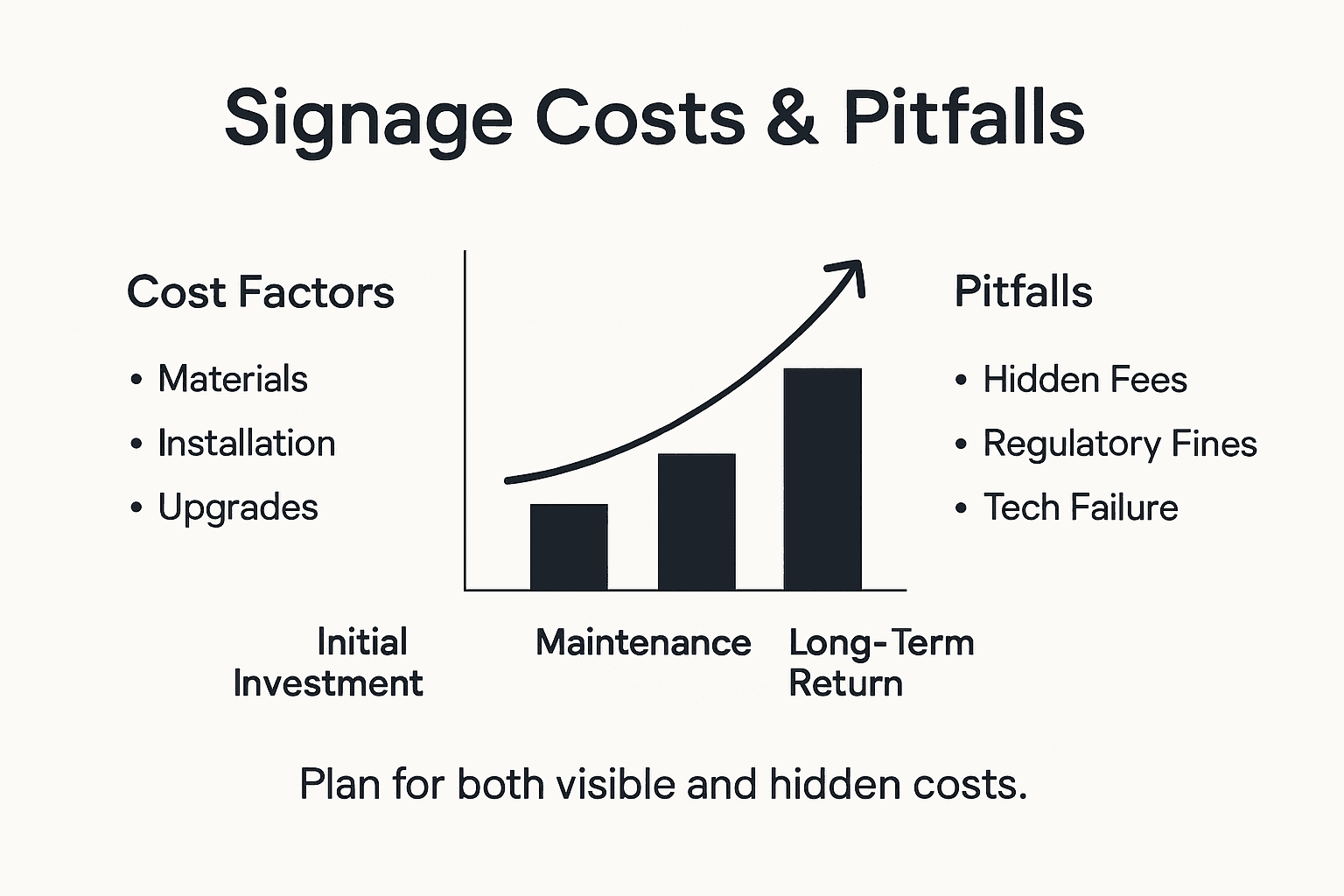
Hidden costs often surprise retail managers when implementing signage solutions. Local regulatory requirements can introduce unexpected expenses related to permits, design modifications, and compliance standards. Common pitfalls include overlooking zoning restrictions, underestimating installation complexity, and failing to account for potential retrofitting expenses. Businesses might encounter substantial financial penalties for noncompliance, making it crucial to budget for professional consultation and thorough regulatory research before sign implementation.
Technological evolution presents another critical cost consideration in retail signage. Digital displays and interactive systems require ongoing content management, software updates, and potential hardware replacements. Energy-efficient options might have higher upfront costs but can generate significant long-term savings through reduced electricity consumption and improved operational efficiency. Smart retailers approach signage as a strategic investment, carefully weighing initial expenses against potential marketing impact, customer engagement benefits, and operational advantages.
Pro Tip: Create a comprehensive five-year cost projection for your signage strategy, including potential technology upgrades, maintenance expenses, and regulatory compliance costs to avoid unexpected financial surprises.
Elevate Your Retail Experience with Custom Signage That Drives Sales
Struggling to capture your customers’ attention and turn foot traffic into lasting sales? Effective retail signage is not just decoration it is a strategic tool that boosts engagement guides shoppers and builds brand loyalty. At Custom Signs Today, we understand the power of well-designed signs that combine clarity readability and impactful branding to create memorable customer experiences. Whether you need promotional banners vehicle decals or directional signs our custom solutions help you stand out in competitive retail environments.
Explore our diverse range of signage options in our Uncategorized category where quality and customization meet to fulfill your unique business needs. Don’t wait until your current signage is outdated or ineffective take action now to transform your retail space into a dynamic sales engine. Visit Custom Signs Today and request your free quote today to discover how tailored signage solutions can elevate your brand and increase customer engagement immediately.
Frequently Asked Questions
What are the main types of retail signage?
Retail signage primarily includes informational signs, promotional signs, directional signs, and branding signs, each serving distinct purposes such as guiding customers, highlighting offers, managing traffic flow, and reinforcing brand identity.
How does signage impact consumer behavior and purchasing decisions?
Effective signage acts as a silent salesperson by communicating brand values, guiding customer interactions, and creating memorable experiences that significantly influence consumer behavior and purchasing decisions.
What legal considerations should be taken into account for retail signage?
Retail signage must comply with federal regulations, particularly the Americans with Disabilities Act (ADA), which outlines accessibility standards such as visual contrast, character size, and tactile elements to ensure equal access for all customers.
What are the potential hidden costs associated with implementing retail signage?
Hidden costs can arise from local regulatory requirements, permits, design modifications, installation complexities, and ongoing maintenance. It’s crucial to budget for potential expenses to avoid financial surprises throughout the signage lifecycle.
Recommended
- Retail Signage Explained: Boosting Business Visibility –
- Retail Sign Placement Guide for Effective Business Impact –
- Why Signage Boosts Sales for Local Businesses –
- Understanding Types of Promotional Signage for Businesses –
- How to Use AI for Ads to Transform Retail and Healthcare – BizDev Strategy
- Instore Experience Design – Corrado Manenti
- The Complete Guide to Billboard Advertising