TL;DR:
- Branded decals serve as effective marketing tools and safety communication assets across various business environments. They build brand recognition, generate organic exposure, and fulfill regulatory requirements when made with appropriate materials and strategic placement. Proper design, material selection, and integration into marketing systems maximize their impact and measurable ROI.
Branded decals are defined as custom-printed adhesive graphics that serve simultaneously as marketing assets and functional communication tools for businesses of any size. The role of branded decals extends well beyond decoration. They build brand recognition, convey safety information, drive customer engagement, and generate organic exposure every time a vehicle, product, or storefront carries your logo into the world. For business owners and marketers who want measurable returns from physical marketing, understanding how decals work across both promotional and operational contexts is the starting point.
How branded decals enhance brand visibility and customer engagement
The most direct marketing benefit of a branded decal is that it turns customers into brand carriers, generating organic exposure without ongoing ad spend. When someone places your logo decal on a laptop, water bottle, or car bumper, that impression travels with them indefinitely. Unlike a digital ad that disappears after a session, a well-made decal keeps working for months or years.
The role of decals in brand promotion goes deeper than passive visibility. Consider how brands like Patagonia and Hydro Flask built cult followings partly through sticker culture. Their customers voluntarily became walking billboards. The global sticker market reached $4.6 billion in 2024 and is projected to approach $8 billion by 2034. That growth signals that consumers respond to stickers as identity signals, not just promotional giveaways.
Packaging and unboxing represent another high-impact application. A branded decal on a shipping box or product package transforms a transactional moment into a brand experience. Subscription box companies like FabFitFun and Glossybox use this tactic deliberately. The decal signals quality and attention to detail before the customer even opens the product.
QR-enabled window decals take engagement further by converting passive foot traffic into measurable digital interactions. Global QR scans grew 57% in 2025 to over 2.2 billion active scanners worldwide. That number means a shop window decal with a QR code is no longer a novelty. It is a legitimate customer acquisition channel.
Key marketing applications for branded decals include:
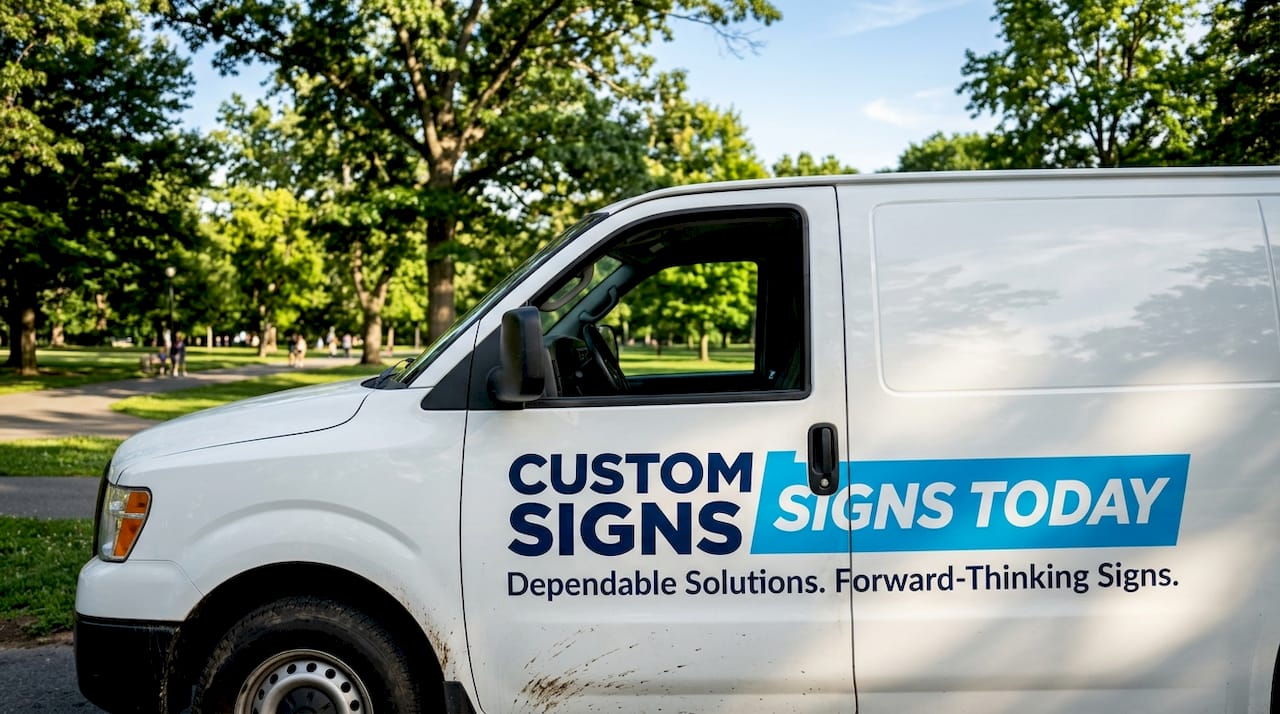
- Vehicle decals on company cars and delivery vans that generate thousands of impressions daily on local roads
- Window graphics on storefronts that communicate promotions, hours, and brand personality to passersby
- Product and packaging decals that reinforce brand identity at the point of unboxing
- Event giveaway stickers that attendees carry into new environments, extending your reach organically
- QR-coded decals that link offline audiences to landing pages, menus, or promotional offers
Pro Tip: When designing decals for giveaways, prioritize bold single-color logos over complex multi-color designs. Simple graphics reproduce cleanly at small sizes and adhere better to irregular surfaces like water bottles and phone cases.
What is the functional role of branded decals in safety and compliance?
Beyond marketing, branded decals serve as silent guides on vehicles and equipment, conveying warnings, operating instructions, and regulatory markers that protect workers and meet legal standards. This dual function is where many business owners underestimate decals. A construction company that brands its excavators with logo decals is also legally obligated to display load capacity warnings, hazard symbols, and emergency contact information on that same equipment.
Fleet operators face specific regulatory requirements from bodies like FMCSA, DOT, and NFPA. These standards dictate placement, size, and reflectivity for safety markings. Fleet decals combine branding with compliance messaging, with company logos typically placed on cab doors, contact information on rear panels, and reflective hazard markers positioned for maximum visibility at night. Getting this wrong is not just an aesthetic problem. It is a liability.
Durable labeling preserves critical information even in harsh environments like manufacturing and logistics, where heat, moisture, and chemical exposure can degrade standard adhesive graphics within weeks. When a safety label becomes illegible, it creates audit failures and genuine workplace risk. The material choice for a decal in a warehouse is therefore a safety decision, not just a design decision.
Here is a practical sequence for deploying decals in compliance-sensitive environments:
- Audit regulatory requirements first. Identify which standards apply to your industry, whether OSHA, DOT, NFPA, or local codes, before designing any decal.
- Map placement zones on each asset. Determine which surfaces receive brand graphics versus safety markers, and confirm that safety markers meet size and contrast requirements.
- Select materials rated for the environment. Outdoor equipment needs UV-resistant vinyl. Chemical environments require solvent-resistant laminates. Cold storage needs adhesives rated for low temperatures.
- Schedule replacement cycles. Even durable decals degrade. Build a maintenance calendar so compliance labels are inspected and replaced before they become unreadable.
- Document everything. Keep records of decal specifications and installation dates for audit purposes.
Pro Tip: For construction sites, partner with a signage provider that offers construction site safety compliant decal templates. This reduces design time and eliminates the risk of producing a label that fails regulatory review.
Decal types and materials: what works for each business context
Choosing the wrong decal type for a given environment is one of the most common and costly mistakes businesses make. A glossy paper-based decal applied to a fleet vehicle will peel within weeks. A standard vinyl decal without UV laminate will fade on a south-facing storefront within a season. The right material depends entirely on where the decal lives and what it needs to communicate.
| Decal type | Typical application | Key material requirement |
|---|---|---|
| Vehicle decals | Fleet branding, delivery vans, company cars | Cast vinyl with UV laminate for outdoor durability |
| Window decals | Storefronts, office glass, retail displays | Perforated vinyl or static cling for removability |
| Equipment decals | Machinery, tools, industrial assets | Polyester or polycarbonate with chemical resistance |
| Packaging decals | Product labels, shipping boxes, unboxing inserts | Paper or BOPP film depending on surface texture |
| Event stickers | Giveaways, trade shows, community campaigns | Standard vinyl or paper for short-term use |
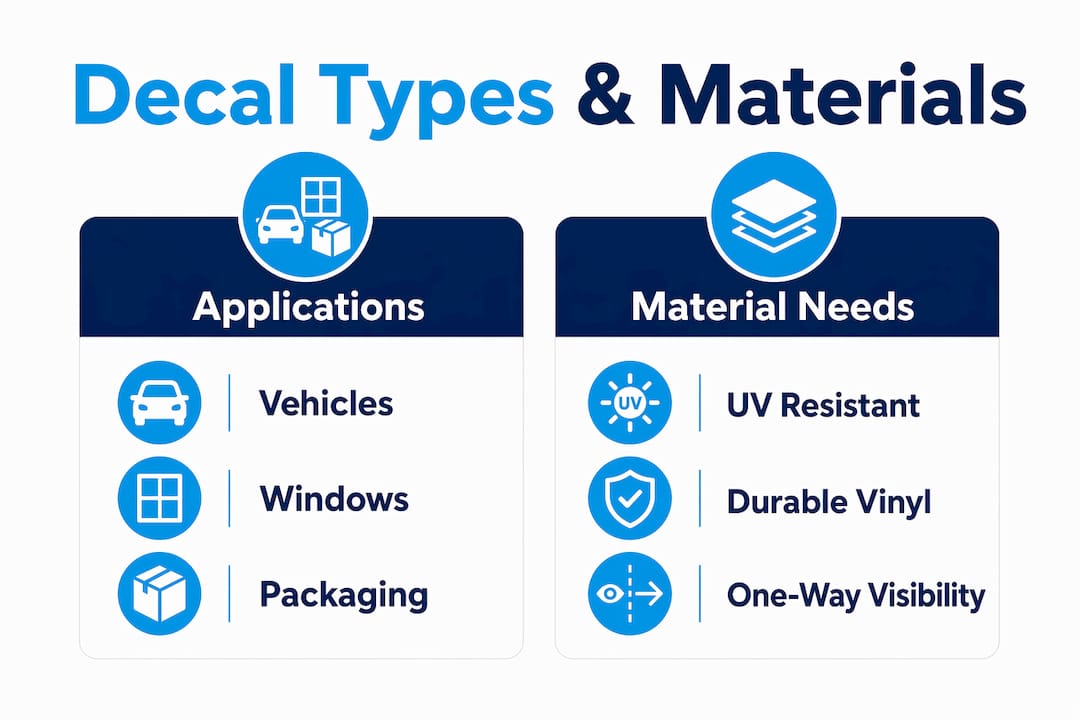
Outdoor decals require materials engineered for UV, moisture, and abrasion resistance to maintain legibility over time. Without proper lamination, a decal that looks sharp on day one becomes visual clutter by month three. For businesses in Florida or other high-UV markets, this is not a minor consideration. It directly affects how long your branding investment performs.
Design legibility is equally critical. A decal viewed from 30 feet on a moving vehicle needs a minimum font size of 2 inches for the primary text, high contrast between text and background, and no more than two typefaces. The custom decals branding guide from Customsignstoday covers these specifications in detail, including how to adapt designs for different surface types and viewing distances.
Window decals deserve special attention for retail businesses. Perforated vinyl allows one-way visibility, meaning your graphic is fully visible from outside while customers inside can still see through the window. This makes large-format window graphics practical for storefronts without sacrificing natural light.
Innovative uses and best practices for maximizing decal impact
The most forward-thinking use of branded decals today combines physical placement with digital tracking. Dynamic QR codes embedded in decals allow businesses to update the destination URL without reprinting the decal, and to measure exactly how many scans each placement generates. A restaurant can run a seasonal promotion by simply updating the QR destination, while the physical decal on the window stays in place.
Community engagement campaigns show what is possible when decals move beyond static branding. The Invergordon Duck Trail in the UK used QR-coded decals placed in local shops to create a discovery trail for visitors, driving foot traffic to participating businesses while linking each stop to digital content. The decals became experiential touchpoints, not just brand markers. Any local business district or event organizer can replicate this model.
Best practices for maximizing the effectiveness of branded decal campaigns:
- Use unique QR codes per placement. One code for your window decal, a different code for your vehicle decal. This tells you which location drives the most engagement.
- Design for the viewing context. A decal on a parked vehicle gets close-up scrutiny. A decal on a moving van gets two seconds of attention. Design accordingly.
- Rotate seasonal designs. Removable window decals let you update messaging for holidays, promotions, or local events without permanent commitment.
- Integrate decals into swag packages. Including a branded decal in a customer order or event bag extends your brand into new environments at minimal cost.
- Inspect and replace on schedule. Faded or peeling decals communicate neglect. A replacement schedule protects brand perception as much as the original investment.
Pro Tip: For digital marketing campaigns that include physical decals, build a focused mobile landing page for each QR destination rather than linking to your homepage. Conversion rates improve significantly when the landing page matches the specific offer on the decal.
Key takeaways
Branded decals deliver measurable value as both marketing tools and operational assets when businesses select the right materials, designs, and deployment strategies for each context.
| Point | Details |
|---|---|
| Dual function drives ROI | Decals serve as brand marketing and safety compliance tools simultaneously, maximizing value per asset. |
| Material selection determines longevity | UV-resistant cast vinyl with laminate is required for outdoor and fleet decals to maintain legibility. |
| QR codes make decals trackable | Dynamic QR codes allow URL updates without reprinting and provide scan data for campaign measurement. |
| Customer-carried decals extend reach | Stickers placed on personal items generate organic impressions that outlast any digital ad campaign. |
| Compliance is non-negotiable | Fleet and equipment decals must meet FMCSA, DOT, or NFPA standards or create legal and safety risk. |
Why I think most businesses are using decals at half their potential
I have worked with hundreds of business owners on visual branding, and the pattern I see most often is this: a company invests in quality vehicle decals for brand visibility, then completely ignores the compliance and engagement layers that would make those same decals work twice as hard. They treat decals as a one-time purchase rather than a living part of their marketing and operations.
The businesses that get the most out of branded decal marketing are the ones that think in systems. They coordinate the logo placement on a fleet vehicle with the QR code on the storefront window and the sticker in the customer’s order box. Each touchpoint reinforces the others. The customer who picks up a sticker at an event scans the QR code on the shop window three weeks later. That is not luck. That is a designed sequence.
The other thing I would push back on is the assumption that decals are a small-budget tactic. The window decal marketing guide shows how a single well-designed window graphic can outperform months of social media spend in terms of local impressions. The cost per impression on a vehicle decal traveling through a metro area is a fraction of what you pay for a digital display ad. The problem is that most marketers do not measure it, so they undervalue it.
My advice: treat your next decal order as a campaign, not a purchase. Define what you want each placement to do, build a QR destination that matches that goal, and set a date to review the data. You will be surprised what you find.
— Yossi
Get professional branded decals from Customsignstoday
Customsignstoday designs and produces custom vinyl decals built for real business environments, from fleet vehicles and construction equipment to retail storefronts and product packaging. Every order is produced with materials selected for the specific application, whether that means UV-resistant outdoor vinyl for South Florida heat or chemical-resistant polyester for industrial equipment. The team at Customsignstoday understands both the branding and the compliance side of decal design, so your graphics meet regulatory standards without sacrificing visual impact. If you want to explore creative decal applications beyond the basics, request a free quote and bring your concept. The team will help you find the right format, material, and design for your goals.
FAQ
What is the role of branded decals in marketing?
Branded decals function as low-cost, high-impression marketing tools that generate organic brand exposure through vehicle placement, product packaging, and customer giveaways. Unlike digital ads, a quality decal continues delivering impressions for months or years after a single production cost.
How do branded decals work for safety and compliance?
Fleet and equipment decals carry safety warnings, hazard symbols, and regulatory identifiers required by bodies like FMCSA, DOT, and NFPA. Proper material selection and placement are legally required in many industries, making compliance a core function of these decals alongside branding.
What materials are best for outdoor branded decals?
Cast vinyl with UV-resistant laminate is the standard for outdoor and vehicle decals because it resists fading, moisture, and abrasion. Standard paper or calendered vinyl degrades quickly in direct sunlight and should only be used for short-term indoor applications.
Can branded decals be tracked for marketing performance?
Yes. Dynamic QR codes embedded in decals allow businesses to track scan volume by placement, update destination URLs without reprinting, and measure which locations drive the most engagement. This turns a physical decal into a measurable digital marketing channel.
How long do branded decals typically last?
High-quality outdoor vinyl decals with UV laminate last three to seven years under normal conditions. Industrial environments with chemical exposure or extreme temperatures require specialty materials rated for those conditions, and replacement schedules should be built into any compliance program.