For most U.S. buyers, the top banner printing services are the ones that require exact specs from you before they quote anything. That single habit separates vendors who deliver what you expected from the ones who surprise you with the wrong material, a color shift, or a turnaround that didn’t include shipping. Read the checklist below, then see how Customsignstoday handles each point end-to-end.
Table of Contents
- Why Customsignstoday is a practical pick for U.S. buyers
- What checklist guarantees you get comparable quotes?
- Which banner material is right for your job?
- What file specs and proofing steps should you expect?
- What drives banner price and how long will it take?
- How to submit a quote request that gets comparable bids
- How Customsignstoday handles banner projects end-to-end
- Key Takeaways
- The spec conversation most buyers skip
- Get a fast, comparable quote from Customsignstoday
- Useful sources and further reading
Why Customsignstoday is a practical pick for U.S. buyers
Customsignstoday serves businesses, real estate agents, and event organizers across the U.S. with custom banners and signage built around a clear intake and proofing process. Here’s where it stands out against the standard vendor checklist:
- Proofing: Digital proofs are standard; printed samples are available for brand-critical orders before full production runs.
- Material range: Vinyl (13 oz and 18 oz), mesh, fabric, and rigid substrates, with finishing options including grommets, hems, pole pockets, and wind slits.
- Lead times: Both standard and rush production are available, with local pickup reducing delivered timelines significantly.
- Installation support: On-site installation options for storefront, real estate, and event banners.
- Local support: Direct communication with the production team, not a call center, which matters when you need a revision fast.
Practical use cases: a real estate agent needing a weatherproof site sign for a new listing, a retailer ordering a grand-opening banner with same-week turnaround, or an event organizer sourcing a fabric backdrop for a photographed stage. Each of those jobs has different material and finishing requirements, and Customsignstoday handles the spec conversation before production starts.
To get a quote, visit the custom sign quotes page and submit your exact dimensions, material preference, quantity, and delivery address.
What checklist guarantees you get comparable quotes?
Failing to define exact specs before requesting quotes is the single most common buyer mistake. Vendors fill in the blanks differently, so bids end up comparing different products at different prices. Fix that by sending every vendor the same spec sheet.
Spec sheet to define before you contact anyone
- Finished dimensions (width × height in inches or feet)
- Single-sided or double-sided print
- Substrate: vinyl weight, mesh, fabric, or rigid board
- Finish: matte, gloss, or satin
- Hem and grommet details: hem width, grommet spacing, corner-only vs. perimeter
- Quantity
- Installation method: freestanding, wall-mounted, fence-hung, or ceiling-hung
Vendor questions to copy and send
| Question | Why it matters |
|---|---|
| What file formats and color modes do you accept? | Prevents color-shift surprises at press |
| Is your quoted turnaround production-only or door-to-door? | Production quotes often hide 3–5 days of shipping |
| Do you offer printed samples before a full run? | Critical for brand-color accuracy |
| Can you share a material spec sheet for the substrate I’m ordering? | Confirms weight, UV rating, and finish |
| What is your revision policy after the digital proof is sent? | Avoids extra charges for minor corrections |
Red flags: a vendor who quotes without asking for dimensions, can’t provide a material spec sheet, or gives an “approximately X days” turnaround without clarifying whether that includes shipping.
Pro Tip: Send the identical spec sheet to every vendor and ask each one to quote the same line items. When you receive bids, compare material weight, finish, proof policy, and total delivered cost, not just the base price. One vendor’s $40 banner plus $25 shipping beats another’s $55 banner with free shipping only if the substrate is equivalent.
Which banner material is right for your job?
Indoor and outdoor material classes are driven by fundamentally different requirements: indoor media prioritizes smooth, high-resolution surfaces; outdoor media prioritizes substrate thickness, UV-stable inks, and wind-handling finishes. The types of banner materials available cover most use cases, but picking the wrong one costs you a reprint.
| Substrate | Weight / Type | Best use |
|---|---|---|
| 13 oz vinyl | Standard weight | Short-term outdoor, indoor promotions |
| 18 oz vinyl | Heavy-duty | Long-term outdoor, high-wind locations |
| Mesh vinyl | Perforated | Fence banners, high-wind exposure |
| Fabric (polyester) | Lightweight | Indoor backdrops, trade show displays |
| Polypropylene | Semi-rigid | Indoor retail, short-term displays |
| Rigid board (Coroplast/foam) | Rigid | Real estate signs, short-term outdoor |
Finishing options and what they do
- Hems: Reinforced edges that prevent tearing; standard on most outdoor banners.
- Grommets: Metal rings for rope or bungee attachment; spacing affects load distribution.
- Pole pockets: Top and/or bottom sleeves for banner stands and horizontal poles.
- Wind slits: Vertical cuts that reduce sail effect on large outdoor banners.
- Lamination: Adds scratch resistance and extends outdoor life; gloss or matte.
- Blockout layer: Opaque center layer for double-sided banners, prevents bleed-through.
Fabric banners reduce glare for photographed backdrops but aren’t durable outdoors unless treated. For outdoor events with overnight exposure, 18 oz vinyl or treated mesh is the safer call. You can also review vinyl sign options and exterior sign specs for weatherproofing details.
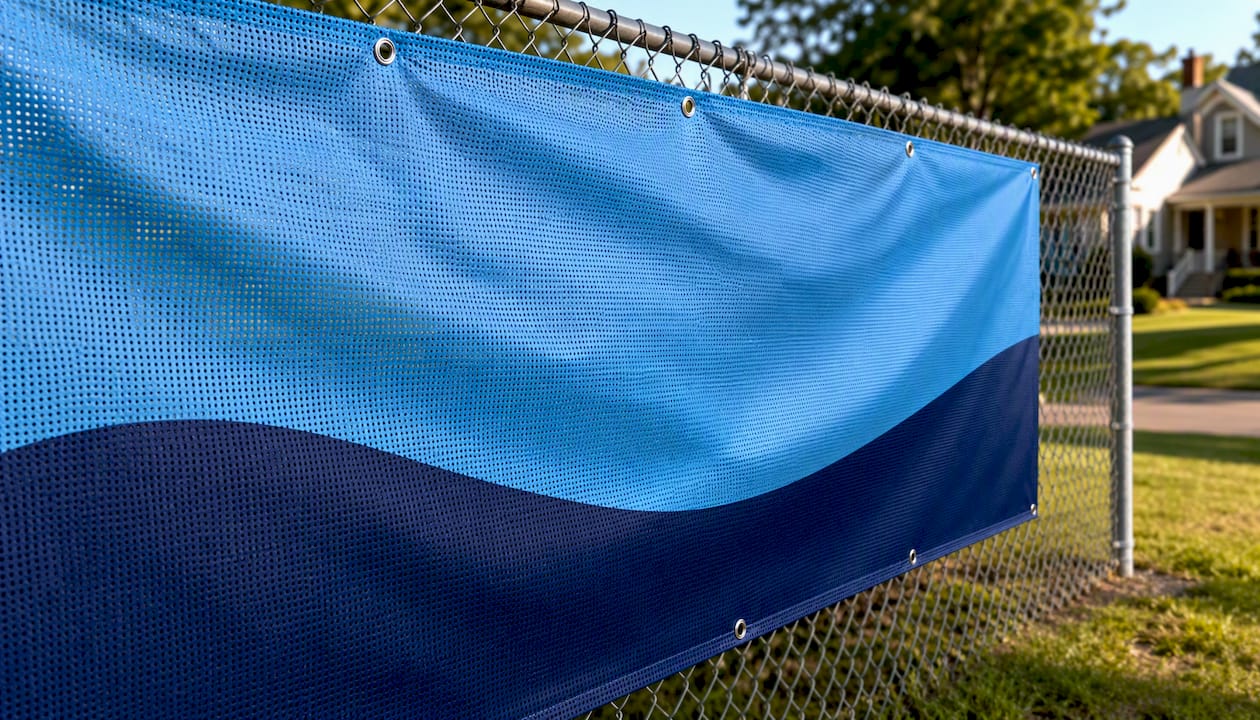
Pro Tip: For banners attached to chain-link or temporary fencing, mesh vinyl is the correct substrate. Solid vinyl in a high-wind location acts as a sail and can pull hardware loose. If you’re mounting to a fence structure, the parking lot fencing spec guide from Advantage Fencing covers load and attachment standards worth reviewing before you finalize grommet spacing.
What file specs and proofing steps should you expect?
File setup matters as much as the design itself. Vendors commonly prefer CMYK color mode, lower DPI for large-format output (since viewing distance reduces the need for 300 DPI), and specific bleed and safe-area rules tied to the finishing method.
File requirements checklist
- Format: PDF, AI, or EPS preferred; high-resolution TIFF or PNG accepted by most vendors
- Color mode: CMYK, not RGB; RGB files shift at press
- Resolution: 100–150 DPI at final print size for large-format; 300 DPI only for small-format or close-view pieces
- Bleed: Minimum 0.5 inches on all sides beyond the finished edge
- Safe area: Keep all critical text and logos at least 0.5 inches inside the finished edge
- Fonts: Outline all fonts or embed them; missing fonts cause substitution errors
- Linked images: Flatten or embed all linked images before sending
What a proper proofing process looks like
A reliable vendor sends a digital proof before production starts. Review it at 100% zoom for text errors, color accuracy, and crop marks. For brand-critical work, request a printed sample. Printed samples reveal finish texture and color behavior that a monitor cannot replicate accurately.
Pro Tip: When reviewing a digital proof, check the grommet and hem positions against your installation plan before approving. Moving a grommet after production means a reprint.
What drives banner price and how long will it take?
A standard 3 ft × 6 ft vinyl banner price varies significantly depending on material weight, finish, and provider, according to large-format pricing surveys. That spread exists because size, substrate, ink coverage, finishing, quantity, and shipping speed all affect the final number independently.
Cost drivers to watch
- Size: larger banners cost more per unit but often less per square foot at volume
- Material weight: 18 oz vinyl costs more than 13 oz; fabric costs more than vinyl
- Finishing: grommets, lamination, and blockout layers each add cost
- Quantity: per-unit price drops significantly at higher quantities
- Rush production: expedited timelines typically carry a surcharge
- Shipping speed: overnight shipping can exceed the print cost on small orders
Local shops can offer same-day or next-day pickup; online printers may offer lower base prices but longer delivered timelines. Standard timing for most online banner services runs approximately two weeks from order to delivery; rush production is available for an extra charge.
Always confirm whether a quoted turnaround covers production only or includes shipping. A three-day production quote plus five-day ground shipping is an eight-day total, not three.
How to submit a quote request that gets comparable bids
Use this template when contacting any vendor. Fill in every field before sending.
- Finished dimensions: ___ ft wide × ___ ft tall
- Quantity: ___
- Substrate: (e.g., 13 oz vinyl, 18 oz vinyl, mesh, fabric)
- Sides: single-sided / double-sided (with or without blockout)
- Finish: matte / gloss / satin
- Hem: yes / no; hem width: ___
- Grommets: yes / no; spacing: every ___ inches; corners only / perimeter
- Pole pocket: top / bottom / both / none; pocket width: ___
- Wind slits: yes / no
- Artwork file: attached (format: ___, color mode: CMYK, resolution: ___ DPI)
- Proof required: digital only / printed sample before production
- Delivery address: ___
- Install notes: (wall-mount, fence-hung, freestanding, etc.)
- Required in-hand date: ___
Quote comparison table
The custom signage step-by-step workflow at Customsignstoday walks through each of these fields in detail if you need guidance filling them in.
How Customsignstoday handles banner projects end-to-end
The production process at Customsignstoday follows a clear sequence that maps directly to the buyer checklist above.
- Spec intake: Dimensions, substrate, finish, quantity, and install method collected before any quote is issued
- Digital proof: Sent for approval before production begins; revisions addressed before press
- Printed sample: Available on request for brand-critical or large-run orders
- Production: UV-stable inks on specified substrate with finishing applied in-house
- Quality check: Finished banner inspected against the approved proof before shipping
- Shipping and installation: Standard and expedited shipping available; on-site installation offered for local projects
Service offerings include vinyl banners (13 oz and 18 oz), mesh, fabric, and rigid substrates, plus a full range of finishing options. The banner portfolio and service page includes photo examples and material specs. Trust signals to look for when reviewing any vendor: a visible photo gallery of finished work, published material specs, and a clear revision policy. Customsignstoday publishes all three.
Key Takeaways
Defining exact specs before requesting quotes is the single step that separates a reliable banner order from a costly reprint.
| Point | Details |
|---|---|
| Specs before quotes | Define size, substrate, finish, and finishing details before contacting any vendor. |
| Proof every order | Require a digital proof; request a printed sample for brand-critical or large runs. |
| Confirm door-to-door turnaround | Production-only quotes hide shipping time; always ask for the total in-hand timeline. |
| Match material to exposure | Outdoor banners need UV-stable inks and 13–18 oz vinyl or mesh; fabric suits indoor backdrops. |
| Customsignstoday | Covers the full checklist: spec intake, digital proofing, printed samples, and installation support. |
The spec conversation most buyers skip
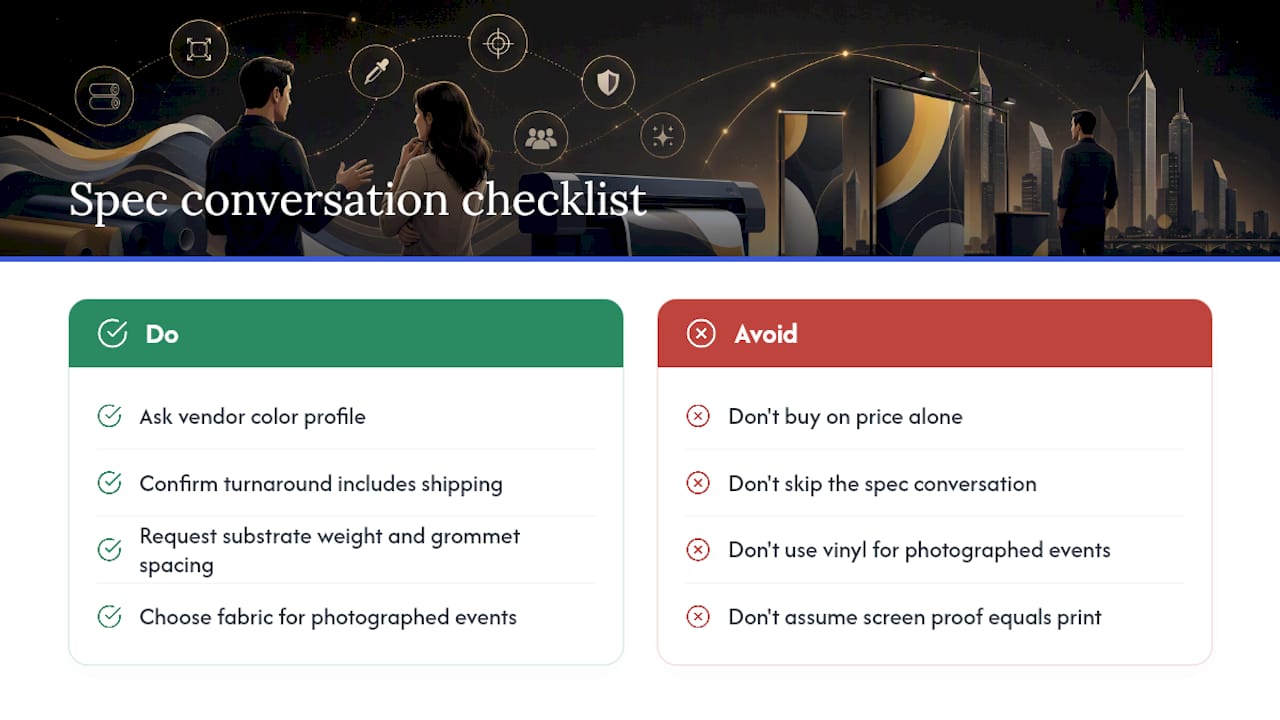
Most buyers focus on price and turnaround, then wonder why the delivered banner doesn’t match the screen proof. The real issue is almost always upstream: no one asked the vendor which color profile they print to, or whether the quoted turnaround included shipping.
Here’s the practical nudge: treat the spec conversation as the purchase decision, not the price. A vendor who answers every question on the checklist above, without hesitation, is worth a few extra dollars per banner. One who can’t tell you the substrate weight or the grommet spacing standard is going to cost you a reprint.
On the fabric vs. vinyl question for live events: if the banner will be photographed (stage backdrops, press walls, product launches), fabric is worth the premium because it eliminates the glare that vinyl creates under event lighting. For anything outdoors overnight, or in a high-wind location, stay with 18 oz vinyl or mesh. The material decision is a five-second call once you know the exposure conditions.
Get a fast, comparable quote from Customsignstoday
Customsignstoday gives you a direct line to a production team that asks the right questions before quoting, not after. No generic online configurator that misses your install requirements. No turnaround estimate that quietly excludes shipping.
Submit your quote with these details ready:
- Exact dimensions, quantity, substrate, finish, and finishing specs (hem, grommets, pole pocket)
- Artwork file in CMYK PDF or AI format, with bleed and safe area set
- Delivery address, required in-hand date, and any installation notes
Start your order at the custom sign quotes page or browse vinyl sign options to confirm your substrate before submitting.
Useful sources and further reading
- Custom Signs Today Banners — Customsignstoday: Service and portfolio page covering banner types, materials, and finishing options available from Customsignstoday.