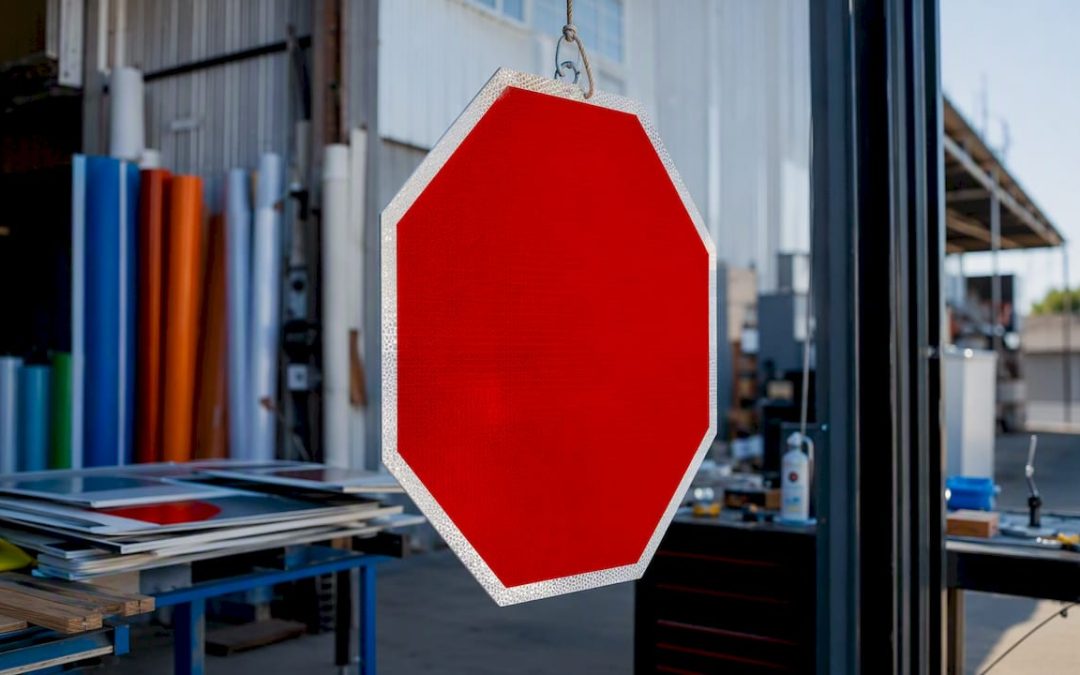
A stop sign is a layered assembly, not a single piece of painted metal. It starts with an aluminum substrate, almost always 5052-H38 aluminum, covered in retroreflective sheeting made of glass beads or microprisms, sealed under a protective overlay, printed with the red and white legend, and bolted on with mounting hardware.
Each layer does a specific job. The aluminum resists rust and stays light enough to mount easily. The reflective sheeting bounces headlights back at drivers at night. The overlay fights off UV rays and scratches. The legend has to stay legible for a decade or more, and the hardware has to hold the sign upright through wind, storms, and the occasional errant bumper.
- Substrate: aluminum, typically 5052-H38 alloy
- Reflective layer: glass-bead or microprismatic sheeting (Diamond Grade being the top tier)
- Protective layer: clear laminate or overlay film
- Graphics: screen-printed or digitally printed inks forming the white legend and border
- Hardware: galvanized or stainless bolts, brackets, and posts
Quick fact: the Federal Highway Administration requires white portions of a sign face to hit a minimum retroreflectivity of 35, red areas at least 7, and a 3:1 contrast ratio between the two, so headlights can pick out the shape at night. Only signs installed by the agency with legal jurisdiction over that road, following Manual on Uniform Traffic Control Devices (MUTCD) and Federal Highway Administration (FHWA) standards, are enforceable traffic control devices.
Key Takeaways
A stop sign’s durability and nighttime visibility depend on three material choices: aluminum alloy gauge, retroreflective sheeting grade, and laminate quality, all governed by MUTCD and FHWA standards.
| Point | Details |
|---|---|
| Substrate choice | Specify 5052-H38 aluminum in .080 inch gauge for high-traffic or high-wind locations. |
| Sheeting grade drives visibility | Diamond Grade microprismatic sheeting outperforms engineering and high-intensity grades at night. |
| Regulatory minimums exist | FHWA requires white retroreflectivity of at least 35, red at least 7, and a 3:1 contrast ratio. |
| Expected lifespan | Modern signs typically last 12 to 15 years before retroreflectivity drops below standard. |
| Buyer inspection tip | Check for peeling edges, uneven brightness, and confirm sheeting grade matches the invoice. |
| Custom Signs Today | Builds signage to specified aluminum gauge and sheeting grade for both regulatory-style and private-property use. |
Table of Contents
- What Is a Stop Sign Made Of, Layer by Layer?
- How Stop Signs Get Made, Step by Step
- What Are the Different Grades of Reflective Sheeting?
- What Standards Govern Stop Sign Materials and Legality?
- How Long Do Stop Signs Last, and When Do They Need Replacing?
- What Most People Get Wrong About Stop Sign Materials
- Ready to Order a Sign Built to Real Specifications?
- Frequently Asked Questions
- Sources
What Is a Stop Sign Made Of, Layer by Layer?
Strip a stop sign down to its parts and you get five distinct materials working together, each chosen for a reason that has nothing to do with tradition and everything to do with physics.
The substrate. Municipal and state agencies overwhelmingly specify 5052-H38 aluminum for the blank itself, usually in .063 inch or .080 inch gauge. The H38 temper gives the sheet enough stiffness to resist warping in heat without becoming brittle in cold. Aluminum also shrugs off corrosion better than steel, which matters on a sign that sits outdoors through decades of rain, road salt, and sun. Plywood and composite plastics show up occasionally for temporary or low-budget signage, but aluminum remains the standard for anything permanent.
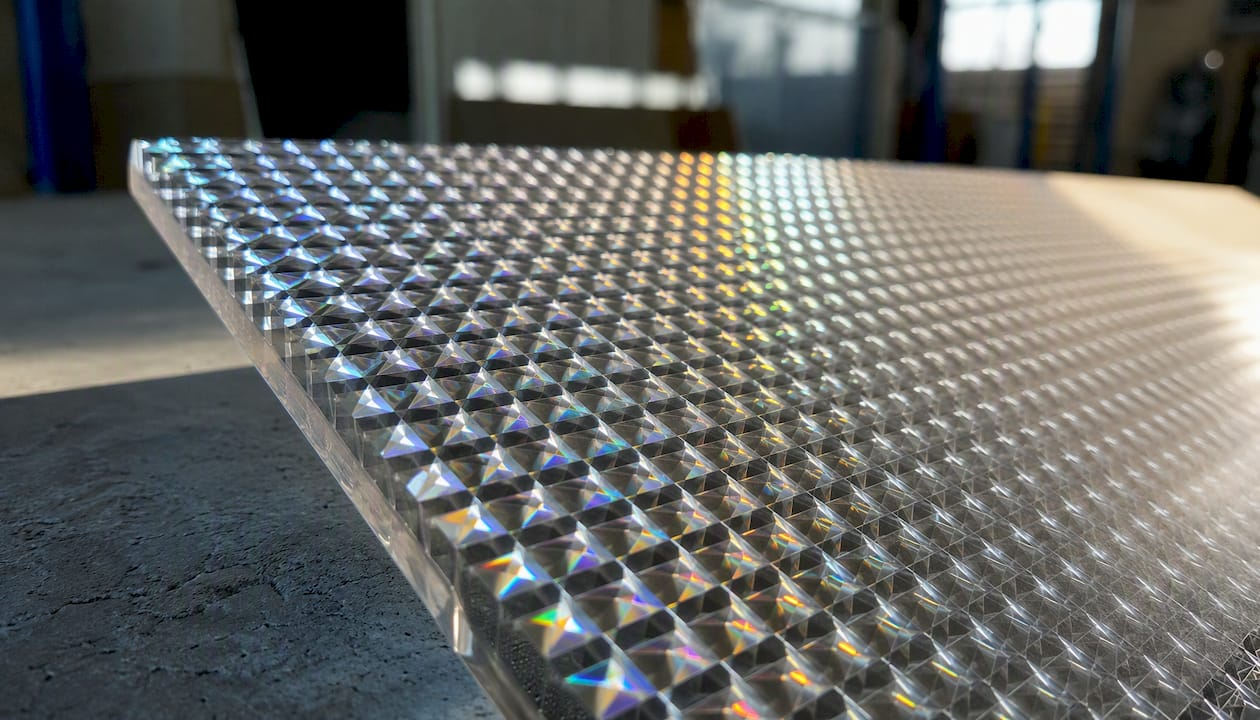
The retroreflective sheeting. This is the layer that actually makes a stop sign visible after dark. It works through either embedded glass beads or microprismatic lenses, both of which redirect light back toward its source rather than scattering it. Manufacturers like 3M produce sheeting under names like engineering grade, high-intensity, and Diamond Grade, with performance climbing at each tier.
The protective overlay. A clear laminate film gets applied over the printed legend to block UV degradation, resist abrasion, and shed grime. Without it, ink and dye can fade within a few years instead of the decade-plus lifespan agencies expect.
The ink and legend. The white “STOP” lettering and border go on through either screen printing or, increasingly, digital printing directly onto the reflective sheeting.
The hardware. Bolts, brackets, and posts complete the assembly, usually galvanized steel or aluminum to match the sign’s own corrosion resistance.
- Common bolt sizes run 3/8 inch or 5/16 inch, matched to standardized hole patterns so signs fit universal brackets.
- Breakaway or slip-base post designs let the post give way on impact, reducing injury risk in a vehicle collision.
Pro Tip: If you’re specifying signage for a private road or a homeowners’ association, ask your supplier what gauge aluminum and what sheeting grade they’re using by name. “Reflective” alone tells you nothing. “Diamond Grade” or “Type III high-intensity” tells you exactly what you’re getting.
How Stop Signs Get Made, Step by Step
Manufacturing a stop sign is less about painting and more about laminating layers with precision, then verifying the result meets a numeric standard.
- Blanking and cutting — Aluminum coil or sheet stock gets cut into octagon blanks using a die press or CNC router.
- Deburring and pretreatment — Edges get smoothed and the surface chemically treated (often per specifications aligned with ASTM B449) so the reflective sheeting adheres properly and resists lifting.
- Applying retroreflective sheeting — Sheeting is heat or pressure applied across the full face of the blank, with no bubbles or wrinkles tolerated.
- Printing the legend — The white “STOP” text and border go on via screen printing or, on modern equipment, digital inkjet printers that fire specialized ink directly onto the sheeting.
- Laminating or overlaying — A clear protective film seals the printed graphics against UV and abrasion.
- Trimming — Excess sheeting or overlay gets trimmed flush to the octagon edge.
- Punching mounting holes — Holes are drilled or punched in a standardized pattern.
- Inspection — Technicians check retroreflectivity, color consistency, and edge adhesion.
- Packaging and shipping — Finished signs are stacked, protected, and shipped to the installer or agency.
Digital printing has changed the math on turnaround. Sign shops that once relied on manual silk-screening, which required separate screens for each color and lengthy dry times, now print and cure designs directly onto reflective sheeting, cutting jobs that took days down to minutes. That shift also improves consistency: a digital file produces the same red and white values every time, where hand-mixed screen ink can drift slightly batch to batch.
Quality checks at reputable shops go beyond a visual glance. Retroreflectivity gets measured with a handheld retroreflectometer, color gets checked against a reference standard, and edges get inspected for lamination lift.
- Confirm the sheeting grade printed on the invoice matches what arrived (Diamond Grade should say so on the film’s own liner marking).
- Hold the sign at an angle in daylight and check for even brightness across the face, not just the center.
- Look closely at the border and legend edges for any peeling or bubbling, which signals poor lamination.
Pro Tip: Before installing a batch of new signs, shine a flashlight on them in a dark room from about 15 feet away. A properly made sign should throw back a bright, even glow across the entire face, not just patches of it.
What Are the Different Grades of Reflective Sheeting?
Retroreflective sheeting works by bending light back toward its source rather than letting it scatter, which is why a stop sign glows under headlights instead of just reflecting a dull glare. Two constructions achieve this: glass-bead sheeting, where millions of tiny spherical beads refract light, and microprismatic sheeting, where a grid of precision-cut prisms redirects it. Microprisms generally outperform beads at wide viewing angles and hold their brightness longer, though they cost more to manufacture.
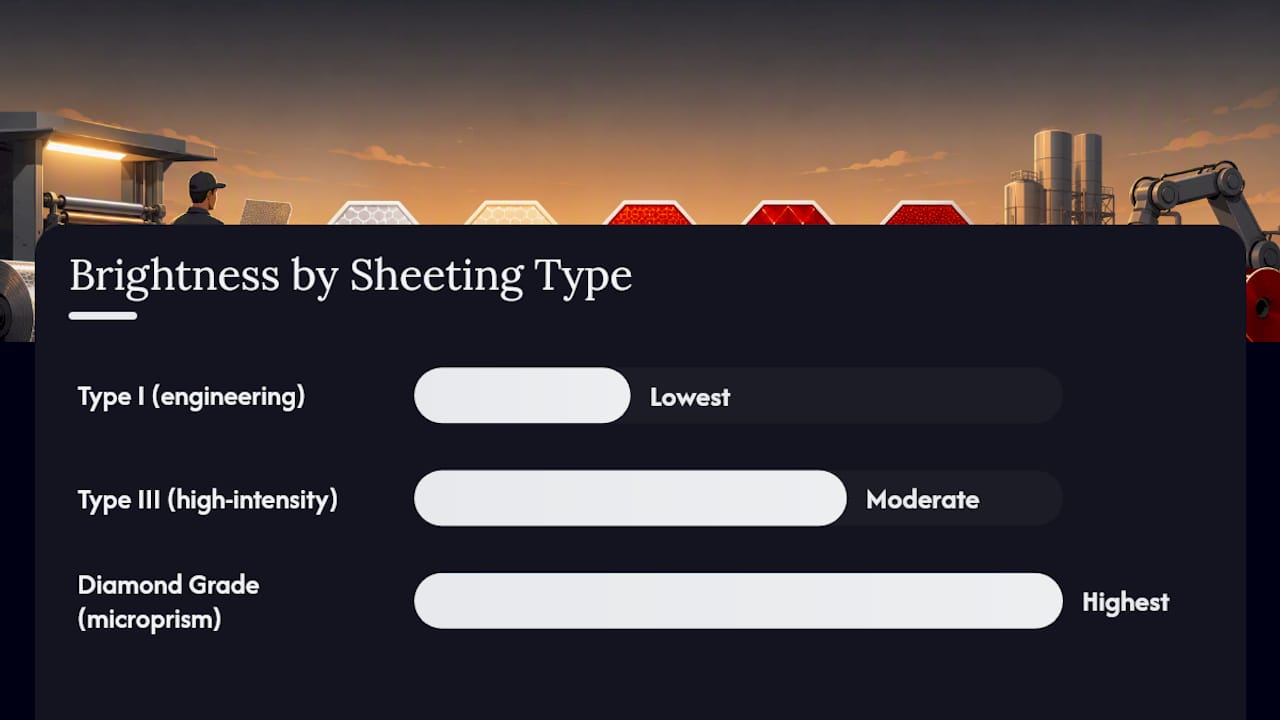
The industry sorts sheeting into recognized tiers. Type I is engineering grade, the entry-level option with the shortest service life. Type III is high-intensity, a mid-tier step up in brightness and durability. At the top sits Diamond Grade, a microprismatic product line that delivers the highest initial brightness and the longest field life. State highway sign shops favor Diamond Grade for red-series regulatory signs like stop signs specifically because nighttime conspicuity is non-negotiable on a device meant to stop traffic.
Federal standards give this a numeric floor. FHWA sets minimums of 35 for white retroreflectivity, 7 for red, and a 3:1 contrast ratio between the two colors on any sign face. A sign that drops below those thresholds, whether from age or a manufacturing defect, is no longer meeting the standard that makes it legible to a driver at night.
| Sheeting Type | Construction | Typical Brightness | Common Use |
|---|---|---|---|
| Type I (engineering grade) | Glass bead | Lowest | Low-traffic or short-term signage |
| Type III (high-intensity) | Glass bead or prismatic | Moderate to high | General regulatory and warning signs |
| Diamond Grade (microprismatic) | Microprism | Highest | Red-series regulatory signs, stop signs, high-speed corridors |
Expected service life: transportation safety professionals note that well-made modern signs stay conspicuous across a typical 12 to 15 year life cycle, with reaction time dropping noticeably once retroreflectivity or contrast falls below the FHWA thresholds.
- UV exposure slowly breaks down the resin binding in glass-bead sheeting, dulling brightness over years.
- Surface abrasion from wind-driven grit scratches the reflective layer, scattering light instead of redirecting it.
- Delamination, where the sheeting separates from the aluminum at the edges, lets moisture in and accelerates failure from that point outward.
What Standards Govern Stop Sign Materials and Legality?
The MUTCD is the rulebook, and it governs far more than color choice. Chapter 2A reserves the octagon shape exclusively for the STOP message, meaning no other regulatory sign in the country is allowed to use that silhouette. Chapter 2B lays out the specifics for the R1-1 stop sign: red background, white legend and border, and a prohibition on adding secondary text or symbols to the sign face itself.
That shape requirement runs deeper than most people assume. An FHWA interpretation letter clarifies that the substrate or paddle itself must be cut into an octagon, not just printed with an octagonal image on a square blank. The reasoning is straightforward: a driver approaching in fog or heavy rain, unable to read the word “STOP,” should still recognize the shape’s silhouette instantly. A square sign with an octagon printed on it defeats that purpose entirely.
The octagonal shape is treated as being just as important as the reflective sheeting itself, because a recognizable silhouette can register with a driver before the legend is even legible. That’s not a design preference. It’s a documented FHWA safety rationale for why the substrate shape is enforceable, not decorative.
Installation authority matters just as much as material compliance. Only the agency with jurisdiction over a given road, whether a city, county, or state department of transportation, has legal authority to install an official stop sign on public right-of-way. A property owner or homeowners’ association putting up a look-alike sign on a public street is not creating an enforceable traffic control device, regardless of how well made it is.
What’s not allowed on public roads:
- Non-octagonal substrates carrying a stop message, even if the printed image looks correct
- Altered or supplemental legends added to the sign face beyond what MUTCD Section 2B.04 permits
- Back-to-back mounting or placement that obscures the octagonal silhouette from any approach angle
- Private installation of official-looking regulatory signs without authorization from the road authority
If you’re weighing signage for a private road, parking lot, or gated community, check with your local road authority before installing anything resembling a regulatory sign. For a broader look at how these standards apply across different sign categories, Custom Signs Today’s guide to traffic sign standards breaks down what’s legally required versus what’s just common practice.
How Long Do Stop Signs Last, and When Do They Need Replacing?
Most modern stop signs built with microprismatic sheeting hold up for roughly 12 to 15 years of full sun exposure before performance drops meaningfully. That range shrinks fast under harsher conditions. Coastal roads see accelerated corrosion from salt air. Northern states dealing with road-salt spray on aluminum posts and brackets watch hardware fail before the sheeting does. Vandalism, from gunshot damage to spray paint, can end a sign’s service life in a single afternoon regardless of material quality.
- Check retroreflectivity with a meter or a nighttime visual test from a vehicle’s headlights at a standard distance.
- Inspect for fading, especially on the red background, which typically degrades faster than the white legend under UV exposure.
- Look for peeling or edge lift where the sheeting or overlay has started separating from the aluminum.
- Check for physical damage including dents, bullet holes, or bent substrate that distorts the octagonal silhouette.
- Test mounting stability by checking for loose bolts, rusted brackets, or a leaning post.
- Confirm legend legibility hasn’t been compromised by graffiti, stickers, or accumulated grime.
Agencies typically choose between two replacement strategies: scheduled replacement on a fixed cycle regardless of visible condition, or condition-based replacement triggered by measured retroreflectivity dropping below the FHWA threshold. Larger departments of transportation lean toward scheduled cycles because they’re easier to budget and staff for. Smaller municipalities more often inspect and replace reactively, which works fine as long as inspections actually happen on a regular basis.
Aluminum’s other advantage shows up at the end of a sign’s life: it’s fully recyclable, and scrap aluminum from retired signs commonly gets melted down and reused rather than landfilled, which keeps the environmental footprint of routine sign replacement relatively low compared to composite or plastic alternatives.
Pro Tip: If you manage signage for a small agency, HOA, or private property, photograph every sign annually with a timestamp and GPS location. It takes minutes, and it turns “the sign looks fine to me” into an actual documented record when budget season or a liability question comes up.
What Most People Get Wrong About Stop Sign Materials
Everyone assumes the aluminum is the expensive part. It isn’t. The substrate is a commodity, cut and pretreated in bulk at low cost. The money and the engineering both live in the sheeting. A blank aluminum octagon with cheap engineering-grade film and one with Diamond Grade sheeting look nearly identical in a parking lot at noon. Put them both on a rural road at night and the difference is not subtle. One glows back at a driver from 500 feet. The other is a dark shape a headlight barely catches.
I’d also push back on the instinct to go cheap on gauge thickness to save a few dollars per sign. A .063 inch blank is fine for a low-traffic residential corner. On a windy corridor or a spot where snowplows or mowers regularly clip sign posts, that thinner gauge dents and warps faster, and a warped substrate distorts the octagon silhouette the MUTCD is so specific about protecting. Specify .080 inch for anything exposed to real physical risk, and don’t let a supplier talk you into the lighter option purely on price.
Installation quality matters as much as material specification, and it’s the part buyers think about least. A Diamond Grade sign bolted to a rusted-out post with loose brackets is a liability wearing an expensive coat of reflective film. Materials and installation are not separate decisions. They’re one decision, made twice.
Custom Signs Today works with clients who need signage built to these exact specifications, whether that’s an official regulatory sign specified by an agency or a private-property sign that still needs to hold up like one.
Ready to Order a Sign Built to Real Specifications?
If you’ve read this far, you already know the difference between a sign that lasts three years and one that lasts fifteen comes down to the substrate gauge, the sheeting grade, and how well the layers are laminated together. Custom Signs Today builds signage to those same standards, specifying aluminum gauge, Diamond Grade or high-intensity sheeting, and weatherproof laminates based on where the sign is going and how much abuse it needs to survive.

Whether you need a private-property sign that mimics regulatory conspicuity without claiming legal authority, a replacement face for existing hardware, or a full custom sign built from scratch, the custom signs service page covers materials, sizing, and mounting options in detail. For properties needing durable directional or informational signage rather than a stop-message device, the site signs page walks through comparable material choices for non-regulatory applications.
One important note: do not install or replace an official traffic control device on a public road without authorization from the agency with jurisdiction over that road. That rule exists for good reason, and it applies regardless of how well-built the sign is.
Ready to move forward? Request a quote through the custom signs page and specify your substrate gauge and sheeting grade preferences up front. It’s the fastest way to get pricing that matches exactly what your project needs.
Frequently Asked Questions
What are stop signs made of?
A stop sign is built from an aluminum substrate (commonly 5052-H38 alloy), a layer of retroreflective sheeting made of glass beads or microprisms, a protective overlay film, printed inks forming the red and white legend, and mounting hardware to secure it to a post.
Are stop signs plastic or metal?
Stop signs are overwhelmingly metal. Aluminum is the standard substrate because it resists corrosion and stays lightweight, while plastic or composite substrates are mostly reserved for temporary or portable signage rather than permanent installations.
What is Diamond Grade sheeting, and why does it matter?
Diamond Grade is a microprismatic retroreflective sheeting line known for the highest initial brightness and longest service life among common sheeting grades, which is why state highway shops favor it for red-series regulatory signs like stop signs.
Can a private property owner install an official-looking stop sign?
Only the agency with legal jurisdiction over a road can install an enforceable stop sign under MUTCD standards. Private property signage that mimics the look can be made, but it carries no legal traffic authority on public streets.
How long does a stop sign last before it needs replacing?
Most modern signs remain fully conspicuous for roughly 12 to 15 years, though UV exposure, road salt, and physical damage can shorten that considerably depending on location and climate.
Sources
- III. SIGN MATERIALS | FHWA – Department of Transportation
- MUTCD Chapter 2A (11th Edition)
- Inside look: Here’s where most of Connecticut’s signs are made – NBC Connecticut