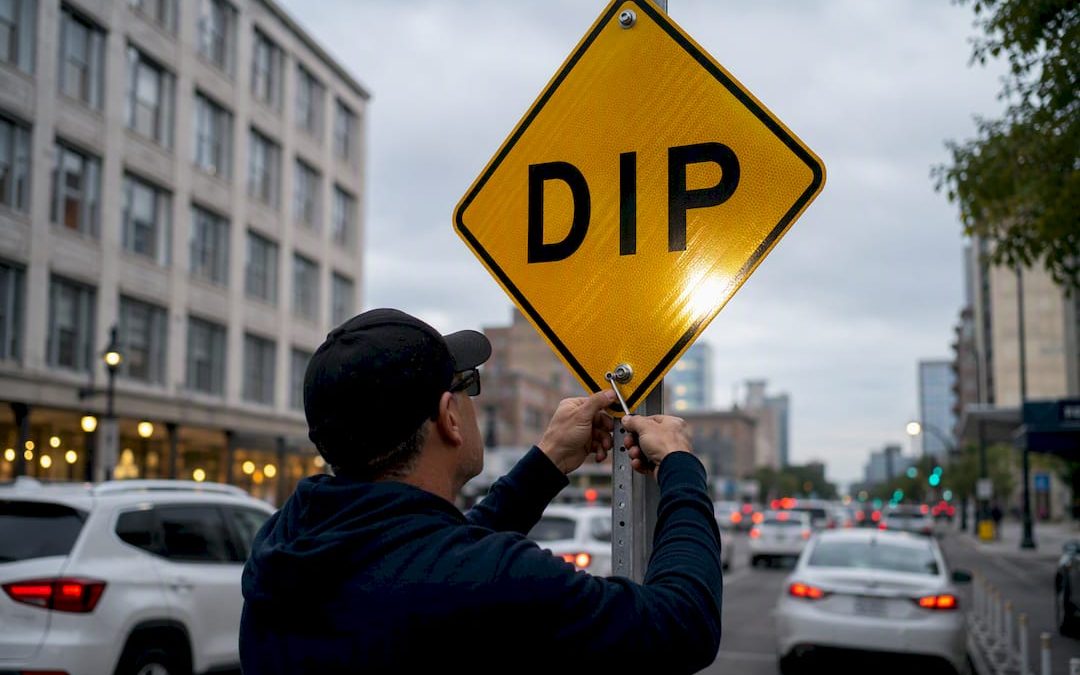
A custom DIP sign is a site specific warning sign, styled after the federal W8-2 design, that you install on a private road or parking lot to warn drivers of a low spot or sharp dip ahead. If you manage a property with a real depression that could jolt a vehicle or scrape a low bumper, that’s the sign you need. Before you do anything else:
- Photograph the dip from a driver’s approach angle, in daylight and at dusk.
- Measure how fast vehicles typically approach it and how much clearance the depression actually eats up.
- Send that information to a sign vendor and ask for a quote built around the W8-2 spec.
The federal standard governing this sign lives in MUTCD Chapter 2C, and a supplier like Customsignstoday can turn those specs into a sign that’s ready to mount.
Key Takeaways
A compliant DIP sign combines a W8-2 diamond design, .080 to .125 inch aluminum, and reflective sheeting matched to approach speed, specified through a complete vendor checklist.
| Point | Details |
|---|---|
| Confirm the sign code | Specify W8-2 to your vendor, adding a W13-1P advisory plaque if speed reduction is needed. |
| Default to 36" x 36" | Size up to 48" x 48" for multi-lane approaches or higher-speed truck routes. |
| Match sheeting to risk | Use engineer-grade sheeting at minimum, diamond-grade for dark or fast approaches. |
| Place the sign by speed, not guesswork | Set advance distance using approach speed to allow real reaction and braking time. |
| Order from a custom fabricator | Customsignstoday builds W8-2 signs to spec, including reflectivity, hardware, and installation options. |
Table of Contents
- What a DIP Sign Means and When You Actually Need One
- What Should a DIP Sign Look Like?
- Materials That Keep a DIP Sign Legible for Years
- Where Should You Mount a DIP Sign and How Big Should It Be?
- How to Specify and Order a Custom DIP Sign
- Don’t Let Sign Blindness Undo Your Warning
- What Does a Custom DIP Sign Cost, and How Long Does It Take?
- Do Private Roads Have to Follow MUTCD Rules?
- Why Spec Accuracy Matters More Than You’d Think
- Get a DIP Sign Built to Spec, Not Guessed At
- Frequently Asked Questions
- Sources
What a DIP Sign Means and When You Actually Need One
A DIP sign tells drivers there’s a sharp depression or vertical dip in the roadway ahead, one abrupt enough to bottom out a suspension or momentarily hide an oncoming car. On private property, that’s a maintenance concern as much as a safety one: a delivery truck that bottoms out in your lot is a liability claim waiting to happen. MUTCD Section 2C.26 frames the W8-2 sign as guidance for genuine hazards, not cosmetic dips that barely register.
That distinction matters when you’re deciding whether to order one at all. Use a DIP sign for:
- A depression sharp enough to cause a hard jolt, scrape a low vehicle, or briefly obscure sightlines.
- A dip that appears where drivers wouldn’t expect it, like a hidden drainage swale across a driveway.
Skip it, or consider alternatives, for shallow depressions that are more nuisance than hazard. Options short of a permanent sign include a temporary cone or marker while you schedule repaving, an advisory speed plaque paired with an existing sign, or simply fixing the pavement so the warning becomes unnecessary. A sign is a stopgap, not a substitute for filling the hole.
What Should a DIP Sign Look Like?
Every DIP sign has to follow the same visual formula regardless of where it’s installed: a diamond shape, black legend and border, yellow background. MUTCD design rules for warning signs lock in that combination because drivers process it instantly, without reading a word.
Sign code to specify: ask your vendor for W8-2, the official DIP designation. If the approach has a blind curve or the dip demands slower speeds, pair it with a W13-1P advisory speed plaque mounted directly below the main sign.
Size: 36" x 36" is the common default size for standard warning signs on conventional roads, and it shows up again in state engineering tables that list 48" x 48" as the step up for higher speed or wider approaches.
Before you approve artwork, run it against this checklist:
- High contrast between the black legend and yellow field, with no faded or muted tones.
- A clean dip symbol with no added clutter, text, or logos crowding the diamond.
- Border thickness that matches standard proportions rather than a thin, hand drawn look.
Materials That Keep a DIP Sign Legible for Years
A sign that fades or peels in two seasons defeats the purpose of installing one. For the substrate, specify .080 to .125 inch aluminum, the standard weight range for outdoor traffic signage. Thinner aluminum warps in heat; thicker adds cost without much benefit for a sign this size.
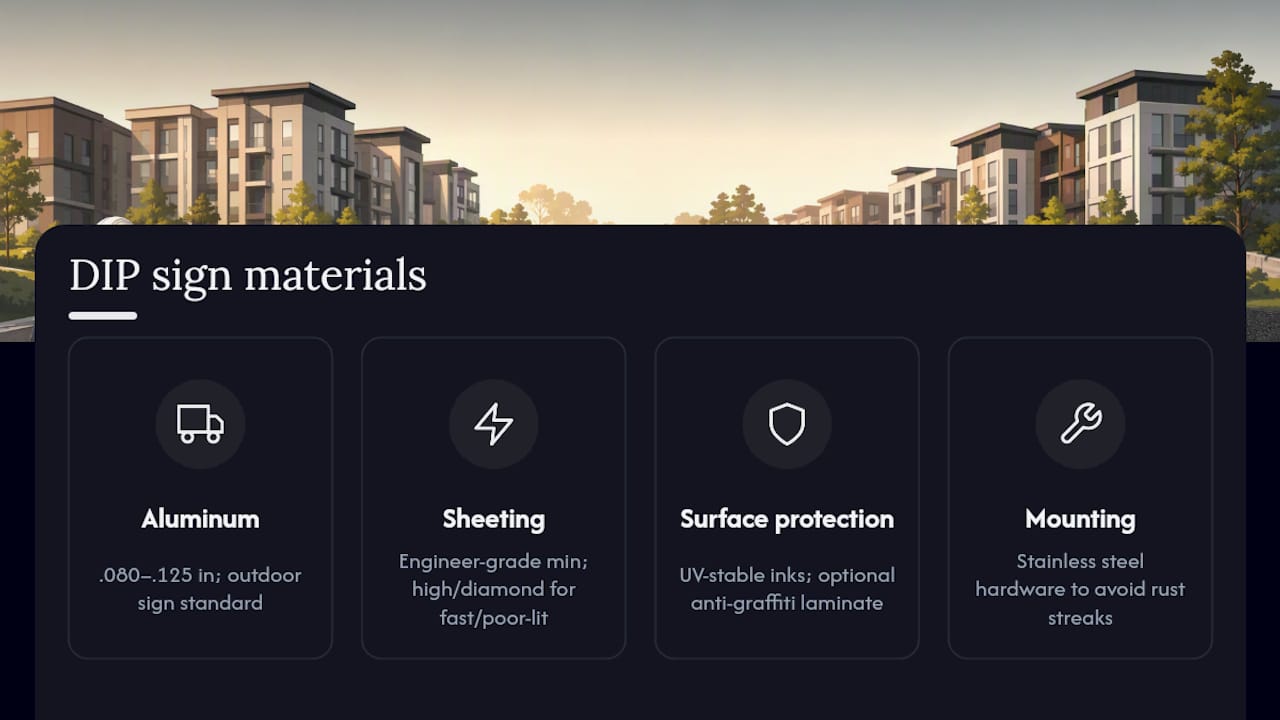
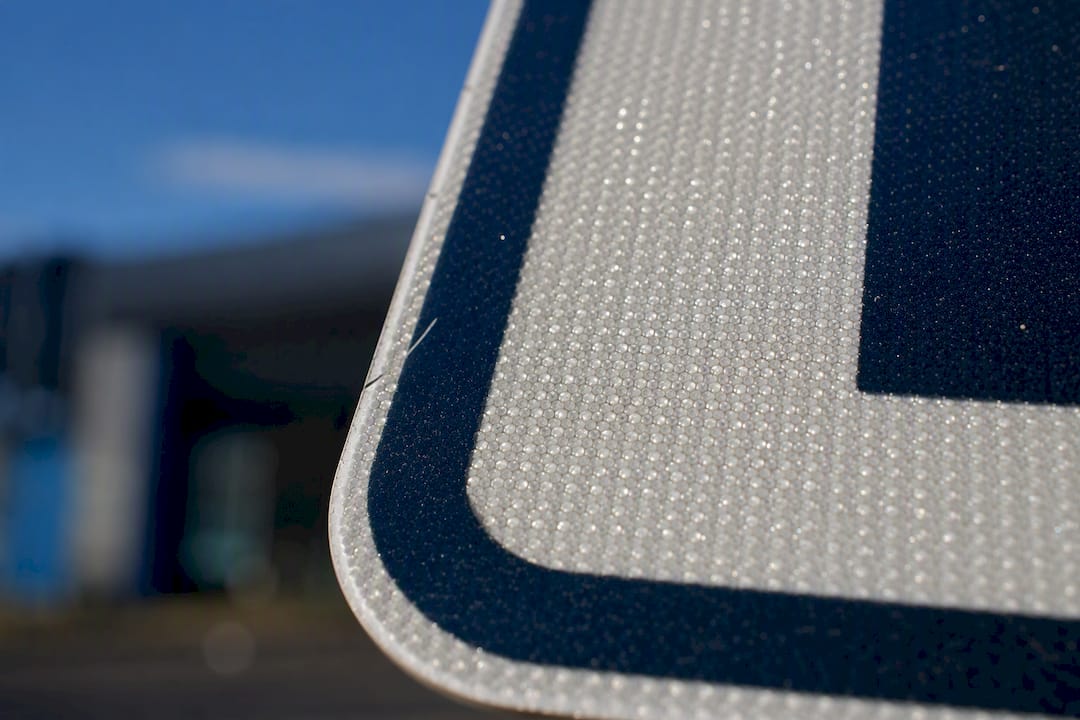
Reflectivity is where a lot of private lots cut corners they shouldn’t. Engineer-grade reflective sheeting is the minimum for nighttime legibility. If your dip sits on a higher speed approach, a truck route, or a poorly lit lot, step up to high-intensity or diamond-grade retroreflective sheeting, which reflects headlights back to the driver far more effectively at distance and off-angle.
Round off the spec with UV-stable inks so colors don’t chalk out in direct sun, and stainless steel mounting hardware so rust doesn’t streak the face within a year. An anti-graffiti laminate is worth the small upcharge on signs near public sidewalks or high-traffic parking.
Pro Tip: If your site gets any nighttime delivery traffic, don’t default to the cheapest sheeting grade just to save a few dollars. A dip that’s invisible at 9 p.m. is the one that ends up in an incident report.
Where Should You Mount a DIP Sign and How Big Should It Be?
Placement decisions come down to three variables: sign size, mounting height, and how far in advance of the dip the sign sits.
- Pick the size based on approach speed and road width. A 36" x 36" sign covers most single-lane private drives and standard parking lot approaches, matching the common MUTCD default. Multi-lane approaches, loading docks with truck traffic, or anywhere vehicles move faster than typical lot speeds call for 48" x 48".
- Set mounting height and lateral offset. Standard practice keeps the sign’s bottom edge several feet above grade and set back from the edge of the drivable surface, high enough to clear pedestrians and low profile vehicles without disappearing behind parked cars.
- Calculate advance distance from approach speed, not guesswork. A sign placed right on top of the dip gives a driver no time to react. Use the posted speed, or the actual 85th percentile speed if you’ve measured it, to figure how much distance a driver needs for perception, reaction, and any braking before reaching the hazard.
- Add a plaque only when it earns its place. An advisory speed plaque under the W8-2 makes sense when the dip requires a specific slower speed to cross safely; a distance or arrow plaque helps when the hazard isn’t visible until a driver is close to it.
How to Specify and Order a Custom DIP Sign
A vendor can only quote accurately if you hand over a complete spec sheet. Walk through this before you request pricing:
- Sign code and legend: W8-2, plus W13-1P if you’re adding an advisory plaque.
- Size: 36" x 36" or 48" x 48", based on your placement analysis.
- Substrate: .080 to .125 inch aluminum.
- Reflectivity class: engineer-grade minimum, high-intensity or diamond-grade for faster or darker approaches.
- Finish options: UV-stable ink, anti-graffiti laminate if applicable.
- Mounting hardware: stainless posts, brackets, or U-channel, depending on your existing sign infrastructure.
- Quantity and site photos: how many signs, and photos of each install location so the vendor can flag clearance or visibility issues before production.
Once you’ve got that list, a request for quote should also ask about:
- Turnaround time from artwork approval to shipped sign.
- Warranty coverage on the reflective sheeting and substrate.
- Whether pricing includes installation or is supply-only.
- A digital proof or mock-up before production starts.
- Whether the vendor can supply MUTCD-compliant artwork outright, so you’re not guessing at proportions yourself.
If you’re set up to mount signs with your own crew, supply-only pricing saves money. If you don’t have the hardware or the ladder work isn’t worth the risk, a full install package removes that variable entirely, and Customsignstoday’s quote process walks through exactly what to include either way.
Don’t Let Sign Blindness Undo Your Warning
More signs don’t equal more safety. Traffic-safety engineers routinely warn that over-signing trains drivers to tune out warnings altogether, so a DIP sign should mark a real hazard, not decorate every minor bump in the lot.
- Reserve DIP signs for depressions that genuinely warrant caution.
- Inspect signage annually, or right after any repaving or lot reconfiguration, and pull down any sign that no longer matches the pavement condition.
- Keep photos, install dates, and the original vendor spec sheet on file for both maintenance and liability purposes.
Pro Tip: Walk your lot once a year with the original site photos in hand. If a “hazard” sign is still standing over pavement you repaired two seasons ago, that sign is now working against you.
What Does a Custom DIP Sign Cost, and How Long Does It Take?
A single reflective aluminum DIP sign, supply-only, typically costs more as size increases, as reflectivity grade goes up, and as you add laminates or specialty finishes. Standard engineer-grade sheeting on a 36" x 36" sign sits at the lower end of that range; high-intensity or diamond-grade sheeting, larger sizes, and anti-graffiti laminate push the price up from there.
- Production lead times run from about a week to several weeks depending on order volume and finish complexity.
- Professional installation adds its own scheduling window, often faster if it’s bundled with production.
- Rush production is usually available for a premium if you need a sign fast after an incident or inspection.
Always request an itemized quote that separates the sign, hardware, shipping, and installation, and confirm warranty terms in writing before you approve the order.
Do Private Roads Have to Follow MUTCD Rules?
The MUTCD is legally mandatory on public roads, and new installations there must meet current provisions. Private lots often aren’t bound by that requirement, but most property owners adopt MUTCD-style signs anyway because drivers already recognize the shape and color from public roads.
If your driveway or lot connects directly to a public street, check with your local authority. Document why you placed the sign where you did, keep dated photos, and log inspections. That paper trail matters far more after an incident than before one.
Why Spec Accuracy Matters More Than You’d Think
Following MUTCD-style specs on private property isn’t bureaucratic box checking. Drivers recognize that diamond shape reflexively, and a sign built to spec holds up in a dispute in a way a mismatched, hand-cut version never will.
A custom sign maker earns its keep when your situation doesn’t fit an off-the-shelf option: an odd mounting surface, a faster approach that needs diamond-grade sheeting, or a job where you’d rather hand off installation entirely. Reach out to Customsignstoday for spec help, a mock-up, or a straight quote.
Get a DIP Sign Built to Spec, Not Guessed At
Customsignstoday designs and fabricates W8-2 DIP signs to the exact specs your site needs, choosing the aluminum gauge, reflective sheeting class, and finish based on your dip’s real approach speed and lighting, not a generic template.

Send site photos and your measurements through the site signs page to get a quote scoped to your exact hazard, or start with the custom sign quote guide if you’re still deciding between supply-only and full installation. Installation support and warranty coverage on materials and hardware are available either way, so the sign you order is the sign that’s still legible and standing straight a few years from now.
Frequently Asked Questions
What does a DIP traffic sign mean on private property?
It means a driver-facing warning that a sharp depression or low spot lies ahead, styled after the federal W8-2 sign so drivers recognize it instantly even off public roads.
Do I legally need a DIP sign on my private lot?
Usually not. Private lots are often exempt from MUTCD requirements, but following the standard design still helps with driver recognition and liability defense.
What size DIP sign should I order?
36" x 36" covers most standard driveways and lots; go to 48" x 48" for multi-lane or higher-speed approaches.
How much does a custom DIP sign cost?
Cost depends on size, reflective sheeting grade, and finish options like anti-graffiti laminate. Request an itemized quote that separates the sign, hardware, and installation.
Can I use a DIP sign for any bump or dip?
No. Reserve it for genuine hazards that could jolt a vehicle or momentarily hide sightlines. Overusing warning signs leads to sign blindness, where drivers stop reacting to them.