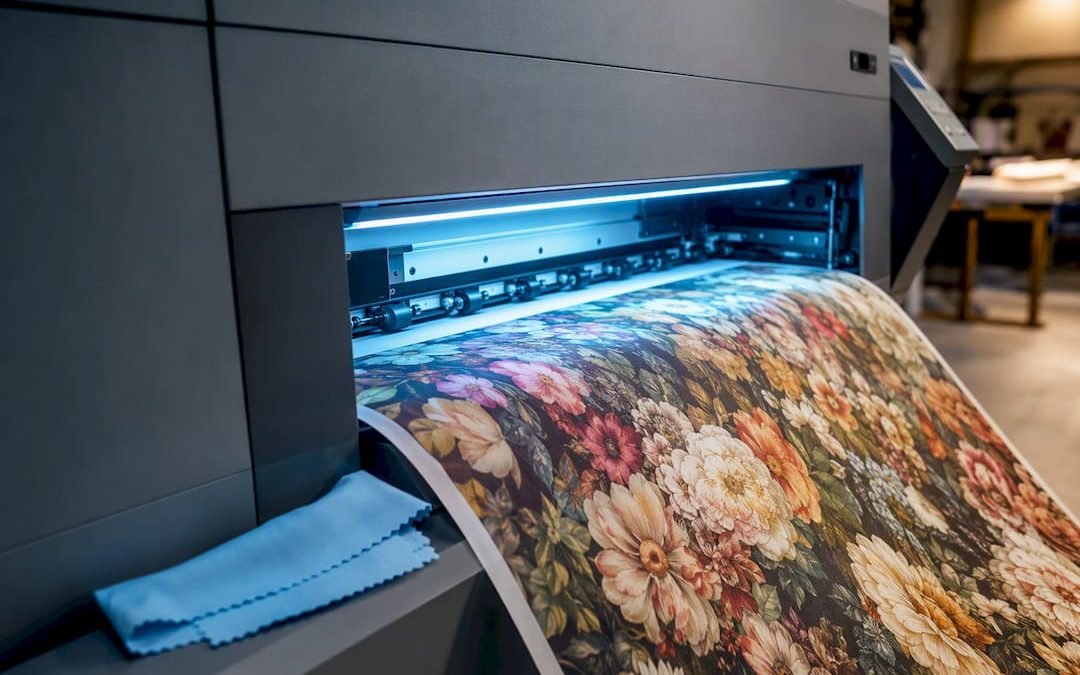
Digital textile printing is an inkjet process that sprays colorants directly onto fabric from a digital file, skipping the screens or engraved cylinders traditional printing needs. That single detail is why it dominates short runs and complex artwork: no tooling costs, no color-per-screen penalty, and a design can go from file to finished fabric in hours. Reactive, acid, disperse, and pigment inks each serve different fibers, and the process shows up everywhere from fashion samples to soft signage banners.
TL;DR:
- Digital textile printing is most cost-effective for runs under 300 to 500 meters and more than six to eight colors due to ink and setup costs.
- Matching fabric and ink type is crucial, with reactive inks for cotton, disperse for polyester, and acid for silk or nylon, to ensure durability.
- Environmental benefits are significant when water and chemical use are minimized, but energy consumption and end-of-life handling still impact sustainability.
- Preproduction file calibration and testing are vital to ensure color accuracy, with a focus on proper ICC profiles and real fabric samples.
- Digital printing excels in flexibility, quick turnaround, and creative freedom, but long runs and special effects may favor traditional screen or rotary methods.
Table of Contents
- How Does Digital Textile Printing Work?
- What Types of Printers and Ink Systems Exist?
- Which Fabrics and Treatments Work Best for Digital Printing?
- Digital vs. Screen and Rotary Printing: Which Wins?
- Where Is Digital Textile Printing Used?
- When Should You Choose Digital Over Rotary Screen?
- Is Digital Textile Printing Better for the Environment?
- How Should You Prepare Files Before Your First Digital Print Run?
- How Textile Printing Connects to Signage and Fabric Displays
- Ready for Custom Fabric Banners and Displays?
- Where to Learn More About Digital Textile Printing
- Sources
How Does Digital Textile Printing Work?
The workflow starts with a design file, usually built in Adobe Illustrator or Photoshop at high resolution with an ICC color profile matched to the fabric and ink set. Get that profile wrong and colors shift the moment ink hits cloth, which is why textile printers spend more time on color calibration than almost any other production variable.
From there, RIP (Raster Image Processor) software takes over. It translates the file into instructions for exactly where and how much ink each nozzle fires, controlling droplet size, placement density, and pass count. This step determines resolution and ink laydown as much as the printhead itself does.
Fabric handling splits into two broad categories: roll-fed systems that feed continuous yardage through the printer, and direct-to-garment machines that print on cut-and-sewn pieces or flat panels. Roll-fed setups demand tighter registration control since a repeat pattern has to align perfectly across meters of cloth.
Printing is only half the job. After ink lands on fabric, it needs to bond permanently, which involves:
- Fixation or curing, using heat, steam, or UV exposure depending on ink chemistry
- Washing, to remove unfixed dye and any pretreatment residue
- Drying and finishing, which sets the final hand feel and appearance
Skip or rush any of these steps and colors fade, crock off on contact, or the fabric stiffens in ways that ruin drape.
What Types of Printers and Ink Systems Exist?
Industrial digital textile printers fall into two camps. Single-pass machines fire all colors in one motion across the fabric width, running at speeds that rival some conventional methods but with less flexibility for touch-up passes. Multi-pass printers move the printhead back and forth several times, trading speed for finer resolution control and better handling of tricky substrates.
Ink chemistry is where things get specific:
- Reactive inks bond chemically with cotton, linen, and other cellulose fibers for excellent wash fastness
- Disperse inks (often via sublimation) work on polyester, turning gaseous under heat to penetrate synthetic fibers
- Acid inks suit silk, wool, and nylon, prized for vibrant color on protein and polyamide fibers
- Pigment inks sit on the surface rather than bonding into the fiber, making them versatile across blends but generally less durable for heavy wash cycles
Specialty setups add white underbase ink for printing on dark or colored fabric, and extended-gamut ink sets (adding orange, green, or violet to the standard CMYK) push color range closer to what screen printing achieves with unlimited spot colors.
Which Fabrics and Treatments Work Best for Digital Printing?
Fiber and ink have to match, or the print simply won’t hold. Cotton pairs with reactive inks, polyester with disperse or sublimation inks, and silk or nylon with acid inks. Mismatch these and you get poor color yield or dye that washes out within a few cycles.
Pretreatment matters just as much as ink choice. Fabric usually gets coated with a solution, often containing alginate or starch derivatives, that improves ink absorption and helps colors fix sharply instead of bleeding at the edges. Skipping pretreatment on absorbent fibers like cotton is a common cause of dull, fuzzy prints.
Post-processing finishes the job:
- Steaming activates reactive dyes and drives color into the fiber
- Curing temperatures for disperse inks typically run higher, since sublimation needs heat to convert dye to gas
- Washing removes excess dye and pretreatment chemicals that would otherwise stiffen the fabric
Dark fabrics need a white underbase first, and blended or recycled fibers often require compromise ink choices since no single chemistry bonds equally well to mixed fiber content.
Digital vs. Screen and Rotary Printing: Which Wins?
Digital textile printing wins on flexibility. There’s no tooling to engrave, no minimum color count, and a designer can iterate through a dozen colorways in an afternoon with photographic-level detail that screen printing simply can’t replicate at that speed.
Rotary screen still wins on raw cost at volume. Bulk dye pastes run cheaper than inkjet ink, and rotary presses hit higher continuous speeds once a job is running. Screen printing also handles certain special effects, metallics, high-opacity coverage on dark grounds, discharge printing, that digital inks still struggle to match without a white underbase workaround.
The practical trade-offs:
- Digital: fast turnaround, zero setup cost, unlimited color, better for prototyping
- Screen/rotary: lower per-meter cost at scale, faster top-end speed, stronger special-effects capability
Many mills run a hybrid model: digital first for validation, screen for scale once a design proves itself in the market.
Pro Tip: *Ink coverage drives per-meter cost more than any other variable.
Where Is Digital Textile Printing Used?
Fashion sampling is the classic use case: brands test colorways and prints without committing to a screen set for each option. Small-batch apparel labels rely on it for the same reason, letting them offer variety without warehousing dead stock.
Beyond apparel, the technology shows up in:
- Home textiles like curtains, upholstery, and printed wallpaper
- Soft signage, flags, and trade show banners
- Sportswear and promotional fabric graphics
- Print-on-demand businesses that need zero inventory risk
Designers lean on digital printing specifically for creative freedom. When speed to market matters more than unit cost, digital wins outright.
When Should You Choose Digital Over Rotary Screen?
Cost per meter depends on ink coverage, ink chemistry, pretreatment and finishing steps, and how much operator time a job demands. Higher coverage and specialty inks push digital costs up fast, while rotary screen’s economics improve the longer a run gets.
Industry guidance puts the crossover point commonly between 300 and 800 meters, with many mills defaulting to roughly 500 meters as a working rule before recalculating per job. Design complexity, color count, and local utility or effluent treatment costs all shift that number, so it’s a starting estimate, not a fixed law.
A simple decision checklist:
- Volume: under a few hundred meters, digital almost always wins on total cost
- Color complexity: more than 6 to 8 colors favors digital, since screens multiply cost per added color
- Lead time: need it this week? Digital skips screen-making entirely
- Special effects: metallics, discharge, or heavy opacity on dark grounds may require a hybrid or screen-based approach
Is Digital Textile Printing Better for the Environment?
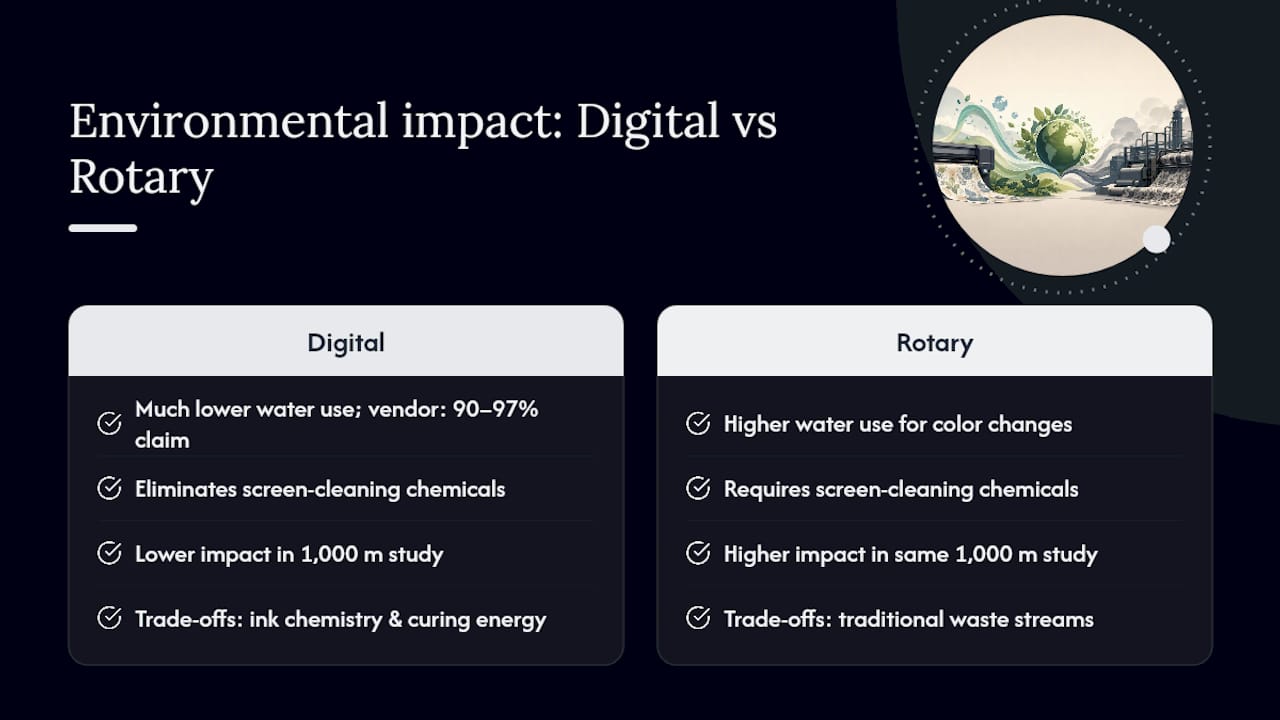
A factory-level comparative study found digital textile printing produced lower environmental impact than rotary-screen printing in a measured case involving a 16-color design across 1,000 meters of cotton. Digital’s advantage largely comes from eliminating screen-cleaning chemicals and reducing water used in color changeovers.
Vendor reporting pushes this further. Epson-related industry coverage cites water reductions as high as 90 to 97 percent for certain integrated digital workflows compared with conventional methods, though those figures come from vendor-promoted systems rather than independent third-party audits.
The trade-off worth knowing: ink chemistry and energy use for curing still carry an environmental cost, and the net benefit depends heavily on what happens to the printed textile at end of life. Ask suppliers about their pretreatment chemistry, effluent handling, and any sustainability certifications before taking a water-savings claim at face value.
How Should You Prepare Files Before Your First Digital Print Run?
Export artwork at the resolution your print partner’s RIP software requires, typically 150 to 300 DPI at final print size, with an ICC profile matched to the specific fabric and ink combination you’re using. Guessing on color profiles is the single most common reason first orders come back looking nothing like the screen proof.
Before committing to a full run:
- Request a test strip on the actual fabric you’ll use in production
- Run a sample of a few meters and check color accuracy against a physical swatch, not just a monitor
- Wash-test the sample using the finishing process the final order will get
- Confirm minimums, lead times, and the supplier’s proof approval policy before placing the full order
Pro Tip: Always ask what ink family a print partner runs before submitting artwork. A file color-corrected for reactive ink will look off if the shop actually runs pigment or acid dye.
How Textile Printing Connects to Signage and Fabric Displays
Printed fabric does more than apparel. It’s become a staple in event backdrops, retail displays, and real-estate signage where a soft, wrinkle-resistant material photographs better than rigid substrates. Fabric banners suit indoor installs and step-and-repeat backdrops; vinyl still wins outdoors where wind load and weather resistance matter more. Customsignstoday helps clients weigh that choice by material, finish, and installation setting.
Ready for Custom Fabric Banners and Displays?
If you’re weighing fabric printing against vinyl for your next event, storefront, or property listing, Customsignstoday builds custom fabric banners with sewn hems, grommets, and finishing details sized to your install, not a generic template. That’s the practical edge over ordering blind from an overseas print shop: you get material guidance up front instead of guessing which fabric weight survives an outdoor booth.
Whether you need a single trade show backdrop or a full set of site signs for a property launch, the team can walk you through fabric weight, ink type, and turnaround before you commit. Fabric backdrops also pair well with vinyl banners for layered retail or event displays, and Customsignstoday’s custom printing services cover both. Request a custom sign quote today and ask about sample swatches before your next order.
Where to Learn More About Digital Textile Printing
For deeper technical grounding, see the Wikipedia overview of digital textile printing, the mill buyer guide on break-even economics, and this practical guide to digital printing for custom apparel.
Sources
- Digital printing (chapter) – inflibnet ebooks
- Innovations and Analysis of Textile Digital Printing Technology. International Journal of Science Technology and Society. 2019;7(2):38.