
TL;DR:
- Trade signage includes visually compelling displays that promote a business’s brand, products, or services at events and in retail spaces. It functions as a silent salesperson, filtering prospects and enhancing visibility through clear, strategic design choices. Business owners benefit from quality trade partnerships, layered formats, and early planning to maximize impact and ROI in in-person marketing.
Trade signage is any visual display a business uses to promote its brand, products, or services in commercial, retail, or event settings. The term covers everything from retractable banners at a trade show booth to illuminated letters above a storefront, vinyl decals on a vehicle, and architectural signs at a corporate entrance. In the signage industry, “trade signage” also refers to a specific manufacturing model where specialist producers supply complex signs to other sign companies. Both meanings matter to business owners and marketers, and this guide covers both in full.
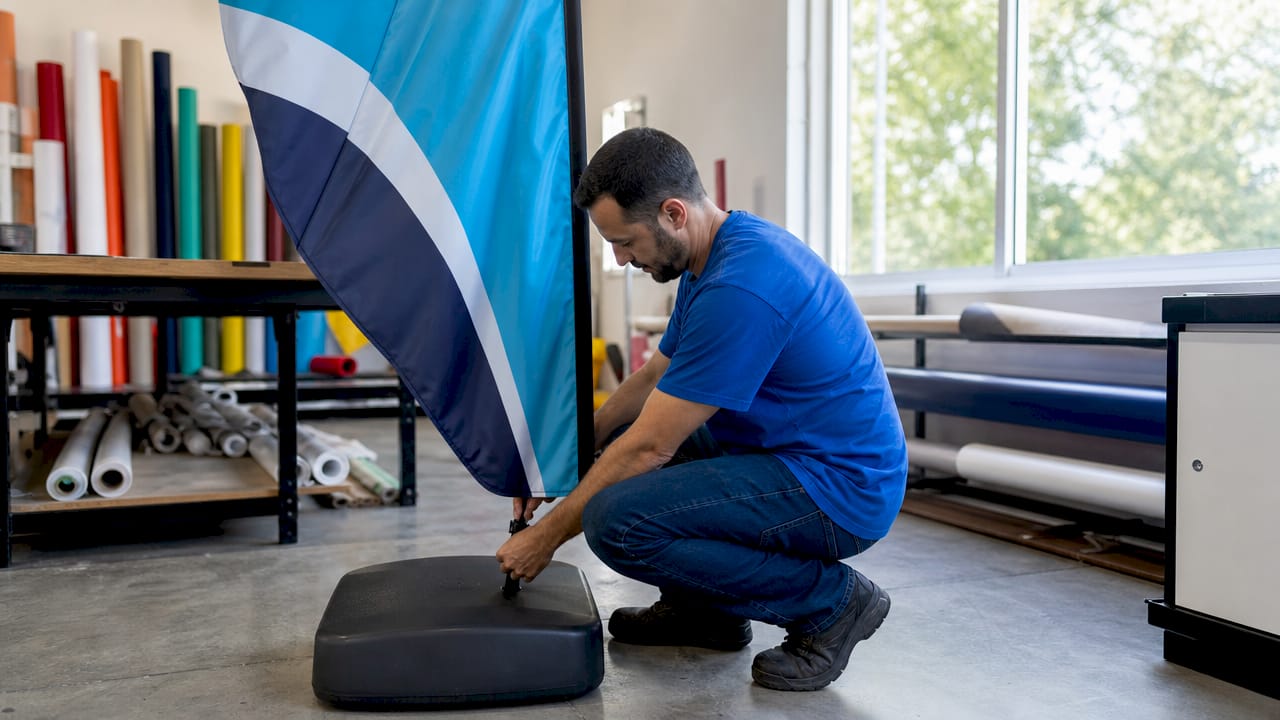
What is trade signage and why does it matter for your business?
Trade signage functions as a silent salesperson. It attracts attention before a single word is spoken, communicates your brand identity at a glance, and tells potential customers whether your offering is relevant to them. 72% of trade show attendees are more likely to purchase from exhibitors they meet in person. That statistic tells you one thing clearly: getting people to stop at your booth or storefront is the first conversion, and signage is what triggers it.
The phrase “trade signage” is sometimes used interchangeably with “trade show signage,” but the industry recognizes a broader definition. Trade show signage refers specifically to displays used at exhibitions and expos. Trade signage, as a wider category, includes any professionally produced visual communication used in a commercial context, from event displays to permanent building signs. Recognizing the distinction helps you make smarter purchasing decisions and communicate more precisely with signage vendors.
What makes trade signage strategically valuable is speed. The average trade show attendee decides within seconds whether to engage a booth. Your signage must communicate your core message before a prospect takes three steps past your display. That constraint forces clarity, which is exactly why well-designed trade signage consistently outperforms elaborate booth setups with weak visual communication.
What are the common types of trade signage and their uses?
The range of trade signage formats available today gives businesses genuine flexibility across venues, budgets, and marketing goals. Each format has a specific job, and choosing the wrong one for your context wastes money and opportunity.
The most widely used formats include:
- Retractable banners: Lightweight and portable, these set up in under two minutes and are the workhorse of trade show booths. Ideal for vertical brand messaging or product highlights.
- Step-and-repeat backdrops: Large fabric or vinyl panels printed with a repeating logo pattern. They anchor a booth visually and double as a branded photo backdrop for social media content.
- Pop-up display walls: Curved or straight fabric frames that create an instant branded environment. Best for larger booth footprints where immersive branding is the goal.
- Tabletop displays: Compact signs that sit on counters or tables. Useful for product detail, pricing, or call-to-action messaging at close range.
- Vinyl decals and window graphics: Applied directly to surfaces for permanent or semi-permanent branding in retail spaces, vehicles, or office windows.
- Illuminated letters and channel signs: Premium architectural signage for storefronts and corporate lobbies. Produced using CNC routing and specialized finishing that most small sign shops cannot replicate in-house.
- Fly signs and feather flags: Tall, lightweight flags that generate movement and catch peripheral vision outdoors. Effective at entrances and high-traffic outdoor areas.
Here is a quick comparison of the most common trade show signage formats:
| Sign type | Portability | Visibility range | Setup time | Best use |
|---|---|---|---|---|
| Retractable banner | High | 10-20 ft | Under 2 min | Booth branding, product messaging |
| Step-and-repeat backdrop | Medium | 20-40 ft | 5-10 min | Brand recognition, photo ops |
| Pop-up display wall | Medium | 20-50 ft | 10-15 min | Full booth environments |
| Tabletop display | Very high | 3-6 ft | Under 1 min | Close-range detail messaging |
| Feather flag | High | 30-60 ft | Under 3 min | Outdoor visibility, entrances |
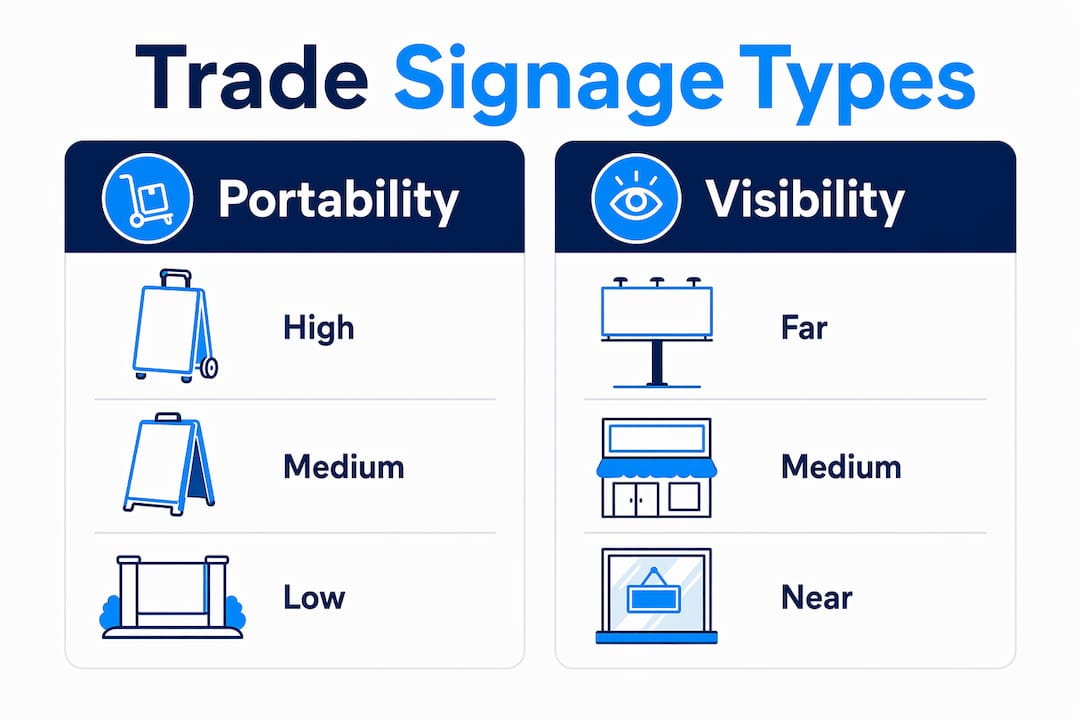
Pro Tip: Always bring at least two signage formats to any trade show: one high-visibility piece for distance (backdrop or pop-up wall) and one close-range piece (tabletop display or retractable banner) for visitors already at your booth. Layering formats creates a complete messaging environment.
How does well-designed trade signage impact visibility and leads?
Good trade signage design is not about being the loudest display in the room. Clear messaging, controlled layouts, and strategic placement consistently outperform clever copy and busy graphics, especially in the distraction-heavy environment of a trade show floor. The principles that separate effective signage from expensive wallpaper are straightforward.
The four non-negotiable design principles for trade signage are:
- High contrast: Dark text on a light background, or vice versa. Low contrast is the single most common reason signage fails to communicate at distance.
- Large, readable fonts: Your headline should be legible from at least 20 feet. If you need to squint, the font is too small.
- Minimal text: Three to five words for a headline. One supporting line maximum. Every additional word reduces reading speed and comprehension.
- Brand consistency: Colors, fonts, and logo usage must match your other marketing materials exactly. Inconsistency signals disorganization to prospects.
Trade signage also functions as a filter. Signs act as filters that signal who an offering is for, allowing visitors to self-qualify before engaging your booth staff. A sign that reads “Custom Packaging for Food Manufacturers” tells the right people to stop and the wrong people to keep walking. That filtering function reduces wasted conversations and improves the quality of every lead your team handles.
“Trade signage acts as a silent salesperson, filtering attendees and setting expectations, which reduces staff workload and improves lead quality.” — What Are Trade Show Signs? Impact Guide
Pro Tip: Test your signage design at the actual distance it will be viewed. Print a draft at full size, tape it to a wall, and walk 20 feet back. If you cannot read the headline in under three seconds, redesign before you order. For more guidance, review these signage design tips before finalizing your artwork.
What are the benefits of trade signage partnerships?
The term “trade signage” carries a second, industry-specific meaning that business owners rarely encounter but should understand. In the sign manufacturing world, trade signage refers to a model where specialist producers supply complex, high-end signage to other sign companies, rather than selling directly to end clients. This behind-the-scenes structure shapes the quality and variety of signs available to you as a buyer.
Trade signage partnerships provide capacity on demand, specialist capabilities, and consistency that help sign companies expand their offerings without investing in expensive new equipment. A local sign shop can offer you illuminated channel letters or precision-routed architectural signs because it sources those products from a trade manufacturer equipped with CNC routers, laser cutters, and specialized finishing systems. You get access to premium products; the sign shop maintains its competitive range without capital strain.
The strategic benefits of trade partnerships extend beyond simple outsourcing. Trade partnerships keep sign shops commercially sharp by enabling growth without heavy investment or overextending in-house production. For you as a client, this means your signage provider can say yes to more complex projects, deliver consistent quality across large orders, and meet tighter deadlines by routing overflow work to a trusted trade partner.
What separates a reliable trade signage partner from a weak one comes down to three factors: quality control processes, clear lead times, and consistent communication. Good trade partners maintain robust quality control and clear timelines, which protects your marketing schedule and your brand reputation. When evaluating a signage vendor, ask directly whether they manufacture in-house or use trade partners, and request samples of trade-produced work before committing to a large order.
“Trade partnerships in signage manufacturing allow companies to say yes to projects beyond their in-house capacity, enabling growth and specialization.” — The Power of Trade Signage, SignLink
How can businesses choose and implement trade signage effectively?
Selecting and deploying trade signage well requires matching the right format to your specific context. A sign that performs brilliantly at an outdoor festival will underperform in a carpeted convention center, and vice versa. Work through these criteria before placing any order.
- Define your venue and space. Indoor trade shows favor fabric backdrops and retractable banners. Outdoor events demand weather-resistant vinyl, feather flags, and UV-stable inks. Confirm ceiling heights and booth dimensions before ordering any display.
- Clarify your primary message. One sign, one message. If your booth has three different signs each promoting a different product line, none of them will register. Decide on your single most important message and build your primary signage around it.
- Plan for portability and setup. Effective trade show signage is designed for fast assembly, transport, and modularity to accommodate multiple events. Confirm that your chosen formats fit in a carry-on or standard shipping box, and that one person can set them up in under 10 minutes.
- Layer your signage for depth. Branded table throws and step-and-repeat backdrops reinforce brand recognition and extend your signage presence into social media when attendees photograph your booth. Combine a backdrop, a retractable banner, and a table throw for a complete branded environment at minimal cost.
- Budget for durability. Signs used at multiple events need to withstand repeated setup, transport, and storage. Specify scratch-resistant laminates for printed panels, reinforced hems for fabric displays, and hard cases for banner stands. The upfront cost difference is minor; the long-term savings are significant.
- Coordinate with your verbal pitch. Your signage sets the expectation; your team’s opening line should confirm it. If your sign says “Fast Turnaround Printing for Retailers,” your first sentence to every visitor should reference that promise. Alignment between signage and pitch is what converts foot traffic into qualified leads.
For businesses new to event marketing, reviewing trade show signage ideas before your first event gives you a practical starting point for format selection and layout planning.
Pro Tip: Order signage at least three weeks before your event. Rush production increases cost, limits material options, and leaves no time to correct errors. Build the production timeline into your event planning calendar from day one.
Key takeaways
Trade signage works because it combines visual clarity, strategic placement, and brand consistency to convert attention into qualified leads before a single conversation begins.
| Point | Details |
|---|---|
| Definition covers two meanings | Trade signage means both commercial visual displays and the industry model of specialist manufacturers supplying sign companies. |
| Signage filters prospects | Well-worded signs self-qualify visitors, reducing wasted staff time and improving lead quality at events. |
| Design clarity beats complexity | High contrast, minimal text, and large fonts outperform elaborate graphics in high-distraction environments. |
| Trade partnerships expand quality | Sign companies use trade manufacturers for complex products like illuminated letters, giving clients access to premium formats. |
| Layering formats maximizes impact | Combining a backdrop, retractable banner, and table throw creates a complete branded environment at any event. |
Why trade signage is still the most underrated marketing asset
I have watched businesses spend tens of thousands of dollars on digital advertising for a trade show and then show up with a wrinkled banner printed at a copy shop. The disconnect is real, and it costs them. Physical signage is the first impression at any in-person event, and first impressions at trade shows happen in seconds, not minutes.
What I find most underappreciated is the filtering function. Marketers obsess over booth traffic numbers, but the quality of that traffic matters far more. A sign that clearly states your niche, your audience, and your value proposition will bring you fewer visitors and better conversations. That is a trade worth making every time.
The trade partnership model in signage manufacturing is equally undervalued. When a sign company tells you they can produce illuminated architectural letters or precision-routed dimensional signs, they are almost certainly working with a specialist trade manufacturer. That is not a weakness. It is how the industry delivers quality at scale. As a buyer, your job is to verify that the trade partner behind your vendor has the quality controls and lead times to protect your deadlines.
Looking ahead, the most interesting development is the integration of physical signage with digital elements: QR codes that link to product demos, NFC-enabled signs that push content to smartphones, and fabric displays with embedded LED lighting. These formats are already available from trade manufacturers. The businesses that adopt them early will have a measurable advantage at events over the next three years.
Treat your signage as a strategic asset, not a line item. The return on a well-designed, professionally produced sign set is higher than almost any other marketing spend at the same price point.
— Yossi
Get professional trade signage from Customsignstoday
Customsignstoday produces custom trade signage built for real marketing performance, from retractable banners and step-and-repeat backdrops to vinyl decals, table throws, and illuminated signs. Every product is made with durable, event-grade materials and printed with precision to match your brand colors exactly.
Whether you are preparing for your first trade show or refreshing your entire event display kit, Customsignstoday offers expert design support, fast turnaround, and straightforward ordering. Explore the full range of custom sign services or request a personalized quote tailored to your event budget and venue requirements. For specialty display options, the face change signs collection offers modular solutions that adapt across multiple campaigns without reprinting your entire booth.
FAQ
What is trade signage in simple terms?
Trade signage is any professionally produced visual display a business uses to promote its brand, products, or services at events, retail locations, or commercial spaces. The term also refers to the industry practice of specialist manufacturers supplying complex signs to other sign companies.
What is trade show signage specifically?
Trade show signage refers to portable, event-specific displays such as retractable banners, backdrops, pop-up walls, and tabletop signs used at exhibitions and expos to attract visitors and communicate brand messaging.
How visible does trade signage need to be?
Effective trade show signage must be visible within a 20 to 50 foot radius and set up by one person in under 10 minutes. Visibility at distance is the primary design constraint for any event display.
What are the most important design principles for trade signage?
High contrast, large readable fonts, minimal text, and brand consistency are the four principles that determine whether trade signage communicates effectively or gets ignored on a busy show floor.
How far in advance should I order trade signage?
Order at least three weeks before your event to allow time for production, shipping, and any corrections. Rush orders limit your material options and increase cost without improving quality.