TL;DR:
- Window lettering helps businesses showcase their branding, contact information, and safety messages on glass surfaces.
- Choosing the right material, design contrast, and application method ensures durability and legibility, especially outdoors.
Window lettering is vinyl text or graphics cut or printed and applied directly to glass surfaces for storefront branding, business hours, promotional messaging, and safety markings. Customsignstoday produces custom vinyl window lettering in a range of colors, sizes, and finishes for businesses that need durable, professional-looking glass signage. The three most common uses are:
- Storefront identification: business name, logo, and tagline on the front door or window
- Hours and contact info: phone number, website, and operating hours displayed at eye level
- Directional and safety labeling: “Enter here,” “Pull,” or frosted-film markings on glass doors
Table of Contents
- What is window lettering and what types can you order?
- How businesses actually use window lettering
- What materials and finishes actually hold up outdoors?
- Design basics that make window lettering legible
- How to apply vinyl window lettering step by step
- How to remove vinyl lettering without damaging glass
- What does window lettering cost, and how long does production take?
- When should you remove temporary manufacturer stickers?
- What local regulations apply to window signage?
- Environmental impact and sustainability of vinyl signage materials
- Key Takeaways
- The mistake most business owners make with window lettering
- Customsignstoday makes custom window lettering straightforward
- Useful sources
What is window lettering and what types can you order?
Vinyl lettering is made by cutting text or shapes from a solid-color vinyl sheet, then backing the pieces with transfer tape so they stay aligned during installation. That is the cut vinyl method. Printed vinyl works differently: full-color artwork is digitally printed onto vinyl stock, then contour-cut to shape. Both end up on your glass; the difference is in how many colors you can use and what the finished surface looks like.
The four main product types you will see on supplier pages:
Cut vinyl lettering is the workhorse of storefront signage. Solid-color, individual letters with a clean, painted-on look. Best for long-term business name and hours displays.
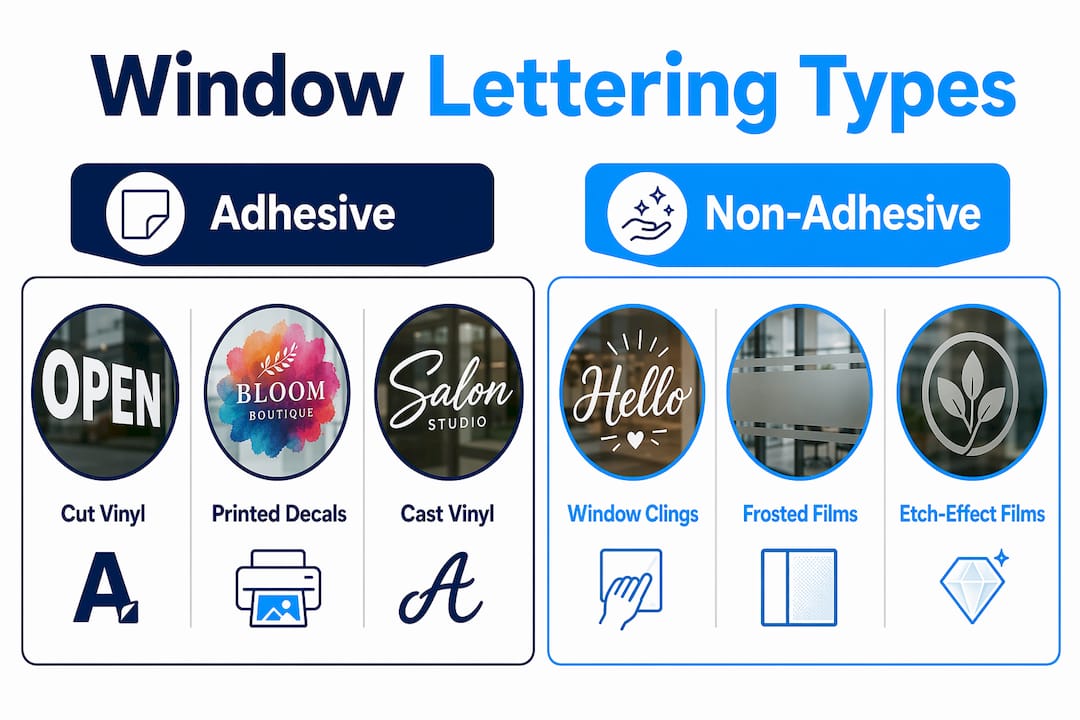
Printed vinyl decals handle full-color logos, photos, and complex graphics. Think promotional window graphics or a seasonal sale banner printed on clear or white vinyl.
Window clings use static electricity rather than adhesive, so they stick and peel without leaving residue. Ideal for short-term promotions or anything you swap out frequently.
Frosted and etch-effect films mimic sandblasted glass. Commonly used for privacy panels, conference room windows, and decorative borders.
A few terms you will see when ordering: cast vinyl is thinner and more conformable, rated for outdoor use for several years; calendared vinyl is thicker and stiffer, better suited for flat surfaces and shorter-term applications. A laminate is a clear protective layer applied over printed vinyl to resist UV fading and abrasion. Reverse-cut means the lettering is applied to the inside of the glass and reads correctly from outside.
How businesses actually use window lettering
The range of applications is wider than most people expect. Here is a quick map of use cases to the type of lettering that usually fits each one:
- Business name and logo on the front door: cut vinyl lettering or printed vinyl decal, long-term cast vinyl
- Hours, phone, and website: cut vinyl, typically white or black for contrast against any background
- Seasonal promotions and sale messaging: window clings or short-term calendared vinyl, easy to swap
- Privacy and decorative panels: frosted film, often reverse-cut for interior application
- Safety markings on glass doors: frosted or solid-color vinyl strips at eye and knee level to prevent walk-into-glass accidents
- Pop-up events and farmers markets: window clings or removable printed vinyl on vehicle windows or portable display panels
A coffee shop might put its logo in white cut vinyl on the front door, post hours in smaller black lettering below, and run a seasonal cling on the side window for a limited drink. A hair salon often lists its service menu directly on the door glass in cut vinyl so passersby can read pricing before they walk in.
What materials and finishes actually hold up outdoors?
| Material | Typical lifespan | Best use | Weather resistance |
|---|---|---|---|
| Cast vinyl (unlaminated) | 5–7 years outdoor | Permanent storefront ID | High |
| Calendared vinyl (unlaminated) | 2–3 years outdoor | Short-term promos, indoor | Moderate |
| Laminated printed vinyl | 3–5 years outdoor | Full-color graphics | High (laminate adds UV protection) |
| Static-cling film | Months to 1 year | Temporary, removable | Low (not for prolonged sun exposure) |
| Frosted/etch film | 3–5 years indoor | Privacy, décor | Low (primarily indoor) |
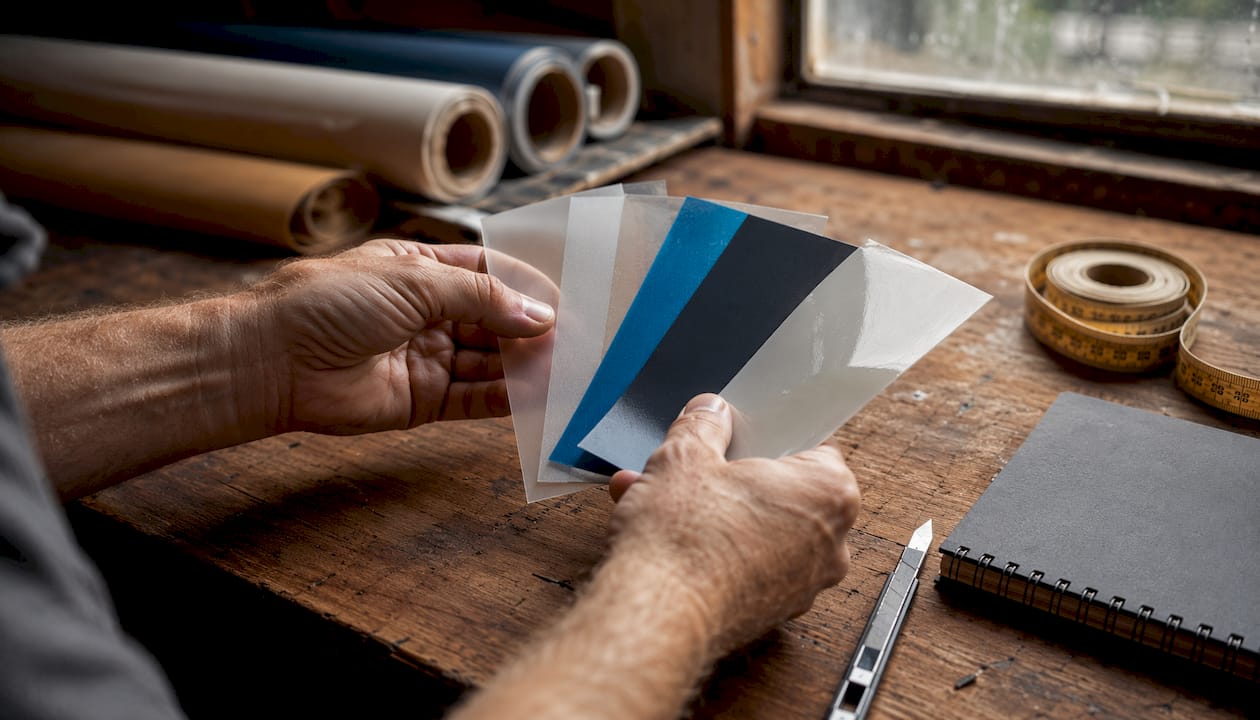
Laminates matter more than most buyers realize. A gloss laminate adds a polished look and protects ink from UV degradation. A matte laminate reduces glare, which is useful on south-facing windows that catch direct afternoon sun. Anti-graffiti laminates let you wipe off spray paint or marker without damaging the vinyl underneath.
Real-world lifespan depends heavily on climate. In Florida or Arizona, intense UV and heat can shorten an unlaminated calendared vinyl’s life to 18 months. In the Pacific Northwest, moisture and mildew are the bigger threats. Cleaning with harsh solvents or abrasive cloths also accelerates edge lifting. Most reputable suppliers back outdoor cast vinyl with a manufacturer’s warranty, but that warranty typically covers material defects, not installation errors or extreme weather events.
Design basics that make window lettering legible
Start with contrast. Dark lettering on a light background, or white lettering on a dark-tinted window, reads clearly from 10 to 20 feet. Pale yellow on white does not, regardless of font size.
Practical sizing rules for street-level storefronts:
- Walk-by viewing (5–10 feet): minimum 2-inch letter height for body text; 4–6 inches for a business name
- Drive-by viewing (30–50 feet): minimum 6-inch letter height; bold weight fonts only
- Minimum stroke width: roughly 1/8 inch for cut vinyl; thinner strokes may not cut cleanly and can lift at edges
- Letter spacing: slightly wider than default for all-caps text; tight tracking on glass can blur at a distance
Simple sans-serif fonts like Helvetica, Futura, or Franklin Gothic hold up better on glass than decorative scripts, especially at smaller sizes. Scripts look elegant on a door logo but become unreadable as body text for hours or phone numbers.
Window reflections are a real problem. Glass reflects sky and street, which can wash out lettering depending on the time of day. Reverse-cut application (inside the glass) protects the vinyl from weather and often improves legibility because the glass itself reduces glare on the lettering surface.

Before you send a file to production, design proofs dramatically reduce rework. Submit vector artwork (AI, EPS, or PDF), confirm colors in the supplier’s color system, and ask for a scaled proof or on-site mockup before approving the final run.
Pro Tip: Ask your supplier for a to-scale PDF proof taped to your actual window before production. Lighting, window tint, and surrounding colors all affect how the finished lettering reads in real life.
How to apply vinyl window lettering step by step
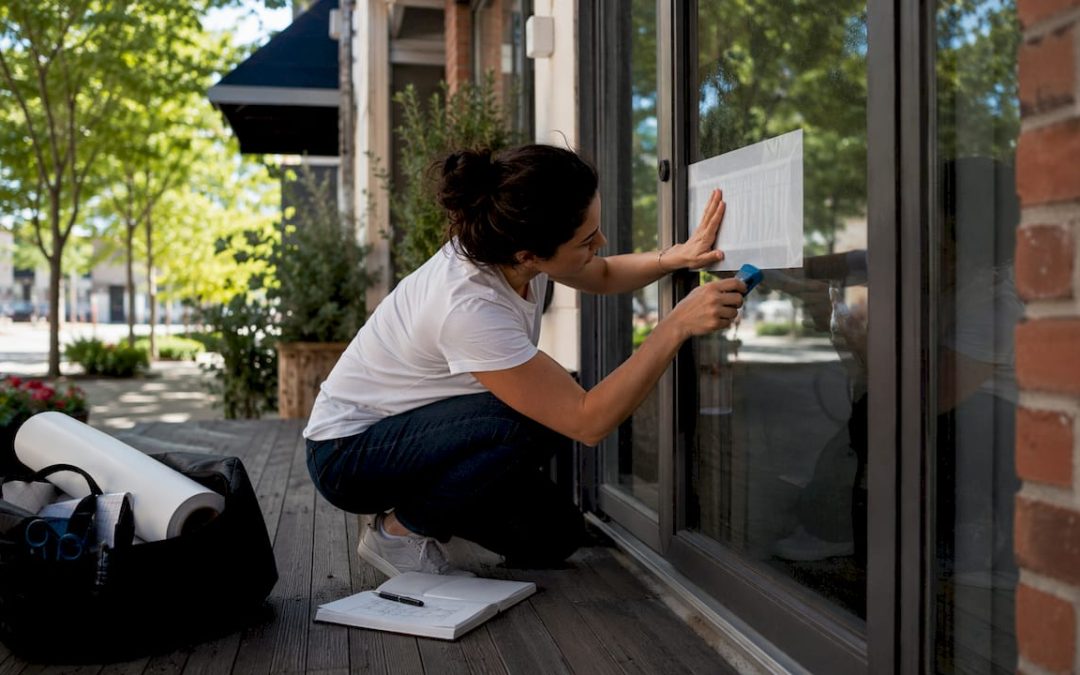
The core sequence is straightforward: clean the glass, position the lettering, squeegee it down, then remove the transfer tape slowly. Here is the full process.
Tools you need:
- Squeegee or credit card
- Spray bottle with a few drops of dish soap in water (wet-apply only)
- Tape measure and masking tape
- Lint-free cloth or paper towels
- Isopropyl alcohol (for cleaning)
Application steps:
- Clean the glass with isopropyl alcohol and a lint-free cloth. Remove all dust, grease, and fingerprints. Even a thin film of cleaner residue can prevent adhesion.
- Measure and mark your placement with masking tape. Use a level for horizontal text.
- Peel the backing paper away from the vinyl, leaving the lettering on the transfer tape.
- Position the transfer tape against the glass and press lightly at the top edge to tack it in place.
- Squeegee from the center outward in overlapping strokes, applying firm, even pressure. This pushes out air and seats the adhesive.
- Peel the transfer tape back at a low angle, slowly. If lettering lifts with the tape, press it back down and squeegee again before continuing.
- Inspect for bubbles. Small ones often disappear within 24–48 hours. Large bubbles can be pierced with a pin at a 45-degree angle and pressed flat.
Dry-apply vs. wet-apply: Dry application is standard for most cut vinyl lettering and gives a faster, permanent bond. Wet application (soapy water misted on the glass) lets you slide the vinyl into position before it bonds, which is useful for large pieces or precise multi-line layouts. Wet-apply adds 24–48 hours of cure time before the adhesive fully sets.
Pro Tip: For multi-line text, use a long strip of masking tape as a baseline guide across the full width of the installation. It keeps every line parallel without measuring each letter individually.
How to remove vinyl lettering without damaging glass
Use heat to loosen the adhesive, peel carefully, then clean up residue with a solvent. That sequence handles most removals cleanly.
- Warm the vinyl with a hairdryer or heat gun on a low setting (roughly 250–350°F) for 30–60 seconds. Work in small sections.
- Lift a corner with a plastic scraper or an old credit card. Never use a metal razor on coated or tinted glass.
- Peel slowly at a low angle, reapplying heat as needed. Pulling too fast tears the vinyl and leaves more residue.
- Clean adhesive residue with isopropyl alcohol or a commercial remover like Goo Gone. Apply, let it soak for 30–60 seconds, then wipe with a lint-free cloth.
- Rinse the glass with clean water and inspect for remaining residue.
Low-E glass warning: Low-E coatings are microscopically thin and scratch instantly with metal tools. If your windows have a Low-E coating (common in energy-efficient commercial buildings), rely entirely on chemical removers and plastic scrapers. Test any solvent on a small, inconspicuous area first.
Older vinyl bonds more aggressively and can shatter into fragments rather than peeling in strips. For heat-applied or aged business decals, plan on a two-step process: heat plus a commercial adhesive remover. Work in a ventilated space and follow the remover’s safety instructions.
What does window lettering cost, and how long does production take?
Price depends on size, material, color count, laminate, and whether you need installation. There is no single flat rate.
| Cost factor | Effect on price |
|---|---|
| Material (cast vs. calendared) | Cast vinyl costs more; justified for permanent outdoor installs |
| Size | Larger pieces use more material and take longer to cut or print |
| Full-color printing | Adds cost over single-color cut vinyl |
| Protective laminate | Adds cost; recommended for outdoor printed vinyl |
| Custom artwork | Design fees apply if you do not supply print-ready vector files |
| Professional installation | Adds labor cost; worth it for large or complex layouts |
Small custom orders (a door logo and hours set) typically turn around within a few business days at most suppliers. Larger or more complex orders can take about a week or longer. Seasonal demand, particularly around the holidays and back-to-school periods, stretches lead times. Order well ahead of any hard deadline. For exact pricing on your project, get a custom quote before committing to a design.
When should you remove temporary manufacturer stickers?
Remove temporary manufacturer stickers within about six months of installation. UV exposure gradually transforms a removable label’s adhesive into something far more stubborn, and what peels off cleanly at three months may require a heat gun and solvent at twelve.
The same principle applies to any heat-applied or older business signage. Decals that have been on a window for several years often bond aggressively and need the full two-step removal: heat to soften, then a commercial adhesive remover for residue.
Pro Tip: Before using any scraper on a commercial window, check whether it has a Low-E coating. Run your finger along the edge of the glass and look for a faint metallic or iridescent tint on the surface. If you see it, put the metal tools away and use Goo Gone with a plastic scraper only.
Safe heat-gun temperature for glass is generally below 300°F. Higher temperatures risk cracking tempered glass or delaminating window tint. A hairdryer on its highest setting is usually sufficient for residential-grade vinyl and is safer for tinted glass.
What local regulations apply to window signage?
Most U.S. cities and counties regulate how much of a storefront window can be covered by signage, typically expressed as a percentage of total window area. Common limits range from 25% to 50% of the visible glass surface, though the exact figure varies by municipality and zoning district.
Sign permits are sometimes required even for vinyl lettering, particularly in historic districts, shopping centers with tenant sign criteria, or commercial corridors with design overlay zones. Check with your local planning or zoning department before ordering large window graphics. Landlords may also impose additional restrictions through lease agreements, so review your lease before committing to a permanent installation.
The Americans with Disabilities Act (ADA) does not directly regulate window lettering content, but ADA-compliant directional and room-identification signs must meet specific contrast, font, and mounting-height standards. If your window lettering serves a wayfinding function, confirm it meets those requirements.
Environmental impact and sustainability of vinyl signage materials
Standard PVC-based vinyl is petroleum-derived and not widely recyclable through municipal programs. Most cut vinyl and calendared film ends up in landfill at end of life. That is the honest baseline.
Several manufacturers now offer PVC-free films made from polyolefin or bio-based materials that reduce plasticizer content and improve recyclability. Some suppliers also offer take-back programs for production waste and off-cuts. Solvent-based inks used in wide-format printing carry VOC emissions; water-based and UV-curable inks are lower-impact alternatives that most modern print shops now use by default.
For businesses prioritizing sustainability, the most practical steps are choosing longer-lasting cast vinyl over short-term calendared film (fewer replacements means less total material), requesting water-based or UV-cured inks, and asking your supplier whether they recycle production waste. Frosted films and window clings, being thinner and often PVC-free, tend to have a smaller material footprint than thick laminated prints.
Key Takeaways
Window lettering is one of the most cost-effective branding tools a small business can put on its storefront, provided you match the material to the exposure, keep the design high-contrast, and follow the correct application and removal sequence.
| Point | Details |
|---|---|
| Material choice drives lifespan | Cast vinyl lasts several years outdoors; calendared vinyl suits short-term or indoor use only. |
| Design contrast is non-negotiable | Minimum 2-inch letter height for walk-by viewing; simple sans-serif fonts outperform scripts at distance. |
| Apply and remove correctly | Squeegee from center outward; use heat and plastic scrapers for removal to protect glass coatings. |
| Remove temporary stickers within six months | UV exposure bakes adhesive and turns removable labels into permanent ones after about six months. |
| Customsignstoday for custom orders | Customsignstoday produces custom vinyl window lettering with quote requests available for size, material, and installation needs. |
The mistake most business owners make with window lettering
Most buyers focus almost entirely on what the lettering says and almost not at all on where it goes and what it is made of. A beautifully designed logo in the wrong vinyl, installed on a south-facing window in a hot climate without a laminate, can look faded and peeling within 18 months. The design is fine. The material decision was wrong.
The second most common mistake is skipping the proof. A design that looks sharp on a monitor can disappear against a dark-tinted window or become unreadable when the afternoon sun hits the glass at a low angle. Professionals nearly always require a scaled proof before production, and that single step prevents the most expensive kind of rework: reprinting and reinstalling.
There is also a Low-E glass problem that catches a lot of people off guard. Building owners and tenants often do not know whether their windows have a Low-E coating, and the first time they find out is when a metal scraper scratches the surface during removal. Check before you scrape, every time.
The businesses that get the most out of window lettering treat it as a maintained asset, not a one-time install. They schedule periodic cleaning, inspect edges for lifting, and plan removal before the adhesive bakes on. That approach keeps signage looking professional and keeps glass surfaces intact for the next installation.
Customsignstoday makes custom window lettering straightforward
Getting professional window lettering does not have to mean weeks of back-and-forth. Customsignstoday produces custom vinyl window lettering in cut and printed formats, with options for laminates, frosted films, and reverse-cut inside-glass application. The team works with supplied artwork or can help prepare print-ready files, and proofs are part of the process before anything goes to production.
To get a quote, have your window dimensions, preferred colors or finish, and any existing logo files ready. If you are unsure about material choice for your climate or installation surface, that is exactly the kind of question to raise upfront. Turnaround on small custom orders is typically fast, but build in extra time during peak seasons. Request your free sign quote directly through the Customsignstoday website and get a real number for your specific project.
Useful sources
- Window Sticker Removal: Goo Gone vs. Razor — Covers UV baking of adhesives, heat-gun technique, and Low-E glass safety; the most detailed removal guide in this research pool.
- How Do You Safely Remove a Window Decal Without Damaging the Glass? — Practical step-by-step removal sequence with guidance on plastic vs. metal scrapers and protecting window coatings.
- How to Remove Vinyl Lettering From Glass | eHow — Focused on older, baked-on vinyl and the solvents and tools that work when standard peeling fails.
- What is vinyl lettering? | Sticker Mule — Clear definition of cut vinyl lettering, transfer tape application, and design guidance including proof recommendations.
- Customsignstoday window lettering service page — Product details, size options, and the starting point for requesting a quote on custom vinyl window lettering.