

{
“@type”: “Article”,
“image”: {
“url”: “https://csuxjmfbwmkxiegfpljm.supabase.co/storage/v1/object/public/blog-images/organization-6408/1771293837598_image.png”,
“@type”: “ImageObject”,
“caption”: “Business team discussing visual presentation”
},
“author”: {
“url”: “https://customsignstoday.us”,
“name”: “Customsignstoday”,
“@type”: “Organization”
},
“@context”: “https://schema.org”,
“headline”: “Visual Communication in Business: Driving Engagement and Growth”,
“publisher”: {
“url”: “https://customsignstoday.us”,
“name”: “Customsignstoday”,
“@type”: “Organization”
},
“inLanguage”: “en-US”,
“articleBody”: “Visual communication in business boosts brand impact, customer engagement, and efficiency. Learn about signage types, strategy, compliance, and common mistakes.”,
“description”: “Visual communication in business boosts brand impact, customer engagement, and efficiency. Learn about signage types, strategy, compliance, and common mistakes.”,
“datePublished”: “2026-02-17T02:04:50.034Z”
}
Every business owner knows that a message can get lost when words alone cannot make an impact. For American companies aiming to stand out, clear and memorable visual communication bridges the gap between an idea and true audience connection. With research showing visuals help simplify complex information and engage employees, this guide highlights how strategic design, effective signage solutions, and thoughtful branding can drive customer engagement and reinforce your unique business identity.
Table of Contents
- Defining Visual Communication In Business
- Types Of Business Signage Solutions
- Impact Of Visual Branding Strategies
- Legal Compliance And Accessibility Standards
- Avoiding Common Visual Communication Mistakes
Key Takeaways
| Point | Details |
|---|---|
| Importance of Visual Communication | Visual communication is essential for conveying complex ideas effectively and enhancing employee engagement through design and storytelling. |
| Signage Solutions | Businesses should choose signage solutions that enhance brand visibility and provide necessary information while aligning with operational needs. |
| Visual Branding | Consistent visual branding helps organizations communicate their identity effectively, creating deeper connections with target audiences. |
| Avoiding Mistakes | Proactively addressing common visual communication mistakes can lead to clearer messaging and improved engagement with diverse audiences. |
Defining Visual Communication in Business
Visual communication in business represents a powerful strategic approach to conveying complex ideas, strategies, and messages through intentional graphic design, imagery, and visual storytelling. By transforming abstract concepts into compelling visual narratives, organizations can bridge understanding gaps and enhance employee engagement.
At its core, visual communication involves strategically using images, charts, graphs, and diagrams to simplify intricate information and reinforce key organizational messaging. Strategic visual metaphors enable businesses to translate complicated strategic plans into accessible, memorable experiences that resonate with employees and stakeholders.
Key elements of effective business visual communication include:
- Clear, purpose-driven design
- Accessibility for diverse audiences
- Alignment with core organizational messaging
- Strategic use of color, typography, and imagery
- Consistent brand representation
Modern businesses leverage visual communication across multiple contexts, from internal presentations and training materials to external marketing collateral and brand identity. Effective visual design principles help organizations communicate more efficiently, reducing complexity and enhancing comprehension.
Pro Tip: Design visual communications with your specific audience’s cognitive preferences and professional background in mind to maximize engagement and understanding.
Types of Business Signage Solutions
Business signage solutions represent a critical component of organizational visual communication, offering diverse options to enhance brand visibility, provide directional information, and support marketing objectives. Commercial display technologies have evolved to provide businesses with sophisticated signage options that meet various operational needs and environmental conditions.
The primary categories of business signage solutions include:
- Painted Signs: Traditional signage featuring hand-painted or digitally printed graphics
- Dimensional Letters: Three-dimensional signage that adds depth and visual interest
- Illuminated Signage: Backlit or internally lit signs for enhanced visibility
- Bracket Signs: Projecting signs mounted perpendicular to building facades
- Digital Display Screens: Dynamic, programmable signage for real-time messaging
Modern businesses can choose between consumer-grade and commercial-grade signage displays, each offering unique characteristics. Retail signage solutions typically range from simple storefront signs to complex digital communication systems that adapt to changing business environments.

Here’s a quick comparison of consumer-grade and commercial-grade signage displays:
| Aspect | Consumer-Grade Displays | Commercial-Grade Displays |
|---|---|---|
| Durability | Designed for light, infrequent use | Built for continuous operation |
| Cost | Lower initial investment | Higher upfront cost |
| Performance | Standard brightness levels | High brightness and clarity |
| Lifespan | Moderate | Extended, 24/7 operation |
| Control Features | Basic remote control | Advanced content management |
Commercial-grade displays are designed for 24/7 operation, featuring enhanced durability and performance compared to consumer-grade alternatives.
Signage technologies have become increasingly sophisticated, with options ranging from static printed signs to interactive digital displays that can be updated remotely and provide real-time information across multiple locations.
Pro Tip: Select signage solutions that not only match your brand aesthetic but also provide flexibility for future business communication needs.
Impact of Visual Branding Strategies
Visual branding strategies represent a sophisticated approach to communicating organizational identity, leveraging design elements that go far beyond simple logos or color schemes. Advanced logo design techniques now utilize data-driven approaches to align visual elements with core brand personality traits, creating deeper connections with target audiences.
Key components of effective visual branding include:
- Consistent Visual Language: Maintaining uniform design across all brand touchpoints
- Strategic Color Psychology: Selecting colors that evoke specific emotional responses
- Narrative-Driven Design: Creating visual elements that tell a compelling brand story
- Adaptable Visual Systems: Developing flexible design frameworks that work across multiple platforms
- Emotional Resonance: Crafting visuals that connect authentically with target demographics
Branding signs play a critical role in translating these strategic visual elements into tangible brand experiences. Companies that successfully integrate visual storytelling can significantly enhance both internal and external brand perceptions.
Visual branding strategies that utilize metaphor-based visuals can dramatically increase audience engagement and support for organizational objectives.
By implementing sophisticated visual communication approaches, businesses can transform their brand from a mere corporate identifier into a powerful narrative that resonates deeply with customers and employees alike.
Pro Tip: Develop a comprehensive visual brand guideline that provides clear, actionable instructions for maintaining consistent brand representation across all communication channels.
Legal Compliance and Accessibility Standards
Businesses must navigate complex legal requirements surrounding visual communication, ensuring that their signage and design strategies meet rigorous accessibility and compliance standards. Web Content Accessibility Guidelines provide comprehensive frameworks for creating inclusive visual communication that serves diverse audience needs.
Key legal compliance considerations for visual communication include:
- Disability Access: Ensuring materials are perceivable by individuals with various impairments
- Federal Regulation Alignment: Meeting Americans with Disabilities Act (ADA) requirements
- Universal Design Principles: Creating visual content usable by people with different abilities
- Alternative Communication Methods: Providing multiple ways to access information
- Digital and Physical Signage Standards: Maintaining consistent accessibility across platforms
ADA sign requirements play a critical role in helping businesses implement legally compliant visual communication strategies. The Department of Justice mandates specific accessibility features that organizations must incorporate into their visual design approaches.
Accessibility is not an optional feature but a fundamental requirement for effective business communication in the modern landscape.
By proactively addressing legal accessibility standards, businesses can create more inclusive visual communication strategies that expand their reach and demonstrate organizational commitment to diversity and equal access.
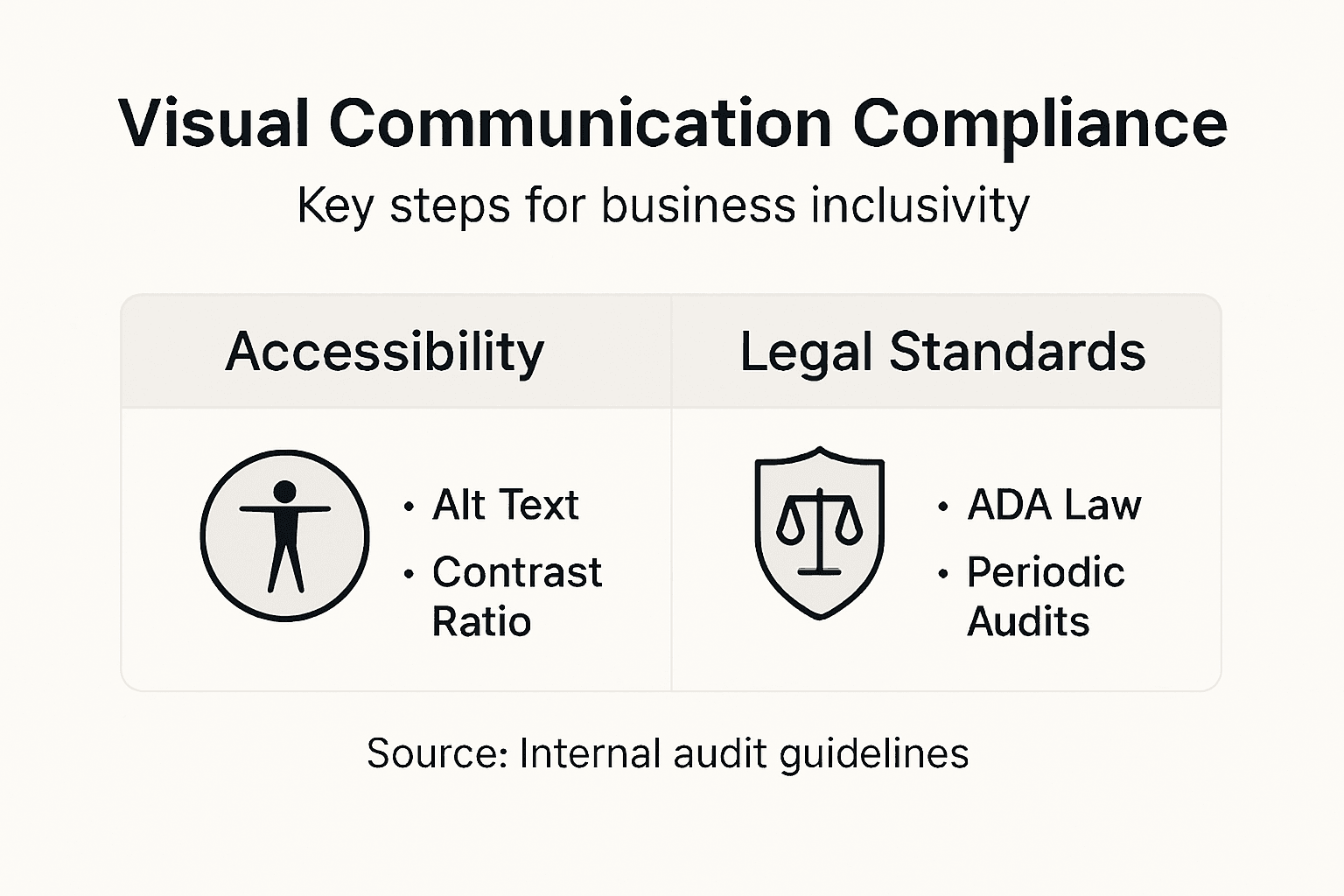
Pro Tip: Conduct regular accessibility audits of your visual communication materials to identify and address potential compliance gaps before they become legal issues.
Avoiding Common Visual Communication Mistakes
Successful visual communication requires strategic planning and careful execution to prevent costly misunderstandings. Visual communication errors can significantly undermine a business’s ability to effectively convey its message and engage with its target audience.
Common visual communication mistakes that businesses should avoid include:
- Color Dependency: Relying exclusively on color to convey critical information
- Poor Contrast: Creating designs with insufficient text and background contrast
- Overcomplicated Layouts: Developing cluttered or visually overwhelming materials
- Ignoring Accessibility: Failing to design for diverse audience capabilities
- Inconsistent Branding: Using varied design elements across different communication platforms
Custom signage design tips can help organizations develop more effective visual communication strategies that minimize potential misunderstandings and maximize message clarity.
This table summarizes common visual communication mistakes and their business consequences:
| Mistake Type | Example | Potential Impact |
|---|---|---|
| Color Overreliance | Using red/green for status | Information exclusion for colorblind users |
| Poor Contrast | Light text on white background | Reduced readability |
| Busy Layout | Too many elements on a slide | Audience confusion |
| Inaccessible Design | Small font, no alt text | Fails legal compliance |
| Branding Inconsistency | Mismatched logo use | Damage to brand credibility |
Effective visual communication is about clarity, simplicity, and universal understanding.
By understanding and proactively addressing potential communication pitfalls, businesses can create more inclusive, engaging, and impactful visual materials that resonate with diverse audiences.
Pro Tip: Implement a comprehensive review process that includes testing visual materials with diverse audience groups to identify potential communication barriers before finalizing designs.
Elevate Your Business Messaging with Custom Visual Communication Solutions
Businesses often struggle with conveying complex ideas clearly while maintaining brand consistency and accessibility. This article highlights the importance of strategic visual communication, effective branding signs, and compliance with legal standards to engage audiences deeply and grow your brand presence. It is critical to avoid common design pitfalls such as poor contrast and color dependency that can limit understanding and exclude potential customers.
At Custom Signs Today, we specialize in transforming these challenges into vibrant opportunities. Whether you need eye-catching banners, durable outdoor signage, vehicle wraps, or tailored decals, our expert team delivers high-quality, custom signage designed to enhance clarity, reinforce branding, and meet accessibility standards. Discover our comprehensive range of solutions and see how thoughtful visual communication can drive engagement now.
Explore our diverse service offerings on our Uncategorized Services page to find the perfect signage option that matches your unique business needs. Don’t wait to turn your brand’s story into an unforgettable visual experience. Visit Custom Signs Today to request your free quote and start creating signage that truly speaks to your audience.
Frequently Asked Questions
What is visual communication in business?
Visual communication in business involves using graphic design, imagery, and visual storytelling to convey complex ideas and messages. It simplifies intricate information and enhances engagement among employees and stakeholders.
How can visual branding strategies impact a business?
Effective visual branding strategies create deeper connections with target audiences by maintaining a consistent visual language, employing strategic color psychology, and telling a compelling brand story across various platforms.
What are some common mistakes in visual communication?
Common mistakes include poor contrast in designs, overcomplicating layouts, relying solely on color to convey information, and inconsistent branding across communication platforms. These can undermine clarity and audience engagement.
Why is accessibility important in visual communication?
Accessibility ensures that visual communication materials are perceptible to individuals with various impairments. Complying with legal standards, such as ADA requirements, expands reach and demonstrates a commitment to diversity and equal access.
Recommended
- Why Signage Boosts Sales for Local Businesses –
- 7 Creative Custom Signage Ideas for Small Business Success –
- Effective Sign Design Principles: Boosting Business Impact –
- 7 Essential Promotional Signage Examples for Businesses –
- Understanding Storytelling Through Abstract Visuals – The Mansion Press
- Rol Van Webdesign in Branding: Meerwaarde Voor MKB | BYTE24
- Fotografia w marketingu B2B: Budowanie Zaufania i Wyróżnienie Marki – Coolheads – Fotografia biznesowa