TL;DR:
- A custom decal is a multilayer vinyl graphic designed for durability and long-term adhesion on demanding surfaces. They differ from stickers by their construction, materials, and intended long-lasting, weather-resistant use in branding and decoration. Proper surface preparation, design resolution, and application techniques are essential for maximizing their lifespan and visual impact.
Most people assume a decal is just a fancy word for a sticker. That misunderstanding leads to poor purchasing decisions, disappointing results, and wasted money. What is custom decals, really? A custom decal is a precision-made graphic product with a multilayer construction designed for durability, accuracy, and long-term adhesion on surfaces where ordinary stickers simply fail. Whether you are a small business owner branding a fleet of vehicles or an individual decorating a laptop, understanding what decals actually are changes how you use them and what results you get.
Table of Contents
- Key takeaways
- What is custom decals: definition and construction
- Decals vs. stickers vs. labels: knowing the difference
- Workflow for custom decals: from design to application
- Common uses and benefits of custom decals
- Ordering and maintaining your custom decals
- My take on custom decals and modern branding
- Get professional custom decals from Customsignstoday
- FAQ
Key takeaways
| Point | Details |
|---|---|
| Decals are not stickers | Custom decals use multilayer construction for precise, durable application on demanding surfaces. |
| Vinyl is the standard material | Most custom decals are vinyl-based, offering weather resistance and long outdoor life. |
| Transfer tape matters | Transfer tape keeps your design aligned during application, especially for complex logos. |
| Decals serve real business needs | Vehicle graphics, storefronts, and event promotions all benefit from decal versatility. |
| Surface prep determines longevity | Cleaning and priming the surface before applying a decal significantly extends its lifespan. |
What is custom decals: definition and construction
At its core, a custom decal is a printed graphic designed to be applied to a surface using a specialized adhesive system. The word “custom” means the design, size, shape, and color are made specifically for your needs rather than pulled off a shelf. That personalization is exactly what makes them so useful for branding and decoration.
What separates decals from other printed graphics is their multilayer construction. A standard custom decal has three distinct layers working together:
- The graphic layer: This is the printed design itself, cut to the exact shape you need.
- The backing paper: A release liner that protects the adhesive until you are ready to apply the decal.
- The transfer tape: A clear or translucent top layer that holds the graphic in position during application and peels away once the decal adheres to the surface.
The material used for most custom decals is vinyl. Vinyl is flexible, waterproof, and resistant to UV light, temperature changes, and abrasion. That combination makes it the go-to choice for outdoor applications, vehicle graphics, and storefront windows. Decals are larger, more permanent, and weather-resistant compared to general-purpose stickers, which is why professionals choose them for high-visibility branding work.
Vinyl decals also come in different finishes. Matte finishes reduce glare and work well indoors. Gloss finishes are vibrant and eye-catching, popular for vehicle graphics and storefronts. Clear vinyl allows the surface below to show through, creating a window decal effect that looks professionally printed directly onto glass.
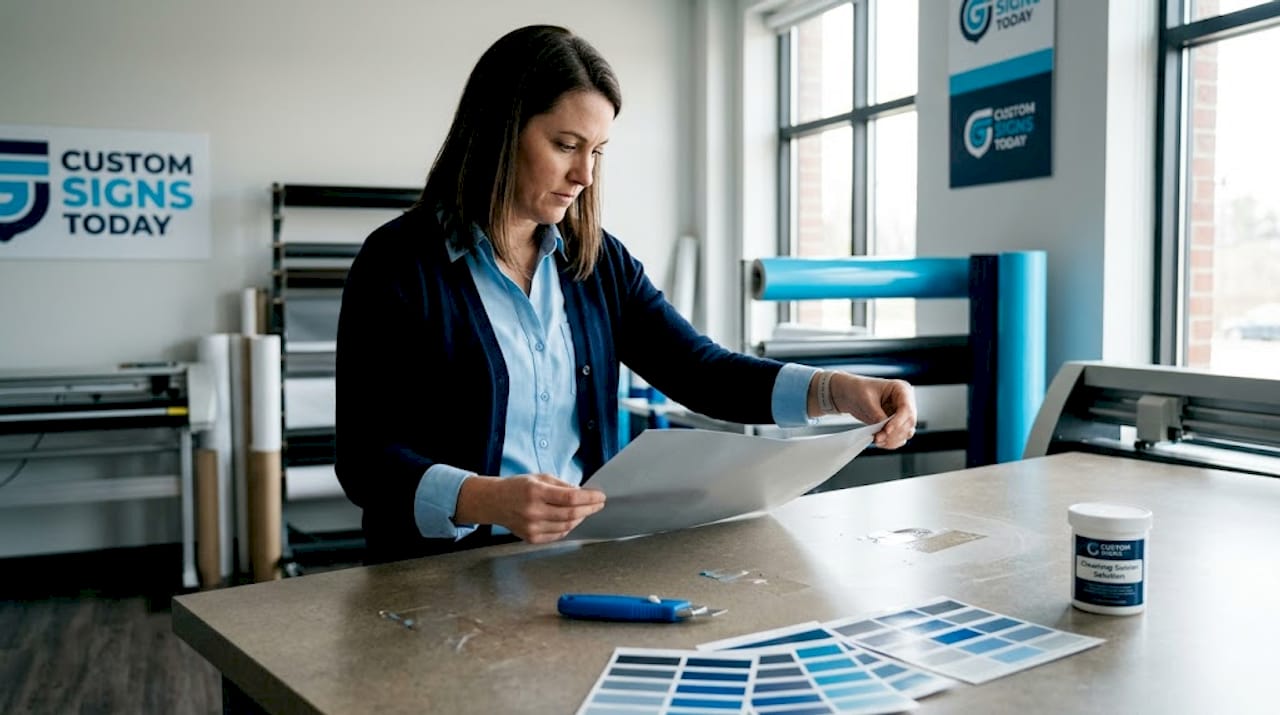
Pro Tip: Always specify your intended surface material when ordering custom decals. Different adhesive strengths are available for smooth glass, textured walls, vehicle paint, and painted metal. Using the wrong adhesive grade is one of the most common reasons decals fail early.
Decals vs. stickers vs. labels: knowing the difference
Plenty of people use these three terms interchangeably. They are not the same product, and using the wrong one costs time and money. Here is a direct comparison to clear up the confusion:
| Feature | Custom Decals | Stickers | Labels |
|---|---|---|---|
| Material | Vinyl or waterslide film | Paper or thin film | Paper or polyester |
| Durability | High, years outdoors | Low to medium | Low, indoor use |
| Typical size | Medium to large | Small | Small |
| Primary use | Branding, vehicles, signage | Personal decoration | Product identification |
| Application method | Transfer tape system | Peel and stick | Peel and stick |
| Removability | Clean removal with heat | Varies, often tears | Often leaves residue |
The key distinction is intent. Decals are typically larger, die-cut, and weather-resistant, designed for long-term branding and identification. A sticker might work fine on a water bottle that stays indoors. A decal is what you need when you are branding a company truck that spends its life outdoors in the rain and sun.
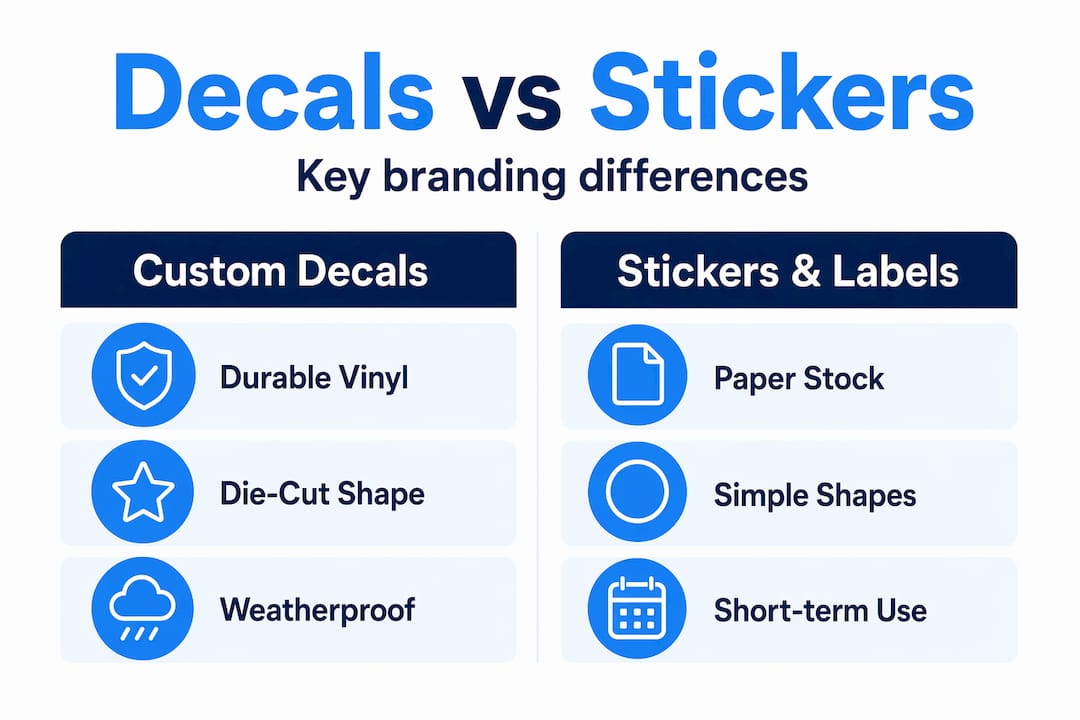
Labels carry product information and are optimized for small-scale print with regulatory compliance in mind. Decals are optimized for visibility and durability. If your goal involves branding, decoration that lasts, or promotional graphics on vehicles and buildings, decals are the right product category.
Decals blend aesthetics with durability, offering more permanent branding than stickers without the permanence of paint. That middle ground is where their real value lives for businesses that need flexibility without sacrificing professionalism.
Pro Tip: If you are a business owner ordering promotional graphics for a temporary event, choose removable vinyl decals. They peel off cleanly with a heat gun, leaving no adhesive residue on glass or painted surfaces.
Workflow for custom decals: from design to application
Understanding the workflow for custom decals takes away the mystery and helps you make better design decisions before you place an order or pick up a squeegee.
-
Start with your design at the right resolution. Custom decal production requires artwork at 300 DPI minimum. Low-resolution images that look fine on a screen become blurry when printed at actual size. Use vector files (AI, EPS, or PDF) when possible because they scale without any quality loss. DIY decal creation requires printing at 300 DPI, sealing with acrylic, and using decal softeners for curved surfaces.
-
Choose your shape and cut type. Decals come in standard rectangles or custom contour cuts that follow the exact outline of your design. Contour-cut decals look more polished and are worth the small added cost for branding applications.
-
Select your material and finish. Confirm whether the decal is going indoors or outdoors, on glass, metal, or a vehicle. This drives your choice of vinyl type, adhesive strength, and laminate finish.
-
Send to print. Professional printers use large-format digital printing on vinyl rolls, then run the printed material through a plotter cutter for precision cutting. Colors are printed in CMYK, so make sure your design files use the right color mode to avoid unexpected shifts in the final product.
-
Apply transfer tape. Transfer tape keeps the design aligned by holding all elements in their correct positions. This is especially critical for logos that include multiple separate letters or shapes that must stay precisely spaced.
-
Prep the surface and apply. Clean the surface thoroughly with isopropyl alcohol. Remove dirt, grease, and wax. Peel the backing paper, position the decal, and use a squeegee to press from the center outward, pushing out air bubbles. Peel the transfer tape at a 45-degree angle slowly.
-
Post-application care. Wait at least 24 hours before exposing a fresh decal to water or direct sunlight. This allows the adhesive to cure and bond properly to the surface.
Pro Tip: For decals going onto curved surfaces like vehicle panels or helmets, warm the vinyl gently with a heat gun before pressing it down. Warm vinyl is more pliable and conforms to curves without lifting at the edges.
Common uses and benefits of custom decals
Custom decals show up in more places than most people realize. Once you understand what they can do, it becomes obvious why businesses use them for vehicle graphics, storefront branding, and event promotions to increase visibility and recognition.
Here are the most impactful ways individuals and businesses put custom decals to work:
- Vehicle graphics and fleet branding. A single branded vehicle acts as a moving billboard. A contour-cut logo and contact information on a company van generates thousands of impressions per day in local traffic.
- Storefront windows. Window decals create professional-looking signage at a fraction of the cost of traditional signs. They are easily updated when hours, promotions, or branding changes.
- Interior wall decals. Offices, retail spaces, and restaurants use wall decals to establish atmosphere and reinforce brand identity without painting or permanent installation.
- Floor graphics. Events, trade shows, and retail stores use floor decals for wayfinding, promotions, and creative branding that stops foot traffic.
- Product labeling and packaging. Small businesses use custom decals on packaging and products as a more polished alternative to printed labels.
- Promotional giveaways. Branded decals given away at events or shipped with orders extend your brand reach into customers’ personal spaces.
Decals offer cost-effective alternatives to painted signage, making them particularly attractive for businesses that update their branding periodically or run seasonal promotions. Removing and replacing a decal takes minutes. Removing and repainting a storefront takes days and hundreds of dollars.
For individuals, the uses range from home decor to personalized vehicle accents. Wall art decals have exploded in popularity for renters who cannot paint. Custom car decals let enthusiasts personalize their rides without permanent modification. Hobbyists creating waterslide decals for models and ceramics represent a growing niche that proves the format’s remarkable versatility.
You can explore creative applications further by looking at decal branding ideas that go well beyond the obvious use cases.
Ordering and maintaining your custom decals
Getting the most out of a decal investment means thinking beyond the order confirmation. How you choose, apply, and care for your decals determines whether they look sharp for three years or start peeling at three months.
When ordering, focus on these factors:
- Indoor vs. outdoor use. Outdoor decals need UV-resistant laminate. Indoor decals do not. Ordering an unlaminated decal for outdoor use is a common and costly mistake.
- Surface compatibility. Textured surfaces like brick or stucco need a high-tack adhesive. Smooth glass or paint takes a standard grade.
- Color accuracy. Request a physical proof or at minimum a digital proof before approving a large order. Colors shift between screen and print.
- Turnaround time. Standard production runs 3 to 5 business days. Rush options are available but add cost. Build your timeline accordingly.
For maintenance, keeping decals clean is straightforward. Use a mild soap and water solution. Avoid pressure washing directly at the edges, which can lift the vinyl. Do not use harsh solvents like acetone, which will degrade the vinyl and laminate. If a corner starts to lift, press it back down with your thumb and use a small amount of vinyl adhesive to resecure it.
Proper surface preparation, durable material selection, and careful application are the three factors that most directly affect how long a decal lasts and how good it looks throughout its life.
Pro Tip: When a decal is ready to be removed, use a heat gun or hair dryer on low setting. Heat softens the adhesive and allows the vinyl to peel away cleanly. Trying to remove a cold decal on a cold day in winter almost always tears the graphic and leaves adhesive residue.
Check out the guide on types of decal signs to match the right decal format to your specific business application.
My take on custom decals and modern branding
I have spent years watching businesses spend serious money on signage that underdelivers, and I have seen equally serious results come from a well-executed decal program that cost a fraction of the price. What I keep coming back to is this: decals occupy a unique position that nothing else quite fills.
Paint is permanent and expensive to change. Printed banners are temporary and look cheap up close. Traditional signs require installation hardware and permits. Decals give you professional appearance, real durability, and the freedom to update your branding when your business evolves. That combination is genuinely rare in the signage world.
What I have learned from working on branding projects is that most businesses underestimate how much design quality matters for decals. A clean, simple logo at large scale reads beautifully as a vehicle decal. A cluttered design with small text becomes illegible at speed. The medium rewards simplicity.
Transfer tape innovation has also made complex decal installations far more accessible than they used to be. Multi-piece graphics that once required a professional installer can now be applied accurately by someone with patience and a squeegee. That democratization is good for small businesses operating on tight budgets.
My honest opinion: if you are running any kind of local business and you are not using vehicle decals or window graphics, you are leaving free advertising on the table every single day.
— Yossi
Get professional custom decals from Customsignstoday
Customsignstoday specializes in high-quality custom vinyl decals built for businesses and individuals who need results that last. From vehicle lettering and window graphics to wall decals and floor graphics, the team at Customsignstoday handles design, printing, and installation from start to finish. Every decal is produced with UV-resistant materials and precision-cut edges for a professional finish that holds up outdoors, on vehicles, and in high-traffic environments. If your business needs vehicle wraps or lettering or you are exploring face change signs to refresh an existing sign cabinet, Customsignstoday can quote and fulfill the job. Contact Customsignstoday today for a free quote and bring your branding vision to life.
FAQ
What is the custom decal definition?
A custom decal is a multilayer vinyl graphic product made to a specific design, size, and shape, applied to surfaces using a transfer tape system for precise, durable adhesion. Unlike stickers, decals are built for long-term outdoor exposure and professional branding applications.
What are vinyl decals and how do they differ from paper stickers?
Vinyl decals are made from flexible, waterproof PVC material with UV-resistant properties that allow them to last years outdoors. Paper stickers absorb moisture and degrade quickly in exterior conditions, making them unsuitable for vehicle graphics or outdoor signage.
How do you create custom decals at home?
Creating decals at home involves printing your design at 300 DPI on a compatible film, sealing it with acrylic spray, cutting to shape, and applying transfer tape before placing it on the target surface. For curved surfaces, a decal softener helps the vinyl conform without bubbling.
Where can you buy custom decals for businesses?
Businesses can order custom decals from professional signage providers like Customsignstoday, which offers design consultation, production, and installation services tailored to branding and promotional needs.
How long do custom vinyl decals last outdoors?
High-quality vinyl decals with UV-resistant laminate typically last three to seven years outdoors, depending on climate, sun exposure, and whether the surface was properly prepared before application.