
TL;DR:
- Permitted signage complies with local regulations on size, placement, content, and duration, ensuring legal operation. Compliance requires understanding jurisdiction-specific rules, permit requirements, and precise placement restrictions to avoid fines or removal. Proper planning, early communication with authorities, and durable installation protect businesses from costly legal issues related to signage laws.
Permitted signage is any sign legally authorized under local government ordinances, covering restrictions on size, placement, content, and illumination to protect public safety and community standards. Business owners and event organizers who ignore these rules risk fines, forced removal, and operational disruptions. The term “permitted signage” is the common SEO phrase, but the recognized industry term is compliant signage or code-conforming signage. Understanding what are allowed signs in your jurisdiction is not optional. It is the foundation of any effective outdoor or event marketing strategy. Municipalities from Spokane, Washington, to York Region, Ontario, to Brisbane, Australia each define their own frameworks, and the differences matter significantly.
What is permitted signage and how is it defined?
Permitted signage refers to any sign that conforms to local zoning codes, sign bylaws, or municipal ordinances without violating restrictions on dimensions, location, materials, or display duration. The word “permitted” does not always mean a formal permit was issued. In many jurisdictions, certain sign types are allowed by right, meaning they are pre-approved as long as they meet specific criteria.
The Spokane Municipal Code illustrates this distinction clearly. Spokane allows temporary signs without a formal permit, but caps freestanding temporary signs at 4 square feet in non-residential zones and sets maximum heights for both post-mounted and stake signs. That means a sign can be “permitted” in the sense that no application is required, yet still be illegal if it exceeds the size threshold. This is one of the most common sources of confusion for business owners.
Brisbane takes a classification-based approach. The Brisbane City Council categorizes signs by advertising device type, including awning fascia signs, A-frame footpath signs, projecting signs, inflatables, and community event signs. Each category has its own approval pathway, and some device types are outright prohibited regardless of size or content. Knowing which category your sign falls into determines whether you need approval, and what conditions apply.
The practical takeaway: always check whether your sign type is pre-approved, conditionally approved, or requires a formal permit before installation.
What types of signage are typically permitted by local regulations?
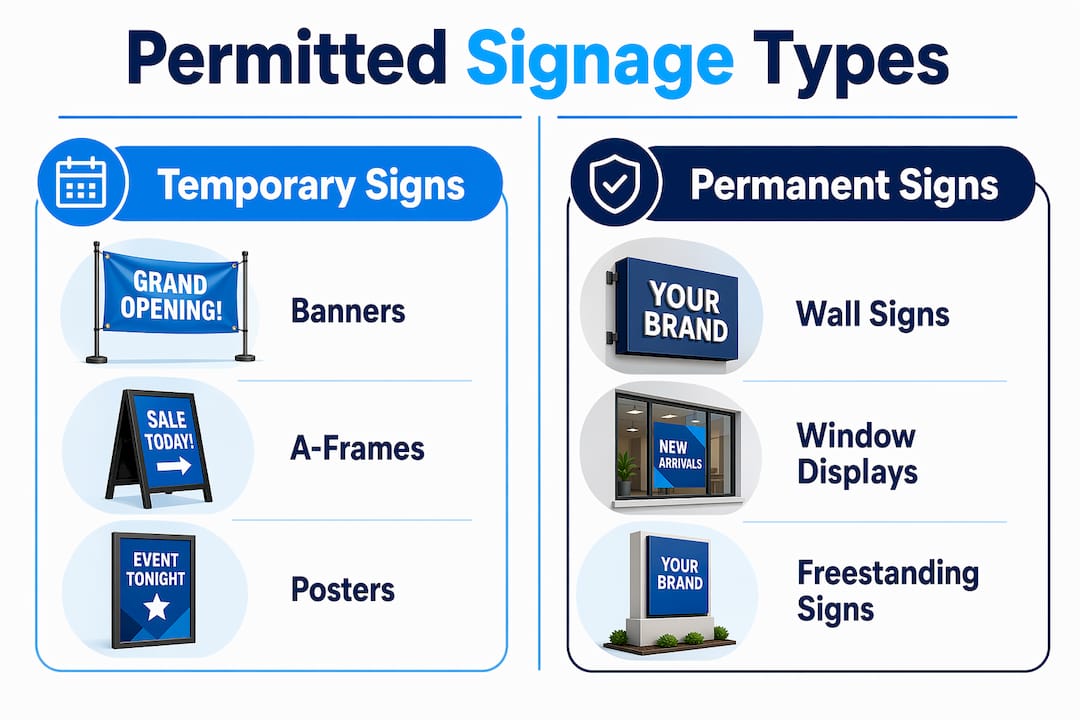
Most local ordinances recognize several standard categories of permitted signs. The table below summarizes the most common types, their typical characteristics, and how regulations generally treat them.
| Sign Type | Typical Characteristics | Regulatory Treatment |
|---|---|---|
| Temporary signs | Paper, vinyl, or fabric; non-durable materials | Often permit-exempt but subject to size and duration limits |
| A-frame signs | Freestanding, portable, placed on sidewalks | Permitted in many zones; restricted near traffic intersections |
| Banners | Fabric or vinyl; attached to structures or poles | Usually require permits; duration limits apply |
| Fascia signs | Mounted flush to a building facade | Permitted with size limits relative to building frontage |
| Freestanding signs | Post-mounted or monument-style; permanent | Require permits; height and area caps enforced |
| Community event signs | Temporary; promote nonprofit or public events | Often given special exemptions with shorter display windows |
The Spokane signage definitions establish that temporary signs are specifically defined by their construction material and installation method. Signs made of non-durable materials like paper, vinyl, or fabric are classified as temporary, which directly affects whether they follow a permit-exempt or permit-required compliance path. This material distinction is not just administrative. It determines your entire approval process.
York Region’s framework adds another layer. The York Region Sign Bylaw restricts temporary sign dimensions to 1.2 meters high and wide, limits placement to designated intersections, and requires permit stickers on all approved signs. Election signs must use A-frame or wooden stake construction only. These specifics show how granular local rules can get, even for signs most people assume are unrestricted.
For event organizers, community event signs and banners are the most frequently used permitted sign types. Both categories carry duration restrictions in most jurisdictions, which means planning your installation and removal timeline is as important as the sign design itself.
Where can permitted signs legally be placed?
Placement rules are where most business owners and event organizers run into trouble. A sign that is perfectly legal in terms of size and content can still be removed or fined if it is installed in a restricted location.
The most common placement restrictions include:
- Right-of-way zones. Signs placed on public sidewalks, road shoulders, or within the road right-of-way typically require a separate street use or encroachment permit, regardless of the sign’s size or type.
- Intersection sight triangles. Most municipalities prohibit signs within a defined distance of intersections to protect driver sightlines. York Region’s bylaw limits placement to specific designated intersections, not just any corner.
- Parking areas. Signs placed in parking lots or near driveways must not obstruct vehicle or pedestrian movement, and height restrictions often apply.
- Private versus public property. A sign on private property may be permitted under zoning rules, but the same sign placed one foot onto a public sidewalk may require an entirely different permit.
Event signage adds another layer of complexity. In Madison, Wisconsin, closing or reserving streets for events requires a Street Use Permit, and any signage placed in those areas falls under that permit’s conditions. Zoning permits may also apply if the event uses adjacent private property. Event organizers who assume their event permit covers all signage in the area are frequently wrong.
Pro Tip: Before ordering any sign, call your local planning or zoning department and ask two specific questions: Is this location in the public right-of-way? And does my sign type require a placement-specific permit? Getting written confirmation protects you if a code enforcement officer later disputes your installation.
For construction-related signage, NYC permit guidance outlines how site signs at construction projects must comply with local sign bylaws, including placement relative to the building line and pedestrian pathways.
How do ordinances regulate content, size, illumination, and duration?
Beyond placement, four additional compliance factors shape what is and is not allowed signage: content, size, illumination, and display duration.
Content restrictions focus on public safety and community standards. Most ordinances prohibit signs that obscure traffic signals, mimic emergency vehicle markings, or display content deemed hazardous to drivers. Off-premises advertising is a particularly restricted content category. The Spokane Municipal Code prohibits construction of new off-premises signs entirely and restricts expansion or relocation of existing ones. Off-premises signs advertise products or services not available at the sign’s location, which is why directional event signs pointing to a venue several blocks away can trigger this rule.

Size limits vary by sign type and zone. Spokane caps temporary freestanding signs at 4 square feet in non-residential zones. York Region limits temporary signs to 1.2 meters in both height and width. Permanent fascia signs are typically regulated as a percentage of the building’s frontage, meaning a larger storefront is allowed a larger sign.
Illumination rules are stricter than many business owners expect. Flashing or strobe-like illumination is prohibited in Spokane, with limited exceptions for electronic message centers that meet specific technical standards. The prohibition targets signs with alternating fully illuminated and non-illuminated light patterns, which are considered driver distractions. This directly limits the use of animated LED signs in many commercial zones.
Duration limits apply primarily to temporary and event signage. York Region and similar municipalities specify allowed display windows to minimize visual clutter and reduce hazards from deteriorating signs. A sign in poor repair can be removed by the municipality at the owner’s expense, which makes timely removal after an event a compliance issue, not just a courtesy.
Common misunderstandings about signage compliance requirements
Several recurring mistakes cause business owners and event organizers to face fines or forced removals even when they believe they are operating within the rules.
- “No permit required” does not mean no rules apply. Spokane’s permit-exempt temporary signs still carry size, placement, and duration restrictions. Assuming exemption from permits means exemption from all regulation is the single most common compliance error.
- On-premises versus off-premises confusion. A sign promoting your business at your location is on-premises. A sign directing customers to your location from a different street or property is off-premises. Off-premises signs face far stricter controls, and many municipalities ban new ones entirely.
- Abandoned signs are prohibited. Most ordinances define an abandoned sign as one that has not been maintained or whose business no longer operates at the location. These signs are subject to forced removal and fines even if they were originally permitted.
- Event permits do not automatically cover signage. As the Madison Street Use Permit framework shows, event signage in public spaces often requires a separate permit process beyond the event permit itself.
Pro Tip: Download your municipality’s sign bylaw as a PDF and search for the words “prohibited” and “exempt.” Reading those two sections first gives you a clear picture of what is absolutely off-limits and what you can use without a formal application.
Complying with sign regulations reduces the risk of citation, forced removal, or fines, and it protects public safety by preventing signage that blocks pedestrian flow or impairs driver visibility. For guidance on safety-driven signage compliance, the principles of material selection and placement directly overlap with local code requirements.
Key takeaways
Permitted signage is legally authorized signage that meets local rules on size, placement, content, and duration. Compliance requires checking both permit requirements and use-specific restrictions before installation.
| Point | Details |
|---|---|
| Definition of permitted signage | Any sign conforming to local zoning codes on size, placement, content, and materials. |
| Permit-exempt does not mean unrestricted | Temporary signs in Spokane require no permit but still carry size and placement limits. |
| Placement rules are jurisdiction-specific | York Region restricts temporary signs to designated intersections with mandatory permit stickers. |
| Illumination and content have hard limits | Flashing signs are prohibited in Spokane; off-premises advertising faces near-total bans in many cities. |
| Event signage needs separate permits | Madison, WI requires Street Use Permits for event signs placed in public rights-of-way. |
Why I think most businesses underestimate signage compliance
Most business owners treat signage as a creative decision and a legal afterthought. After years of working with clients across retail, construction, and events, I have seen that pattern cause real damage. A banner ordered two weeks before a grand opening gets pulled by code enforcement the day before the event because it was 6 inches too wide or placed 10 feet into the right-of-way. That is not bad luck. It is a planning failure.
The detail that surprises most people is how much variation exists between neighboring municipalities. York Region and the City of Toronto share a border, but their sign bylaws differ significantly on temporary sign dimensions and placement rules. An event organizer who ran a successful outdoor promotion in one city cannot assume the same setup works across the street in the next jurisdiction.
What actually works is treating signage compliance the same way you treat any other operational permit. Start early, get written confirmation from the local authority, and build removal dates into your event timeline from day one. I have also found that investing in proper signage installation from the start, using durable materials and correct mounting methods, reduces the chance of a sign being reclassified as a hazard or violation after the fact.
The businesses that avoid compliance problems are not the ones with the best lawyers. They are the ones who called the planning department before they called the sign shop.
— Yossi
Get compliant custom signage from Customsignstoday

Customsignstoday specializes in producing signs built to meet local regulatory standards, from material selection to size specifications. Whether you need face change signs that update your storefront display within existing permitted dimensions, or site signs designed to satisfy construction zone requirements, the team at Customsignstoday works with your compliance needs, not around them. Every custom order accounts for the durability, sizing, and installation requirements that local ordinances demand. Business owners and event organizers in West Palm Beach and across Palm Beach County can request a free quote and get expert guidance on which sign types fit their specific permitted use case.
FAQ
What does “permitted signage” mean?
Permitted signage refers to any sign that complies with local zoning codes and ordinances governing size, placement, content, and display duration. The term covers both signs that require a formal permit and those that are pre-approved by right under specific conditions.
Do all temporary signs require a permit?
Not always. Spokane, for example, allows temporary freestanding signs without a permit in non-residential zones, provided they stay within 4 square feet and meet placement rules. However, permit-exempt does not mean regulation-free.
What are examples of permitted signs for events?
Common examples include A-frame signs, banners, and community event signs. These are typically permitted with duration limits and placement restrictions. Event signage placed in public rights-of-way, as in Madison, WI, requires a Street Use Permit regardless of sign type.
Can I place a sign anywhere on my property?
No. Even on private property, signs must comply with setback rules, intersection sight-triangle restrictions, and height limits. Placement within a public right-of-way, even accidentally, triggers separate permitting requirements.
What happens if my sign violates local ordinances?
Violations typically result in a notice of non-compliance, a fine, or forced removal at the owner’s expense. In York Region, signs in poor repair can be removed by the municipality directly. Repeated violations can affect future permit applications.