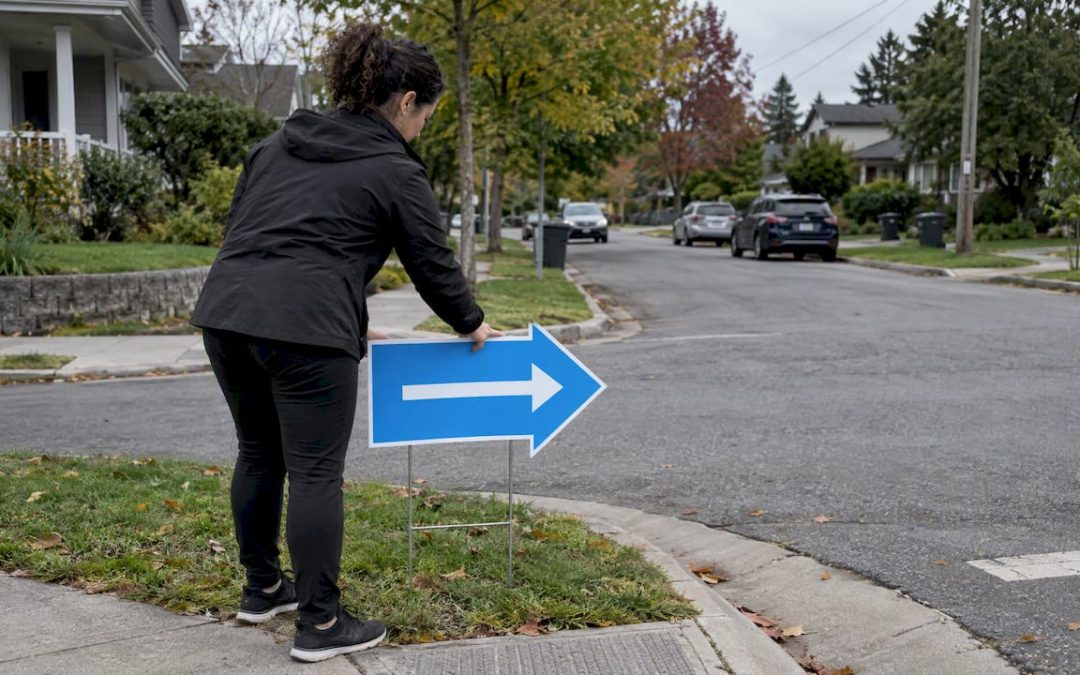
Effective open house sign approaches include a directional arrow chain from the nearest arterial road, a high-contrast yard sign at the curb, an A-frame welcome board at the entry, and a branded sign-in hub inside the door. Put the arrow chain and yard sign up first since they capture drive-by traffic, and always confirm local placement rules and daylight-only removal before you leave anything curbside.
TL;DR:
- On routes with several turns, place a matching arrow at each turn and a confirmation sign near the driveway; reserve feather banners for busy arterials.
- Keep roadside wording under ten words, making “Open House” largest, followed by the house number, event time, and one suitable call to action.
- Use coroplast for stake signs, PVC for reusable A frames, vinyl for banners, and aluminum for signs kept up through a listing.
- On dead end streets, skip long arrow chains; at condo entrances, use one A frame, and check HOA rules before placing signs off property.
- Some local codes limit off property A frames to three feet and four to six square feet per face, while requiring agent presence and prompt removal.
Table of Contents
- Top Creative Open House Sign Ideas and Examples
- What to Put on Every Open House Sign
- Materials, Color, and Durability That Hold Up Outdoors
- Placement, Routing, and the Rules That Keep You Compliant
- Design Checklist and Ready-to-Order Templates
- Lessons From Producing Hundreds of Open House Signs
- Order Custom Open House Signs Built for Your Next Listing
- FAQ
- Sources
Top Creative Open House Sign Ideas and Examples
Every open house benefits from a layered sign system rather than a single yard sign. Think of it as a path: a driver spots a sign on the main road, follows two or three more to the property, then meets a welcome board and a sign-in table that reinforce your brand the whole way.
Directional arrow chains do the heaviest lifting in neighborhoods with more than one turn between the main road and the house. Place the first arrow at the nearest intersection with enough traffic to matter, then add one every turn after that so a driver never has to guess. Keep spacing even, usually one sign per turn plus a confirmation sign close to the driveway, and adapt spacing based on local conditions. Use the same color and font on every sign in the chain so it reads as one system instead of a scatter of mismatched stakes. NAR guidance points to bold, high-contrast colors and strategic placement at busy intersections as two of the more reliable ways to increase foot traffic and reinforce brand recognition at the same time. Our directional signage solutions page covers common arrow layouts if you want a template to start from.
A-frame welcome boards belong right at the front walk or driveway entrance, not out at the curb where the yard sign already lives. Give the board three content blocks: your brand mark and photo near the top, “Open House” in the largest type on the panel, and a short line underneath with the time window. Because an A-frame sits close to pedestrians rather than passing cars, you can afford smaller type and a bit more copy than a roadside sign allows. Our custom A-frame signs page has panel sizes and base options if you’re ready to order one.
Feather banners and tall vinyl banners matter most on arterial roads where a standard yard sign gets lost among traffic signals and other visual noise. A feather banner’s height gives it a visibility advantage a 24-inch yard sign can’t match from a moving car, so reserve it for the busiest stretch of your route rather than every corner. Anchor it with a weighted base or ground stakes rated for wind, since a banner that’s blown over stops working entirely. Browse feather and vinyl banners for sizing options built for exactly this use.
Yard panels and stake signs remain the workhorse for narrow lots and quieter streets where a full banner would be overkill. A photo-panel variant, your headshot and brokerage logo printed directly on the panel, adds a layer of brand recognition that a plain text sign skips. For lots with limited frontage, a single well-placed panel angled toward the dominant traffic direction outperforms two signs crowded together.
Movement draws the eye, which is why flags and windsocks have become a steadier alternative to balloons. NAR’s broker-news coverage notes that flags and banners hold up better over a full day of outdoor use and pair naturally with signage placed two days ahead of the event. A simple flag at the curb catches peripheral vision from drivers the same way a balloon cluster does, without the deflation problem by hour three.
QR codes, flyer tubes, and photo panels turn static signage into something a visitor can act on immediately. A QR code on the yard sign or A-frame that links straight to a property page or a digital sign-in form saves you a conversation and captures a lead even if nobody walks in. A flyer tube mounted on the stake sign keeps printed handouts dry and available without staffing the curb.
Situational adjustments matter as much as the sign itself:
- Tight cul-de-sac: skip the long arrow chain and rely on one strong yard sign plus a clear A-frame, since drivers are already slowing down.
- Busy arterial: lead with a feather banner at the main turn, then step down to standard arrows for the final approach.
- HOA neighborhoods: confirm sign-code rules before placing anything beyond your own yard, since many associations restrict off-premise signage entirely.
- Condo complexes: a single well-placed A-frame near the building entrance usually beats multiple yard signs, which often aren’t permitted on shared property.
Pro Tip: Keep every sign in a single open house’s chain the same color and font so a driver recognizes the system after seeing just one sign, not five different ones.
What to Put on Every Open House Sign
Every sign in your system should answer one question in under two seconds: what is this, and what do I do next. That means a strict copy hierarchy, not a sign crowded with every detail you’d like someone to know.
- “Open House” dominates the panel. This phrase should take up the largest share of visible space on any roadside sign. It’s the single piece of information a driver needs to register before deciding whether to slow down.
- Address or house number, plus a directional arrow if the sign isn’t at the property itself. A readable number matters more on a yard sign than a full street address, since context tells the driver they’ve arrived.
- Date and time, kept short. “Today 1–4pm” reads faster than a full date and works for any sign placed the day of the event.
- Agent contact and brokerage name, sized last. A phone number or a QR code pointing to a landing page covers this without crowding the top of the sign; include the brokerage name only where your office requires it.
- A single call to action, chosen for the sign’s location. “Sign in here” belongs on the A-frame or hub near the door, “Text for tour” works well on a curb sign aimed at drivers who won’t stop, and “RSVP via QR” suits a sign posted days in advance of the event.
Hold every roadside sign to fewer than ten words total. Test it by reading the sign out loud at the pace you’d pass it in a car: if you stumble or need a second glance, cut a word. A sign inside the house, like the hub near your sign-in sheet, can carry a bit more copy since visitors are standing still when they read it.
Materials, Color, and Durability That Hold Up Outdoors
The right material depends entirely on where the sign lives and how long it needs to survive. Coroplast yard signs are the standard for curb and corner placement because they’re light, inexpensive, and easy to swap out between listings, though they dent and fade faster under repeated sun exposure than heavier options. PVC panels used on A-frames trade a little weight for a flatter, more rigid surface that holds crisp type and photo printing better over multiple uses. Vinyl banners handle feather flags and arterial signage well since the material flexes in wind instead of cracking, and aluminum panels are worth the extra cost for a site sign that stays up for the full length of a listing rather than a single weekend.
Color and contrast decide whether a sign gets read at all. NAR’s guidance specifically recommends bold, high-contrast colors to boost visibility and reinforce brand recognition, which in practice means dark text on a bright background, or the reverse, rather than mid-tone combinations that blur together from a moving car. Fluorescent or reflective stock adds another visibility layer for dusk showings, though check local rules first since some sign codes restrict reflective materials on roadside signage.
Typography should favor a clean sans-serif font like Helvetica, Arial, or Montserrat over anything decorative, since script and condensed fonts lose legibility at speed. A general rule for roadside copy: at least three inches of letter height for every ten feet of intended reading distance, so a sign meant to be read from a car window needs noticeably larger type than one placed at a walkway.
- Coroplast: lightweight and affordable, best for short-term yard and stake signs.
- PVC panels: rigid and smooth, ideal for A-frame inserts and photo printing.
- Vinyl: flexible and wind-resistant, the standard for banners and feather flags.
- Aluminum: the most durable option, suited to signs that stay up for a full listing period.
UV-resistant, fade-resistant inks matter more than most agents realize. A sign printed without UV-stable ink can visibly fade within a single season of regular outdoor exposure, which is why we recommend confirming ink type before placing a repeat order for signs that will see multiple open houses, based on how custom real estate signage is typically specified for outdoor durability.
A laminate or UV coating extends a sign’s working life further, and storing panels flat and out of direct sun between showings prevents warping, especially with PVC. On the sustainability side, reusable flags and banners cost more upfront than a balloon cluster but survive dozens of open houses instead of one afternoon, which is part of why NAR’s broker-news team points to flags as the more dependable choice over time.
Placement, Routing, and the Rules That Keep You Compliant
A placement map turns sign setup from a guessing game into a repeatable five-minute task. Start by picking two to three high-visibility nodes, typically the nearest major intersection, a secondary turn, and the property entrance itself, then mark the arrow intervals between them based on the posted speed limit of each road. Residential streets with lower speeds can have signs spaced closer together than faster arterial roads, where drivers need more advance notice to react safely.
- Mark your nodes first. Identify the two or three points where a driver has to make a decision, and that’s where a sign goes.
- Set spacing by speed, not habit. Faster roads need earlier warning, so place the first arrow farther back from the turn on arterial streets than on quiet side streets.
- Assign a retrieval zone to every sign you place. Note on your map who’s responsible for pulling each sign at the end of the day, so nothing gets left behind overnight.
- Photograph the finished layout. A quick photo at setup documents exactly where every sign stood, which doubles as proof of compliant daylight placement if a question ever comes up.
Regulatory rules vary by jurisdiction, but a few patterns show up consistently across the sign-code matrices realtor associations publish. One regional matrix lists common limits like a roughly 3-foot maximum height and 4 to 6 square feet per face for off-premise A-frame signs, along with daylight-only placement windows and outright bans on attaching signs to utility poles or medians. Many of the same ordinances also require the agent to be physically present while an off-premise sign is displayed and call for removal the moment the open house ends, so build that into your day-of plan rather than treating it as an afterthought.
The MUTCD governs temporary traffic-control signage on public roads and offers useful safety principles even for a residential open house: avoid placing directional signs where they could block a driver’s sightline at an intersection, and keep signs far enough from the roadway edge that they don’t become a hazard if a vehicle drifts. These aren’t optional suggestions in areas where a sign sits near a public right-of-way, so treat sightline clearance as a baseline rule for every arrow placement.
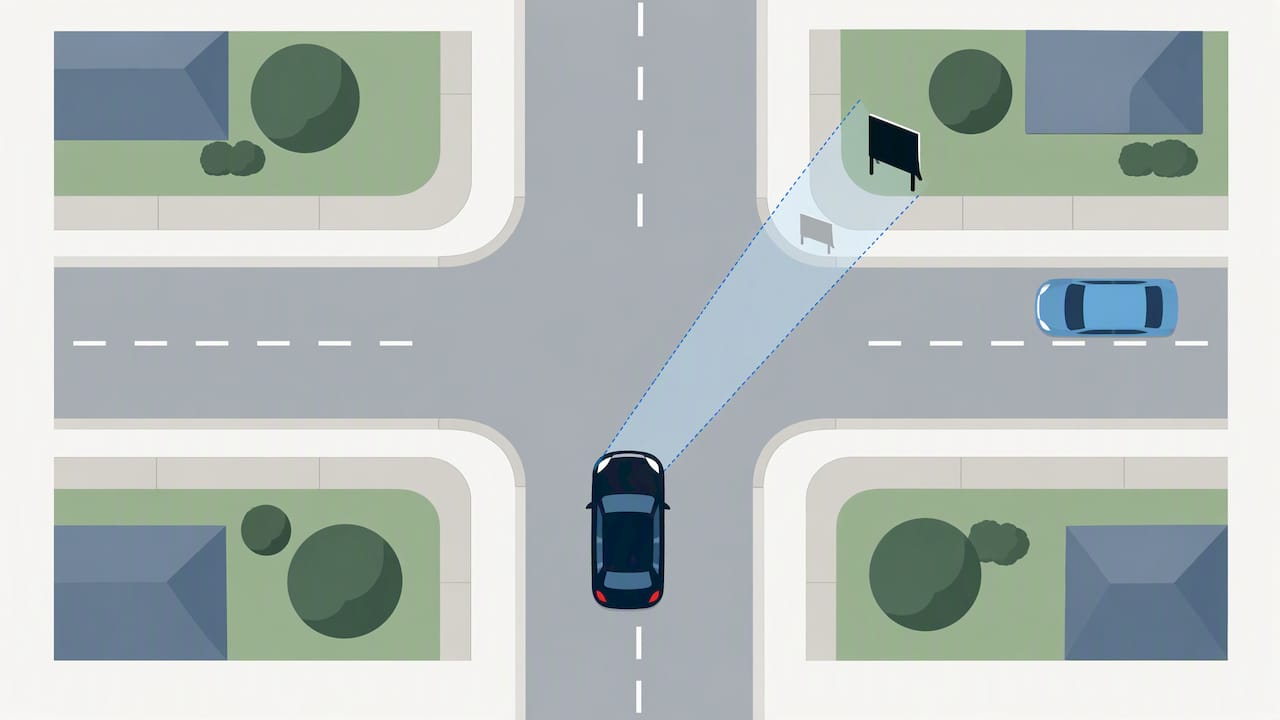
Before you leave the house, run a short day-of checklist: confirm any HOA or permit requirements for the specific street, weight every A-frame and stake sign against forecasted wind, double-check that the sign-in hub sits in clear view of the entry, and know exactly who’s pulling signs at closing time. Realtor recommends keeping printed sign-in sheets and clear event details ready alongside your signage, plus a cleanup step once the event wraps.
Pro Tip: Keep a labeled bin per neighborhood with your printed placement map, stakes, and arrow signs together, so setup for a repeat listing in the same area takes minutes instead of a full inventory search.
Design Checklist and Ready-to-Order Templates
Before you send anything to print, run through a short design checklist: confirm bleed and safe-area margins so text doesn’t get trimmed, place your logo in a consistent corner across every sign in the set, request a proof before full production, and check contrast by viewing the file in grayscale, since a design that reads clearly in black and white will read even better in color.
- Arrow chain panel: bold arrow graphic, “Open House” in large type, minimal else.
- A-frame welcome board: logo and photo up top, “Open House” centered, time window below.
- Feather banner: brokerage colors, “Open House” vertically readable from a distance.
- Yard panel: “Open House,” house number, and a QR code in the corner.
- Photo panel: agent headshot, brokerage logo, and a short tagline.
- Sign-in hub: “Welcome, please sign in” with space for a printed sheet or tablet.
Sample copy for a small roadside panel: “Open House / Today 1-4pm / Follow Arrows.” For a larger A-frame: “Open House Today / 1:00 to 4:00 PM / Scan for Details” with a QR code beneath the text.
A QR code should link to something useful the moment it’s scanned: turn-by-turn directions if placed early in the chain, a digital sign-in form at the hub, or the full property listing page on a yard panel. Keep the destination simple since most visitors are standing on a sidewalk, not sitting at a desk.
When you’re ready to order, request a physical print proof before a full run, specify UV-stable inks for anything spending a full day outdoors, and ask for rounded corners and weighted bases on A-frames so they hold up against wind and foot traffic.
| Template | Best placement | Key copy element |
|---|---|---|
| Arrow chain panel | Turns between arterial and property | Large directional arrow |
| A-frame welcome board | Front walk or driveway entrance | “Open House” centered |
| Feather banner | Busy arterial road | Vertical “Open House” text |
| Yard panel | Curb at property line | House number plus QR code |
| Sign-in hub | Just inside the entry | “Welcome, please sign in” |
Lessons From Producing Hundreds of Open House Signs
Working with agents on directional and open house signage at Customsignstoday has shown a consistent pattern: listings with a full routing plan and a branded sign-in hub generate more conversations with visitors than listings relying on a single yard sign. One recurring mistake is treating the yard sign as the whole strategy and skipping the hub entirely, which means visitors arrive with no clear next step once they’re through the door. Pick one routing plan and one high-contrast sign to test on your next listing before adding more pieces.
— Yossi
Order Custom Open House Signs Built for Your Next Listing
We offer design and production services for A-frames, yard signs, feather banners, and directional sign sets suitable for routing plans, with materials designed to hold up through a full showing weekend.

Browse our custom signs lineup or request a quote to get A-frames, banners, and directional arrows printed and ready before your next open house.
FAQ
What should be on an open house sign?
An open house sign should lead with “Open House” in the largest type, followed by the address or house number, the date and time, and a short call to action like a phone number or QR code. Keep total wording under ten words so it reads clearly at driveway speed.
How do you make open house signs stand out?
High-contrast color combinations and consistent branding across every sign in your routing chain make the biggest difference, according to NAR’s guidance on open house marketing. Adding movement, such as a flag or feather banner, also draws attention from drivers who might otherwise pass a static yard sign.
What is the best material for open house signs?
Coroplast works well for short-term yard and stake signs, while PVC panels suit A-frames that need a flatter, more durable surface for repeated use. Vinyl banners and aluminum panels hold up best for feather flags and longer-term site signage exposed to full days of weather.
How many open house signs should you have?
The right count depends on how many turns lead from the nearest main road to the property, with one arrow sign per turn plus a yard sign and an A-frame at the entrance being typical. Many local sign codes also cap the number of off-premise signs an agent can place, so check your regional sign-code matrix before finalizing your layout.
Sources
- National Association of Realtors (NAR)
- Regional sign-code matrix (NWREALTOR)
- Manual on Uniform Traffic Control Devices (MUTCD) — Part 6
- Realtor