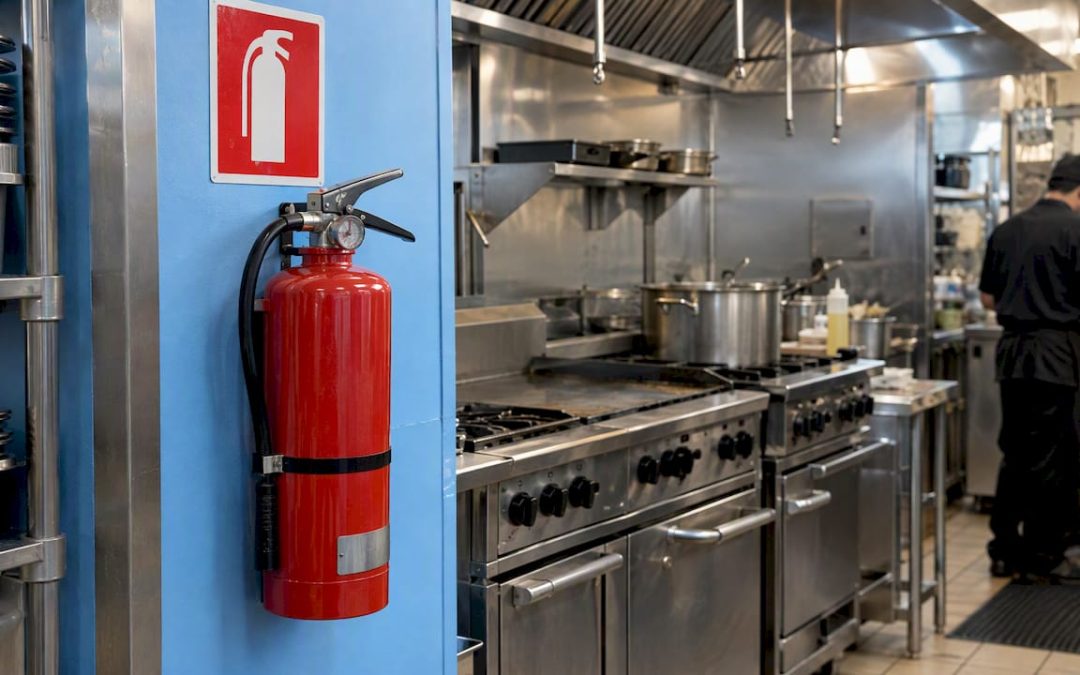
A wet chemical fire extinguisher sign tells staff, at a glance, that the unit beside it is a Class K extinguisher built for cooking oils and fats. It should say “WET CHEMICAL” and “CLASS K” in high-contrast lettering, hang where it is visible from the cooking line, and sit with an extinguisher that is within 30 feet of the fryers. If your kitchen also has a hood suppression system, a separate placard is usually needed too. The two signs do different jobs, and mixing them up is the most common mistake we see.
This guide is for restaurant owners, property managers and facility teams who need to order, place or replace these signs. It covers wording, placement, materials, the placard question and a short checklist you can hand to your sign maker.
TL;DR
- Say both “wet chemical” and “Class K” on the sign. The hazard is the cooking medium, so the letter K matters most.
- Mount the sign at the extinguisher, in plain sight, with a clear route to it. Class K units should be no more than 30 ft (9.1 m) of travel from the cooking hazard.
- A portable extinguisher sign is not the same as the fixed-system placard. If you have a hood suppression system, post the placard near the Class K unit as well.
- A sign cannot fix a wrong extinguisher or a blocked path. Check the unit, the distance and the clearance first, then order the sign.
- Your local fire marshal has the final word on wording and placement.
Table of Contents
- What a wet chemical sign actually identifies
- What the sign should say
- The sign versus the suppression-system placard
- Placement: where the sign earns its keep
- Materials and finishes for a kitchen
- Who must be trained, and what the sign cannot do
- Our perspective
- Getting your sign made
- Pre-order checklist
- FAQ
- Sources
What a wet chemical sign actually identifies
Wet chemical extinguishers contain a liquid agent designed for fires in cooking oils and fats. The U.S. Fire Administration explains that extinguishers use different agents such as water, CO2, dry chemical or wet chemical, depending on the fire they are intended for. In the US, the class that matches wet chemical is Class K: vegetable or animal oils and fats in cooking appliances.
That is why a sign reading only “fire extinguisher” falls short. A cook who sees a red cylinder on the wall may grab the nearest unit. An ABC multipurpose extinguisher is not a substitute for a Class K unit on a commercial cooking-oil hazard. The sign is there to stop that wrong grab.
There is a second reason. NFPA code-development material notes that when multiple extinguishers with different ratings or hazard purposes sit together, they must be signed or placarded so a novice user picks the right one. A kitchen with an ABC unit by the dish pit and a Class K unit by the fryers is exactly that situation.
What the sign should say
Keep the message short enough to read in two seconds, from across a busy line.
- “WET CHEMICAL” as the headline. This is the phrase people search for and the one staff hear in training.
- “CLASS K” in large, separate lettering. Do not bury it in small print. Class K is not numbered like A or B ratings, so the letter itself is the key mark.
- The hazard in plain words. “For cooking oils and fats” or “For fryers and cooking appliances” removes any doubt.
- A recognizable symbol. Many manufacturers use a letter-shaped class marking, and the NFPA fact sheet includes a table of extinguisher class and letter-shaped symbol markings. Match your sign to the symbol on the cylinder label so the two never disagree.
- Optional second language. If your crew reads Spanish more comfortably than English, a bilingual sign is a practical choice. Keep the English wording intact.
What to leave off: marketing, logos that compete with the message, and decorative fonts. A safety sign is read under stress.
Reading the cylinder before you order
Do not choose wording from color or memory. Read the cylinder label. You are looking for the Class K classification, wording about wet chemical or cooking-oil use, and a recognized testing mark. The USFA recommends checking for a UL Listed or ULC Listed mark on any extinguisher. The sign should repeat what the label says, never contradict it.
The sign versus the suppression-system placard
This is the distinction that gets missed. Two different pieces of signage can appear near a kitchen extinguisher:
| Wet chemical / Class K identification sign | Fixed-system placard | |
|---|---|---|
| Purpose | Identifies the portable extinguisher and the hazard it is for | Tells staff to activate the fixed hood system before using the portable unit |
| Typical message | “Wet chemical, Class K, for cooking oils and fats” | An instruction about the order of actions when an appliance fire occurs |
| Where it goes | At or above the extinguisher | Near the Class K extinguisher where a fixed system is present |
| Needed when | A Class K extinguisher is provided | A hood suppression system protects the cooking line |
NFPA code-development material discusses posting a conspicuous placard near a Class K extinguisher when a fixed extinguishing system is present. Restaurant fire guidance from OSHA’s youth-worker pages gives the same order of operations: sound the alarm, summon the fire department and activate the fixed system, and use a portable extinguisher only when trained and safe to do so.
Some suppliers sell one sign that combines both messages. That can work, but ask your fire marshal or extinguisher service company whether they want the placard worded a particular way. Inspectors often have a preferred phrasing, and re-making a sign costs more than asking first.
Placement: where the sign earns its keep
A sign is only as good as the path to the extinguisher behind it.
Distance and visibility
The NFPA fact sheet states that Class K extinguishers should be no more than 30 ft (9.1 m) of travel distance from the hazard. OSHA’s eTool repeats the 30-foot figure for Class K. Do not apply the 75-foot rule you may know from general extinguisher placement. That is for other classes, not for a cooking line.
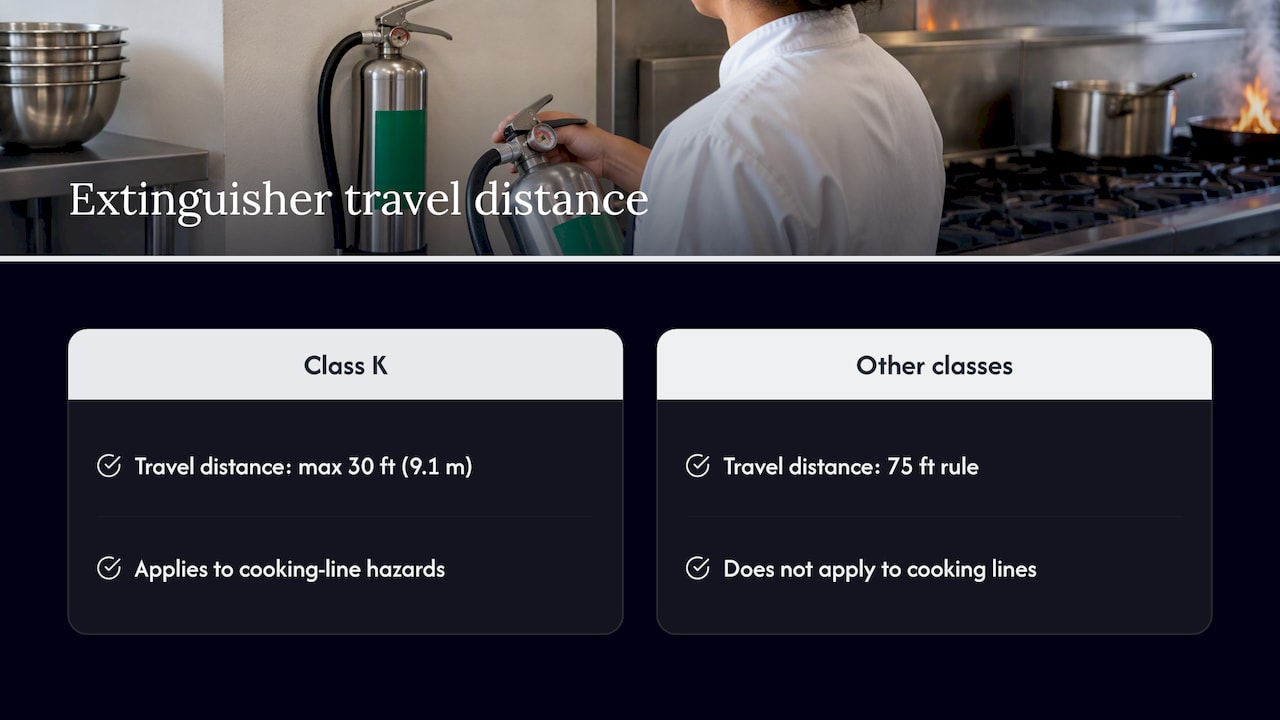
The same fact sheet says that where visual obstructions cannot be avoided, arrows, lights or signs are needed to show where the extinguisher is. So in a kitchen with a bend, a pass-through or tall shelving, you may need a second directional sign pointing to the Class K unit, in addition to the one at the extinguisher.
Walk the line before you order
Before finalizing sign size and position, do this with a manager and a line cook:
- Stand at each fryer, griddle and range. Can you see the sign from there?
- Measure the actual walking route to the extinguisher, around equipment, not in a straight line.
- Check that nothing is stored in front of the unit or the sign.
- Confirm the sign will not be hit by steam, splatter or a swinging door.
- Note the lighting. A dim corridor may call for a photoluminescent or reflective material.
OSHA requires employers to mount, locate and identify portable extinguishers so they are readily accessible without exposing employees to possible injury. The identification part is where your sign fits. The accessibility part is on you. OSHA has also cited employers where extinguishers were not mounted, located and identified for ready access, which shows a visible sign does not help if the unit behind it is hard to reach.
For general principles on height, sightlines and mounting, our guide to effective sign placement applies directly to safety signage.
Materials and finishes for a kitchen
Kitchens are hard on signs: grease, heat, steam, and frequent wipe-downs with degreasers. Choose a material for the spot, not just the price.
- Rigid plastic or aluminum. Good for wall mounting near the extinguisher. Stays flat, wipes clean, and does not curl in humidity.
- Self-adhesive vinyl. Fits a smooth wall, cabinet or door, and works well for small identification labels. The surface needs to be clean and non-porous so the adhesive holds.
- Photoluminescent. Useful where the lights might fail or the route passes through a dim storage area. Check that the material you are offered is rated for the brightness and glow time your inspector expects.
- Projecting or flag-mounted signs. Helpful when a shelf, hood or wall return hides a flat sign from the line of work.
Ask for rounded corners and a matte or low-glare laminate. Reflections under kitchen lighting can make red-on-white lettering hard to read from an angle.
Who must be trained, and what the sign cannot do
A sign is a cue, not training. OSHA’s restaurant guidance says employees expected to fight fires must be educated on the types of extinguishers and how to use them correctly, and that people should always read the label before using an extinguisher. The sign speeds up recognition. It does not replace a drill.
OSHA also requires monthly visual inspections and an annual maintenance check for workplace extinguishers. Add the sign to that monthly walk: is it still attached, legible, unobscured and matched to the unit?
If you are renovating or opening a new kitchen, upkeep reaches beyond the extinguisher. Grease, dust and construction residue build up fast around hoods and cooking lines, and the commercial cleaning safety tips from an Australian cleaning team are a useful companion when you plan fire protection signage alongside a kitchen build-out. Note that Australian rules differ from US ones, so use the US sources above for compliance.
Our perspective
Most of the signage mistakes we see are not about the sign. They are about the order of decisions. A business orders a sign first, then finds the extinguisher is on the far side of a prep table, or that the placard wording does not match what the inspector wants. The sign gets remade.
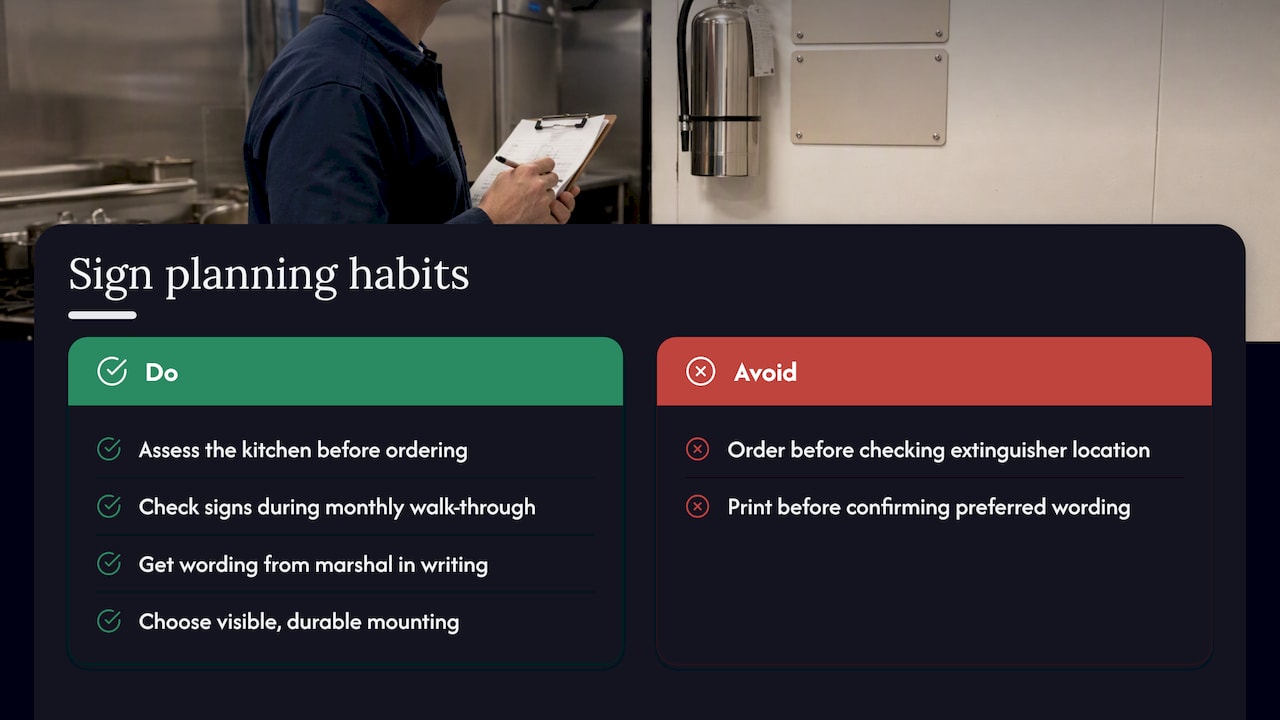
Our approach is to start with the environment. We look at where the cooking line is, how people move through the kitchen, what the extinguisher label says and what your local authority expects. Then we fit the sign to the brand and the room: the right size, a material that survives grease and cleaning, and a mounting spot that stays visible. Our process covers consultation and compliance questions through to installation, and we work with businesses locally and nationwide.
Two habits we recommend. First, put the Class K sign and any fixed-system placard on your monthly extinguisher walk-through. Second, ask your fire marshal for wording in writing before you print. A five-minute email saves a reprint.
— Yossi
Getting your sign made
If you need a wet chemical or Class K identification sign, a directional sign pointing to it, or a full set of kitchen safety signs, we make them to your size, material and wording. Send us a photo of the extinguisher label and the wall where it hangs, and tell us whether you have a hood system. We will take it from there. Start with our custom signs page and request a quote, or look at our interior signs for wall-mounted options. For the wider picture, see our Class K signage compliance guide and the mandatory safety signs checklist.
Pre-order checklist
Bring these answers to your sign maker:
- Does the cylinder label say Class K and show a UL or ULC mark?
- Is the unit within 30 ft (9.1 m) of travel from every cooking appliance?
- Is there a hood suppression system, and does your fire marshal want a placard?
- How many sightline problems are there: corners, shelves, doors?
- Do you need a second directional sign?
- What surface will the sign mount on, and how hot, wet or greasy is it?
- Do you want bilingual wording?
- Who will check the sign each month?
Local fire-code adoption varies. The International Fire Code is adopted and amended by individual jurisdictions, so the local fire marshal remains the final check on any wording or placement rule.
FAQ
How do you identify a wet chemical fire extinguisher?
Read the cylinder label. Look for the Class K classification, wording about wet chemical or cooking oils and fats, and a testing mark such as UL Listed. Do not rely on color alone, since appearance varies by manufacturer.
Is a wet chemical extinguisher the same as Class K?
In US kitchens, yes in practice: wet chemical extinguishers are the type used for Class K fires, which involve vegetable or animal oils and fats in cooking appliances. The label should state Class K. An ABC multipurpose unit is not a replacement for it on a commercial cooking-oil hazard.
How far can a Class K extinguisher be from the fryers?
NFPA’s fact sheet and OSHA’s eTool both give a maximum of 30 ft (9.1 m) of travel distance. That is walking distance around equipment, not a straight line. Your local fire marshal may add requirements.
Do I need a placard if I have a hood suppression system?
NFPA material discusses posting a conspicuous placard near a Class K extinguisher when a fixed extinguishing system is present, telling staff to activate the system first. Ask your fire marshal or extinguisher service provider for the exact wording they expect.
Can a sign replace a blocked or badly placed extinguisher?
No. A sign only helps people find and identify a unit. The extinguisher still has to be accessible, correctly selected and within the allowed distance. A sign that leads to an obstructed unit does not fix the problem.
Sources
- OSHA 29 CFR 1910.157, Portable fire extinguishers
- OSHA restaurant safety: cooking fires
- OSHA citation record for extinguishers not mounted, located and identified
- NFPA fact sheet: Fire extinguisher location and placement
- NFPA 10 public comment responses
- U.S. Fire Administration: Choosing and using fire extinguishers
- 2024 International Fire Code