
TL;DR:
- Digital signage captures significantly more views and recall than static signs, making it more effective for dynamic messaging. It offers faster updates, real-time data integration, and higher engagement, but requires higher initial investment and ongoing software costs. Traditional signage remains preferable for permanent, outdoor, or regulated displays with low update needs.
Digital signage uses electronic screens to display dynamic, programmable content that updates instantly, while traditional signage relies on fixed, printed materials with a single, unchangeable message. The gap in performance between these two formats is measurable. Digital signage captures 400% more views than static displays, and viewers recall digital content at 83% compared to 45% for printed posters. For business owners and marketing managers weighing digital vs. traditional signage, the right choice depends on your update frequency, budget, and communication goals. Customsignstoday works with businesses across both formats to match the right solution to the right situation.
How do digital and traditional signage differ in effectiveness?
Digital signage wins on attention and recall by a wide margin. The 83% recall rate for digital content versus 45% for static posters reflects a fundamental difference in how the human brain processes motion and light. Moving images and video trigger involuntary attention, which is why a screen in a retail window pulls more eyes than a printed banner in the same spot.
The engagement advantage extends beyond attention. Digital signage increases impulse purchases by 19.8% and reduces perceived wait times by 30–35% in retail and service environments. That second statistic matters for restaurants, clinics, and service counters where perceived wait time directly affects customer satisfaction scores.
Traditional signage effectiveness is strongest when the message is permanent and the environment is predictable. A wayfinding sign in a parking garage, a regulatory notice on a construction site, or a branded monument sign at a building entrance all perform exactly as intended with static materials. The message never changes, so the medium never needs to change either.
The table below shows where each format leads on key performance factors.
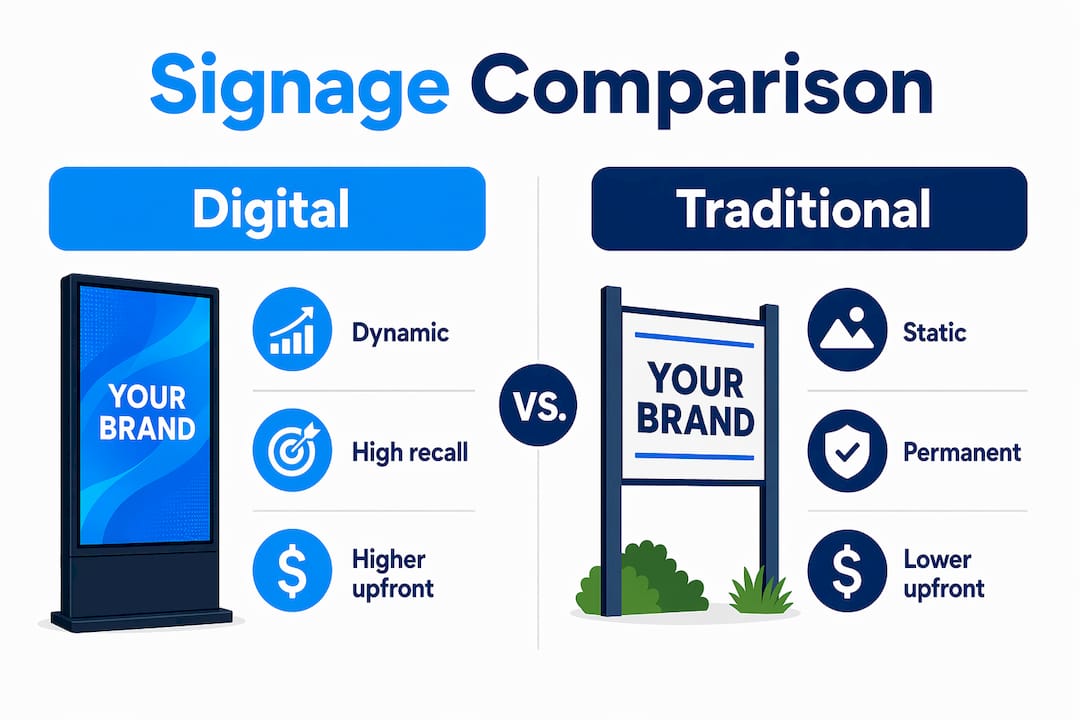
| Factor | Digital signage | Traditional signage |
|---|---|---|
| Viewer recall rate | 83% | 45% |
| Views captured vs. static | 400% more | Baseline |
| Impulse purchase lift | 19.8% increase | Minimal measurable lift |
| Content flexibility | Instant, remote updates | Requires physical replacement |
| Best environment | High-traffic, dynamic messaging | Permanent, low-change locations |
Digital signage also opens capabilities that printed formats cannot replicate. Content scheduling through dayparting lets a restaurant show breakfast promotions at 8 a.m. and dinner specials at 5 p.m. on the same screen. Live data integration allows real-time price changes, emergency alerts, and queue management displays. None of those functions are possible with a printed sign.
- Motion and video drive the recall advantage. Static content competes with everything else in a viewer’s field of vision. Moving content wins that competition automatically.
- Dayparting lets a single screen serve multiple audience segments across the day without any physical intervention.
- Live data feeds connect signage to inventory systems, weather data, or social media, making content feel current and relevant.
- Emergency messaging can override all scheduled content instantly, a capability that printed signs simply cannot provide.
What are the cost considerations for digital versus traditional signage?
Upfront costs favor traditional signage. A basic printed sign runs $180–$600 for entry-level illuminated boards, while a single-screen digital setup costs $500–$850 including hardware and initial software. That gap feels significant at the point of purchase.
The cost picture reverses over time. Traditional signs incur recurring fabrication and installation costs every time the message changes. A business running weekly promotions pays for new print materials and installation labor each cycle. Digital signage eliminates both of those costs after the initial setup.
Digital signage breaks even within 2–3 years when content updates are frequent. That timeline shortens as update frequency increases. A retailer changing promotions weekly reaches break-even faster than a business updating content monthly.
| Cost category | Digital signage | Traditional signage |
|---|---|---|
| Initial hardware | $500–$850 per screen | $180–$600 per sign |
| Content update cost | Near zero (remote) | Print + installation each time |
| Software subscription | $10–$50+ per screen/month | None |
| Break-even timeline | 2–3 years (frequent updates) | N/A (lower upfront, higher recurring) |
| Best for | High-frequency messaging | Permanent or low-change displays |
Software subscriptions add an ongoing line item that business owners often underestimate. Digital signage software runs $10–$50 or more per screen per month. For a five-screen deployment, that is $600–$3,000 per year before any hardware or content costs. That budget must be planned from day one, not discovered after installation.
Pro Tip: Before committing to digital signage, calculate your current annual spend on print production and installation for signage updates. If that number exceeds $1,500 per year, digital signage will likely pay for itself within the break-even window. If you update content rarely, traditional signs remain the more economical choice.
Learning more about maximizing signage ROI before you buy helps you set realistic expectations for both formats.
What operational factors distinguish digital and traditional signage?
Content management is where digital signage creates the clearest operational advantage. A marketing manager can update messaging across 50 locations simultaneously from a single dashboard. That capability is not possible with physical signs, where each location requires a separate print run, delivery, and installation visit.

Traditional signage requires physical intervention for every change. Swapping a printed banner means ordering new materials, waiting for production, scheduling installation, and paying labor costs. For businesses with multiple locations, that process multiplies at every site. The operational burden of frequent updates makes traditional signage impractical for dynamic messaging at scale.
Digital signage introduces its own operational requirements. Screens need power, which limits placement options. Hardware requires maintenance and eventual replacement. Software platforms need updates and monitoring. Digital signage is an ongoing service commitment that demands hardware, software subscriptions, and a content management strategy to function effectively.
Key operational differences to factor into your planning:
- Remote content control lets digital signage managers push updates to any number of locations without travel or physical labor.
- Power dependency means digital screens cannot go where electrical infrastructure does not exist, which rules them out for many outdoor and construction site applications.
- Durability favors traditional signage in harsh outdoor environments. Printed materials and dimensional signs tolerate weather, dust, and temperature extremes better than electronic displays.
- Installation complexity is higher for digital signage. Screens require mounting, power routing, and network connectivity. Traditional signs need mounting only.
- Scalability strongly favors digital for multi-location businesses. Centralized control makes it practical to manage consistent messaging across dozens of sites.
Effective signage installation practices matter for both formats. Poor installation shortens the lifespan of any sign, digital or traditional.
When should businesses choose digital versus traditional signage?
The decision comes down to three variables: how often your message changes, whether power is available at the display location, and what your total budget looks like over a three-year horizon.
Traditional signage is the right choice when the message is permanent or nearly permanent. Regulatory signs, permanent wayfinding, and artisanal brand identity displays all belong in this category. Some regulatory environments actually require static signs by law, which removes digital from consideration entirely. Outdoor locations without reliable power access also default to traditional formats. A construction site sign, a real estate yard sign, or a monument sign at a property entrance all work best as printed or fabricated materials.
Digital signage fits businesses where content changes frequently and the location has reliable power. Retail stores running weekly promotions, restaurants updating daily specials, and corporate offices managing internal communications all benefit from the flexibility of screens. Digital signage increases employee engagement by 350% compared to traditional print communications in workplace settings. That figure reflects how much more attention a screen commands over a printed bulletin board.
The most effective deployments combine both formats strategically. A restaurant uses a fabricated exterior sign for permanent brand identity and digital menu boards inside for daily specials. A retail chain uses printed window graphics for seasonal brand campaigns and digital screens for in-store promotions. Each format does what it does best.
Pro Tip: Map your signage by update frequency before choosing a format. Any sign you update more than four times per year is a strong candidate for digital. Any sign that stays the same for a year or more is better served by traditional materials.
A smart signage strategy accounts for both formats and assigns each one to the right job.
Key takeaways
The most cost-effective signage strategy assigns digital formats to high-frequency messaging and traditional formats to permanent displays, based on update frequency, location power access, and a realistic three-year budget.
| Point | Details |
|---|---|
| Recall and attention | Digital signage delivers 83% viewer recall versus 45% for static printed signs. |
| Cost break-even | Digital signage pays for itself within 2–3 years when content updates are frequent. |
| Operational fit | Remote content control makes digital signage practical for multi-location businesses. |
| Traditional strengths | Printed and fabricated signs remain the right choice for permanent, outdoor, or regulated displays. |
| Best approach | Combining both formats assigns each to the job it performs best, maximizing total signage ROI. |
Why I think most businesses get this decision backwards
Most business owners I talk to frame this as a binary choice: go digital or stay traditional. That framing costs them money. The businesses that get signage right treat the two formats as tools in the same kit, not competitors.
The mistake I see most often is buying digital screens and then neglecting the content strategy. A screen showing the same slide for three weeks delivers worse results than a well-designed printed poster. Screen fatigue sets in fast when content stops feeling current. The hardware is not the investment. The content calendar is.
The other common error is dismissing traditional signage as outdated. A high-quality fabricated sign at your building entrance communicates permanence and credibility in a way that a screen never quite matches. Brand authenticity has real value, and some materials carry it better than pixels do.
My honest recommendation: start by auditing how often each sign in your business actually changes. Signs that stay static for more than a year should stay traditional. Signs tied to promotions, menus, or time-sensitive information are where digital earns its cost. That audit takes an afternoon and will save you from buying the wrong format for the wrong location.
— Yossi
Customsignstoday can help you get the right format in the right place
Choosing between formats is only half the decision. Execution determines whether the sign actually works. Customsignstoday produces both traditional and digital-ready signage for businesses in West Palm Beach and across Florida, with professional design and installation built into every project.
For businesses that need flexible display options without committing to full digital infrastructure, face change signs offer a practical middle ground. The frame stays in place and the face swaps out, cutting production and installation costs on every update. For businesses ready to build a full signage plan, Customsignstoday offers custom sign services covering every format from banners and site signs to dimensional lettering and vehicle wraps. Request a free quote and get a recommendation matched to your actual update frequency and location requirements.
FAQ
What is the main difference between digital and traditional signage?
Digital signage displays dynamic, programmable content on electronic screens that update remotely and instantly. Traditional signage uses fixed, printed, or fabricated materials with a single static message.
Is digital signage worth the higher upfront cost?
Digital signage breaks even within 2–3 years for businesses that update content frequently, because it eliminates recurring print production and installation costs. For businesses with static messaging, traditional signs remain more economical.
Can digital and traditional signage work together?
Yes. The most effective deployments use traditional signs for permanent brand identity and wayfinding, and digital screens for promotions, menus, and time-sensitive messaging. Each format handles the job it does best.
What ongoing costs does digital signage require?
Digital signage software subscriptions typically run $10–$50 or more per screen per month, plus hardware maintenance and content creation. These costs must be budgeted from the start, not treated as optional.
When does traditional signage outperform digital?
Traditional signage outperforms digital in locations without reliable power, for regulatory or permanent wayfinding signs, and where brand authenticity requires physical materials. Some regulatory environments legally require static signs.