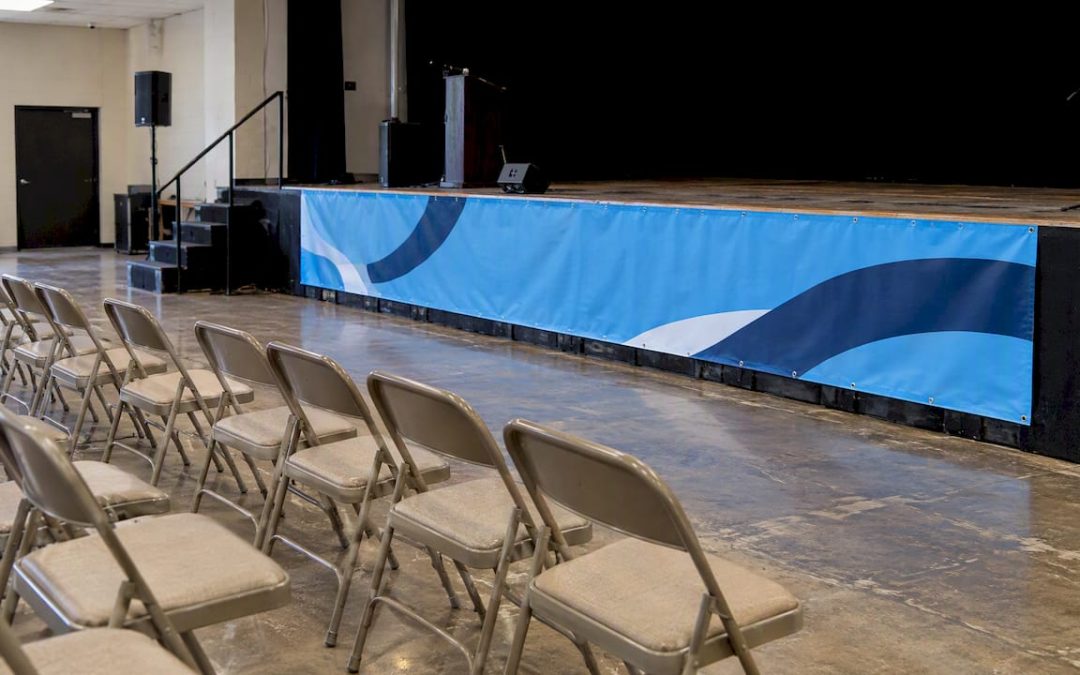
The best event banners do one job: they tell a passerby what is happening, when and where, and what to do next, in about three seconds. Below are nine event banner examples, grouped by occasion, with the copy, layout and format that suit each. After them you will find what to include, how to choose size, material and placement, and a few mistakes to avoid before you approve a proof.
TL;DR
- Put one message on the banner: a headline, a supporting line and a call to action.
- Match the format to the event: vinyl for fences and entrances, retractable for indoor booths, feather flags for roadside and sidewalk traffic.
- Use high contrast and large sans-serif lettering, and place the key message at eye level or above head height in a crowd.
- Plan placement and hardware (grommets, wind slits, stands) before you finalize artwork.
- Proof the file at full size and check spelling, date and web address twice.
Table of Contents
- What counts as an event banner
- Nine event banner examples by occasion
- What to include on an event banner
- Design choices that make a banner readable
- Choosing size, material and placement
- Our perspective
- Mistakes to avoid before you approve a proof
- Get your event banners made
- FAQ
- Sources
What counts as an event banner
An event banner is any printed or digital graphic that announces, directs or brands an event. Printed versions are usually vinyl, mesh or fabric. They hang on fences, stages and building fronts, stand on retractable frames, or fly from poles. Digital versions work as headers on registration pages, email newsletters and social ads.
The same event often needs several. A charity run might have a large vinyl banner over the start line, feather flags on the access road, a retractable banner at the check-in table and a digital banner for the registration page. Each has a different reader, distance and reading time, so each is designed differently.
Nine event banner examples by occasion
1. Grand opening banner
The job is to make a new location impossible to miss. Use the business name in your brand color, a short line such as “Now Open” and the date range or a single offer. Hang it across the storefront or on the fence line facing the heaviest traffic. Keep the logo big and skip the product list.
A vinyl banner with reinforced edges works well here because it stays up for weeks. If the opening celebrates a new brand, repeat the same colors on a window graphic so the front reads as one design.
2. Trade show booth banner
A booth competes with dozens of others for a few seconds of attention. The strongest layouts state what you do for the visitor, not who you are: a benefit headline, your logo and a booth number or web address. A retractable banner works because it sets up in minutes and packs into its own case.
We cover this in more depth in our guide to trade show banner examples and in our piece on effective trade show signs.
3. Charity run or fundraiser banner
These banners serve two audiences: participants who need to find the start and check-in, and sponsors who want their logos seen. Put the event name and cause large across the top, the date and location in a supporting line, and sponsor logos in a clean row along the bottom. Group sponsors by tier so the biggest supporters get the largest logos.
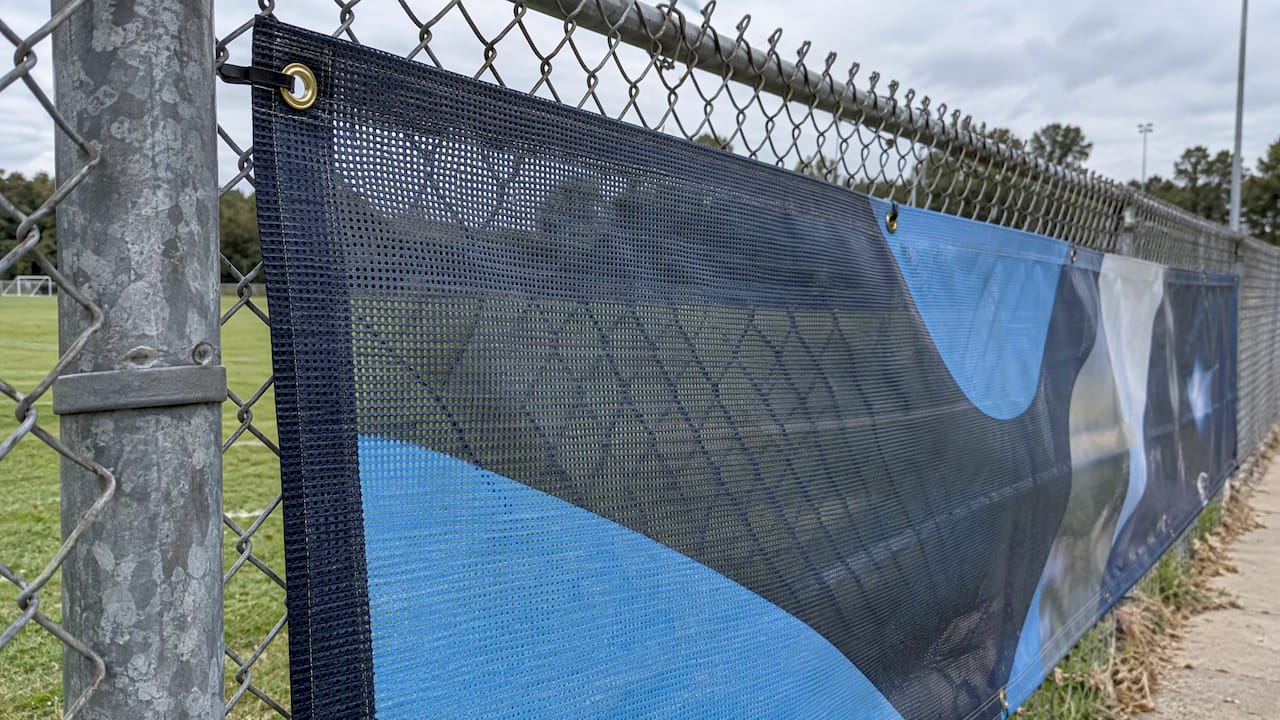
Mesh banners suit open fields and fences because air passes through them, which reduces wind load.
4. Festival and community fair banner
This is where color and illustration earn their place. A festival banner can be playful, with hand-lettered type or a bold graphic, as long as the name and dates stay legible from across a street. Hang one at each approach road and use feather banners to mark entrances and parking.
Our guide to outdoor event signage covers weather, wind and visibility for this kind of setup.
5. Conference or seminar banner
Conference banners are quieter and more professional. A dark blue or charcoal background with white text, the event name, theme line, date and city, and a sponsor strip. A retractable banner at registration and a larger backdrop at the stage entrance cover most needs.
A step and repeat backdrop, with the event and sponsor logos tiled across it, doubles as a photo wall. Keep logo spacing generous so photos stay clean when guests stand in front.
6. Real estate open house banner
An open house banner has to work from a moving car. Use “Open House” in very large letters, the day and hours beneath and an arrow or the agent’s brand. Skip the paragraph about the property: the listing handles that.
If you promote listings, look at our examples of property banners and our real estate banner guide. Check local rules on temporary signs before posting, which we cover in the real estate sign compliance guide.
7. Sports and school event banner
These celebrate team identity and thank sponsors. Use team colors, a strong mascot or logo and the season or tournament name. A long horizontal vinyl banner suits a fence or gym wall, and sponsors can have their own panels so they can be added season to season.
8. Pop-up sale or promotion banner
A sale banner works best when it carries one number or one offer. “Weekend Sale” with the dates is enough. Place it where people already pause, such as an entrance or checkout line. A freestanding A-frame sign or a feather banner at the curb catches walk-by traffic.
9. Digital event banner
A digital banner keeps the same logic with different dimensions. It can appear in social feeds, thumbnails on listing pages and newsletter headers, often with a button that sends people to register. One marketing source notes that event banners must both announce information and advertise to prompt clicks, so event banners serve both roles. Keep the headline, date and one action, and reuse the colors and typeface from the printed banner so the event looks consistent.
What to include on an event banner
Most banners need five elements, in this order of importance:
- Event name or headline. It should be the largest text.
- Date and time. Use a format your audience expects, such as Oct 12, 10 a.m. to 4 p.m.
- Location. For banners at the venue, a direction or arrow is often more useful than an address.
- A call to action. “Register today,” “Free entry,” or a short web address.
- Logos. Your brand and, where relevant, sponsors.
One company’s guidance suggests keeping copy to a headline, a supporting line and a call to action, and it reports that single-message banners beat complex ones in its own campaign data. Treat that figure as one marketer’s experience, not a rule, but the principle matches what we see: when a banner tries to say five things, people read none of them.
Avoid QR codes that are too small to scan from where people stand. If you use one, test it at the actual printed size and distance.
Design choices that make a banner readable
Contrast and color
High contrast does most of the work. Black on yellow and white on dark blue are classic pairings, and the same event banner design guidance recommends clean sans-serif type and a strict hierarchy in which the headline is far larger than the supporting text. Avoid light gray on white, thin script fonts and busy photo backgrounds under text.
Type size and hierarchy
A simple check: stand back from your proof on screen until the banner is the size of a postage stamp. If you can still read the headline, you are close. If not, the headline is too small or the background is too busy.
Height and crowds
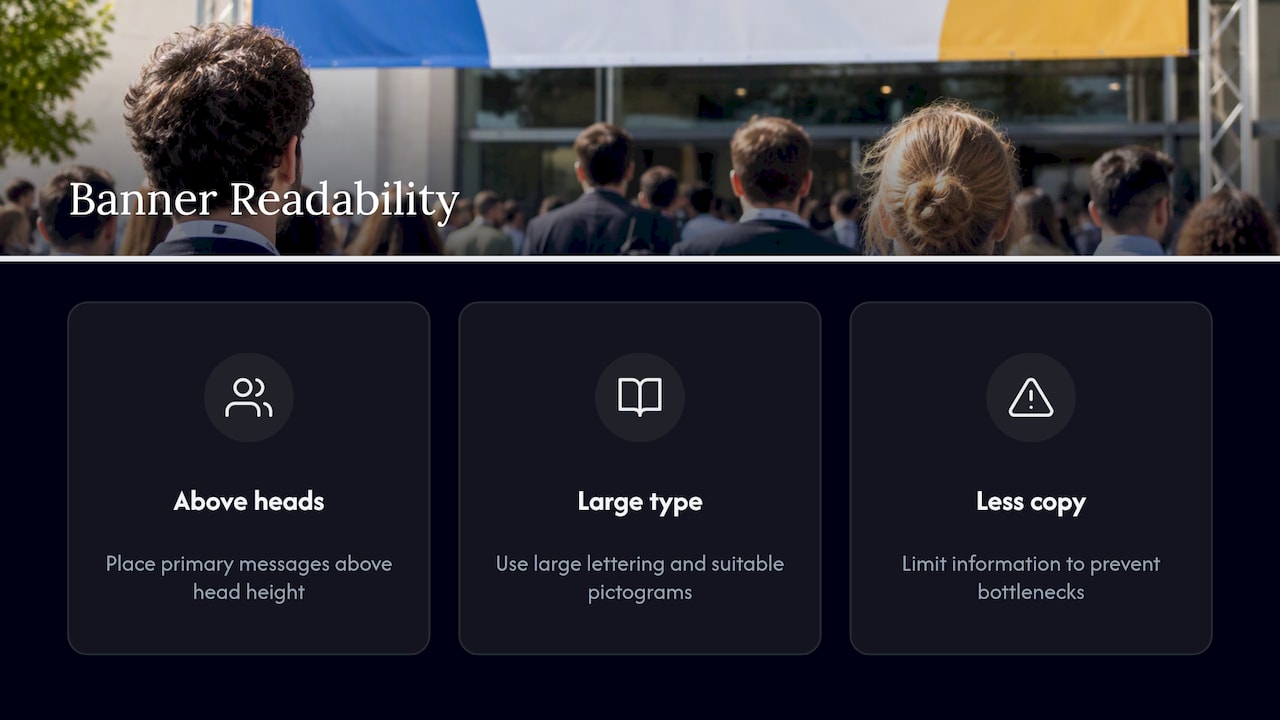
In crowded venues, people at the back cannot see signs at eye level. Transport for London’s event signage standards say that primary messages should sit above head height in crowded environments and that inclusive signs use large lettering and pictograms where suitable. That is a UK transit document, but the logic applies to any packed hall or festival entrance. The same standards limit how much information a sign carries, to avoid people stopping to study it and creating bottlenecks.
Images
Use a single strong image or none. Photos need to be high resolution at the final print size, since a file that looks fine on a laptop can look soft at six feet wide. Ask for a proof before printing.
Choosing size, material and placement
Start from where the banner will hang and how far away the viewer will be, then work backward.
| Setting | Common format | Why it fits |
|---|---|---|
| Fence, building front, stage | Vinyl banner with hems and grommets | Durable, large, weather-resistant |
| Open field, windy site | Mesh banner | Airflow reduces wind load |
| Indoor booth, lobby, registration | Retractable banner | Quick setup, portable |
| Roadside, entrance, parking | Feather banner | Moves and draws the eye from a distance |
| Sidewalk, storefront | A-frame sign | Reaches foot traffic without mounting |
A few practical rules:
- Distance sets size. The farther away the reader, the fewer words and the larger the type.
- Plan for wind. Outdoor vinyl needs a secure fixing along the whole edge, not just the corners, and mesh or wind slits help on exposed sites.
- Check location rules. Many cities and property managers regulate temporary signs. Ask the venue or your local permitting office before you print.
- Think about reuse. A date-free banner with your brand and a tagline can serve several events. For one-off events, put the date on a removable panel or print a separate strip.
Our guides on how to design event signage and how to customize signs for events walk through the decision in more detail.
Our perspective
Most event banners that fail were not badly designed. They were designed for the wrong place. Someone made a lovely layout on a screen and never asked where it would hang, how far away people would stand or how long they would look.
We start every banner project with those questions. Where is it going, indoors or outside? Who needs to read it and from how far? What is the one thing they should do afterward? Only then do we talk size, material and finishing. We handle design, fabrication and installation guidance, and we advise on compliance for outdoor placements, so the banner fits both the brand and the site.
One habit we recommend to event organizers: build a banner set, not a single banner. Use the same colors, typeface and headline across the entrance banner, the feather flags, the registration banner and the digital header. People recognize the event before they read it.
— Yossi
Mistakes to avoid before you approve a proof
- Too much copy. If your banner has a paragraph, move it to your website and put the web address on the banner.
- Wrong date or typo. Read every number aloud and have a second person check the proof. Reprints cost more than proofreading.
- Low-resolution art. Send vector logos or high-resolution files sized for the final print.
- Ignoring the background. Text over a busy photo loses contrast. Add a solid panel or darken the image.
- No plan for hanging. Confirm fixing points, poles or stands before production.
- Ordering too late. Allow time for proofing, revisions and shipping, particularly for multiple formats. Ask us for the current turnaround on your project.
Get your event banners made
If you are planning an event, we produce vinyl, retractable, feather and mesh banners, along with A-frame signs and window and wall graphics, in custom sizes and materials for indoor and outdoor use. Browse our banner options, then request a quote with your event date, venue and approximate size, and we will help you choose the format. If you also need directional signs or entrance graphics, our custom signs page covers those.
FAQ
What is an event banner?
An event banner is a printed or digital graphic that announces, directs or brands an event. Printed ones hang, stand or fly at the venue, while digital ones sit in emails, social posts and registration pages. Both aim to get the right people to the right place with a clear action.
What should I put on an event banner?
Include the event name, the date and time, the location and one call to action, plus your logo and any sponsors. Make the event name the largest element. Leave out anything that does not help someone decide to attend or find the venue.
How do I make a catchy banner without crowding it?
Limit it to a headline, a supporting line and a call to action. Use two or three colors with strong contrast and a single image or graphic. If you have more to say, send readers to a web address or QR code that is large enough to scan.
What size should an event banner be?
It depends on viewing distance and mounting space. A fence or building banner can be several feet wide, while a retractable stand has a fixed size set by its hardware. Tell us the location and how far away people will stand, and we can recommend dimensions.
Sources
- Banner Design for Events That Actually Gets Noticed
- Events Signage Standards, Transport for London
- BtoB event banner design checklist, Flagout