
Under the Health and Safety (Safety Signs and Signals) Regulations 1996, employers only have to put up safety signs and signals where a risk assessment shows that other control measures cannot bring residual risk down to an acceptable level. The Regulations name specific sign categories and non-visual signals, require ongoing maintenance and testing, and put a training duty on employers under regulation 5. HSE guidance document L64 and the Legislation are the two references worth bookmarking before you touch a single signboard.
TL;DR:
- Signage must be installed only after a documented risk assessment confirms it cannot be sufficiently addressed by other safety controls.
- Sign types and placement must strictly follow Schedule 1 standards, including shape, color, size, and design, to ensure compliance and visibility.
- Regular inspection, maintenance, and testing are required to keep signs legible and functional, especially for illuminated and acoustic signals.
- Staff must receive suitable training to understand and act on safety signs, with records of instruction forming a key part of compliance.
- Non-compliance often stems from incorrect sign orders, improper installation, or lack of documented assessment and training, which inspectors quickly verify.
Table of Contents
- What the Health and Safety Signs and Signals Regulations 1996 Actually Require
- The Sign and Signal Types the Regulations Define
- Getting Placement, Maintenance, and Testing Right
- Training and Information Duties Under Regulation 5
- Fire Signs, Transitional Rules, and What Inspectors Actually Flag
- Practical Compliance Checklist for Signs and Signals
- Where Suppliers See Compliance Go Wrong
- Getting Compliant Signage Made and Installed
- Where to Verify the Rules Yourself
- Sources
- FAQ
What the Health and Safety Signs and Signals Regulations 1996 Actually Require
The Health and Safety (Safety Signs and Signals) Regulations 1996 apply across almost every workplace in Great Britain, from warehouses and construction sites to offices and retail units. The instrument sits under the Health and Safety at Work etc. Act 1974 and implements EU Directive 92/58/EEC, which is why the pictogram styles look familiar across borders even now that the UK has left the EU.
The legal trigger sits in regulation 4. It requires employers to provide and maintain safety signs “where a risk assessment… shows that it is not possible to avoid or adequately reduce risk by other means,” and it ties that obligation to compliance with Schedule 1 of the Regulations. That single clause changes how most businesses approach signage. A sign is not step one. It is what you install after collective protections, engineering controls, and safe systems of work have already been considered and still leave a residual risk worth flagging.
That sequencing links directly to the separate duty under the Management of Health and Safety at Work Regulations 1999, which requires every employer to carry out a suitable and sufficient risk assessment in the first place. You cannot lawfully decide you need a “Wear Eye Protection” sign without first documenting why the hazard exists, why it cannot be eliminated, and why a sign is the appropriate remaining control. HSE’s guidance document L64 reinforces this, explaining that signs become necessary specifically where significant risk remains after those other measures have been applied.
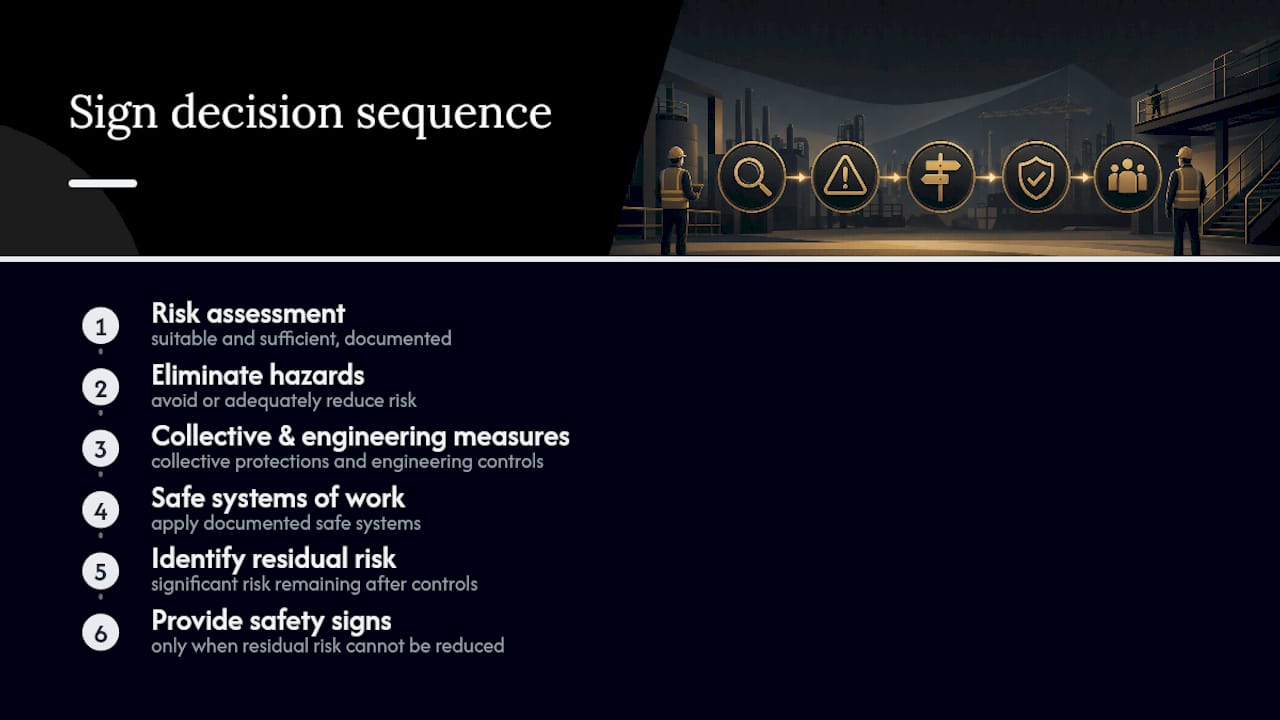
For safety officers, the practical implication is straightforward but often missed: signage decisions need a paper trail. Inspectors do not just check whether a fire exit sign is present. They ask what risk assessment justified it, whether the sign type matches the hazard, and whether staff were told what it means. A business that buys signs off a catalog without that underlying assessment has technically missed the point of the law, even if the walls look compliant. The Regulations are a control measure standard, not a decoration requirement, and treating them that way from the outset saves a lot of retrofitting later.
The Sign and Signal Types the Regulations Define
Schedule 1 to the Regulations breaks safety communication into two broad families: permanent signboards and occasional or intermittent signals. Knowing which family a hazard calls for is often where compliance goes wrong, because a business will install a signboard where a verbal or acoustic signal was actually the better fit.
Permanent signboards fall into four categories, each with a distinct shape and color coding under Schedule 1:
- Prohibition signs — round, red border, black pictogram on white (“No Smoking,” “No Access for Unauthorized Persons”).
- Warning signs — triangular, yellow background, black border and pictogram (“Caution: Forklift Trucks,” “Danger: High Voltage”).
- Mandatory signs — round, blue background, white pictogram (“Wear Hearing Protection,” “Wash Hands”).
- Emergency escape or first-aid signs — rectangular or square, green background, white pictogram (“Fire Exit,” “First Aid Point”).
- Fire-fighting equipment signs — rectangular or square, red background, white pictogram (extinguisher and hose reel locations).
Occasional signals cover situations where a fixed board would not communicate fast enough or would not be visible in every condition. This includes illuminated signs (exit signs that stay lit or activate on alarm), acoustic signals (fire alarms and evacuation tones), and verbal or hand signals, which HSE guidance covers in detail for operations like crane lifts, vehicle marshaling, and confined space work. A hand signal system only works if everyone on site has been trained to the same code, which is one reason the Regulations pair sign design rules with a training duty rather than leaving it to custom.
Schedule 1 also sets minimum intrinsic features that apply regardless of category: pictograms must be simple, unambiguous, and consistent with recognized design, colors must meet the specified codes, and dimensions must scale to viewing distance so text and symbols stay legible. BS EN ISO 7010 is the pictogram standard HSE points to for meeting that consistency requirement, and using it is the easiest way to prove a sign design is defensible if it is ever questioned.
Containers and pipes carrying hazardous substances get their own rules under Schedule 1: labeling must identify the substance and its hazard using the same pictogram system, and this extends to marking obstacles, traffic routes, and dangerous locations inside a facility, not just chemical stores. Businesses running mixed pedestrian and vehicle traffic often underestimate how much of Schedule 1 applies to floor marking and route delineation rather than wall-mounted signs.
Getting Placement, Maintenance, and Testing Right
A technically correct sign that nobody can see from the relevant sightline is functionally useless, and that gap between “compliant on paper” and “compliant in practice” is where most enforcement issues start.
Placement decisions should follow a simple hierarchy: identify where a worker’s eyeline naturally falls when approaching the hazard, then confirm nothing (racking, machinery, other signage) blocks that view under normal working conditions. Sign crowding is a genuine problem on busy sites. Stack too many boards in one location and workers stop reading any of them individually, which defeats the purpose of the Regulations’ clarity requirements.

Maintenance obligations apply to every sign type covered by Schedule 1 except hand signals and verbal communication, which by their nature cannot be “maintained” the way a physical board can. HSE guidance is direct on this point: signs must retain their intrinsic qualities over time, which means fading, cracking, or obscured signboards need replacement, not just acknowledgment on an inspection checklist.
A practical maintenance and testing routine looks something like this:
- Visually inspect signboards on a set schedule (monthly is common for high-traffic areas) for fading, damage, or obstruction.
- Test illuminated signs, including battery backup or emergency power supply, on the interval set by the manufacturer or your fire risk assessment.
- Test acoustic alarm signals for audibility above ambient site noise, including during the loudest normal operating conditions.
- Confirm no new equipment, storage, or partition has created a blind spot since the last review.
- Log every check with date, inspector name, and any remedial action, because that log is what an inspector will ask for first.
Illuminated exit signs need particular attention to emergency power. If the sign only works when mains power is live, it fails at exactly the moment it matters most during a power-cut evacuation. The same logic applies to acoustic alarms in high-noise environments. A signal drowned out by machinery is not a functioning control, regardless of what the Regulations say on paper.
Workers with impaired hearing or vision need signage adjustments that go beyond the standard sizing tables, and PPE itself can interfere with signal detection. Ear defenders reduce alarm audibility, and some safety glasses affect color perception. Building those factors into placement decisions is part of taking the risk assessment seriously rather than treating it as a one-off document.

Pro Tip: Walk your own site at the busiest time of day and at the quietest, then again with hearing protection on. If a sign or alarm loses effectiveness in either condition, that is your maintenance priority, not the sign that already looks fine.
Training and Information Duties Under Regulation 5
Regulation 5 requires employers to give employees “comprehensible and relevant information” about safety signs, plus “suitable and sufficient instruction and training” so that the meaning of those signs, particularly ones using words, is properly understood. Buying the right signboard satisfies half the law. Teaching people what it means satisfies the other half, and inspectors treat the two as inseparable.
“Comprehensible and relevant” has a practical test: could a new starter, on day one, correctly act on the sign without asking a colleague what it means? If the answer depends on tribal knowledge rather than the sign itself, the information duty has not been met, regardless of how compliant the physical sign is.
Suitability and sufficiency scale with risk. A low-hazard office needs a brief induction covering fire exits and assembly points. A site running forklifts, confined spaces, or hand-signal-directed lifting operations needs structured initial training plus scheduled refreshers, because signal meanings for lifting operations are exactly the kind of thing people forget between jobs.
Recordkeeping matters as much as delivery. A practical approach includes:
- Signed induction records showing sign and signal training was delivered, dated, and by whom.
- Refresher training tied to a fixed interval or triggered by a site change (new equipment, new layout, new hazard).
- A short verification check, even informal, confirming staff can identify and explain key signs relevant to their role.
- Integration of sign meaning into toolbox talks so it is reinforced outside formal training sessions.
Short, role-specific training modules tend to outperform long generic sessions. Five minutes on the three signs relevant to a warehouse picker’s actual work sticks better than a forty-slide deck covering every pictogram in Schedule 1.
Fire Signs, Transitional Rules, and What Inspectors Actually Flag
Fire safety signage sits at the intersection of these Regulations and separate fire safety legislation, and the Regulations included a transitional provision when they came into force: pre-existing fire safety signs that did not yet meet the new standard had until 24 December 1998 to be brought into compliance. That transitional window closed decades ago, so any fire sign on a UK site today is expected to meet current Schedule 1 standards without exception.
In practice, HSE and local authority enforcement action rarely stems from a single dramatic failure. It comes from a pattern of small gaps: a faded fire exit sign nobody replaced, an evacuation alarm that was never re-tested after a refit, or new staff who were never actually walked through what the mandatory PPE signs on the factory floor mean. Missing or incomplete training records are one of the most common findings, because they are also the easiest thing for an inspector to ask for and the easiest thing for a business to have never created.
Incorrect sign type is another recurring issue, usually where a warning sign has been used where a mandatory sign was needed, or a generic sticker has been substituted for a Schedule 1 compliant board.
If enforcement action does follow an inspection, the remedial path is usually the same regardless of the specific breach: fix the physical sign or signal immediately, document the risk assessment that should have driven the original decision, and put a dated training record in place before the follow-up visit. Inspectors respond far better to evidence of a system now working than to a promise that it will.
Practical Compliance Checklist for Signs and Signals
Turning the Regulations into an audit trail is mostly a matter of sequencing the same five steps every time a new hazard or site change comes up.
- Document the risk assessment decision. Record specifically why collective and procedural controls were insufficient and why a sign or signal is the necessary remaining measure, referencing the Management of Health and Safety at Work Regulations duty that triggered it.
- Map hazard locations and match sign types. Walk the site, list every hazard needing a sign or signal, and assign the correct category (prohibition, warning, mandatory, emergency, fire-fighting) with dimensions suited to viewing distance.
- Record standard compliance. Note that pictograms follow BS EN ISO 7010 and that placement, color, and legibility meet Schedule 1, so the paper trail exists before anyone asks for it.
- Assign maintenance ownership. Name a specific person responsible for scheduled inspections, illuminated sign testing, acoustic signal testing, and emergency power checks, with dates logged.
- Run training and keep the records. Deliver induction and refresher sessions on sign meaning, verify understanding, and retain signed attendance records as your regulation 5 evidence.
Signage is consistently the last line item safety officers check, and the last step in the hierarchy of controls it belongs to reflects that. A sign that exists without a documented risk assessment behind it, or without a training record proving staff understood it, leaves a gap an inspector will find in minutes.
Where Suppliers See Compliance Go Wrong
The mistakes we see most often start at the ordering stage, not the wall. A business orders a generic “Caution” sign when the hazard actually calls for a specific pictogram, or picks a signboard sized for a corridor and installs it across a warehouse aisle where the viewing distance is three times longer. Undersized signs and mismatched pictograms are the two errors that show up most in post-inspection sign replacements.
Installation and testing pitfalls come next. Illuminated exit signs get mounted without anyone confirming emergency power actually reaches that circuit, and acoustic alarms get tested once at installation and never again, even though ambient noise levels on a working floor change as equipment and staffing change.
When a stock sign will not do the job, a custom solution is usually the right call, whether that means a specific hazard combination, an unusual mounting surface, or multilingual wording for a mixed-language workforce. Whoever supplies it, ask directly whether the design follows BS EN ISO 7010 and get that confirmation in writing. That single question filters out a surprising number of suppliers who cannot actually answer it.
— Yossi
Getting Compliant Signage Made and Installed
Custom Signs Today builds compliant safety signage the way it should be built: matched to your actual risk assessment, not pulled from a generic catalog page. Where a stock prohibition or mandatory sign does not fit an unusual mounting surface, sizing, or bilingual need on your site, we produce a custom sign designed around BS EN ISO 7010 pictograms and durable materials rated for indoor or outdoor exposure.

To get a fast, accurate quote, send us your site plan or floor layout, the relevant risk assessment notes explaining why a sign is required, and the dimensions and quantities you need for each location. If your facility needs both wall-mounted interior signage for corridors and escape routes and larger exterior signs for fire-fighting equipment or vehicle traffic areas, we can quote both in a single request. Reach out with your specifications and we will confirm sign type, material, and pictogram compliance before anything goes into production.
Where to Verify the Rules Yourself
Do not take a signage supplier’s word for what the Regulations require, including ours. Read regulation 4 and Schedule 1 directly on legislation.gov.uk, and keep HSE’s guidance document L64 on hand for practical interpretation of design and maintenance duties. BS EN ISO 7010 is the pictogram standard referenced throughout HSE guidance, and it is worth sourcing the current edition rather than relying on older sign templates that may predate revisions.
Sources
- The Health and Safety (Safety Signs and Signals) Regulations 1996 — Regulation 4
- Safety signs and signals. The Health and Safety Regulations 1996. Guidance on Regulations — HSE
FAQ
What Regulations Cover the Use of Safety Signs?
The Health and Safety (Safety Signs and Signals) Regulations 1996 govern signage and signals in workplaces across Great Britain, requiring signs only where a risk assessment shows other controls cannot adequately reduce the risk. HSE guidance document L64 provides the practical detail on how to apply the Regulations.
What Are the Four Main Health and Safety Signs?
Schedule 1 defines four core signboard categories: prohibition signs (round, red border), warning signs (yellow triangle), mandatory signs (blue circle), and emergency escape or first-aid signs (green rectangle), with fire-fighting equipment signs (red rectangle) often listed as a related fifth category. Each has a fixed shape and color coding that cannot be substituted.
What Are the Requirements for Safety Signage Under the 1996 Regulations?
Signs must meet the minimum intrinsic features set out in Schedule 1, including approved colors, clear pictograms, adequate size for the viewing distance, and ongoing maintenance to keep them legible. Employers must also provide training under regulation 5 so staff understand what each sign means, and a business like Custom Signs Today can help specify signs that meet those Schedule 1 dimensions and pictogram standards.
What Are the Five Main Safety Sign Types People Ask About?
Most guidance groups signage into prohibition, warning, mandatory, emergency escape or first-aid, and fire-fighting equipment signs, covering the visible signboard categories in Schedule 1. Occasional signals such as illuminated exit signs, acoustic alarms, and hand signals sit alongside these as a separate but equally regulated category.
Do Small Businesses Need to Follow These Regulations?
Yes. The Regulations apply regardless of business size, but the scale of signage required depends entirely on what your risk assessment identifies. A low-hazard office may need only fire exit and first-aid signage, while a warehouse or construction site will need a far broader set of prohibition, warning, and mandatory signs.