
TL;DR:
- Request a detailed signage quote by providing precise dimensions, materials, artwork in vector format, and clear deadlines to ensure accuracy from the start. Writing a specific, organized request and following up promptly helps vendors deliver complete, timely responses, reducing delays and errors. Proper preparation and clear communication are essential for obtaining accurate estimates and maintaining project timelines.
Knowing how to request a signage quote correctly can mean the difference between getting an accurate price on day one and spending two weeks in back-and-forth emails that eat into your project timeline. Most delayed or inaccurate quotes come down to one thing: missing core details like sizes, quantities, materials, and proper artwork files. Whether you’re a small business owner ordering exterior signs or an event planner sourcing banners for a weekend conference, this guide walks you through every step of the signage quote process so you get clear answers fast.
Table of Contents
- Key takeaways
- How to request a signage quote: gather your details first
- Writing an effective quote request email
- Common mistakes that slow down your signage quote
- What to expect after you send your request
- What I’ve learned from watching quote requests succeed and fail
- Get accurate signage quotes with Customsignstoday
- FAQ
Key takeaways
| Point | Details |
|---|---|
| Prepare specs before reaching out | Having dimensions, quantities, and material preferences ready speeds up accuracy from the first reply. |
| Vector artwork matters | Submitting AI or EPS files instead of low-res images prevents delays and extra design charges. |
| State your deadline upfront | Vendors need your timeline to flag rush fees and schedule installation correctly. |
| Read every quote line by line | Verify materials, installation, delivery fees, and payment terms before signing off. |
| Follow up within 48 hours | If a quote feels incomplete, ask specific clarifying questions quickly to keep the project on schedule. |
How to request a signage quote: gather your details first
The single biggest reason quotes arrive late or off-target is that the request was vague. Before you type one word to a vendor, pull together these specifics.
Dimensions and quantity. Write down the width and height for every sign you need, even if they’re approximate. Specific dimensions and quantities speed up quote accuracy and unlock volume pricing that vendors won’t automatically mention unless you ask. Ordering ten identical banners is priced very differently than ordering one.
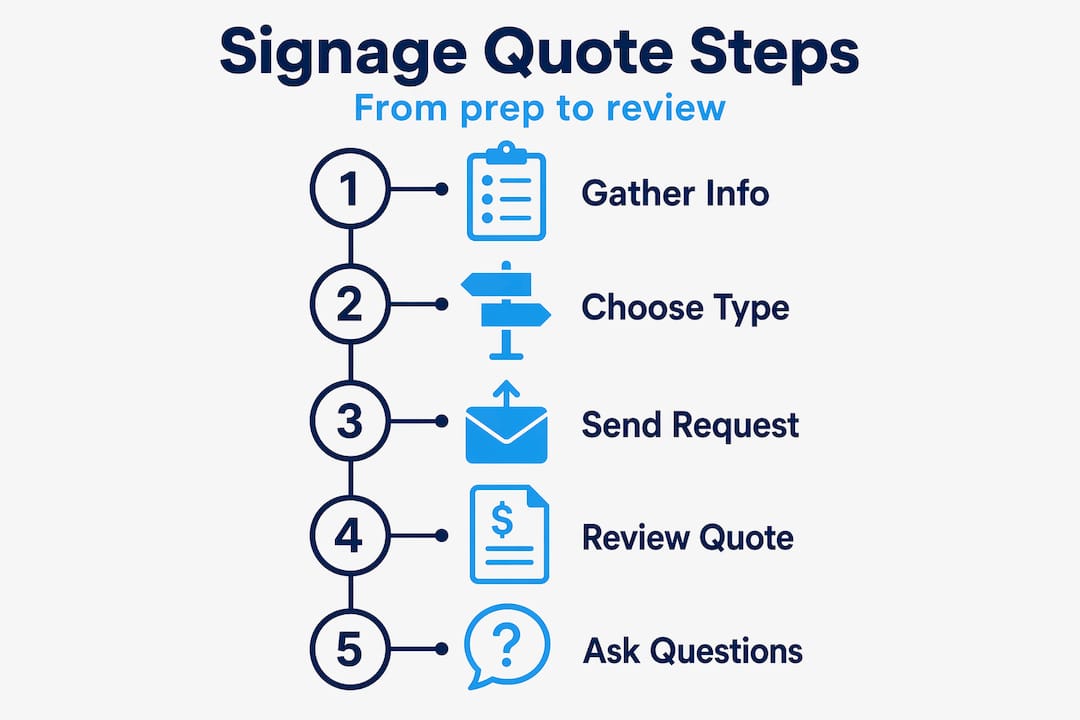
Sign type and materials. Are you looking at vinyl banners, rigid foam board signs, illuminated channel letters, or vehicle decals? Naming the material upfront saves the vendor from guessing and saves you from getting a quote built on the wrong substrate.
Artwork files. This is where most people trip up. Vector files in AI or EPS format are the standard because they scale to any size without losing quality. A JPEG screenshot of your logo is not a suitable substitute. If you don’t have vector files yet, read up on preparing your artwork files before you send the request so the vendor can quote accurately without adding a design fee.
Color codes, installation needs, and timeline. Include your Pantone or hex color codes so the printer matches your brand exactly. Note whether you need professional installation, and if so, where the sign will be mounted. Communicating your project deadline upfront lets vendors schedule production and flag any rush fees before you’re surprised by them.
Use this quick comparison to decide what level of detail each project type needs:
| Project type | Minimum info needed | Ideal info to include |
|---|---|---|
| Single banner for an event | Size, material, quantity | Artwork file, deadline, mounting method |
| Retail storefront signs | Sign type, size, location | Installation needs, color codes, permits |
| Vehicle wrap or decals | Vehicle make/model, coverage area | Photos of vehicle, vector logo, timeline |
| Multi-location signage | Quantity per location, dimensions | Full spec sheet, installation contact per site |
Pro Tip: Create a simple one-page spec sheet you can reuse for every quote request. Include your business name, logo file location, standard brand colors, and a notes field for project-specific details. You’ll cut your prep time in half on every future request.
Writing an effective quote request email
Once your specs are ready, the way you write the request determines how quickly and completely a vendor responds. Clear subject lines and professional tone improve the chance of a prompt and complete reply. Here’s a structure that works.
- Write a specific subject line. “Quote Request: Outdoor Banners for Grand Opening, May 2026” tells the vendor immediately what you need and when. Generic subject lines like “Sign Question” get buried.
- Open with a brief introduction. Two sentences: who you are, what your business or event is. You don’t need a paragraph. Just enough context so the vendor understands your situation.
- List your specifications in bullet points. This is not the place for narrative paragraphs. Quantities, sizes, materials, and finishes should each be their own line. Vendors scan these requests fast, and a clear list means nothing gets missed.
- Attach your artwork and site photos. Using vendor forms fully and uploading relevant files when prompted reduces back-and-forth significantly. If emailing directly, attach your vector file and a photo of the installation location.
- Ask specific questions. Don’t wait for the quote to wonder about delivery. Ask in the request: “Can you confirm lead time, shipping cost, and whether professional installation is available?” Asking about delivery fees upfront prevents sticker shock when the invoice arrives.
- State your deadline clearly. Something like, “We need the signs on-site by May 10th, so please let me know if this is achievable with your current schedule.”
- Close with a polite call to action. “I look forward to your quote and am happy to answer any questions you have about the project.” This opens the door without pressure.
If the vendor has an online quote form, use it as designed instead of emailing separately. Forms are built to capture exactly what the vendor needs, and a complete submission almost always results in a faster, more accurate response.
Pro Tip: Send quote requests to two or three vendors at the same time using the same spec sheet. This gives you a fair comparison without extra work, and it subtly signals to each vendor that they’re competing for your business.
Common mistakes that slow down your signage quote
Even well-intentioned requests regularly fall into a few traps. Recognizing them before you hit send will save you days of unnecessary delays.
- Vague size descriptions. “Medium banner” or “standard size” means something different to every vendor. Always use inches or feet for width and height.
- Missing quantity. Vendors price signage differently at one unit versus ten units versus fifty. Leaving quantity blank forces a follow-up email before any pricing can be calculated.
- Low-resolution images. Sending a JPEG logo pulled from a website does not allow the print shop to produce clean output. It often means an added design fee or a project hold while proper files are sourced.
- No installation information. Installation averages around $464 for professional sign placement. Vendors who don’t know whether you need installation will quote product only, leaving a major cost out of the estimate.
- Ignoring payment terms. Many small business owners skip this until invoice day. Clarify upfront.
“Quotes are only as accurate as the information behind them. Incomplete requests are the number one cause of delays and cost overruns on signage projects.” — Digital Signage Hub
For larger or multi-location projects, an informal email is often not enough. An RFP with itemized pricing components covering hardware, installation, support, and multi-year cost estimates gives you a fair comparison between vendors and prevents scope creep later. If you’re outfitting three retail locations or managing a large-scale event, consider this approach seriously. It’s also how professionals in related fields like construction evaluate complex vendor bids when comparing service providers across multiple scopes.
If a quote comes back incomplete or confusing, don’t accept it. Reply with a numbered list of specific questions. Ask the vendor to revise and reissue. A good vendor will do this without issue.
What to expect after you send your request
Knowing the typical signage quote process helps you plan and avoid surprises.
| Stage | Typical timeline | What to watch for |
|---|---|---|
| Initial response | 1 to 3 business days | Acknowledgment and any clarifying questions |
| Quote delivery | 3 to 5 business days | Full itemized breakdown of costs |
| Production | Days to several weeks | Varies by sign type and complexity |
| Installation | Scheduled at quote approval | Confirm date and site access requirements |
When the quote arrives, read it line by line. Look for separate line items covering materials, labor, delivery, and installation. Professional sign shops typically require a 50% deposit before production begins, with the balance due on completion or delivery. If payment terms aren’t listed, ask before you approve anything.
Comparing quotes across vendors means looking at total cost, not just unit price. A cheaper sign that requires you to source your own installer, pay separately for delivery, and reprint due to poor material quality is rarely the better deal. Factor in service, warranty, and what happens if something needs to be corrected.
Pro Tip: When comparing two quotes that are close in price, ask each vendor what their revision and reprint policy is. The vendor who stands behind their work with a clear policy is almost always the better long-term partner, even at a slight premium.
If the timeline doesn’t work or the price needs adjustment, don’t be afraid to go back. You can negotiate quantities, adjust materials, or phase the project across multiple orders. Vendors prefer a revised request over a lost job. For a deeper look at what happens once you approve a quote, the custom sign workflow guide at Customsignstoday breaks down each production stage clearly.
What I’ve learned from watching quote requests succeed and fail
I’ve reviewed hundreds of signage projects, and the pattern is always the same. The requests that move smoothly are the ones where the business owner or event planner came in prepared. Not perfectly prepared. Just prepared enough to give the vendor something real to work with.
The requests that stall almost always have the same issues. No artwork files. No dimensions. No timeline. The vendor sends a follow-up. The client takes a day to respond. The vendor sends another follow-up. Suddenly a five-day turnaround becomes three weeks, and the event is getting uncomfortably close.
What I’ve also noticed is how much vendor relationships matter. Being polite, specific, and responsive turns a transactional quote request into a working partnership. Vendors go out of their way for clients who communicate well. That’s not a soft skill. That’s a practical advantage.
My honest advice: spend 20 extra minutes before you send the request. Pull your brand files, measure the wall or space, write down exactly what you need and when you need it. That 20 minutes will save you far more time on the back end, and it will almost always result in a more accurate quote on the first try.
For event planners especially, the stakes are even higher because the deadline is fixed. There’s no flexibility when the conference starts on Friday. Getting your event signage right starts with a complete, well-organized request the first time.
— Yossi
Get accurate signage quotes with Customsignstoday
Customsignstoday makes the signage quote process straightforward for small business owners and event planners who want accurate pricing without the back-and-forth. The team handles everything from banners and retail signs to vehicle wraps and exterior lightbox displays, all with professional installation support and expert guidance throughout.
Whether you’re branding a storefront or outfitting a trade show, exploring exterior lightbox sign options is a great starting point for businesses that want maximum visibility. If you’re planning a full branding refresh, the retail signage guide walks through what types of signs deliver the strongest results. Request a free quote directly through the website and get a response from a real signage expert who understands your goals and timeline.
FAQ
What information do I need to request a signage quote?
You need exact dimensions, quantity, sign type, material preference, artwork files in vector format, your deadline, and any installation requirements. The more specific your request, the faster and more accurate the quote will be.
How long does it take to get a signage quote back?
Most vendors respond within one to three business days with initial acknowledgment and deliver a full quote within three to five business days, depending on project complexity.
Why do I need vector artwork for a signage quote?
Vector files like AI or EPS scale to any sign size without losing quality, which is required for professional print output. Low-resolution images produce blurry results and often trigger added design fees.
What payment terms should I expect for a signage order?
Most sign shops require a 50% deposit to start production, with the remaining balance due upon completion or delivery. Always confirm payment terms before approving a quote.
When should I use an RFP instead of a simple quote request?
Use an RFP for multi-location or complex signage projects where you need to compare vendors on itemized total cost of ownership including installation, support, and long-term service, not just product price alone.