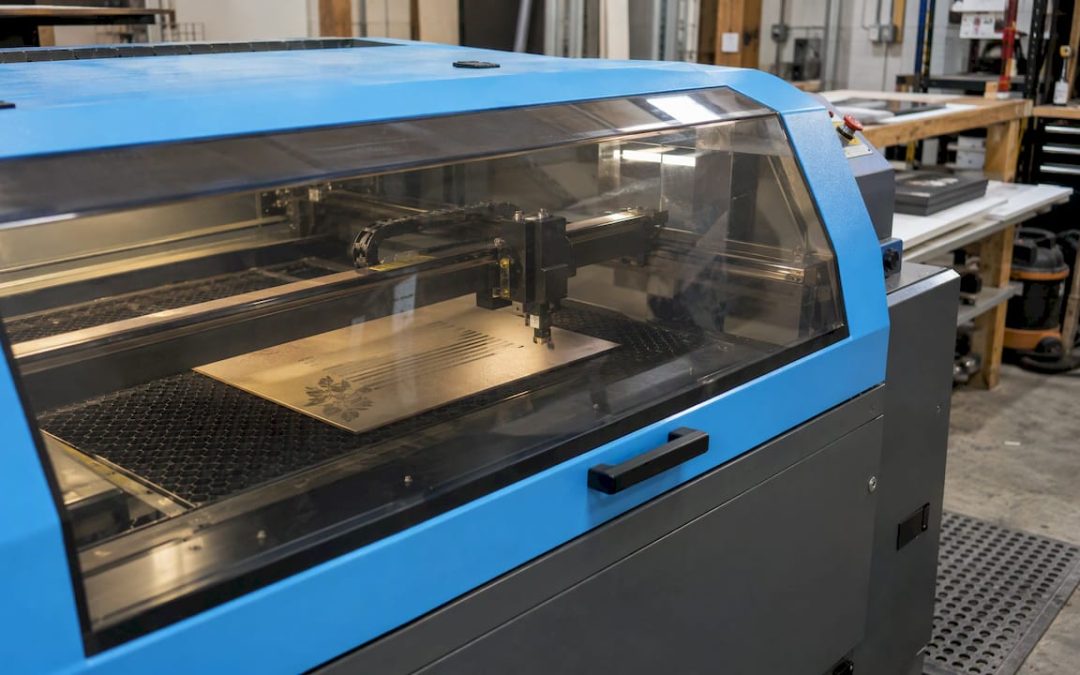
A laser engraved sign carries its message in the material itself, so it cannot peel, scratch off or fade the way a printed label can. For a business owner, property manager or event organizer, the right result comes from three decisions made before any engraving starts: the material, the contrast between mark and background, and where the sign will hang. This guide walks through each one, with the checks that keep a sign readable and compliant. It also covers how to brief a sign provider so the first proof is the right one. If you want a custom sign designed, fabricated and installed for your location, you can start with a quote request through our custom signs page.
TL;DR
- A laser engraved sign has its text or logo cut or etched into the surface, so the mark is permanent and abrasion-resistant rather than applied on top.
- Material decides the look and the lifespan: laminated plastic and acrylic suit indoor doors and directories, while anodized aluminum and UV-rated materials suit exterior use.
- Contrast, not depth, makes an engraved sign legible. Choose a material that changes color when engraved before you pick a font size.
- Room-identification signs in public and commercial spaces usually fall under ADA tactile rules, so raised characters, braille, finish and mounting height need to be specified up front.
- Give your sign provider the location, viewing distance, size and a vector logo file, and the quote and proof come back faster and closer to final.
Table of Contents
- What a laser engraved sign actually is
- Where businesses use laser engraved signs
- Choosing the material
- Making an engraved sign readable
- How long engraved signs last, indoors and out
- ADA rules for room and space signs
- Materials that should never be laser engraved
- How to order a laser engraved sign for your business
- What to put in your quote request
- Our perspective
- Get your signs designed and installed
- FAQ
- Sources
What a laser engraved sign actually is
A focused beam of light removes or alters the surface of a material, and the design becomes part of the sign. The beam exposes the material to intense heat. Depending on how long it dwells, the surface either changes color or evaporates, and the result is a permanent, abrasion-resistant mark.
Two engraving styles matter when you read a proof:
- Raster engraving fills letters and images line by line, point by point. It suits solid letters, images and wood.
- Vector engraving traces curves and lines one after another. It is typically faster for thin lines, such as outlines and fine borders.
The laser type follows the material. CO2 lasers suit nonmetals such as plastics, stone and wood, while fiber lasers work better on metals because metals absorb their wavelength more readily. A computer program controls the path, power and speed, which is why the same logo can be repeated across fifty doors with identical results.
That repeatability is the main business case. A multi-location retailer, a property with 120 units or a conference with dozens of rooms needs signs that match each other, and a computer-controlled process delivers that.
Where businesses use laser engraved signs
Engraved signs show up wherever a message must last and look professional. The common groups are:
- Office and corporate: door plaques, desk nameplates, directory boards and award plaques.
- Retail and hospitality: menu boards, price displays and wayfinding.
- Industrial and safety: equipment labels, warning signs, serial number plates and compliance tags.
- Property and residential: house numbers, memorial plaques, unit identifiers.
- Events: conference room and breakout signage, sponsor plaques and permanent venue wayfinding.
For property managers, the strongest use is interior wayfinding. Suite numbers, restroom signs, stairwell labels and tenant directories all need to look consistent and survive years of hands, cleaning and sunlight. Our interior signs and directional and door signs pages cover those needs.
For storefronts and building exteriors, engraved metal and UV-stable plastics work for address plates, entry plaques and tenant panels. Large, high-visibility messages such as banners, vehicle graphics and temporary event signs are usually better served by printed vinyl and fabric, which is why a full signage plan often mixes methods. See our banners and vehicle lettering pages for those.
Choosing the material
Material is the biggest decision, because it sets the color of the engraving, the feel of the sign and how long it lasts outdoors. This table summarizes the options most buyers consider.
| Material | How the engraving looks | Best for | Notes |
|---|---|---|---|
| Two-layer laminated plastic | Removing the colored top layer reveals a contrasting core, such as white on black | Door plates, nameplates, indoor information signs | The most efficient method for indoor signs is surface engraving on two-layer materials; UV-resistant grades also work outdoors |
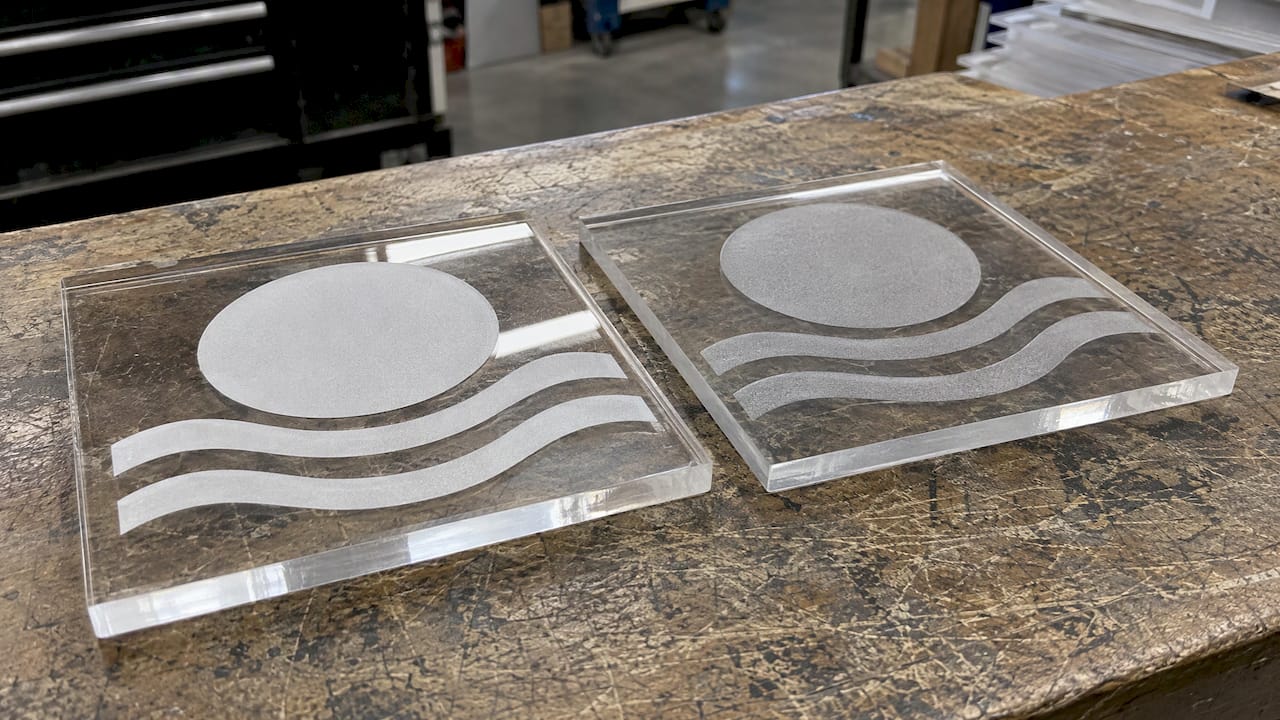
| Acrylic | Frosted, clear-edged marks; can also be cut to shape | Lobby signs, tenant boards, award plaques | Sheet type matters (see below) |
| Anodized aluminum | Durable, high-contrast marks | Exterior plaques, equipment tags, address plates | Resistant to UV, moisture and abrasion |
| Stainless steel and brass | Crisp, formal, metallic look | Corporate entrances, dedications, industrial labels | Bare metals generally call for a fiber laser |
| Wood | Warm, darkened marks | Interior nameplates, hospitality, rustic branding | Hardwoods such as oak and walnut engrave crisply; softwoods burn more readily |
| Glass | Frosted, etched look | Office partitions, privacy and branding panels | Often paired with vinyl graphics |
Cast versus extruded acrylic
Acrylic comes in two forms that look the same on a spec sheet and engrave very differently. Cast acrylic engraves to a more even frosted white, while extruded acrylic tends to melt and gives a duller mark. If a proof looks gray rather than bright white, the sheet type is the first thing to check.
Metal and the finishing question
Stainless steel is the choice for signs that must look formal and last decades. If you are curious about the fabrication side, a guide to laser cutting stainless steel explains how process and design choices affect edge quality. For labels that go on equipment and panels, a look at panel labelling checks shows why consistent, durable labels prevent assembly mistakes.
Making an engraved sign readable
The most common failure with engraved signs is a message that looks good on a screen and cannot be read in the hallway. The fix is to decide in this order:
- Where it hangs and who reads it. Indoor or outdoor, eye level or overhead, read in passing or read standing still. Viewing distance sets the minimum letter height.
- Material for contrast. A deeper cut in a material that does not change color gives a mark you can feel but not see. Pick a two-layer plastic, cast acrylic with a dark backing or a filled engraving before anything else.
- Size and spacing. Fewer words in larger letters read faster than a full paragraph. Keep logos simple, because fine detail disappears at small sizes.
- File format. Send a vector logo, such as an .AI or .EPS file, so lines stay crisp at any size. A low-resolution JPEG forces redrawing and slows the proof.
- Finishing. Color fills in engraved areas, polished edges on acrylic and the mounting method all change how the sign looks on the wall.
A quick test before approving a proof: print it at actual size, tape it where the sign will go, and step back to the real viewing distance. If you squint, increase the letter height or change the material for more contrast.
How long engraved signs last, indoors and out
Because the design is part of the surface, there is nothing to peel or fade. Engraved text is resistant to UV light, chemicals and weathering, and engraved signs rarely need replacing beyond simple cleaning.
Outdoors, the material still matters. Manufacturers of weather-rated laser materials publish accelerated testing to the ISO 4892 weathering standard, with UV-resistant acrylics rated for years of outdoor exposure and coated metals for UV and saltwater resistance. For a coastal property or a sun-exposed storefront, ask for a UV-stable plastic or anodized metal rather than an indoor-grade laminate.
Cleaning
For acrylic signs, the sheet maker’s guidance is to use clean fresh water and a mild soap with a soft cloth or sponge, without scrubbing. Window-cleaning fluids and solvents such as alcohol or acetone can damage the sheet, so keep them out of your janitorial routine for lobby and door signs. Give your facilities team a one-line cleaning instruction when you install a set of signs.
ADA rules for room and space signs
If your signs identify permanent rooms and spaces in a commercial building, a hotel, a clinic or a school, accessibility rules apply. In the U.S., the Americans with Disabilities Act (ADA) Standards say tactile signs must have raised characters repeated in Grade 2 braille. They also carry requirements for non-glare finish and color contrast. The same guide sets mounting height for raised characters and braille at a minimum of 48 inches and a maximum of 60 inches above the floor, measured from the baseline of the lowest tactile character.
Two practical consequences for buyers:
- Not every sign needs to be tactile. The guide notes that other information in addition to permanent room labels does not have to be raised or brailled, though informational and directional signs must still meet the visual criteria.
- A flat engraved name plate is not automatically an ADA sign. If it labels a permanent room, ask for it to be specified as tactile from the start.
Code requirements also vary by city and by building type, so a compliance review before fabrication costs far less than replacing a set of signs after an inspection. Our ADA signs page covers this, and compliance consulting is part of what we offer.
Materials that should never be laser engraved
A buyer does not run the laser, but should know why a provider may steer a design away from certain plastics. Some materials release harmful gases or catch fire under a beam. A university laboratory safety document lists polycarbonate as a high fire hazard, halogen-containing materials such as PVC and vinyl as releasing toxic or corrosive gases, and styrenes and ABS as releasing toxic benzene gas.
That is why a professional shop identifies the exact material before it engraves. If your brief says “vinyl” or “banner material,” the shop will print or cut it using a different process rather than a laser, and that is normal. It is also a reason to describe the goal of the sign and let the fabricator choose the substrate, instead of supplying your own material from a stockroom or a previous job.
How to order a laser engraved sign for your business
The process is the same whether you need one plaque or two hundred room signs.
Step 1: List every sign and where it goes
Walk the building or site with a floor plan. Note the location, indoor or outdoor, mounting surface and approximate viewing distance. This is where mistakes start: a missed stairwell or a second entrance turns into a second order. We offer installation guidance and compliance consulting at this stage, so the list reflects what the space needs, not just what you remembered.
Step 2: Decide the message and the hierarchy
Write the exact text, including suite numbers, tenant names and any required wording. Mark which lines matter most so the designer can scale them accordingly. Check spelling and numbers twice, because a typo in an engraved sign cannot be corrected, only remade.
Step 3: Match the material to the environment
Use the table above as a starting point, then confirm with the provider. We handle full customization of size, materials and design, so you can name your priority (durability, formal look, budget, speed) and get a recommendation instead of guessing between plastics and metals.
Step 4: Send brand files
Send a vector logo and your brand colors. If you only have a screenshot, say so early so the artwork can be rebuilt before the proof.
Step 5: Approve the proof at real size
Check the text, the spacing, the contrast and the scale against the wall. Approve in writing, and keep the proof with your project file for any reorder.
Step 6: Plan installation
Decide mounting before fabrication: adhesive, screws, standoffs or frames. Certified installation is part of our positioning, which matters when the signs are tactile and mounting height needs to be right. For exterior work, check local sign permit requirements in your city or county before the signs go up.
Step 7: Reorders and changes
Tenants change and rooms are renamed. Ask for the final artwork to be saved so replacement plates match the originals. For larger exterior signs where only the graphic changes, our face change signs page explains the approach.
What to put in your quote request
A complete request gets a faster, more accurate answer. Include:
- The number of signs and each size, or a floor plan.
- Indoor or outdoor, and the mounting surface.
- Whether the signs identify permanent rooms (ADA).
- Logo files and brand colors.
- Your deadline. If you are close to an opening or an event, see our same-day page for what is possible.
- Your city, so compliance and installation can be planned.
If you want to understand how quotes are built before you ask for one, our guide to custom sign quotes explains what drives the numbers.
Our perspective
Most of the signage problems we see people worry about are not about the engraving. They are about the brief. A sign is part of how a customer, a tenant or a guest moves through your space, so we start with the place and the person reading it, and only then talk about material.
That is why we offer the whole path: consultation, design, fabrication, compliance consulting and certified installation. When one team handles it, the sign on the third floor matches the sign at the entrance, the contrast is right for the lighting and the mounting height is right for the code.
Our approach is to align each sign with your brand and your environment, using durable materials for indoor and outdoor use. Tell us what the sign has to do, and we will recommend how to build it.
Yossi
Get your signs designed and installed
We design and fabricate custom signs for businesses, real estate agents, event organizers and property managers, from interior and exterior signs to banners, vehicle graphics, decals and printed materials. You choose the size, materials and design, and we handle consultation, compliance and installation guidance for local and nationwide clients.
Send us your sign list and location through a custom sign quote request, or see our exterior signs and site signs for outdoor projects.
FAQ
How long does a laser engraved sign last?
The engraved mark is part of the material, so it does not peel or fade like applied graphics. Indoors, a properly chosen sign can last for many years with only simple cleaning. Outdoors, lifespan depends on the material, so choose UV-stable plastics or anodized metal.
Can a laser engraved sign be used outdoors?
Yes, with the right material. Anodized aluminum and UV-resistant plastics are made for sun, moisture and abrasion. Indoor-grade laminates and wood are better kept inside or under cover.
Are laser engraved signs ADA compliant?
Only if they are made to the standard. Signs that label permanent rooms and spaces need raised characters and Grade 2 braille, with specified finish, contrast and mounting height. Tell your provider the sign identifies a permanent room so it is specified correctly from the start.
What file should I send for an engraved sign?
Send a vector file, such as .AI or .EPS, along with the exact text and your brand colors. Vector artwork keeps edges crisp at any size and avoids redrawing. If you only have a low-resolution image, mention it when you request the quote.
What should not be laser engraved?
PVC, vinyl, polycarbonate and ABS release toxic fumes or create fire risk under a laser. A professional sign provider identifies the material before engraving and uses another process when a material is unsuitable.
Sources
- Guide to the ADA Accessibility Standards, Chapter 7: Signs (U.S. Access Board)
- Laser Cutter Safety Materials (University of Victoria)
- Extruded Acrylic Sheets cleaning guidance (Plaskolite)
- How does laser engraving work? (laser FAQ)
- Sign-making techniques for lasers
- UV-resistant laser materials for outdoor engraving
- A Comprehensive Guide to Laser Engraving (Xometry)
- Sign engraving with laser: materials, tips and techniques
- Choosing the right materials for laser engraving
- Laser cutting stainless steel: process, quality and design
- Panel labelling checks for manufacturers