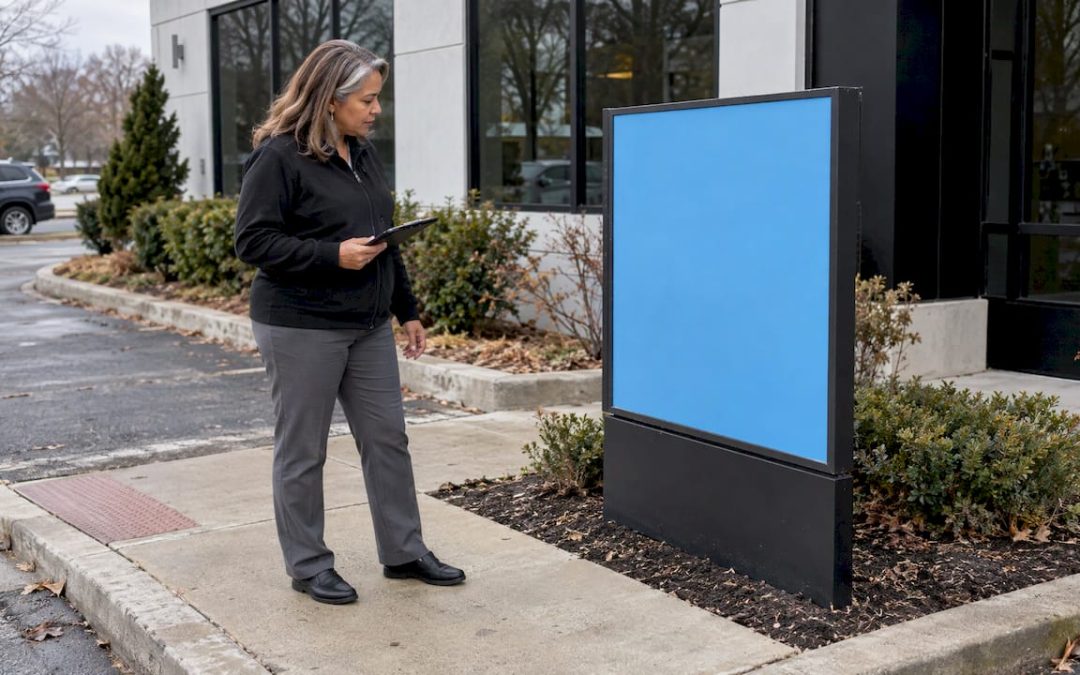
Property sign compliance means that every sign on or around your property meets the rules that govern it before it goes up: the city’s sign code and permits, your landlord’s or association’s criteria, accessibility standards for interior and wayfinding signs, and safety rules for job sites. The rules differ by city, so the safest approach is to settle the sign’s category, size, location and lighting first, then design and fabricate to those limits. That is how we work at Customsignstoday: our process runs from consultation and compliance through fabrication to certified installation, so the sign you approve is the sign that can legally go up.
TL;DR
- Most permanent exterior signs need a permit from the city or county, and many also need separate zoning, building, electrical or right-of-way approvals.
- Some signs are exempt, such as non-illuminated real estate signs in many cities, but the limits on size, setback and lighting still apply.
- Interior signs that name permanent rooms and spaces must meet ADA tactile and Braille rules. Directional signs need only the visual requirements.
- Construction and safety signs follow their own standards, and the permit holder or owner is usually responsible for them.
- Settle the category, size and placement before you order. Changing a finished sign costs more than changing a drawing.
Table of Contents
- What property sign compliance actually covers
- Municipal sign codes: the same idea, different numbers
- When a permit is required and when it is not
- Landlord criteria and private rules
- Accessibility: where ADA rules apply to your signs
- Safety and construction signs
- Real estate signs: the common exemption with its own limits
- How to find out which rules apply to your address
- Common compliance mistakes
- Perspective
- Get the sign built to the rules
- FAQ
- Sources
What property sign compliance actually covers
A sign on a property can be touched by four different layers of rules at once. Missing any one of them can lead to a removal order, a fine or a rejected installation.
- Municipal sign code and zoning. The city decides what you can display based on the zoning district. These rules cover size, height, location, lighting, projection and how many signs you may have.
- Building and electrical codes. A large or heavy sign has to be built and anchored so it survives wind and, in some regions, earthquakes. Illuminated signs add electrical requirements.
- Private rules. Your lease, a shopping center’s sign criteria or a homeowners’ association can be stricter than the city.
- Accessibility and safety standards. Federal ADA guidelines shape interior and wayfinding signs. Workplace and construction rules shape warning signs.
Our guide on why signage regulations exist explains the reasoning behind these layers. Here we focus on what you have to do.
Municipal sign codes: the same idea, different numbers
There is no single national sign code in the US. Each city writes its own, and the numbers vary a lot. The examples below show what the rules look like in practice. They are not your local rules, but they show which questions your sign has to answer.
New York City. The Buildings Department says signs must comply with the Construction Codes, the Zoning Resolution and the Rules of the City of New York, and that violations can bring fines. Zoning there limits signs by district: all signs are strictly limited in residential districts, advertising signs are banned in most commercial districts, and extra restrictions apply near arterial highways and larger public parks.
Seattle. The city’s Sign Code, part of its Land Use Code, regulates most permanent signs, awnings, billboards and temporary signs based on the property’s zoning. It separates on-premise signs (advertising what is sold on the property) from off-premise signs, and sets allowed types, sizes and quantities per zone, with extra restrictions along scenic routes, in special review districts and at historic landmarks.
Denver. The city requires a zoning permit for most signs on private property, a separate right-of-way permit if the sign extends over public property, and an electrical permit if the project includes electrical work. Real estate signs need no zoning permit, but they must sit on private property at least 3 feet back from the sidewalk, cannot be lit or animated, and can only be wall, window or ground signs.
Fremont, California. Its municipal code requires a sign permit for any sign on private property unless it is expressly exempt. It also requires consent from the legal owner and the person in possession, keeps a four-foot clear path on the sidewalk, bans signs in the visibility triangle at intersections, and requires permanent signs to be firmly anchored.
The pattern is the same everywhere: a sign is judged by where it is, how big it is, how it is lit and how it is built. If you can answer those four questions for your sign, you can get a clear answer from the city.
When a permit is required and when it is not
A sign permit is permission from the local government to install or alter a sign at a specific address. Most cities require one for permanent signs and exempt a defined list of small or temporary ones.
San Diego is a useful example of how an exemption list reads. The city requires a sign permit for installing or altering any sign except 13 listed categories. Those include non-illuminated real estate and construction-site signs, window signs, and non-illuminated accessory warning signs such as “no parking” or “security service” up to 12 square feet that do not project over a public right-of-way.
Two lessons follow for owners and managers:
- An exemption has conditions. “Non-illuminated”, “up to 12 square feet” and “not over the right-of-way” are all conditions. Add a light or a larger panel and the sign may fall out of the exempt group.
- Heavy signs trigger engineering. San Diego asks for structural calculations by a California-registered architect or engineer for items such as monument ground signs over 6 feet tall, wall signs over 70 square feet or 600 pounds per sign box, and roof signs at or above the roof line, so the sign resists seismic, wind and dead loads.
The practical takeaway: do not assume a sign is exempt because a neighbor’s sign went up without trouble. The neighbor’s sign may have been grandfathered or permitted under different facts.
Landlord criteria and private rules
City approval does not settle everything. If you rent, your lease may include landlord sign criteria: binding rules on the size, style, mounting and sometimes the colors of tenant signs. Shopping centers and business parks often require the landlord to approve drawings before you apply for a city permit. Homeowners’ associations do the same for residential communities.
Cities generally expect this consent too. Fremont, for example, requires the consent of the legal owner and the person in possession before a sign is placed. So the sequence is usually:
- Read your lease or association rules for sign clauses.
- Get written approval of the design and location from the landlord or manager.
- Apply to the city with that approval attached where required.
Our article on what permitted signage means for business owners walks through that sequence in more detail.
Accessibility: where ADA rules apply to your signs
The Americans with Disabilities Act sets design standards for signs inside most commercial and public buildings. The rules apply to specific categories, not every sign you own. The US Access Board’s guide says tactile characters and Braille apply to signs identifying permanent rooms and spaces, required exit stairway, passageway and exit discharge door labels, elevator floor-level and car-control labels, and rail station identification signs.
The same guide draws useful lines:
- Directional and informational signs (directions, instructions, regulations, hours) need to meet the visual requirements only, such as character size and contrast. They do not need to be tactile.
- Exterior room signs that are away from the doorway they serve do not need to be tactile.
- Temporary signs posted for 7 days or less, and some other listed categories, are exempt from both the visual and tactile requirements.
So a restroom sign, a suite number or an exit door label needs tactile characters and Braille. A banner announcing a weekend sale does not. Details on which exit doors qualify are in our guide to ADA exit sign requirements, and our interior signs are made to the room-by-room needs of an office, clinic or retail space.
Safety and construction signs
If you manage a site under construction or renovation, a second set of rules applies. These rules aim to warn people of hazards and inform the public.
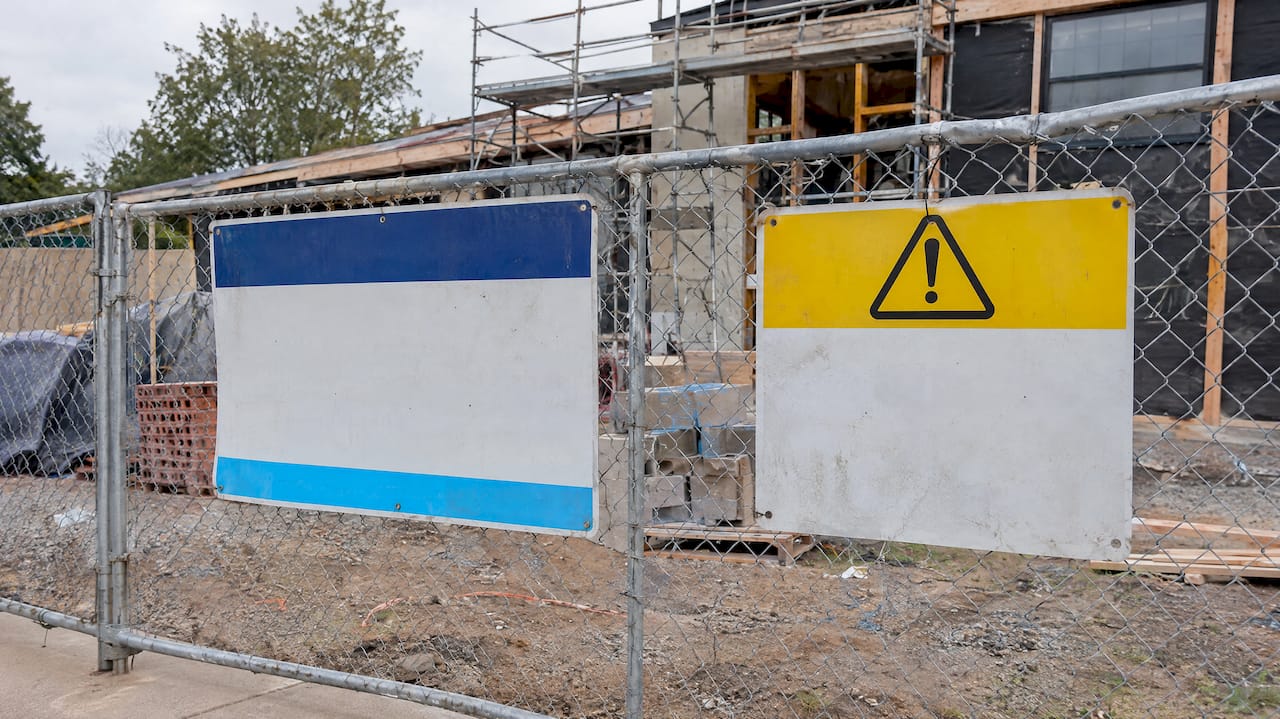
New York City. Chapter 33 of the NYC Construction Code, as amended by Local Law 77 and effective June 10, 2023, makes the permit holder responsible for construction and demolition site signs, or the building owner if no permits are active. Fenced sites need a panel showing the project and a completion date, owner and contractor contacts, a bilingual 311 statement and the primary permit. Illuminated business or advertising signs are prohibited on construction equipment and temporary installations.
California. Cal/OSHA’s Pocket Guide for the Construction Industry lists required postings such as hazard warnings at asbestos and lead work sites, confined spaces, controlled access zones, cranes and high-lift trucks, powder-actuated tools, lasers and air compressors with automatic start.
For property managers the takeaway is simple. Safety signage has required wording, colors and placement, and responsibility sits with a named party. Order those signs to the specification your jurisdiction or safety plan names, not to a generic template. Our site signs cover this kind of project work.
Real estate signs: the common exemption with its own limits
For agents, the good news is that cities often treat non-illuminated real estate signs lightly. Denver and San Diego both exempt them from a zoning or sign permit, as noted above. The bad news is that the exemption comes with placement rules: Denver wants them 3 feet back from the sidewalk, unlit and unanimated.
Agents who work across several cities should keep a short table of local limits for each market. Something like this works:
| Question | Why it matters |
|---|---|
| Is a permit needed for a listing sign? | Many cities exempt non-illuminated ones, some do not |
| Maximum sign area and height | Oversized riders or panels can break the exemption |
| Setback from sidewalk or curb | Signs in the right-of-way are often removed |
| Lighting or movement allowed? | Lit or animated signs usually need a permit |
| Owner consent needed? | Almost always, in writing |
| How long can it stay up? | Some codes limit temporary signs by duration |
Our real estate sign compliance guide goes further, and our real estate signs and A-frames can be sized to your local limits.
How to find out which rules apply to your address
The authority on your sign is the city or county, not a template and not a neighbor. A reliable routine looks like this:
- Write down the facts. Address, zoning district if you know it, sign type (wall, monument, projecting, window, banner), size, height, whether it is lit, and whether it overhangs public property.
- Contact the local planning, zoning or building office. The permitting counter can tell you the sign’s category, whether a permit is needed, the forms, and any overlay or historic-district rules. This step belongs to the authority, and it is part of any compliant project.
- Check private requirements. Read your lease or association rules, and get the owner’s written consent.
- Ask about extras. Separate approvals may apply for electrical work, structural review or the public right-of-way.
- Design to the answers. Give your sign maker the limits in writing so the design, materials and mounting are built to them.
The fifth step is where we take work off your hands. Our process covers consultation, compliance, design, fabrication and certified installation, and we customize size, materials and design to your brand and the setting. You bring the facts from steps 1 to 4, and we turn them into a sign that fits.
Common compliance mistakes
- Treating an exemption as a blank check. Adding illumination or a larger panel can change the category.
- Ignoring the right-of-way. Signs that hang over a sidewalk or sit too close to it trigger separate permits or removal.
- Skipping owner consent. Cities and leases both expect it.
- Blocking sightlines. Fremont bans signs in the intersection visibility triangle, and many other codes do the same.
- Using the wrong sign type for ADA categories. A printed room label without tactile characters will not satisfy the rule for permanent rooms.
- Forgetting installation quality. Codes expect permanent signs to be firmly anchored and built to the building and electrical codes. Our business signage installation guide explains what a sound installation involves.
Perspective
Most compliance problems we hear about start the same way: someone orders a sign first and asks about the rules afterward. By then the size is fixed, the artwork is approved and the budget is spent.
We prefer to start with the address. When a business owner, agent or property manager comes to us, we begin with consultation and compliance, then move to design, fabrication and certified installation. That order matters because a sign is a small construction project: it has a size, a weight, a mounting and often a light, and each of those is something a city or landlord can regulate.
Our view is that the best sign is the one you never have to change. It matches the brand, it is made from durable materials that suit indoor or outdoor use, and it fits the rules of its location. Getting there takes a few facts up front and a maker who treats the rulebook as part of the design brief.
Yossi
Get the sign built to the rules
If you manage a storefront, a listing portfolio, an event or a multi-tenant property, we can handle the sign from consultation through fabrication to certified installation. We make exterior signs, interior signs, banners, vehicle graphics, real estate signs and more, in the sizes and materials your location calls for, for local and nationwide clients.

Send us your address, sign type and approximate size through a quote request. You can read how that works in our guide to custom sign quotes, or start at our custom signs page.
FAQ
Do I need permission to put up a sign on my property?
Usually yes, in two ways. Cities typically require a sign permit unless the sign falls in an exempt category, as in San Diego and Fremont. You also need the property owner’s consent, which many codes and nearly all leases require in writing.
Do real estate signs need a permit?
Often not, if they are small and non-illuminated. Denver and San Diego both exempt them from a permit, but Denver still requires them to sit at least 3 feet back from the sidewalk and bans lighting and animation. Check your city’s limits for size, placement and duration.
Which signs have to be ADA compliant?
Signs that identify permanent rooms and spaces, exit doors and stairs, and elevator controls need tactile characters and Braille, per the Access Board’s guide. Directional and informational signs need only the visual requirements, and temporary signs posted for 7 days or less are exempt.
Who is responsible for construction site signs?
It depends on the jurisdiction. In New York City, the permit holder is responsible for site signs, or the building owner if no permits are active. Safety signs also follow workplace rules, such as the hazard postings listed in California’s construction guide.
Can my landlord restrict my sign even if the city approves it?
Yes. Lease sign criteria and shopping center rules are separate from the city code and can be stricter on size, style and mounting. Get written approval of the design from the landlord before you order.
Sources
- Sign – Buildings, NYC Department of Buildings
- Sign Code, Seattle Construction and Inspections
- Signs, City and County of Denver
- Chapter 18.193 Regulation of Signs on Private Property, Fremont
- How to Obtain a Permit for Signs, City of San Diego
- Chapter 7: Signs, US Access Board
- NYC Building Code Chapter 33, Safeguards During Construction or Demolition
- Cal/OSHA Pocket Guide for the Construction Industry 2022