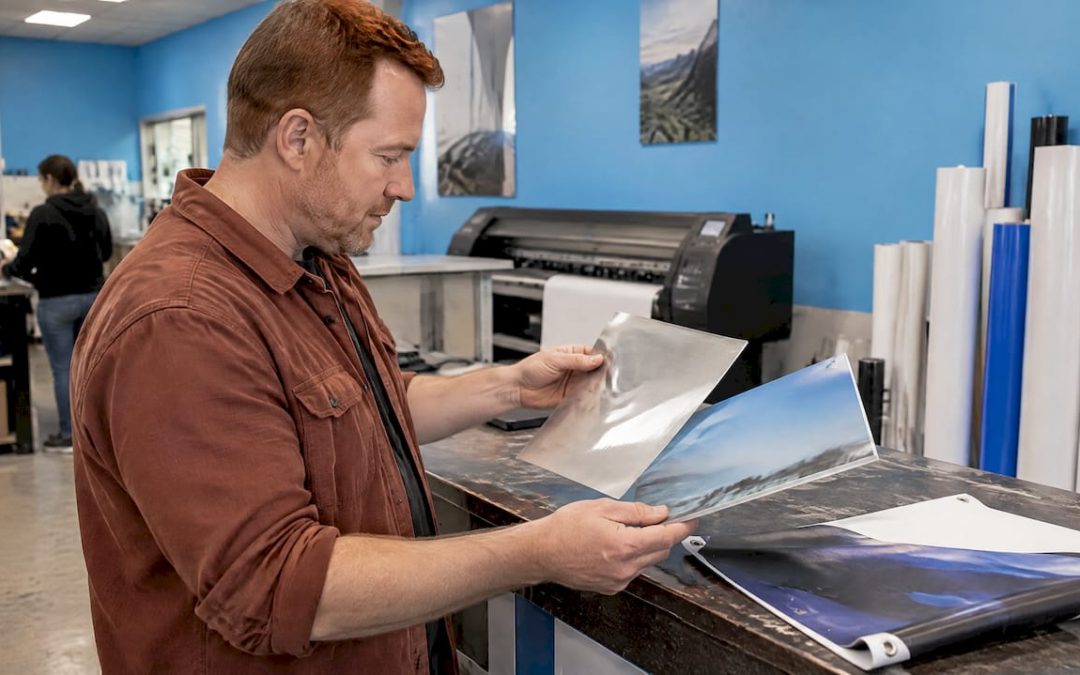
Signage and printing is the work of turning your brand and message into physical pieces that people read from a sidewalk, a car window or across a lobby: banners, storefront signs, vehicle graphics, decals, window graphics, brochures and business cards. The best way to buy it is as one coordinated project, not a pile of separate orders. When the sign on your building, the wrap on your van and the card in a client’s hand all come from one consultation, they match, they work in their setting and they get installed correctly. That is how we approach it at Customsignstoday: consultation, design, fabrication and installation guidance handled together.
TL;DR
- Start from the job the sign has to do (attract, direct, identify, announce), then choose the format and material.
- Indoor and outdoor signs need different materials, and moving vehicles and windows need their own formats.
- Legibility depends on type, spacing, scale and contrast against the real surroundings, not just a good-looking layout.
- Most ordering mistakes come from skipping measurements, placement, artwork preparation or local rules before production.
- One supplier for signs and print keeps your brand consistent and saves you from coordinating several vendors.
Table of Contents
- What signage and printing covers for a business
- Match the sign to the job
- Indoor versus outdoor: why materials differ
- Making a sign readable
- Placement: put it where people look
- Preparing artwork the right way
- Mistakes that cost businesses money
- Who needs what: quick scenarios
- Why one provider for signs and print makes sense
- Our view
- Ready to start your project
- FAQ
- Sources
What signage and printing covers for a business
The phrase sounds broad because it is. In practice a printing and sign company does three things: it designs your visuals, produces them on the right material, and helps you get them in place. Some pieces are signs in the strict sense: rigid or mounted displays that identify a building or direct people. Others are printed graphics: vinyl, banners, decals, brochures. Most businesses need a mix.
A useful way to think about it is by where the piece lives and who sees it.
- Outside the building: storefront and exterior signs, banners, property signs, site signs.
- Inside the building: reception and room signs, wall graphics, directional and wayfinding signs, window graphics.
- On the move: vehicle lettering, wraps and magnets.
- In hand: business cards, brochures and other custom printing.
- At events and listings: retractable banners, feather banners, A-frame signs, real estate signs.
We produce all of these in custom sizes and materials, which means the first decision is not a product name. It is the situation the sign will face.
Match the sign to the job
Before you ask for a quote, write down one sentence: who needs to see this, from how far away, and what should they do next? A sign that tries to do everything usually does nothing well.
| Your goal | Format that usually fits | Where it works |
|---|---|---|
| Be found from the street | Exterior signs | Storefronts, office buildings, shopping centers |
| Guide people once inside | Interior signs and directional signs | Lobbies, hallways, suites, multi-tenant buildings |
| Announce a sale, opening or listing | Banners | Fences, building fronts, event entrances |
| Stand out at a trade show or event | Retractable and feather banners | Booths, registration tables, outdoor events |
| Advertise where you already drive | Vehicle lettering and magnets | Service vans, delivery cars, company fleets |
| Brand a surface | Vinyl wraps, wall and window graphics, decals | Walls, glass, vehicles, equipment |
| Leave something behind | Custom printing | Business cards, brochures, handouts |
| Market a property | Real estate signs and site signs | Yards, development sites, open houses |
Storefront and exterior signs
Your exterior sign is the one piece that works every hour you are open and often when you are closed. It has to be read at a distance, in changing light, by people who are moving. That pushes you toward larger letters, simple wording and strong contrast. Lightbox and face-change formats suit businesses whose message or tenant name may change over time.
Banners in their several forms
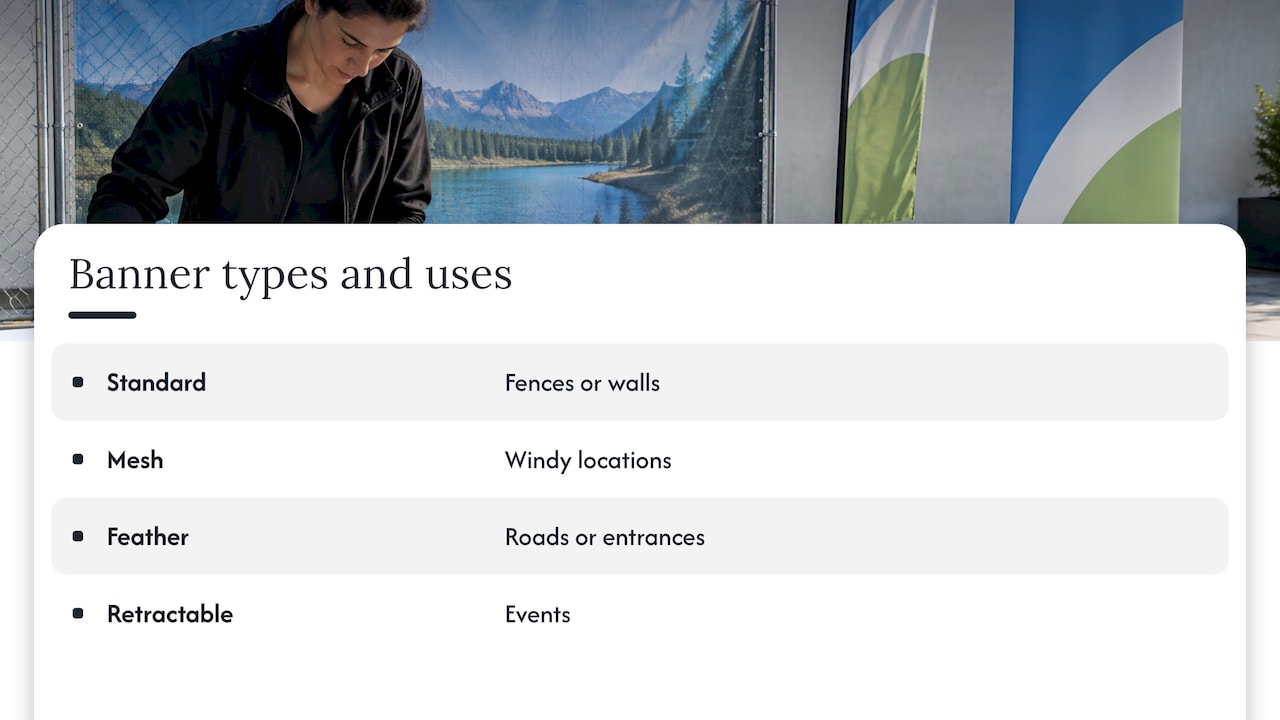
Banners are the fastest way to put a message in front of people. The format matters more than owners expect. A standard banner suits a fence or wall. A mesh banner is built for locations where wind passes through. A feather banner catches attention along a road or at an entrance. A retractable banner packs down and goes with your team to events. Choosing the wrong one is the most common reason a banner looks great in the proof and disappoints on site.
Vehicle graphics
A vehicle works as a moving sign. Lettering carries the essentials: name, phone number, website, service. A full or partial wrap adds color and brand impact. Magnets suit businesses that use personal vehicles part of the time or want a removable option. Because a vehicle is seen briefly and from odd angles, the message needs to be short.
Window, wall and decal graphics
Vinyl is a flexible tool. Window graphics can carry your hours and logo, wall graphics can turn a bare office wall into a brand statement, and decals can label equipment, products or doors. They are often the most affordable way to refresh a space without replacing hard signs.
Indoor versus outdoor: why materials differ
An outdoor sign faces sun, rain, wind and temperature swings. An indoor sign faces handling, cleaning and close viewing. Material, finish and fastening all follow from that. When you request a quote, say clearly where the piece will hang and how long you expect it to last. Is it a one-week event or a five-year fixture? A short-term banner and a permanent building sign should not be priced, built or mounted the same way.
We design and produce with durable materials suited to indoor and outdoor use, and we select them with you based on the location and how long the sign has to stay up. Questions worth settling in the consultation:
- Will the sign be exposed to direct sun or weather, or kept inside?
- Is it permanent, seasonal or single-use?
- How will it be attached: wall, post, fence, glass, vehicle body?
- Will people touch it, walk past it closely, or read it from a distance?
- Does the surface (brick, glass, painted metal, textured wall) need a particular method?
The fastening question is the one people forget. A sign that is right on paper can fail because the wall behind it is not what you described.
Making a sign readable
A sign that cannot be read quickly is just decoration. The ISO standard on information signs, ISO 28564-3:2019, says legibility is supported by legible typefaces, appropriate spacing and scaling, and sufficient luminance and color contrast. It also notes that how conspicuous a sign is depends on its contrast with the surrounding environment, not only with its own background.
That second point changes how you should review a proof. A navy sign with white lettering looks sharp on a screen, but on a dark brick wall in shade it can fade into its surroundings. Check the design against the place where it will hang.
Practical checks before you approve a design:
- Keep the message short. A name, a service, a contact. Everything else belongs on a website or brochure.
- Pick one typeface family and avoid thin decorative scripts for anything read from a distance.
- Give letters room. Tight spacing blurs at a distance.
- Use strong light and dark contrast between lettering and background. Our guide on the role of contrast in signage goes deeper on readability and compliance.
- Imagine the viewing distance and speed. A roadside sign is read in seconds.
Placement: put it where people look
The same ISO standard recommends positioning information signs where users expect them, such as near entrances, reception or information points and places where people need help finding their way. It also says height and angle should account for whether people are standing or seated and the direction they approach from.
For a business this translates into a few simple decisions. Put your identity sign where the customer first looks for the entrance. Put directional signs at decision points: a hallway junction, an elevator lobby, a parking lot split. Mount interior signs at a height and angle that people can read comfortably as they walk toward them.
If your property has multiple tenants, a large parking area or several buildings, directional signage deserves its own plan. Our guides on planning directional signs for any space, types of directional signage and wayfinding signage for businesses and properties walk through the options.
Preparing artwork the right way
Printed pieces are only as good as the artwork behind them. The most common trouble is a small, low-quality logo file stretched to fit a large banner. It looks acceptable on a phone and soft and pixelated at full size.
What to gather before you order:
- Your logo in its original form. Vector formats such as AI, EPS or PDF scale to any size without losing sharpness. A screenshot or a web image does not.
- Exact brand colors. Supply color codes or a brand guide so the printed color matches your other materials.
- Final wording, proofread. Phone numbers, URLs and spellings are the details that cost the most to fix after production.
- Photos at full resolution, if you plan to use any.
- Dimensions of the surface, measured, not estimated. For vehicles, the make, model and year; for windows and walls, the visible area.
If you do not have these, you do not need to solve it alone. Our design team can work from what you have and prepare the artwork for production, so the file that reaches the printer is the right one for the material and size.
Mistakes that cost businesses money
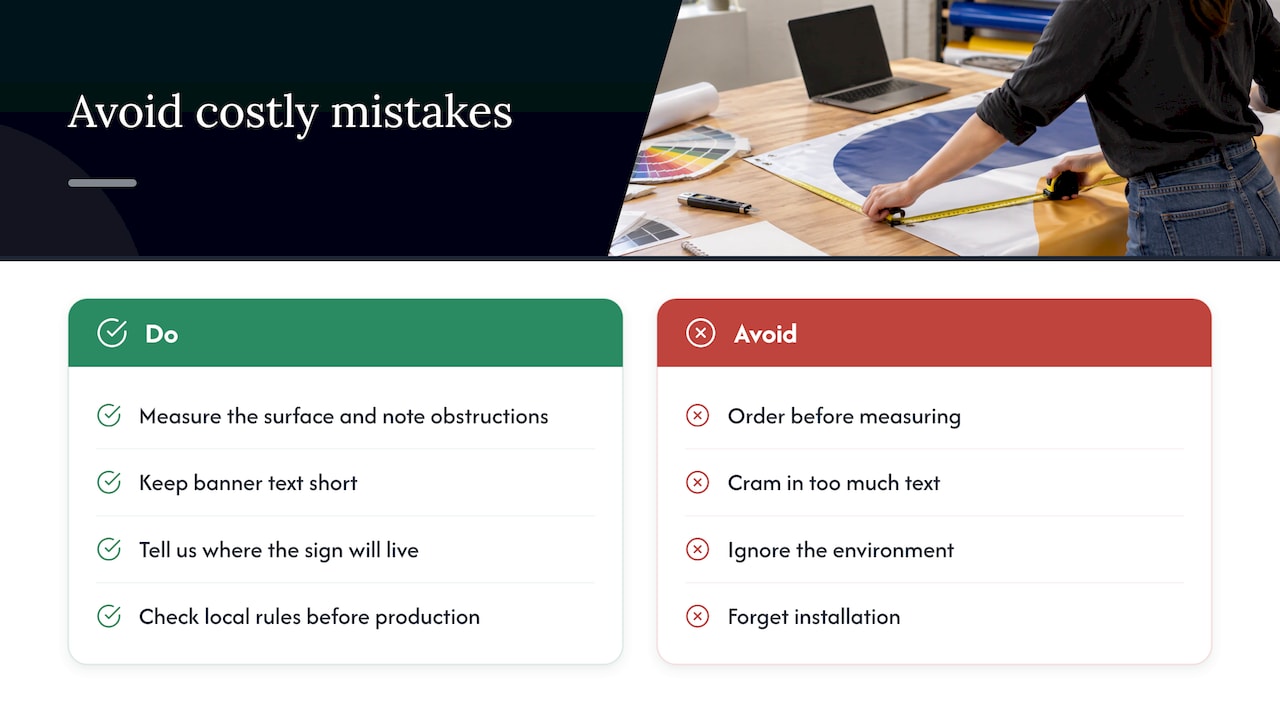
Ordering before measuring. A sign that is slightly too big or too small for its mounting space either looks off or needs remaking. Measure the actual surface and note obstructions such as lights, pipes and trim.
Cramming in too much text. If you need more than a few seconds to read it, it is too long for a banner or a vehicle.
Ignoring the environment. A material that suits an indoor wall may not survive a sunny parking lot. Tell us where it will live.
Skipping local rules. Many cities and property owners regulate outdoor sign size, placement and sometimes lighting. Landlords and associations can add their own approval requirements. Check with your local permitting office and your property manager before production, and ask us about compliance as part of the consultation. Compliance consulting is part of what we offer for indoor and outdoor signage.
Treating each piece separately. A banner from one source, vehicle decals from another and cards from a third rarely match in color or style. Coordinating them is a job in itself.
Forgetting installation. A well-made sign badly mounted is still a bad sign. Plan how it goes up, and who does it, from the start. We provide installation guidance, and our positioning includes certified installation.
Who needs what: quick scenarios
A new retail or office location
Start with the exterior sign and window graphics, then add interior signs and directional pieces. Business cards and brochures round out the first-day kit. Ordering them together helps keep type, colors and logo placement consistent.
A real estate agent
You need signs that go up quickly, read from the street and carry your name and number clearly. Real estate signs, property banners and site signs cover most listings. Our guide to real estate banners and the piece on banners in property marketing cover how agents use them.
An event organizer
Events mean tight timing and mixed environments: indoor registration, outdoor entrances, parking. Retractable banners, feather banners, A-frame signs and directional signs do most of the work. Give us the event type and venue and we can recommend the right mix.
A property manager
A building needs consistent identity and navigation: entrance signs, suite and room signs, directional signs and sometimes safety signage. Standardizing the look across the property keeps it professional and makes later replacements easier.
A service company with vehicles
Start with vehicle lettering on every vehicle for a consistent fleet look. Consider wraps for the vehicles that spend the most time on the road. Add decals for equipment and magnets for flexible use.
Why one provider for signs and print makes sense
Signs and print share the same foundation: your logo, colors, typefaces and message. When they come from one place, you brief once, approve once and get pieces that look like they belong together. You also have one team to ask about materials, installation and compliance instead of three.
Our positioning is simple: personalized service, expert design and fabrication, a broad product range, durable materials, certified installation, and fast turnaround for local and nationwide clients. The process runs from consultation through compliance to installation, with each sign aligned to your brand and environment. If you want to see how quoting works, read about custom sign quotes.
Our view
Most of the signage problems we hear about are not printing problems. They are planning problems: the wrong format for the place, a design that does not read at distance, a wall that is not what the order assumed.
That is why we start with a consultation, not a catalog. Where will it hang, who needs to see it, how long should it last? Once those answers are clear, size, material and design follow naturally, and the sign, the vehicle graphics and the printed pieces can all carry the same brand.
We build custom, in the size and material the job needs, and we stay with you through compliance and installation guidance. A sign should work on the day it goes up and keep working long after.
Yossi
Ready to start your project
We produce banners, storefront and exterior signs, interior signs, vehicle wraps and lettering, vinyl graphics, decals, business cards and brochures, all custom. Tell us what you need, where it will go and when, and we will take you through design, production and installation. Request a quote on our site to begin.
If you already know the category, go straight to the page for banners, exterior signs or custom printing.
FAQ
What do signage and printing companies do?
They design, produce and help install visual communication for businesses: signs, banners, vehicle graphics, vinyl and decals, and printed pieces like cards and brochures. A full-service company also advises on materials, placement and local rules. We handle consultation, design, fabrication and installation guidance in one process.
What is the difference between a sign and a banner?
A sign is usually a more permanent, rigid or mounted piece that identifies or directs, such as a storefront sign or interior room sign. A banner is a flexible printed piece, suited to promotions, events and listings. Many businesses use both: a permanent sign for identity and banners for time-limited messages.
What should I send before requesting a quote?
Send your logo in its original file, brand colors, the exact wording, and measurements of the space. Tell us whether the sign will be indoors or outdoors and how long it should last. If you are missing any of this, we can work from what you have and guide you through the rest.
How do I make sure my sign is easy to read?
Keep the wording short, use clear typefaces with generous spacing, and choose strong contrast against the surface it will sit on. Judge the design against the actual surroundings, not only on a screen. Our design team reviews these points with you before production.
Can one company handle both my signs and my printed materials?
Yes. We produce signs, banners, vehicle graphics, vinyl, business cards and brochures, so your brand looks the same on every piece. It also means one point of contact for your whole project.