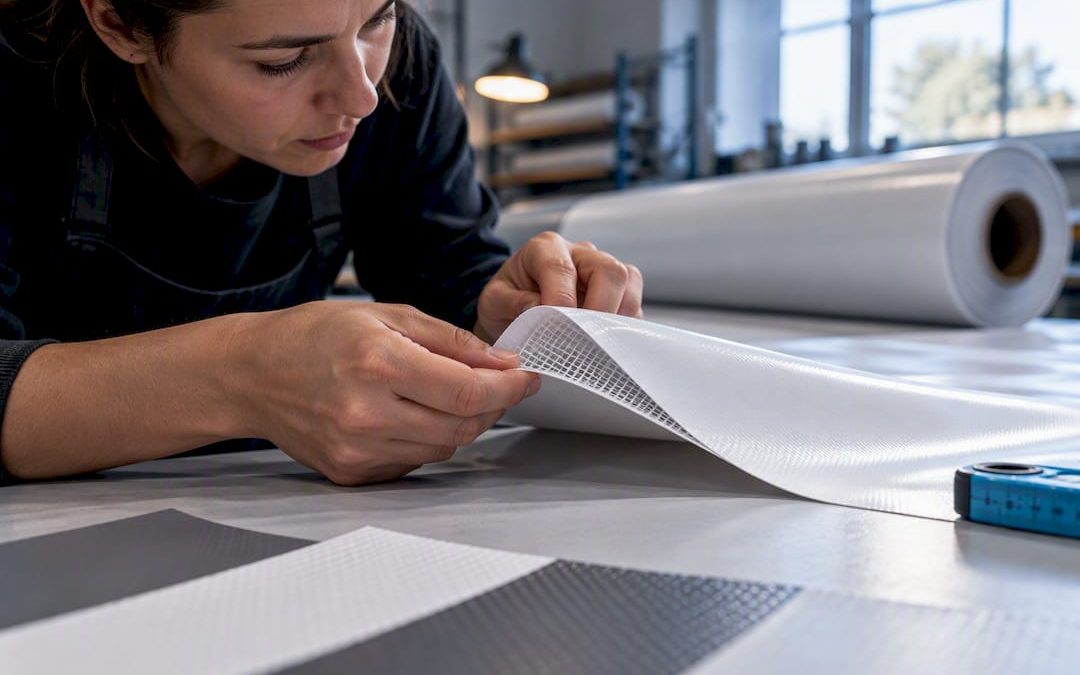
The main flex banner materials are frontlit, backlit, blockout, mesh, and specialty variants like PVC-free fabrics. Pick frontlit for standard outdoor and indoor display, backlit for illuminated lightboxes, blockout for double-sided signs, and mesh for windy, high-mounted installations. The right final choice always comes down to three numbers: GSM (weight), scrim denier (strength), and whether the material is coated or laminated.
TL;DR:
- Using 440gsm or higher banner material with HALS UV stabilization ensures longevity for permanent outdoor signs, while lighter options suit short-term displays.
- Mesh banners with open-area percentages above 40% are ideal for windy environments but may weaken fine detail and close-up readability.
- Backlit banners require a GSM between 20% and 40% to balance brightness and avoid hot spots or a washed-out appearance in daylight.
- Double-sided signs should use blockout banners with a third layer for sharp, independent printing on each face, despite higher costs.
- Confirming the scrim denier (500D to 1000D), coating method, and flame rating upfront helps match the material to specific environmental and regulatory needs.
Table of Contents
- Types of Flex Banner Material at a Glance
- Frontlit, Backlit, Blockout, and Mesh: Specs and Best Fit
- What’s Actually Inside a Flex Banner
- How to Specify Flex Banner Material for Your Project
- Matching Ink and Finish to Each Banner Type
- Getting the Most Life Out of Your Banner
- How Custom Signs Today Approaches Banner Specification
- A Practical Take on Common Specification Mistakes
- Get Banner Samples and a Quote from Customsignstoday
- Sources
- FAQ
Types of Flex Banner Material at a Glance
Each flex banner type solves a different physical problem, making it essential for construction sites to choose the right material to ensure durability and visibility, as highlighted by Sam’s Dumpster Rentals. Some manage light, others manage wind, and some manage both sides of the same sign.
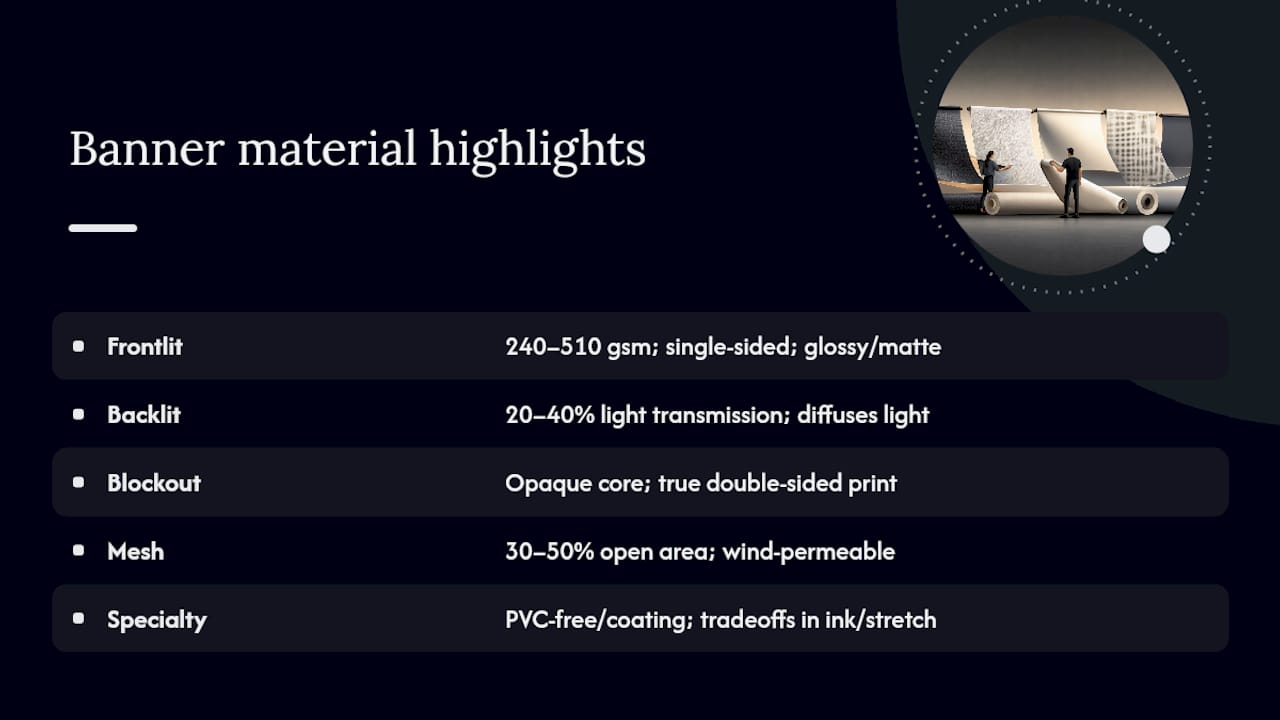
- Frontlit: Standard opaque PVC lit from the front by ambient or external light. Best for storefronts, trade shows, and general outdoor advertising where you want punchy color and sharp text.
- Backlit: Semi-translucent PVC built to diffuse light evenly from behind. Best for lightboxes, illuminated storefront panels, and airport or retail displays viewed after dark.
- Blockout: Three-layer PVC with an opaque core sandwiched between two printable faces. Best for double-sided signs like pole banners and street pennants where you can’t allow one side’s image to bleed through onto the other.
- Mesh: Perforated PVC with open channels that let wind pass through. Best for building wraps, fence banners, and any large-format install exposed to serious gusts.
- Specialty (PVC-free, coated/laminated variants): Eco-conscious fabrics or performance-tuned coatings built for specific environmental or budget goals. Best for brands with sustainability commitments or short-run indoor jobs where PVC’s added durability isn’t needed.
The trade-offs matter as much as the benefits. Mesh cuts wind load dramatically, but the perforation pattern is visible up close, which softens fine detail and small text. Backlit material looks flat and washed out under direct daylight if you use it without a light source behind it. Blockout costs more than standard frontlit because you’re paying for a third layer of material, and PVC-free options often trade some tear strength for a lighter environmental footprint.
Frontlit, Backlit, Blockout, and Mesh: Specs and Best Fit
Marketing names like “premium banner vinyl” tell you almost nothing. Weight, scrim, and finish tell you everything.
Frontlit banners typically run from 240gsm for light indoor jobs up to 510gsm for heavy-duty outdoor use. They accept solvent, eco-solvent, UV, and latex inks, and you can order them in glossy or matte finish depending on whether you need pop or glare control. The upside is versatility: frontlit works for almost any single-sided display. The downside is that it does nothing for you in low-light settings without external illumination.
Backlit banners use a milky, semi-translucent PVC engineered to diffuse light rather than let it pass straight through. Light transmission typically runs 20% to 40%, which is the sweet spot for even glow without hot spots behind an LED panel. Get the GSM too high and the panel looks dim; too low and you see every light fixture behind it as a distinct bright patch.
Blockout banners put a black or gray opaque layer between two outer print surfaces, which is what allows sharp, independent printing on both sides. This construction is standard for double-sided pole banners, feather flags, and street pennants viewed from both directions.
Mesh banners use an open-area percentage, usually between 30% and 50%, to let wind pass through the sign instead of tearing it off its frame. A higher open-area percentage suits tall building wraps where wind load is the biggest risk; a lower percentage suits fence banners viewed at closer range where some sharpness still matters.
Specialty variants cover PVC-free fabrics and coating alternatives. These are not identical drop-in replacements for standard PVC. They generally offer a better environmental profile but can differ in stretch resistance, ink adhesion, and price, so match the substitute to the job rather than assuming it performs the same across every use case.
What’s Actually Inside a Flex Banner
A flex banner isn’t just “vinyl.” It’s a composite: a woven scrim core sandwiched in a PVC compound, finished with a surface treatment that determines how it prints, bends, and ages.
The scrim is a polyester mesh woven into the middle of the material, and its thread count, expressed in denier, is the single biggest driver of tear resistance. Entry-level banners use scrim around 500D. Materials built for permanent outdoor signage push up to 1000D, which resists ripping at grommet points and holds its shape under sustained wind pressure.
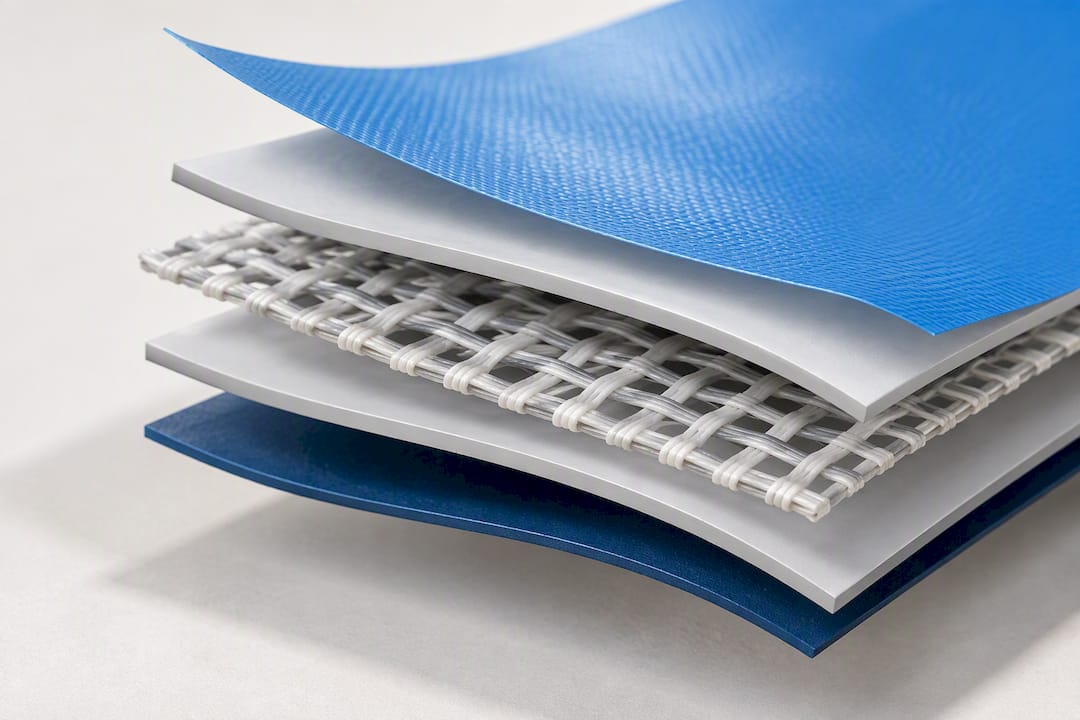
The PVC compound surrounding that scrim contains a few key additives worth asking your supplier about by name. Titanium dioxide (TiO2) gives the material its bright white base and directly affects how vivid your printed colors look. Plasticizers keep the PVC flexible enough to roll, fold, and hang without cracking. HALS, short for hindered amine light stabilizers, is what slows down UV degradation and keeps colors from fading within a single season outdoors.
How that compound gets bonded to the scrim is the other half of the equation, and it splits into two manufacturing methods with real performance consequences.
| Manufacturing method | Bond quality | Surface finish | Best for |
|---|---|---|---|
| Coated (calendered) | Higher delamination resistance | Smoother, more consistent print surface | Long-term outdoor signage |
| Laminated | Lower cost, more prone to edge separation | Slightly less uniform | Short-term indoor or budget runs |
Calendered coating fuses the PVC directly into the scrim under heat and pressure, producing a bond that resists peeling at the edges even after years outside. Laminated materials press two separate PVC films around the scrim instead, which costs less to produce but leaves a seam that can start separating at grommets, hems, or high-flex points first.
How to Specify Flex Banner Material for Your Project
Specification decisions come down to five variables: weight, scrim strength, open-area percentage, fire rating, and finishing. Get these right before you request a quote and you’ll skip the back-and-forth entirely.
- Set your GSM by lifespan, not budget. Short-term indoor or event banners work fine at 280 to 340gsm. Permanent outdoor installations need 440gsm or heavier to survive repeated sun and wind cycles.
- Match scrim denier to installation duration. A 500D scrim is fine for a weekend trade show. A permanent building-mounted banner should carry scrim up to 1000D.
- Confirm UV stabilization for anything outdoors. Ask specifically whether HALS is included in the compound, not just whether the material is “UV rated.”
- Pick mesh open-area percentage by height and distance. Higher percentages (closer to 50%) suit tall façades where wind load dominates; lower percentages (closer to 30%) suit ground-level fence banners viewed up close.
- Request flame-retardant certification for indoor public spaces. Look for NFPA 701 in the US or B1/M1 ratings if you’re sourcing internationally, especially for banners in venues, schools, or retail spaces with fire code requirements.
- Choose your hem and grommet method deliberately. Welded hems hold up better under sustained wind pull than stitched hems, which can loosen over repeated flexing.
Pro Tip: Ask any supplier for the material’s datasheet before you order a full run. A real datasheet lists TiO2 whiteness index, HALS loading, scrim denier, and tensile break values. If a supplier can’t produce those numbers, you’re buying a marketing name, not a specification.
For durability specifics tied to outdoor exposure zones, see this breakdown of durable signage materials for lasting outdoor performance.
Matching Ink and Finish to Each Banner Type
Printing the wrong ink on the wrong surface is one of the most common and most expensive mistakes in banner ordering. Get the pairing wrong and you’ll see poor adhesion, dull color, or premature cracking.
- Frontlit banners accept solvent, eco-solvent, UV, and latex inks without much fuss, making them the most forgiving surface for most print shops.
- Backlit material needs printer settings tuned specifically for translucent stock. Print too much ink density and you get burn-through spots; print too little and colors wash out once the light source is switched on behind it.
- Matte finishes cut glare and work better for outdoor signs viewed at odd angles or under direct sun. Glossy finishes punch up color saturation but show every fingerprint and reflection indoors.
- Cold lamination adds scratch protection and a richer surface look, but it introduces a seam at the material’s edge that can lift over time, especially on banners that get rolled and unrolled repeatedly.
Getting the Most Life Out of Your Banner
Expected lifespan varies enormously by material and environment. A basic event banner might only need to survive a weekend, while a premium outdoor sign should hold up for years.
Short-term event banners at 280 to 340gsm are built for single use or a handful of installs, not year-round exposure. Standard outdoor banners in the 440gsm range with HALS stabilization typically last one to three years before fading or edge wear becomes noticeable. Premium outdoor materials with heavier scrim and higher additive loads can push past three to five years.
Clean banners with mild detergent and a soft cloth. Skip abrasive scrubbing, which grinds grit into the print surface and accelerates fading. Store rolled, not folded, to avoid creasing that weakens the PVC at fold lines over time.
Pro Tip: Replace a banner the moment you spot fabric tears near the grommets or seam separation at the hems. Those are structural failures, not cosmetic ones, and they tend to worsen fast once wind gets behind a loose edge.
How Custom Signs Today Approaches Banner Specification
Getting banner specs right takes more than picking a GSM number off a chart. Customsignstoday works through material weight, scrim strength, coating method, and flame rating with every custom order, matching the banner to how and where it’ll actually hang. If you want a second opinion on a spec sheet or a sample swatch before committing to a full print run, that’s a conversation worth having before the order goes to press.
A Practical Take on Common Specification Mistakes
The most common mistake isn’t picking the wrong banner type. It’s mismatching spec to duration: ordering 280gsm frontlit for a permanent storefront sign that needed 440gsm, or hanging mesh where full-color close-up readability actually mattered and getting complaints about the see-through pattern. Backlit glare from direct sunlight without a working light source behind it is another recurring complaint. Order a sample and a small test print before committing to a full production run. It’s cheap insurance against a costly reprint.
— Yossi
Get Banner Samples and a Quote from Customsignstoday
Choosing between frontlit, backlit, blockout, and mesh gets a lot easier once you can hold the actual material in your hands. A professional signage provider’s advantage isn’t guesswork over a spec sheet. It’s having a team that walks through GSM, scrim denier, and coating method with you before your project goes to print, so the banner that arrives matches the wind exposure, lighting, and lifespan your installation actually needs.
Whether you need a heavy-duty mesh wrap for a windy façade or a backlit panel for a retail lightbox, the process starts the same way: tell the signage provider what the sign needs to survive, and get material recommendations built around that answer instead of a generic catalog listing. Visit the banners page to request a sample swatch or a free quote, and get your specification locked in before your next print run.
Sources
For deeper specification data, the PVC flex banner specifications guide and the PVC flex banner raw material and print durability guide cover GSM, scrim, and coating differences in more technical depth than most buyers will ever need, but they’re worth having on hand when comparing supplier quotes.
- PVC flex banner specifications guide
- PVC flex banner raw material, quality & print durability guide
- Mesh banners vs polyester banners: which is the best option
- Frontlit vs Backlit vs Blockout banner materials: what’s the difference?
FAQ
What Material Is Used for Flex Banners?
Flex banners are made from PVC compound bonded to a woven polyester scrim core, finished with additives like titanium dioxide for whiteness and HALS for UV protection. The bonding method, coated or laminated, determines how well that PVC layer resists peeling over time.
How Many Types of Flex Banners Are There?
There are five main categories: frontlit, backlit, blockout, mesh, and specialty variants like PVC-free fabrics. Each is engineered for a different combination of lighting, wind exposure, and printing requirements rather than being interchangeable versions of the same product.
Which Flex Material Is Best?
There’s no single best material. It depends on your use case: frontlit for standard single-sided display, backlit for illuminated lightboxes, blockout for double-sided signs, and mesh for windy, large-format installations. Customsignstoday can walk through your specific installation site and recommend the material spec that fits it.
What GSM Should I Choose for an Outdoor Banner?
Short-term outdoor or event banners work at 280 to 340gsm, while permanent outdoor installations need 440gsm or heavier with HALS UV stabilization and stronger scrim. Going lighter than that on a permanent sign shortens its usable life significantly.
Does Mesh Banner Material Reduce Print Quality?
Yes, slightly. The open-area percentage that lets wind pass through also makes the perforation pattern visible up close, softening fine detail and small text compared to solid PVC. Mesh is best reserved for large-format installs viewed from a distance, not close-range signage.