TL;DR:
- Event decals are versatile vinyl adhesive graphics used on floors, walls, and stages to enhance branding and attendee guidance during events. Proper surface preparation and adhesive selection are essential for clean removal and surface safety, with different types suited for indoor or outdoor applications. Strategically incorporating decals into event design can boost visibility, social media engagement, and venue experience, making them a valuable branding tool.
Event decals are custom adhesive graphics, most commonly made from vinyl, applied to floors, walls, windows, and stages to brand event spaces, direct attendees, and create photo-ready environments. The industry term for these products is “vinyl event graphics,” though event planners widely use “event decals” to describe the full category. Understanding what event decals are, and how to deploy them strategically, separates forgettable events from ones that generate social media coverage and repeat attendance.
What are event decals and how do they work?
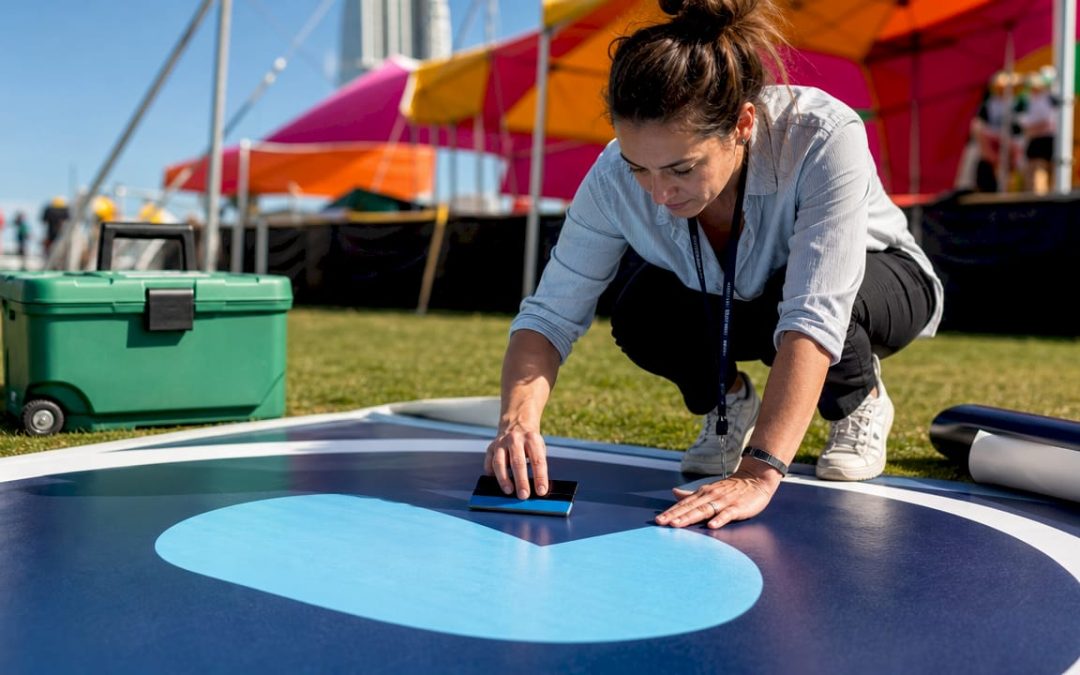
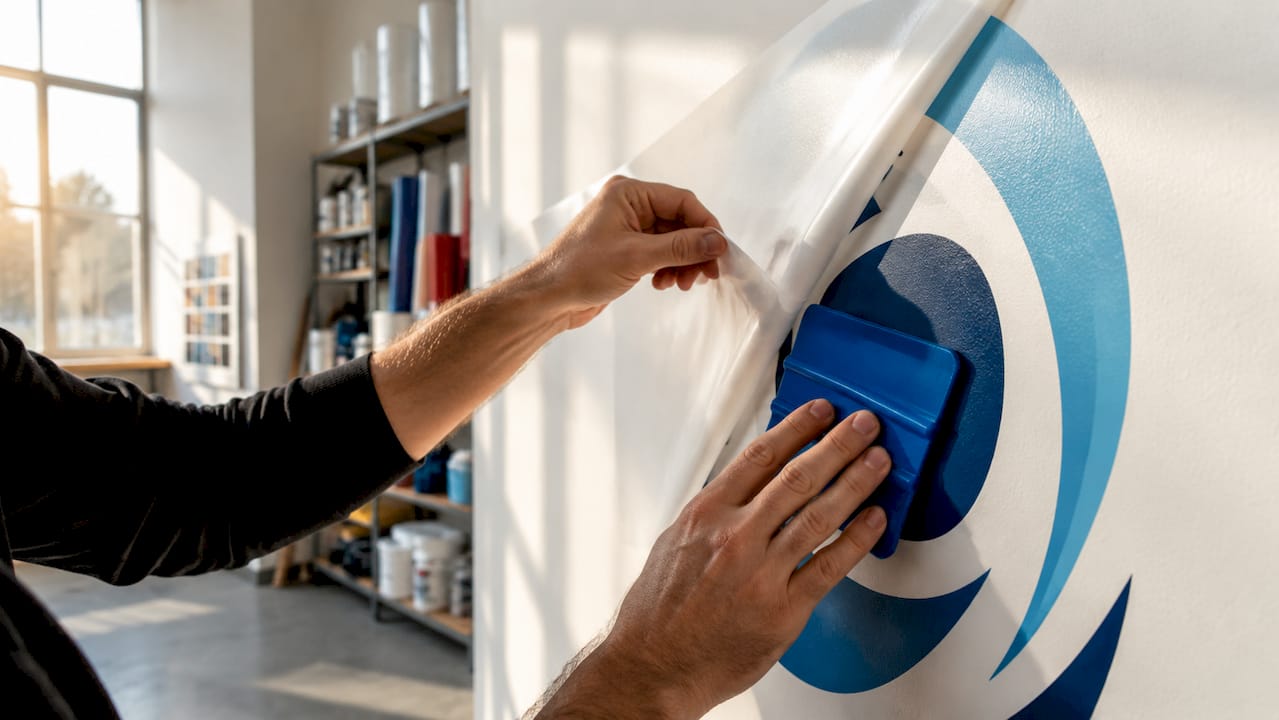
Event decals are adhesive graphics transferred onto surfaces through pressure or heat, serving both decorative and branding purposes across the events industry. The graphic is printed onto vinyl film, backed with an adhesive layer, and covered by a release liner until application. When you press the decal onto a prepared surface, the adhesive bonds to create a flat, seamless graphic that looks like it belongs there permanently, even when it is designed to come off cleanly after the event.
The core appeal for event planners is versatility. A single decal order can cover your sponsor logos on the entrance floor, directional arrows through a convention hall, and a branded photo backdrop on the main stage. That range of application from a single material type makes vinyl event graphics one of the most cost-efficient tools in an event planner’s toolkit. Customsignstoday produces these graphics for events of all sizes, from intimate corporate dinners to large-scale trade shows.
The adhesive technology is what makes event decals genuinely useful rather than just decorative. Removable adhesives bond via contact pressure and use a lower tack formulation that holds firmly during the event but releases cleanly without leaving residue or damaging the venue surface. That clean removal is the difference between getting your deposit back and paying for floor refinishing.
What types of event decals are available?
Event decals fall into four primary categories, each engineered for a specific surface and use case. Knowing which type fits your event prevents costly mistakes in material selection.
Floor decals are the most widely used type at events. Floor graphics use strong vinyl with a slip-resistant, scuff-resistant top laminate to handle high foot traffic without becoming a safety hazard. They work on concrete, hardwood, tile, and carpet-ready substrates. Common applications include sponsor logos at entrances, directional arrows through large venues, and branded step-and-repeat patterns.
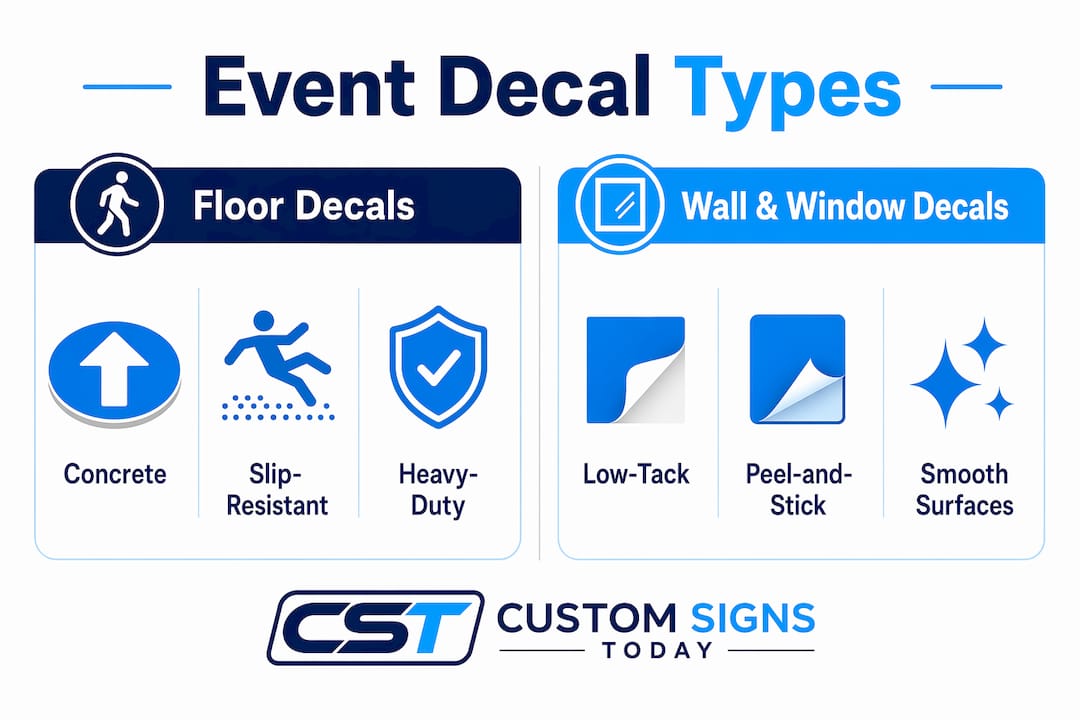
Wall and window decals use low-tack, peel-and-stick vinyl that applies smoothly to painted drywall, glass, and smooth-surface panels. They are ideal for instant branded displays at registration desks, sponsor walls, and session room identifiers. Because they remove without damaging surfaces, venue managers rarely object to their use.
Stage and backdrop decals are large-format graphics applied directly to stage facades, podiums, or freestanding panels. These create the polished, photo-ready environments that show up in press coverage and attendee social posts. They are typically printed on higher-tack vinyl since stage surfaces are not walked on and the graphic needs to stay perfectly flat under lighting.
Removable vs. permanent adhesive decals represent a choice rather than a type. Permanent adhesives create a stronger bond suited for multi-day outdoor events, while removable adhesives are the standard choice for indoor venues where surface protection matters.
| Decal Type | Primary Surface | Adhesive Type | Best Use Case |
|---|---|---|---|
| Floor decal | Concrete, tile, hardwood | Removable, slip-resistant laminate | Wayfinding, sponsor logos, crowd flow |
| Wall decal | Painted drywall, smooth panels | Low-tack removable | Branded displays, session signage |
| Window decal | Glass, acrylic | Low-tack removable | Entrance branding, sponsor recognition |
| Stage/backdrop decal | Stage facades, panels | Medium to high-tack | Photo backdrops, speaker branding |
| Permanent outdoor decal | Concrete, asphalt, metal | High-tack permanent | Multi-day festivals, outdoor wayfinding |
For a broader look at how these fit into a full event signage strategy, the outdoor event signage comparison from Customsignstoday breaks down material choices across all sign types.
What materials and adhesives make event decals work?
The performance of any event decal comes down to two components: the vinyl film and the adhesive layer. Getting both right for your specific event is what separates a graphic that looks great all weekend from one that starts peeling by Saturday afternoon.
High-quality event vinyl is durable, dimensionally stable, and resistant to scuffing from foot traffic and equipment movement. The top surface is typically finished with a protective laminate that adds scuff resistance and, for floor applications, a textured non-slip coating. This laminate also protects the printed ink from fading under event lighting and prevents the graphic from looking worn after a full day of foot traffic.
Adhesive selection is where most planners make their first mistake. The options break down clearly:
- Low-tack pressure-sensitive adhesive: Bonds on contact, holds firmly during the event, and releases cleanly. Best for indoor venues, carpeted surfaces, and any location where surface damage is a concern.
- High-tack permanent adhesive: Creates a stronger bond suited for outdoor surfaces, rough textures, or multi-day events in high-traffic areas. Removal may require solvents and can risk surface damage.
- Repositionable adhesive: A specialty formulation that allows the decal to be lifted and reapplied during installation. Useful for large-format graphics where precise alignment matters.
Lifespan ranges for removable decals run approximately 1 to 7 days for trade shows and single-day events, 1 to 4 weeks for short promotional campaigns, and 1 to 6 months for longer installations. Choosing a decal rated beyond your actual event duration is a common and avoidable waste of budget.
Pro Tip: Match your adhesive strength to your event duration, not to your confidence in the graphic. A decal rated for 6 months on a 2-day event will bond more aggressively than necessary and risk pulling paint or finish on removal. Ask your supplier for the specific adhesive rating before ordering.
Professional-grade event decals can last several months, but removing them within a year keeps the removal clean and residue-free. For most event planners, the sweet spot is a removable vinyl rated for 1 to 4 weeks, which gives you setup buffer, full event coverage, and easy teardown.
What are the real benefits of event decals for planners?
Event decals serve multiple strategic purposes including branding, guest guidance, and creating shareable visual moments that extend your event’s reach on social media. That combination of functions in a single, low-cost format is why experienced planners treat decals as a core budget line rather than an optional add-on.
The specific advantages that matter most to event organizers include:
- Brand consistency at scale: Decals let you apply your event identity, sponsor logos, and color palette across an entire venue without the cost of printed banners at every surface.
- Wayfinding and crowd control: Floor graphics with directional arrows or color-coded zones reduce staff workload and attendee confusion in large venues. This is particularly effective at multi-track conferences and trade shows.
- Social media amplification: A well-designed floor or wall decal becomes a natural photo backdrop. Attendees photograph branded environments and share them, extending your event’s reach without additional marketing spend.
- Cost efficiency vs. permanent signage: Decals cost a fraction of fabricated signs and can be reprinted for each event with updated sponsors, dates, or themes.
- Venue-friendly removal: Removable wall decals allow organizers to update signage and décor without risking damage to venue walls or triggering costly repair fees.
The event branding signage guide from Customsignstoday covers how strategic signage placement, including decals, connects directly to attendee experience and sponsor satisfaction.
Pro Tip: Design at least one floor or wall decal specifically as a photo moment. Place it near a high-traffic area, include your event hashtag in the design, and watch attendees do your social media marketing for free.
How to use event decals effectively
Effective decal use starts before the graphic is even printed. Surface preparation, placement planning, and design decisions all affect whether your decals perform as expected or become a problem to manage on event day.
-
Audit your surfaces before ordering. Walk the venue and identify every surface where you plan to apply decals. Note the material, texture, and finish. Waxed floors, freshly painted walls, and textured concrete all require different adhesive specifications. Ordering without this information leads to adhesion failures.
-
Clean surfaces immediately before application. Contaminants like dust, wax, and moisture reduce adhesive effectiveness and cause edge lifting under foot traffic. Wipe surfaces with isopropyl alcohol and allow them to dry completely before applying any decal.
-
Plan placement around attendee flow. Map your expected foot traffic patterns and place directional decals where decisions happen, at intersections, room entrances, and registration queues. Decals placed in low-traffic areas waste budget and miss their wayfinding purpose.
-
Coordinate decal design with your full signage system. Decals should use the same fonts, colors, and logo treatments as your banners, digital displays, and printed materials. Inconsistency in visual identity undermines the professional impression you are building.
-
Test adhesion 24 hours before the event. Apply a small test piece to each surface type and check it the next day. This catches adhesion problems before your full installation and gives you time to adjust your approach.
Pro Tip: For large venues, create a scaled floor plan and mark every decal placement location before the installation crew arrives. This eliminates guesswork on event day and prevents the common mistake of placing wayfinding arrows too far from decision points to be useful.
For more design and customization guidance, the event sign customization guide from Customsignstoday covers how to align your decal designs with a full event visual identity.
Key takeaways
Event decals are vinyl adhesive graphics that combine removable adhesive technology with slip-resistant laminates to deliver temporary, high-impact branding across floors, walls, windows, and stages at any event.
| Point | Details |
|---|---|
| Definition and material | Event decals are vinyl adhesive graphics designed for temporary application on event surfaces. |
| Adhesive selection matters | Match adhesive tack to event duration to protect venue surfaces and avoid premature peeling. |
| Four primary types | Floor, wall, window, and stage decals each serve distinct branding and wayfinding purposes. |
| Surface prep is non-negotiable | Clean, dry, flat surfaces are required for proper adhesion and clean removal after the event. |
| Strategic social media value | Designing one decal as a photo moment generates attendee-driven social media coverage at no extra cost. |
Why event decals deserve more strategic attention than most planners give them
Most event planners I have worked with treat decals as a last-minute add-on, something ordered in the final week to fill visual gaps. That approach consistently underuses one of the most flexible branding tools available. The planners who get the most out of decals start with them in the design phase, treating floor and wall graphics as part of the spatial experience rather than decoration.
The trend I find most interesting right now is the use of floor decals as interactive social media triggers. A well-placed, well-designed floor graphic with a QR code or a branded hashtag becomes a content creation prompt. Attendees photograph it, share it, and tag the event without any prompting. That organic amplification is worth far more than the cost of the decal itself.
The mistake I see most often is adhesive mismatch. Planners order the cheapest available decal without checking the adhesive rating against their venue surface or event duration. The result is either a decal that starts peeling on day one or one that bonds so aggressively it pulls the venue’s floor finish on removal. Both outcomes are avoidable with a five-minute conversation with your supplier before the order is placed.
My honest recommendation is to view event decals as a spatial branding investment, not a print expense. When you design them with the same intention you bring to your stage set or your keynote presentation, they transform how attendees experience and remember your event.
— Yossi
Get custom event decals from Customsignstoday
Customsignstoday produces custom vinyl event decals built for the demands of real events, including slip-resistant floor graphics, removable wall decals, and large-format stage graphics. Every order is produced on high-quality vinyl with adhesive options matched to your event duration and surface type.
Whether you are branding a corporate conference, a trade show booth, or an outdoor festival, Customsignstoday offers full customization from design to delivery. The team works with event planners to select the right materials, adhesive strength, and finish for each application. Request a free quote and get your event graphics produced to spec, on time, and ready to install.
FAQ
What does “event decal” mean?
An event decal is a custom adhesive graphic, typically made from vinyl, applied to floors, walls, windows, or stages at events for branding, wayfinding, or decorative purposes. The term covers both temporary removable graphics and more permanent installations depending on the adhesive used.
How long do event decals last?
Removable event decals are rated for approximately 1 to 7 days for single-day events, 1 to 4 weeks for short promotions, and up to 6 months for longer campaigns. Professional-grade decals can last up to a year but should be removed before that point to keep removal clean and residue-free.
Can event decals damage venue floors or walls?
Decals made with low-tack removable adhesive are specifically engineered to peel off cleanly without leaving residue or damaging surfaces. The key is matching the adhesive type to the surface and removing the decal within the rated lifespan.
What surfaces can event decals be applied to?
Event decals adhere to concrete, tile, hardwood, painted drywall, glass, acrylic, and smooth panel surfaces. Surface preparation is critical: the surface must be clean, dry, and free of wax, dust, or moisture for the adhesive to bond correctly and remove cleanly.
Where can you buy custom event decals?
Custom event decals are available from professional signage providers like Customsignstoday, which offers vinyl floor graphics, wall decals, and stage graphics with customizable adhesive options, sizes, and finishes suited to event environments.