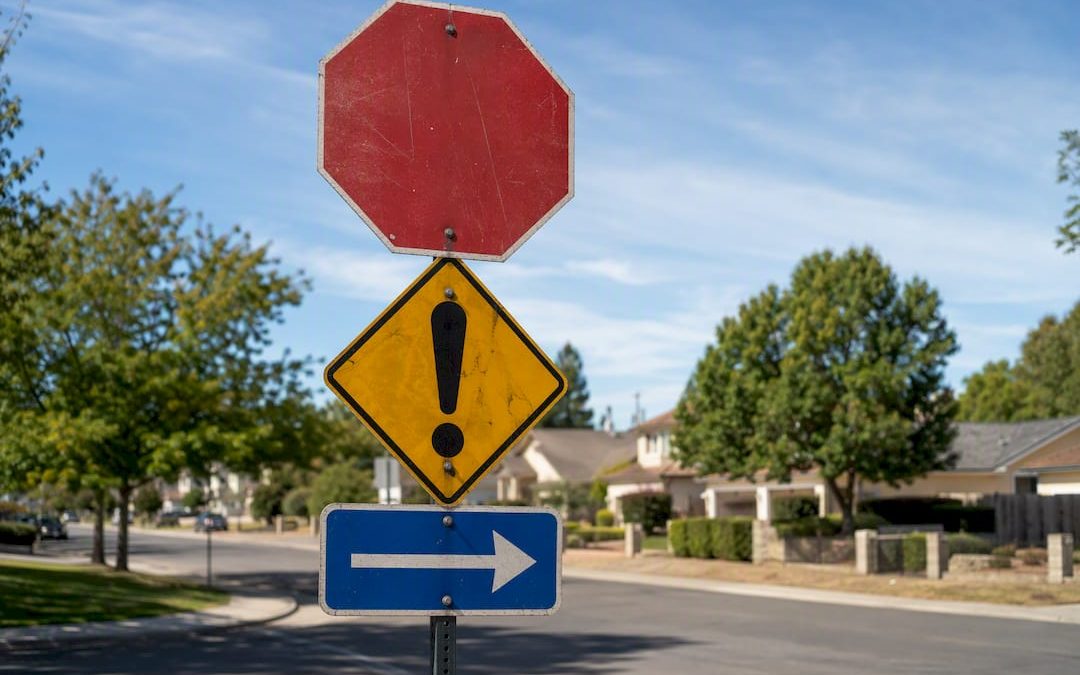
There are three types of traffic signs on American roads: regulatory signs, which enforce traffic laws; warning signs, which flag hazards ahead; and guide signs, which help you navigate. This classification comes straight from the Manual on Uniform Traffic Control Devices (MUTCD), the federal standard that governs how every stop sign, yield sign, and highway marker in the country looks and functions.
Each category has one job:
- Regulatory signs tell you what the law requires or forbids, and you can get ticketed for ignoring them.
- Warning signs alert you to something risky ahead so you can adjust your driving before it becomes a problem.
- Guide signs point you toward where you’re going without carrying any legal weight.
FHWA guidance built this system around one goal: letting drivers recognize a sign’s purpose in a split second, often before they’ve even read a word on it.
Key Takeaways
The MUTCD splits every American traffic sign into three functional categories, regulatory, warning, and guide, each defined by legal weight rather than appearance alone.
| Point | Details |
|---|---|
| Three categories, one standard | Regulatory, warning, and guide signs are all defined by the MUTCD, not by individual states or cities. |
| Regulatory signs are enforceable | STOP, YIELD, and speed limit signs carry legal weight, and ignoring them can result in a citation. |
| Warning signs are advisory | Yellow diamonds flag hazards like curves and crossings but carry no legal penalty for a missed reaction. |
| Guide signs handle navigation | Green, blue, and brown signs direct route choices, services, and recreational stops without enforcing anything. |
| Compliance requires the right fabrication | Customsignstoday builds regulatory, warning, and guide signage to MUTCD-informed shape, color, and reflectivity standards for property and business use. |
Table of Contents
- What Are Regulatory Signs and Why Are They Legally Binding?
- What Do Warning Signs Mean on the Road?
- What Are Guide Signs Used For?
- How Can You Quickly Identify Any Traffic Sign?
- Why Does the Three-Category System Exist?
- A Signmaker’s View on Getting Signs Right
- Need Compliant Signage for Your Property or Business?
- Where to Verify These Standards
- Sources
What Are Regulatory Signs and Why Are They Legally Binding?
Regulatory signs carry the force of law. The MUTCD’s Part 2C defines them as notices of traffic laws or regulations, and ignoring one isn’t a style choice. It’s a citation waiting to happen.
You can usually spot them by color and shape before you’re close enough to read the text. White backgrounds dominate the category, red shows up specifically on prohibitions like STOP and DO NOT ENTER, and the octagon shape is reserved exclusively for one sign in the entire system.
- STOP sign (red octagon): come to a complete stop, then proceed only when clear.
- YIELD sign (red and white triangle): slow down and give the right of way to other traffic.
- Speed Limit sign (white rectangle, black text): the posted number is the legal maximum, not a suggestion.
- DO NOT ENTER (red circle with white bar): the road ahead is closed to your direction of travel.
- No Turn on Red (white rectangle, red and black symbols): a specific restriction at that intersection only.
Running a stop sign or blowing past a posted speed limit isn’t a gray area. Police departments treat regulatory sign violations as straightforward, ticketable offenses precisely because the MUTCD classifies these signs as enforceable law, not friendly advice.
What Do Warning Signs Mean on the Road?
Warning signs don’t carry legal penalties. They exist to give you a heads up about something the road itself won’t announce, whether that’s a blind curve, a school zone, or a spot where deer cross at dusk.
The MUTCD defines warning signs as notices for situations that might not be readily apparent, and they follow a strict visual pattern: a yellow diamond, almost without exception. School zones get an upgrade to fluorescent yellow-green, which studies on driver attention consistently rank as one of the most eye-catching colors on the road.
- Curve Ahead: slow down before you enter the turn, not while you’re in it.
- Pedestrian Crossing: scan the shoulders and crosswalk, even if you don’t see anyone yet.
- Merge: expect vehicles entering your lane and be ready to adjust speed.
- Slippery When Wet: reduce speed further than you would on a dry curve or hill.
- School Zone: watch for reduced speed limits and children near the roadway.
Pro Tip: If a stretch of road throws five warning signs at you in half a mile, don’t tune them out. Traffic engineers know over-signing causes habituation, where drivers stop registering signs altogether. Treat every yellow diamond as new information, not background noise.
What Are Guide Signs Used For?
Guide signs handle navigation, not enforcement. Nobody gets pulled over for missing an exit, but guide signs are what keep you from missing it in the first place. The MUTCD’s Part 5 covers route designations, destinations, distances, and services, and the color coding does most of the heavy lifting once you know the system.
- Green signs handle route markers, directional guidance, and mile markers.
- Blue signs point you to services: gas, food, lodging, hospitals.
- Brown signs mark recreational and cultural sites like parks or historic landmarks.
- Interstate shields (red, white, and blue) identify the specific highway you’re on.
- Exit signs count down distance and often list what’s available at that exit.
Reading these ahead of time changes how you drive, not just where you end up. Spotting a green exit sign a mile out gives you time to move into the correct lane instead of cutting across three lanes of traffic at the last second. That’s the whole point of the guide category: information early enough to act on it calmly.
How Can You Quickly Identify Any Traffic Sign?
Shape and color tell you the category before you’ve read a single word, which is exactly how the system was designed to work.
| Shape | Color | Sign Type |
|---|---|---|
| Octagon | Red | Regulatory (STOP only) |
| Triangle | Red and white | Regulatory (YIELD) |
| Diamond | Yellow | Warning |
| Rectangle | Green, blue, or brown | Guide |
| Circle | Yellow or red | Railroad or regulatory advisory |
A three-step study method covers most of what a new driver or test-taker needs:
- Group by shape first, not by memorizing individual signs one at a time.
- Build flashcards pairing shape and color combinations with their category, then quiz yourself out of order.
- Run practice tests from your state’s driver manual to catch gaps before the real exam.
One detail worth knowing if you’re ever involved in installing signs rather than just reading them: reflectivity requirements vary by category, and regulatory signs typically need the highest reflectivity rating because visibility failures on those signs carry the most legal and safety risk.
Why Does the Three-Category System Exist?
The three-way split isn’t arbitrary. It’s built around function, not appearance, which is a distinction the MUTCD’s classification guidance treats as central to how signs get manufactured, placed, and maintained nationwide.
A sign’s category determines its legal weight, its required visibility standard, and even how it gets positioned relative to the roadway. A stop sign and a curve warning sign might both be small metal placards, but one enforces law and the other only advises. That distinction shapes everything from material specs to placement height.
Application also shifts by road type. Freeway guide signs, for example, get their own detailed chapters in the MUTCD because message sequencing and placement distance work differently at 70 mph than they do on a residential street.
A Signmaker’s View on Getting Signs Right
Classroom explanations of sign categories are clean. Real-world sign fabrication is messier, and that gap is where problems show up. At Customsignstoday, the details that separate a compliant regulatory sign from a rejected one usually come down to reflectivity grade, exact color matching, and correct mounting height, not the design itself. A sign that looks right on a computer screen can still fail an inspection if the sheeting doesn’t meet the reflectivity class required for its category. Anyone commissioning site or safety signage should treat that compliance check as a separate step, not an afterthought, and industry primers on regulatory versus warning versus guide sign conventions back up why manufacturers take shape and color rules so literally.
— Yossi
Need Compliant Signage for Your Property or Business?
Knowing the difference between regulatory, warning, and guide signs is one thing. Getting a sign fabricated that actually meets MUTCD specs for shape, color, and reflectivity is another problem entirely, and it’s one Customsignstoday solves without the guesswork of sourcing materials yourself. Customsignstoday builds signage to the same shape, color, and reflectivity standards MUTCD sets for public roadways, then applies that same rigor to private property, construction sites, and commercial storefronts.
If you manage a property that needs enforceable parking or safety signage, the site signs service covers regulatory and warning signage built for real-world conditions, not just classroom examples. For permanent installations that need to hold up outdoors for years, the face change signs option handles durable fabrication without starting the whole structure from scratch. Request a quote today and get a compliance-minded read on exactly what your property needs.
Where to Verify These Standards
- FHWA sign principles: explains the reasoning behind standardized design.
- Pennsylvania Driver’s Manual: a state-level example of how these categories get taught to new drivers.