You see them every day on your commute, but can you name them correctly? Most drivers recognize a stop sign or yield sign instantly, yet struggle to identify warning diamonds or regulatory rectangles by their official names. Understanding road safety sign names and meanings goes beyond simple recognition. It empowers parents to teach children vital safety skills, helps educators design effective traffic awareness programs, and enables community advocates to communicate more precisely with local authorities about roadway improvements. This guide breaks down the essential categories, names, and purposes of road safety signs so you can navigate roads with greater confidence and contribute to safer communities.
Table of Contents
- Types Of Road Safety Signs And Their Names
- Common Road Safety Signs: Names, Shapes, And Meanings
- Understanding Regulatory Signs: Official Names And Importance
- How To Recognize And Interpret Warning And Informational Signs Effectively
- Explore Custom Safety Signs For Your Community And Business
- Frequently Asked Questions
Key takeaways
| Point | Details |
|---|---|
| Sign categories | Road safety signs fall into regulatory, warning, and informational types, each serving distinct purposes |
| Shape and color coding | Specific shapes like octagons and triangles plus colors like red and yellow enable instant recognition |
| Official names matter | Knowing proper sign names improves communication with authorities and enhances safety education |
| Universal application | Parents, educators, and safety advocates all benefit from understanding sign terminology and meanings |
Types of road safety signs and their names
Road safety signs serve as the silent guardians of our streets, highways, and neighborhoods. Road safety signs are classified into regulatory, warning, and informational categories, each designed with specific visual cues to communicate different types of messages. Regulatory signs enforce traffic laws and rules, typically featuring red, white, or black color schemes that command immediate attention and compliance. These include stop signs, speed limit postings, no parking zones, and one-way street indicators that carry legal weight.
Warning signs alert drivers and pedestrians to potential hazards or changing road conditions ahead. You’ll recognize these primarily as yellow diamond-shaped signs with black symbols or text, positioned strategically before curves, intersections, school zones, or areas where wildlife might cross. Their bright coloring ensures visibility even in poor weather or low light conditions, giving you precious seconds to adjust your speed or attention level.
Informational signs provide guidance rather than commands or warnings. These helpful markers appear in blue or green rectangular formats, directing you to highway exits, rest areas, hospitals, gas stations, and tourist attractions. Understanding these three fundamental categories helps you process traffic signs more efficiently:
- Regulatory signs tell you what you must or must not do
- Warning signs prepare you for upcoming road conditions
- Informational signs guide you to destinations and services
- Each category uses distinct colors and shapes for quick recognition
Common road safety signs: names, shapes, and meanings
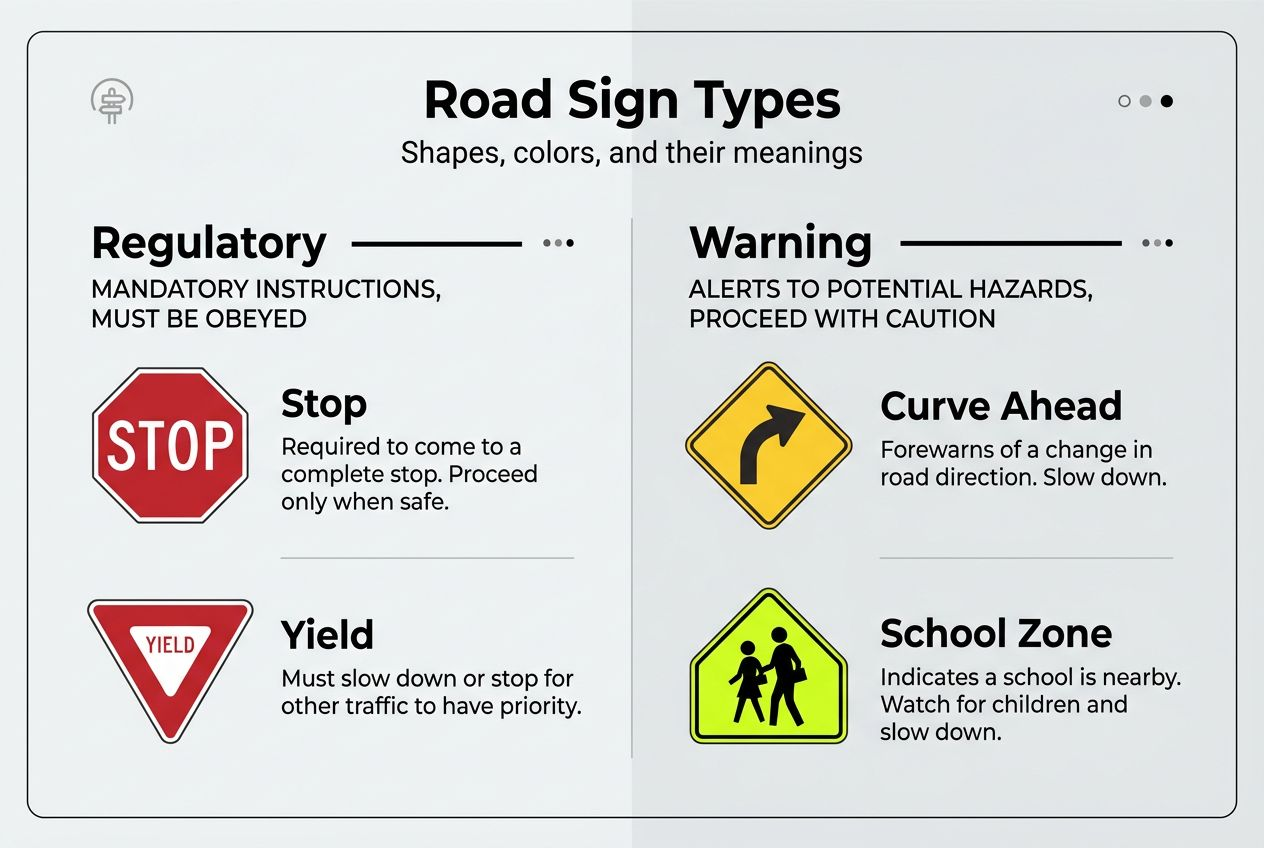
The octagonal stop sign stands as perhaps the most universally recognized traffic control device worldwide. Its eight-sided red shape with white letters commands drivers to come to a complete halt, check for cross traffic, and proceed only when safe. No other sign uses this distinctive octagon shape, making it identifiable even when covered in snow or viewed from behind.
Yield signs take the form of inverted triangles, pointing downward to suggest giving way to other traffic. Different shapes and colors in road signs convey specific meanings to help quick driver recognition, and the yield sign’s unique triangular profile ensures drivers can identify it instantly even before reading the text. Speed limit signs appear as white rectangles with black numbers, clearly stating the maximum legal velocity for that road segment. These regulatory markers change frequently based on school zones, construction areas, or transitions between urban and rural settings.
Warning signs employ the diamond shape almost exclusively. A yellow diamond displaying a curve symbol alerts you to upcoming bends in the road, while a pedestrian crossing diamond shows a walking figure to indicate areas where foot traffic may enter the roadway. The slippery when wet sign features a skidding car icon, warning drivers that pavement conditions may reduce tire traction during or after rainfall.

Informational signs guide rather than command. Green rectangular signs mark highway exits, displaying route numbers and destination cities with white lettering. Blue rectangular signs point to services like hospitals, rest areas, and food establishments. Here’s a comparison of the most common sign types:
| Sign Name | Shape | Primary Color | Purpose |
|---|---|---|---|
| Stop | Octagon | Red | Command complete halt |
| Yield | Inverted Triangle | Red/White | Give way to traffic |
| Speed Limit | Rectangle | White | State maximum speed |
| Curve Warning | Diamond | Yellow | Alert to road bends |
| Highway Exit | Rectangle | Green | Provide route guidance |
Pro Tip: Train yourself to recognize signs by shape and color first, then confirm with symbols or text, which dramatically improves reaction time in challenging driving conditions like fog or heavy rain.
Understanding regulatory signs: official names and importance
Regulatory signs carry the force of law behind their simple designs. Speed limit signs, no parking zones, no U-turn markers, and one-way street indicators all fall under this critical category. These traffic signs communicate rules that drivers must follow to maintain order, prevent collisions, and ensure smooth traffic flow. Violating regulatory signs often results in traffic citations, fines, points on your driving record, or worse, serious accidents that could have been prevented.
The legal authority of these signs cannot be overstated. Regulatory signs carry legal authority and non-compliance may lead to fines or accidents, making them essential components of traffic law enforcement. A no parking sign in a fire lane isn’t merely a suggestion; it’s a legally enforceable restriction designed to keep emergency vehicle access clear. Similarly, do not enter signs at highway off-ramps prevent wrong-way driving that could cause head-on collisions.
To properly interact with regulatory signs, follow this systematic approach:
- Identify the sign by its official name and distinctive markings
- Understand the specific legal requirement or restriction it conveys
- Follow the instruction immediately and completely
- Recognize that violations carry defined penalties and safety risks
Common regulatory signs include the stop sign, yield sign, speed limit postings, no turn on red indicators, one-way arrows, do not enter circles, and parking restriction notices. Each uses standardized colors, shapes, and symbols established by federal transportation authorities to ensure consistency nationwide. This uniformity means a speed limit sign in Florida looks identical to one in Oregon, reducing confusion for travelers and creating predictable road environments.
Pro Tip: Parents and educators should actively teach children to recognize and respect regulatory signs during everyday travel, building foundational safety habits that last a lifetime and extend beyond driving to pedestrian awareness.
How to recognize and interpret warning and informational signs effectively
Warning signs deserve special attention because they prepare you for conditions that require immediate adjustments to your driving behavior. These markers typically feature bright yellow backgrounds paired with black symbols or text, creating high contrast that remains visible across various lighting and weather conditions. The diamond shape itself signals caution before you even process the specific symbol displayed.
Informational signs serve a completely different function, guiding rather than warning or commanding. Route markers display highway numbers in distinctive shield shapes. Green signs indicate distances to upcoming cities and mark exit ramps. Blue signs direct you to traveler services including rest areas, gas stations, food options, and lodging. Brown signs point toward recreational areas, parks, and tourist attractions. Proper placement and clarity of warning signs are critical for preventing accidents and enhancing safety, ensuring drivers receive adequate notice to respond appropriately.
Master sign interpretation with this four-step process:
- Observe the shape and background color to determine sign category
- Read any symbols, icons, or text to understand the specific message
- Anticipate the road condition or situation being communicated
- Adjust your speed, lane position, or attention level accordingly
Typical warning signs you’ll encounter include:
- Sharp curve ahead markers showing directional arrows
- Pedestrian crossing signs displaying walking figures
- School zone warnings with children crossing symbols
- Slippery road indicators featuring skidding vehicle icons
- Deer crossing alerts in rural or wooded areas
- Merge and lane reduction warnings for highway travel
Clear, well-maintained signage makes the difference between safe navigation and dangerous surprises. Faded paint, obscured visibility from overgrown vegetation, or damaged sign faces compromise their effectiveness dramatically. Community safety advocates play a vital role in monitoring sign conditions throughout their neighborhoods and reporting maintenance needs to local transportation departments.
Pro Tip: During routine drives through your community, actively scan for damaged, faded, or obscured signs and report them to your city’s public works department, contributing directly to neighborhood safety improvements.
Explore custom safety signs for your community and business
Beyond standard road signs, communities and businesses often need customized safety signage to address specific local conditions or property requirements. Whether you’re managing a school zone, private road, parking facility, or commercial property, professionally designed custom signs ensure your safety messages reach their intended audience with clarity and authority. Modern sign manufacturing combines durable materials with reflective coatings and weather-resistant finishes, delivering products that maintain visibility and legibility for years.
Custom traffic signs allow you to communicate unique messages while maintaining the visual language drivers already understand. Need to mark a private drive with specific speed limits? Require specialized parking instructions for your business? Want to create attention-grabbing safety reminders for your facility? Professional sign providers offer solutions that comply with relevant standards while addressing your particular needs. Explore options for face change signs that allow message updates, durable site signs for construction and development areas, and comprehensive traffic control solutions that keep your community moving safely.
Frequently asked questions
What is the difference between regulatory and warning road signs?
Regulatory signs tell you the rules you must follow by law, typically appearing in red and white color schemes like stop signs or speed limits. Warning signs alert you to potential hazards or changing conditions ahead, usually displayed as yellow diamonds with black symbols. Regulatory signs carry legal consequences for non-compliance, while warning signs prepare you to adjust your driving behavior safely.
How can I teach children to recognize important road safety signs?
Use consistent visual examples during walks or car rides, pointing out signs and explaining their meanings in simple terms. Create educational games or quizzes focused on matching sign shapes, colors, and meanings to reinforce learning through repetition. Practice identifying signs together regularly, and praise correct recognition to build confidence and long-term retention of this vital safety knowledge.
Why is the shape of a road sign important?
Shapes like octagons for stop signs, triangles for yield markers, and diamonds for warnings quickly convey the sign’s category before drivers can read text or identify symbols. This shape-based recognition system enables faster response times, particularly valuable in poor visibility conditions or when signs are partially obscured. Your brain processes geometric shapes more rapidly than words, making shape coding an essential safety feature.
Where can I find official lists of road safety sign names?
Official traffic authorities maintain comprehensive databases of standardized sign names, meanings, and specifications available through government transportation websites. Custom sign providers also publish detailed catalogs showing official traffic signs with proper terminology and usage guidelines. These resources help educators, safety advocates, and curious drivers learn accurate sign identification and understand the reasoning behind each design choice.