
TL;DR:
- Print on demand signage is made after an order, ensuring precision and customization for each client. Custom sign shops handle everything from site surveys to installation, specializing in durable, project-specific products. Proper permitting and in-house crews are essential to avoid costly delays or removals.
“Print on demand” in the context of local custom signage means a professional sign shop produces your sign, banner, vehicle wrap, or decal only after you place an order — no inventory, no guessing, no generic templates. Every piece is made to your exact specs, for your specific location, and installed by the shop’s own crew.
The core promise of local print-on-demand signage: you get a product built for your wall, your vehicle, or your storefront — not a catalog item shipped in a box. Customsignstoday backs that promise with physical site surveys, in-house fabrication, and W-2 installation crews who show up and finish the job.
This guide covers the local, professional signage workflow — the kind that involves a tape measure, a permit application, and a bucket truck. If you’re an Etsy seller looking to brand your booth, your storefront, or your delivery vehicle, this is the process you need to understand before you call anyone.
Table of Contents
- What products does local print-on-demand signage cover?
- How does the print-on-demand sign process work, start to finish?
- Which materials hold up and which ones are right for your project?
- What drives the cost, and how long will your project take?
- How do you vet a local sign company before you commit?
- What should you confirm during a site survey?
- Why installation is where most sign projects succeed or fail
- How Customsignstoday handles made-to-order signage for U.S. businesses
- Key Takeaways
- The part of this process most business owners underestimate
- Get started with Customsignstoday
- Useful sources
What products does local print-on-demand signage cover?
A full-service local sign shop handles far more than a banner or a yard sign. Here’s the realistic product set:
- Storefront signs (flat-panel, illuminated cabinet, channel letters, blade signs)
- Monument and pylon signs (freestanding, often requiring engineering and permits)
- Banners (vinyl, mesh, fabric — indoor and outdoor)
- Trade-show displays (retractable stands, tension fabric, tabletop graphics)
- Vehicle graphics and full wraps (cars, vans, trucks, trailers)
- Vinyl decals (window clings, floor graphics, wall decals)
- Window graphics (perforated, frosted, full-color printed)
- Coroplast signs (real-estate, construction, temporary campaigns)
- Canvas prints and framed posters (retail interiors, lobby art, event branding)
Most of these include professional installation when you work with a full-service shop. Coroplast yard signs and small decals are typically drop-shipped or handed off at pickup. Anything mounted above ground level, attached to a building facade, or connected to electrical power almost always requires on-site installation by a qualified crew.
Finish options worth asking about: illuminated components (LED modules, neon flex), UV-resistant lamination, brushed aluminum hardware, and dimensional lettering. Channel letters and monument signs frequently require permits and sometimes structural engineering sign-off before fabrication can begin.
How does the print-on-demand sign process work, start to finish?
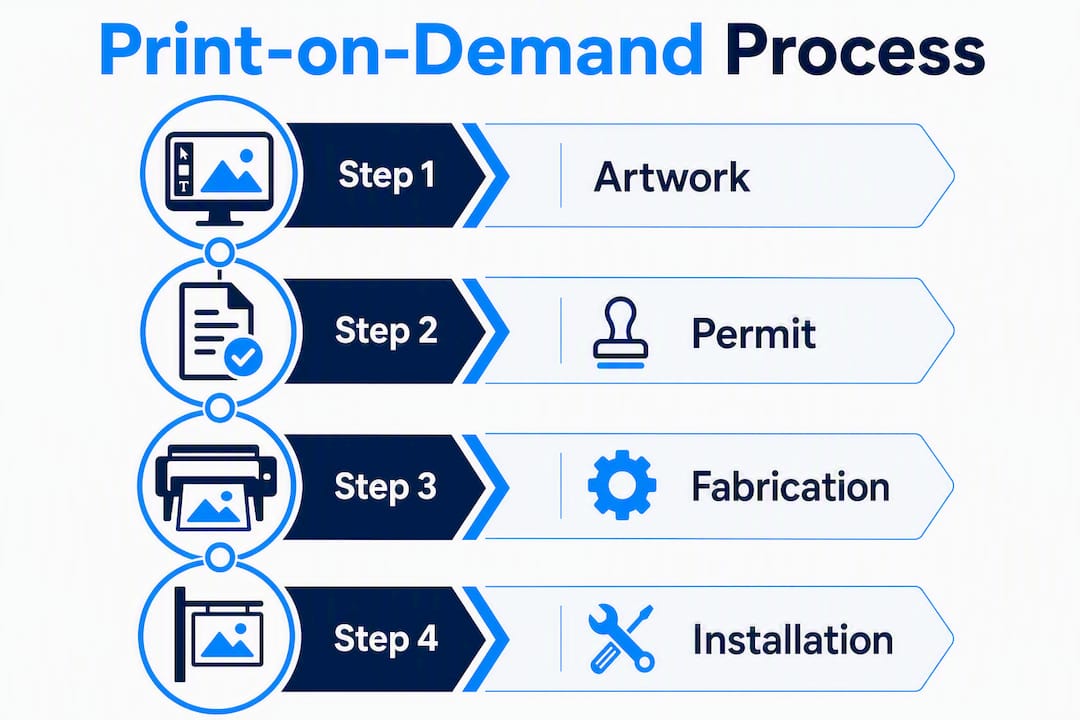
A local made-to-order sign job moves through six to eight steps: quote, site survey, design proof, material selection, fabrication, quality control, permit approval (where required), and professional installation.
- Request a quote. You describe the project — size, location, material preference, timeline. The shop gives you a ballpark, not a final price.
- Physical site survey. A technician visits your location to measure the mounting surface, check wall composition, assess electrical access, and photograph the space. Quotes without a site survey are educated guesses at best.
- Design proof. The shop produces a scaled rendering showing your sign in context. You review and approve before anything gets made.
- Material selection. Based on the survey findings, the shop recommends the right substrate, ink system, and hardware for your exposure level and budget.
- Permit application (if required). The shop submits drawings to the local municipality. This step runs parallel to fabrication prep but should be resolved before production starts.
- Fabrication. Your sign is built in-house. In-house production means the same team that designed it is cutting, printing, and assembling it.
- Quality control. Finished pieces are checked against the approved proof for color accuracy, dimensions, and structural integrity.
- Professional installation. W-2 crews handle mounting, electrical connections, and cleanup. They carry the right equipment and liability coverage.
Pro Tip: Never authorize fabrication before you have a stamped, approved permit in hand. Starting production early can trigger forced removal orders at your expense — a costly mistake that a reputable shop will warn you about upfront.
Etsy sellers typically plug into this process at steps one and three: they supply brand artwork or logo files, specify a lead time that fits their shop’s launch date, and sign off on the proof before the shop moves to production.
Which materials hold up and which ones are right for your project?
Pick your material based on three variables: exposure to weather, viewing distance, and how long you need it to last.
- Cast vinyl (outdoor decals, vehicle graphics): rated for five to seven years outdoors; conforms to curves and rivets on vehicles without lifting.
- Calendered vinyl (banners, flat-surface decals): more affordable, best for flat applications and shorter campaigns.
- Aluminum composite (ACM) (building signs, monument faces): rigid, weather-resistant, and holds dimensional graphics well; standard for permanent exterior signs.
- Acrylic (lobby signs, dimensional lettering): clean, professional look for interior brand walls and reception areas.
- Coroplast (real-estate signs, temporary campaigns): lightweight and cheap; not meant to last more than a season outdoors.
- Canvas (interior art, retail branding, event backdrops): warm texture for framed prints and display graphics.
UV inks and lamination extend outdoor life significantly. Lamination also protects against scratching during installation. For illuminated signs, UL-listed electrical components are non-negotiable — most municipalities require them for permit approval.
On letter sizing: follow the 1-inch-per-10-feet rule for readability. A sign viewed from 50 feet needs letters at least 5 inches tall. High-mounted building signs should carry your brand name, not your phone number — detail disappears at distance.
What drives the cost, and how long will your project take?
The biggest cost drivers are size, material, electrical or illumination components, permit fees, and installation complexity. A sign requiring a bucket truck and two-person crew costs more to install than one mounted at eye level with a drill.
| Project Type | Typical Price Range |
|---|---|
| Channel letters (set) | $2,500–$10,000 |
| Monument sign | $5,000–$25,000 |
| Vehicle wrap (full van) | $3,500–$5,500 |
| Lobby / interior sign | $500–$4,000 |
| Major building sign | $5,000–$15,000+ |
Source: published fabricator pricing data and industry guidance.
Timeline callout: Simple banners and decals typically take a few business days. Vehicle wraps may take about one to two weeks including design approval. Permitted building signs can require several weeks, depending on municipal review times. Never assume a permit will clear in under two weeks.
A quote without a site survey is a placeholder, not a price. The wall composition, electrical access, and mounting height all affect final cost in ways no phone call can capture.
How do you vet a local sign company before you commit?
Start with the basics that separate capable shops from risky ones:
- In-house fabrication and W-2 installation crews. Shops that rely on subcontractors for installation lose accountability the moment a problem appears on-site.
- Proof of insurance. General liability and workers’ comp, current certificates on request.
- Permit experience. Ask how many permitted signs they’ve pulled in your municipality in the last year.
- Portfolio with before-and-after photos. Not just finished shots — photos that show the mounting surface and installation context.
- Written spec sheets and warranty terms. Vague warranty language (“we stand behind our work”) is not a warranty.
- UL-listed electrical components for any illuminated sign.
Red flags: a quote delivered without a site visit, evasive answers about who actually installs the sign, no written change-order process, and a price that seems too low for the scope.
Pro Tip: Ask specifically for a recent example of permit coordination — the shop should be able to name the municipality, describe the submission process, and tell you how long approval took. A shop that has done it before will answer without hesitation.
What should you confirm during a site survey?
A physical survey prevents guessing and costly rework. Bring these questions:
- What is the exact mounting surface material (brick, stucco, metal panel, wood fascia)?
- What is the wall thickness and structural backing behind the face?
- Is there electrical access within reach of the sign location, and what is the voltage?
- What is the building height and clearance from grade to mounting point?
- What is the primary viewing distance from the street or parking area?
- Are there landlord, HOA, or municipal restrictions on sign size, illumination, or color?
- Who handles the permit submission — the shop or the tenant?
- Are there utility lines, HVAC equipment, or other obstructions near the mounting zone?
Ask for a written site-survey report with photos. A shop that won’t provide one in writing is a shop that won’t be accountable if the measurements are wrong.
Why installation is where most sign projects succeed or fail
Installation is where signage projects most frequently succeed or fail — not in the design phase, not in fabrication. Improper anchors, wrong fasteners for the wall type, missing weatherproofing, and unqualified installers account for the majority of post-install failures.
Never authorize fabrication before a stamped permit is issued. Proceeding without approval can result in a stop-work order or forced removal — both at the owner’s expense, not the shop’s.
What looks like “hanging a sign” often requires a lift, structural anchors rated for wind load, and electrical testing before the circuit is energized. Subcontracted installers may not carry the right certifications or equipment for your specific job.
Pro Tip: Insist on W-2 installers and ask for documented safety procedures: lift certification, electrical testing protocol, and proof of confined-space training if the install involves a tight mechanical space. A shop that uses its own crew can answer these questions directly.
How Customsignstoday handles made-to-order signage for U.S. businesses
Customsignstoday offers full-service custom signage for U.S. small businesses and Etsy sellers who need professional, location-specific signs rather than generic printed goods.
Core capabilities:
- Physical site surveys before final pricing
- In-house fabrication across banners, vehicle wraps, decals, vinyl signs, and building graphics
- W-2 installation crews with proper equipment and insurance
- Design proofs and written approvals before production begins
- Permit coordination for regulated sign types
- Written warranties and material specifications
Etsy sellers use Customsignstoday for booth signage, branded vehicle graphics, storefront displays, and pop-up event banners — all produced to order and installed or delivered on a confirmed timeline. Request a custom sign quote to get started with a site survey and design proof.
Key Takeaways
Local print-on-demand signage requires a site survey, in-house fabrication, and W-2 installation crews to deliver results that hold up — and Customsignstoday provides all three.
| Point | Details |
|---|---|
| Site survey is non-negotiable | Any quote without a physical site visit is a guess that will likely change at your expense. |
| Permit before production | Never authorize fabrication without a stamped, approved permit — forced removal is costly and avoidable. |
| Material matches the use case | Match substrate to exposure and viewing distance; cast vinyl for vehicles, ACM for permanent exterior signs. |
| Vet for in-house crews | Shops with W-2 installers are accountable; subcontracted crews are not. |
| Customsignstoday next step | Request a quote and site survey at customsignstoday.us for made-to-order signage with professional installation. |
The part of this process most business owners underestimate
Most business owners focus on the design and the price. The permit and the install are where projects actually break down — and those two phases are almost impossible to manage without a shop that has done it before in your specific municipality.
A site survey is not a formality. It’s the moment where a qualified technician finds the conduit that would have cracked during drilling, or spots the landlord restriction that would have voided the lease clause, or measures the clearance that changes the sign height and triggers a different permit category entirely. Skipping it to save a week almost always costs more time in the end.
The shops worth hiring treat themselves as a strategic partner navigating municipal bylaws, landlord restrictions, and engineering requirements — not just a vendor printing your logo on vinyl. That distinction shows up in the warranty, the permit paperwork, and the crew that shows up with the right lift for the job.
Get started with Customsignstoday
Customsignstoday is the direct alternative to ordering generic printed goods online and hoping they fit your space. For U.S. small businesses and Etsy sellers who need signage that actually works on-site, the process is straightforward.
Three steps to get your sign made and installed:
- Request a quote at customsignstoday.us/custom-signs — describe your project and location.
- Schedule a site survey so the team measures your space and confirms mounting, electrical, and permit requirements before anything is priced or produced.
- Approve your proof and schedule installation — once the design is confirmed and the permit is cleared, fabrication begins and your W-2 crew handles the rest.
Relevant service pages by project type: face-change signs for storefront updates, vehicle lettering and wraps for fleet branding, and vinyl signs and banners for events, promotions, and temporary campaigns.
Useful sources
- How to Choose A Sign Company: Red Flags & Green Flags — covers in-house vs. subcontractor crews, site survey requirements, and published price ranges by project type.