
A compliant workshop needs eight sign categories: Danger, Warning, Caution, Mandatory (PPE), Emergency/Exit, Fire equipment, chemical labels under HazCom, and lockout/tagout tags. Each must follow OSHA and ANSI color and wording rules, and every hazardous chemical needs a label or an accessible written alternative. Start with a quick inventory and fix any missing danger, exit, or fire signs first.
TL;DR:
- Danger signs should be placed at the exact point of operation on machines, like saw blades or presses, to alert workers of immediate hazards.
- Chemical labels must include six key elements and be visible on containers or accessible via alternative methods to meet OSHA requirements.
- Signs near bright lights or reflective surfaces should use non-glare finishes, high contrast, and be tested from a worker’s typical viewing position for maximum readability.
- Regular inspections, including monthly visual checks and quarterly documented audits, are essential to maintain sign visibility and compliance over time.
- Proper material choice, such as aluminum for heavy machinery and photoluminescent panels for exits, ensures signs withstand environmental conditions and remain effective.
Table of Contents
- Essential Workshop Signs: A Prioritized Checklist and Where to Put Them
- Regulatory Essentials: What OSHA, HCS and ANSI Require for Signs and Labels
- Placement, Size, Contrast and Visibility: Practical Rules for Effective Signs
- Chemical Labeling and HazCom: Labels, Process Signs, and SDS Access
- Materials, Durability and Selecting Sign Types for Workshop Environments
- Maintenance, Inspection and Training: Keep Signs Effective and Defensible
- Publisher Perspective: A Compliance-First Approach to Workshop Signage
- How Custom Signs Today Can Help: Request a Quote or Compliance Review
- Sources
- FAQ
Essential Workshop Signs: A Prioritized Checklist and Where to Put Them
Not every sign carries the same weight, and a workshop with limited time or budget should fix the highest-risk gaps first. Danger signs belong at the exact point of operation on a machine, where contact would cause serious injury. Fire extinguisher signs go directly above or beside the cabinet, never blocked by storage. Exit signs must sit over every egress route so a worker glancing up during an evacuation sees the path immediately.
- Danger: red panel, reserved for immediate, serious hazards at the point of operation.
- Warning: orange panel, for hazards that could cause death or serious injury but are less immediate than Danger.
- Caution: yellow panel, for hazards linked to minor to moderate injury or a reminder about unsafe practices.
- Mandatory (PPE): blue panel, posted at entry points where eye, hearing, or hand protection is required.
- Emergency/Exit and fire equipment: posted over routes and at extinguisher or hose cabinets.
Some signs are legally required in specific situations (chemical labels, machine guarding warnings); others, like general housekeeping reminders, are recommended but not mandated. A checklist-style resource can help sort which is which for your shop.
- Walk the floor and list every machine, exit, and chemical storage point.
- Flag any point of operation without a Danger or Caution label, starting with saws and presses.
- Check that lockout/tagout tags are present on every machine with an energy isolation point, and note that placement matters: a radial saw’s caution label belongs at the end of the guard where the blade exits.
Regulatory Essentials: What OSHA, HCS and ANSI Require for Signs and Labels
OSHA 1910.145 sets the baseline: Danger signs use red, Warning signs use orange, and Caution signs use yellow, with wording that is legible and free of sharp or splintering edges. These aren’t stylistic choices, they’re the standard that inspectors check against.
The Hazard Communication Standard governs chemical labeling separately. Every shipped hazardous chemical container needs six elements on its label.
- Product identifier
- Signal word
- Hazard statements
- Pictograms
- Precautionary statements
- Responsible party contact information
OSHA requires every hazardous chemical label to carry these six elements under 1910.1200. Missing even one is a common citation point during inspections.
ANSI Z535.4 guidance adds structure on top of the OSHA baseline: standardized panel formats, signal words, and pictograms that make a sign instantly recognizable rather than something a worker has to stop and read closely. That consistency reduces both confusion on the floor and legal exposure if an incident happens.
Placement, Size, Contrast and Visibility: Practical Rules for Effective Signs
A sign that meets every color and wording requirement still fails if nobody can read it from where they’re standing. Mounting height should put the sign at typical eye level for the workstation it protects, not wherever space is available. Size and letter height should scale with the distance a worker will actually be from the sign when the hazard matters.
- Use non-glare finishes on signs near windows or bright shop lighting to avoid washout.
- Keep color contrast crisp; a faded red Danger panel reads as background noise.
- Test visibility by standing at the operator’s normal position and the main walkway, not just at the sign itself.
Placement specifics matter enough that OSHA has issued directives on individual machines. For radial saw caution labels, the requirement is that the label sits at the end of the guard where the blade teeth exit during operation, not on the frame or the motor housing. A common mistake is mounting a sign where it looks tidy rather than where the hazard actually occurs.
Pro Tip: Walk your own floor as a first-day hire would and note every spot where you’d have to search for a warning sign; those are your gaps.
Chemical Labeling and HazCom: Labels, Process Signs, and SDS Access
Every hazardous chemical container needs a label with the product identifier, signal word, hazard statements, pictograms, precautionary statements, and responsible party contact, as required under 1910.1200. For stationary process containers, such as a large tank that’s never moved, employers may use an alternative like a sign or process sheet instead of a label, as long as the same hazard information stays accessible to workers on every shift.
- Inventory every chemical in the shop, including small portable containers workers fill from bulk stock.
- Confirm safety data sheets are physically or digitally accessible at all times, not locked in an office.
- Label every portable container a worker might use, even if it’s just for a shift.
- Revise labels whenever new hazard information becomes available for a chemical already in use.
Training ties directly into this: workers need to understand what a label’s signal word and pictogram mean and know exactly how to pull up an SDS, not just that one exists somewhere.
Materials, Durability and Selecting Sign Types for Workshop Environments
A sign that’s technically correct but degrades in six months from oil and metal chips isn’t doing its job. Aluminum panels hold up well against abrasion and impact, making them a common choice for point-of-operation signs near heavy machinery. Laminated vinyl works for interior applications where cost matters more than extreme durability. Photoluminescent panels are worth considering for exit and egress signage, since they stay visible if lighting fails.
- Choose non-glare finishes for signs near bright task lighting or windows.
- Specify rounded corners and tamper-resistant fasteners, especially in high-traffic areas.
- Confirm the substrate is rated for the shop’s actual conditions: heat near welding stations, chemical exposure near solvent storage, UV exposure if mounted near an exterior door.
- Ask your vendor for expected service life so replacement isn’t a surprise.
A material selection guide can help match substrate to environment before you commit to a large order.
Maintenance, Inspection and Training: Keep Signs Effective and Defensible
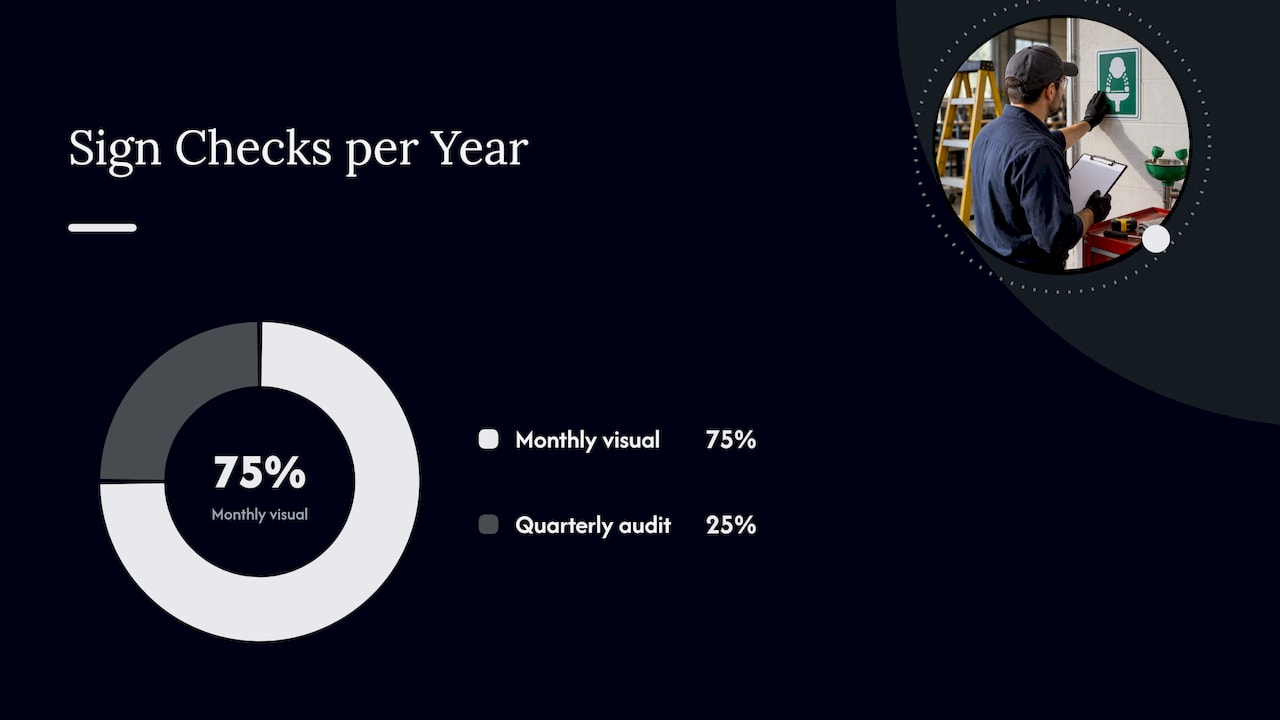
A sign that was compliant on installation day can fail an inspection two years later if nobody checked it in between. A monthly visual walk-through catches obvious problems fast: fading, physical damage, or a sign that’s been relocated by accident during a shop reorganization. A quarterly documented audit should record legibility, condition, and whether the sign is still in the correct location relative to the hazard it addresses.
- Run a monthly visual check of every posted sign and label.
- Complete a quarterly documented audit and file the results with other safety records.
- Fold sign checks into existing machine guarding inspections, since NIOSH’s machine safety checklists already cover guard presence, emergency stop accessibility, and general machine condition.
Training should reinforce what the signs mean, not just that they exist: cover sign meanings during onboarding, revisit them in toolbox talks, and test SDS access during emergency drills so it isn’t theoretical.
Pro Tip: Pair every quarterly sign audit with the same day’s machine guarding inspection so nothing gets checked twice or missed entirely.
Publisher Perspective: A Compliance-First Approach to Workshop Signage
A professional signage provider builds durable, code-aligned signs for workshops and offers consultation on material and placement choices. The typical process runs from a site survey to a material and mounting recommendation, then production and installation.
— Yossi
How Custom Signs Today Can Help: Request a Quote or Compliance Review
Running a compliance-ready workshop means matching the right sign to the right spot, in the right material, and Custom Signs Today handles that from design through installation so you’re not sourcing panels from three different vendors. 
- Custom sign design built around specific machine layouts and hazard points.
- Material selection suited to shop environments involving heat, chemicals, or outdoor exposure.
- Installation guidance to help ensure mounting height and placement meet standards, not just wall space availability.
Start with a quick inventory of your current signs, then request a free quote for whatever’s missing. If you need both indoor machine signage and outdoor exit or hazard signs, browse interior signs and exterior signs options together so your shop’s signage reads as one consistent system.
Sources
- 1910.145 – Specifications for accident prevention signs and tags. | Occupational Safety and Health Administration
- ANSI Z535.4-2023: product safety sign or label? | ANSI blog
- Machines General Requirements – Self-Inspection Checklist | NIOSH | CDC
FAQ
What Are the 5 Main Safety Signs?
The five main categories are Danger, Warning, Caution, Mandatory, and Emergency/Exit or Fire equipment signs, each defined by color and signal word under OSHA 1910.145. Some sources group chemical hazard labels as a sixth category since they follow a separate standard.
What Are Workshop Safety Signs?
Workshop safety signs are standardized visual warnings posted near machines, exits, and chemical storage to communicate hazards, required protective equipment, or emergency information. They follow OSHA color and wording rules and often layer in ANSI-style pictograms for faster recognition.
What Are the OSHA Requirements for Safety Signage?
OSHA requires accident-prevention signs to use specific colors and signal words under 1910.145: red for Danger, orange for Warning, and yellow for Caution, with legible wording and durable construction. Separately, hazardous chemical containers need labels meeting the six elements required by 1910.1200.
What Are the 4 Types of Safety Signs?
A common four-part grouping is Danger, Warning, Caution, and Mandatory signs, distinguished by color and the severity of the hazard each addresses. Emergency and fire equipment signs are sometimes treated as a separate fifth category depending on the framework used.
How Often Should Workshop Signs Be Inspected?
A monthly visual check catches fading, damage, or misplacement, while a quarterly documented audit should record legibility and correct location for each sign. Pairing these checks with existing machine guarding inspections, as outlined in NIOSH’s checklists, keeps both systems current without duplicating effort.