TL;DR:
- Over 60% of drivers misunderstand traffic signs, increasing road safety risks.
- Proper signage significantly reduces crashes and legal liabilities for businesses.
- Shape, color, and standards like MUTCD ensure signs are clear, consistent, and effective.
Over 60% of drivers misunderstand at least one traffic sign they encounter regularly, and that gap in knowledge is not just a trivia problem. It creates real danger on roads, exposes businesses to liability, and leads to costly violations. Whether you manage a parking lot, run events, or simply want to drive more confidently, knowing what traffic signs actually mean and why they look the way they do gives you a serious edge. This article walks through the core categories, shape and color conventions, federal standards, and what all of it means for your safety and compliance.
Table of Contents
- What are traffic signs and why do they matter?
- Types of traffic signs and what they mean
- How shape and color reveal sign meanings
- US traffic sign standards: MUTCD and uniformity
- Our perspective: The real-world challenge of sign meaning and compliance
- Need compliant, effective signage? We can help
- Frequently asked questions
Key Takeaways
| Point | Details |
|---|---|
| Traffic sign basics | Traffic signs deliver essential instructions, warnings, and directions that keep everyone safe on the road. |
| Types and meanings | Regulatory, warning, and guide signs each play unique roles in enforcing laws, highlighting hazards, and providing navigation. |
| Shape and color codes | Quickly identify sign intent using standardized shapes and colors, such as red octagons for stop signs. |
| Standardization importance | Federal MUTCD rules ensure people recognize signs instantly, reducing accidents and confusion everywhere in the US. |
| Beyond compliance | Even perfectly designed signs require smart placement and ongoing attention to maximize safety and effectiveness. |
What are traffic signs and why do they matter?
Traffic signs are visual tools placed along roads, intersections, and properties to guide, warn, and regulate everyone sharing that space. Drivers, cyclists, and pedestrians all rely on them to make split-second decisions. Without them, roads would be a guessing game with very high stakes.
At their core, traffic sign types serve three broad functions: they tell you what you must do, what to watch out for, and where to go. According to the Pennsylvania Driver’s Manual, signs are standardized devices categorized primarily into three main types, each with a specific purpose and visual language.
Here is why that matters in practice:
- Regulatory signs enforce laws. Ignoring them is a legal offense.
- Warning signs alert you to hazards ahead. Missing them can cause crashes.
- Guide signs help you navigate. Getting these wrong wastes time and can create dangerous last-minute maneuvers.
- Businesses that place improper or missing signs on their property face liability if an incident occurs.
The safety impact of correct signage is measurable and significant. Research shows that proper signage cuts crashes at rural intersections by up to 29%. That is not a minor improvement. It represents lives saved and injuries prevented through nothing more than clear, well-placed signs.
“A sign that is misread or ignored is worse than no sign at all, because it creates false confidence in a system that has already failed.”
For businesses, road safety sign meanings are not optional knowledge. If your property has a loading zone, a pedestrian crossing, or a one-way drive, the signs you post must communicate intent clearly. Poorly designed or non-standard signs can confuse drivers and put you in a difficult legal position if someone gets hurt.
Understanding signage and safety is also critical for event organizers and property managers who need temporary traffic control. The rules that apply to public roads largely apply to private lots and event venues too, especially when the public is involved.
Types of traffic signs and what they mean
Now that you know why signs matter, let’s break down the three main categories every driver and business owner should recognize instantly.
Traffic signs are categorized into regulatory, warning, and guide/information types, each with a distinct visual style that signals its purpose before you even read the words.
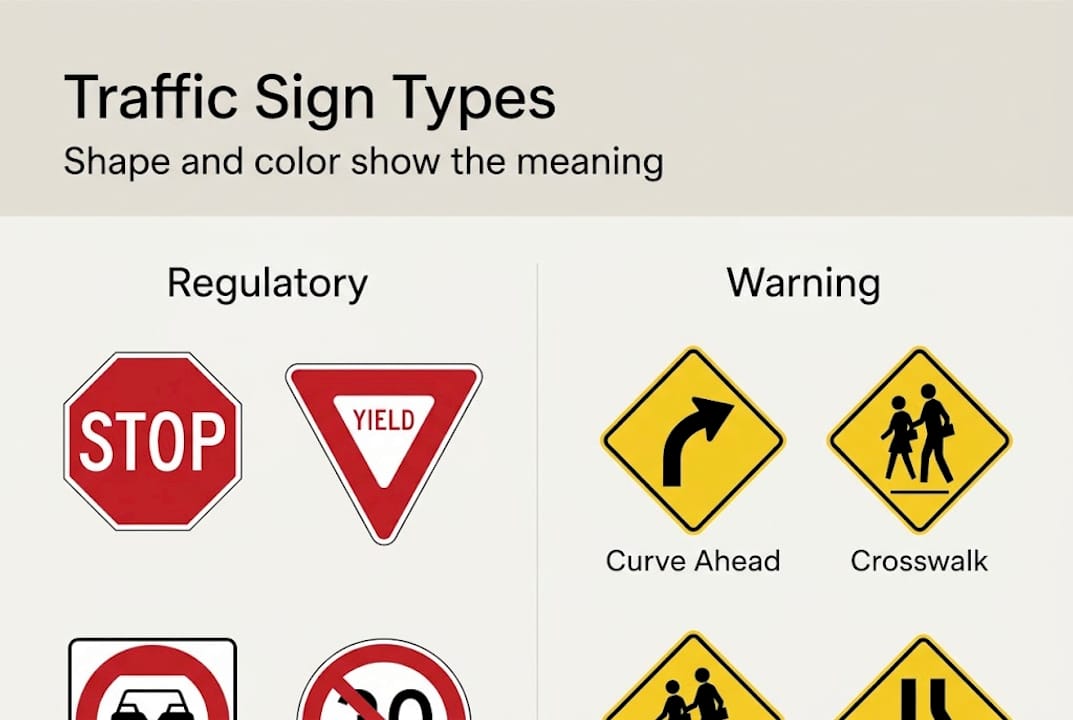
| Type | Purpose | Common examples | Typical colors |
|---|---|---|---|
| Regulatory | Enforce laws and rules | STOP, YIELD, speed limit, no U-turn | Red, white, black |
| Warning | Alert to hazards or changes | Curve ahead, pedestrian crossing, merge | Yellow, orange |
| Guide/Information | Navigation and services | Highway markers, exit signs, rest areas | Green, blue, brown |
Here is what each category demands from you:
- Regulatory signs are not suggestions. Running a STOP sign or exceeding a posted speed limit is a violation, period.
- Warning signs require you to adjust your speed or behavior before you reach the hazard. They give you lead time.
- Guide signs help you plan your route and find services. Missing one is annoying. Missing a regulatory sign is dangerous.
Pro Tip: When you see a sign you do not immediately recognize, look at its color first. That alone will tell you whether you need to act now, prepare, or simply gather information.
For a deeper guide to road sign shapes and what each communicates, it helps to study them alongside real-world examples. Businesses posting signs on their property should mirror these categories so that visitors intuitively understand what is expected of them.
Looking at examples of traffic signs in context also helps you spot gaps in your own property’s signage. A missing warning sign near a blind corner or a faded regulatory sign at a lot entrance can create the same confusion as having no sign at all.
How shape and color reveal sign meanings
Shape and color are the two fastest ways to decode a sign, even before you read a single word. This is intentional design, not coincidence.
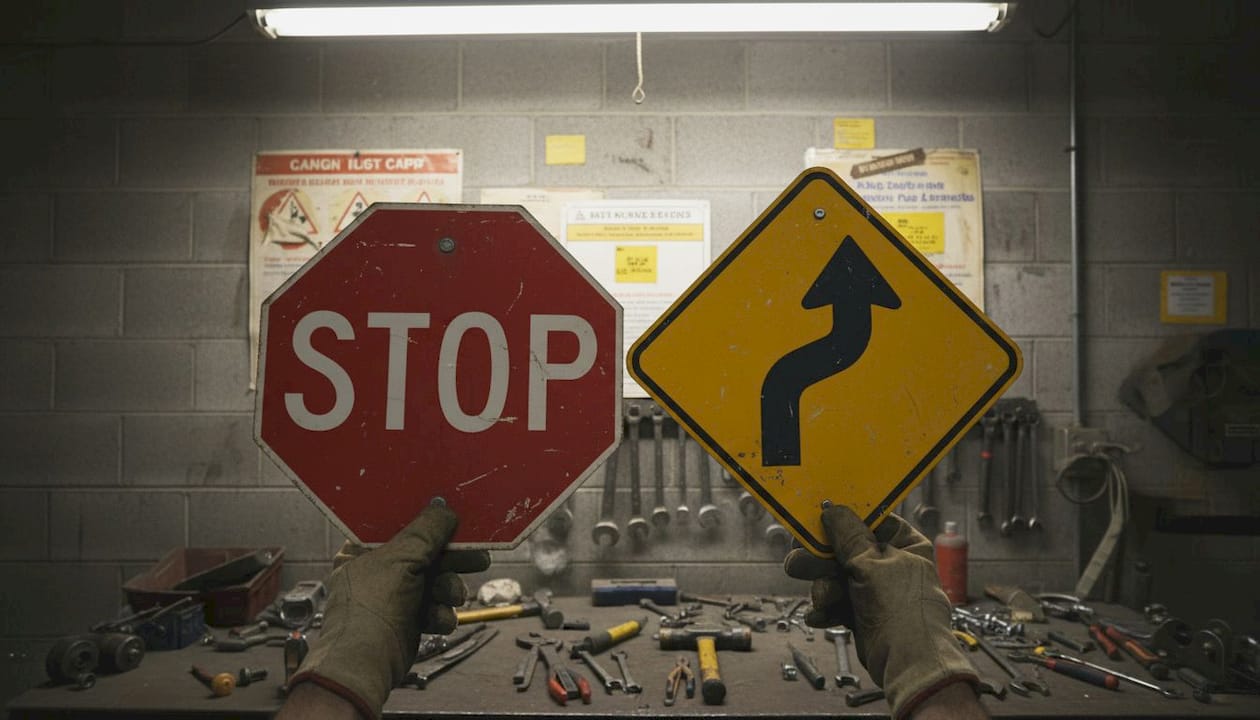
The Iowa Driver License Manual confirms that shapes carry specific meanings: an octagon means STOP and only STOP, an inverted triangle means YIELD, a diamond shape signals a warning, a rectangle is used for regulatory or guide information, and a pennant shape marks a no-passing zone.
| Shape | Meaning | Example sign |
|---|---|---|
| Octagon | Stop completely | STOP |
| Inverted triangle | Yield to others | YIELD |
| Diamond | Warning ahead | Curve, pedestrian |
| Rectangle | Regulatory or guide | Speed limit, one way |
| Pennant | No passing zone | No passing |
| Circle | Railroad crossing warning | RR advance warning |
Color adds another layer of instant communication:
- Red means prohibition or a required stop.
- Yellow signals a general warning.
- Orange is used in construction and work zones.
- Green provides directional or permitted movement information.
- Blue indicates motorist services like gas, food, or lodging.
- Brown marks recreational areas and cultural sites.
Here is a simple process for decoding any unfamiliar road sign shape guide:
- Note the shape first. Is it a diamond, octagon, or rectangle?
- Check the color. Red means stop or prohibition. Yellow means caution.
- Read the text or symbol if present.
- Combine all three clues to determine the required action.
- Act accordingly before you reach the sign’s location.
Pro Tip: Teach yourself to read signs from the outside in. Shape, then color, then text. This sequence matches how your brain processes visual information under pressure, and it is the fastest path to correct interpretation.
US traffic sign standards: MUTCD and uniformity
Every traffic sign you see on a US road follows a single national framework called the MUTCD, which stands for the Manual on Uniform Traffic Control Devices. This document governs how signs are designed, where they are placed, and how reflective they must be to remain visible at night.
All US traffic signs must comply with the MUTCD, standardizing design, placement, and retroreflectivity for safety. Every state follows it, though some states add local supplements for specific conditions.
Here is what MUTCD compliance actually covers:
- Sign design: Colors, fonts, symbols, and sizes are all specified.
- Placement: Height, lateral offset from the road, and visibility distance are regulated.
- Retroreflectivity: Signs must reflect enough light to be readable at night by a driver with normal headlights.
- Maintenance: Faded or damaged signs must be replaced on a defined schedule.
“Uniformity in signage is not bureaucracy. It is the reason a driver from Florida can navigate a road in Montana without confusion.”
For businesses managing exterior signage standards, MUTCD compliance is especially important when your signs direct traffic on or near public roads. Even private lots that connect to public streets can fall under local traffic ordinances that reference MUTCD guidelines.
Pro Tip: If you are posting traffic control signs on your property, check your local municipality’s ordinances. Many reference MUTCD directly, and non-compliant signs can be ordered removed, leaving you without coverage during the gap.
Understanding mandatory business signs and how they align with MUTCD standards protects you legally and operationally. A sign that does not meet the standard is not just ineffective. It can be used against you in a liability claim.
Our perspective: The real-world challenge of sign meaning and compliance
Here is something the technical guides rarely say out loud: knowing what a sign means and actually responding to it correctly are two very different things. The research backs this up.
Driver compliance studies show glance rates at signs range from 40 to 60%, even in controlled conditions. Work zones see higher attention, but unsafe speeds persist. Dynamic, illuminated signs improve pedestrian detection and compliance in ways that static signs simply cannot match.
This tells us something important: the sign standard is a floor, not a ceiling. Businesses and event organizers who treat MUTCD compliance as the finish line are leaving safety on the table. The real goal is behavioral change, and that sometimes requires more than a correctly sized rectangle on a post.
We have seen properties where every sign was technically compliant but drivers still ignored them because the signs were placed where no one looked, or because the font was too small for the approach speed. Compliance without context is not enough.
The smarter approach is to treat safety evidence as a starting point for your signage strategy, not a checklist. Think about your specific audience, their speed, their distractions, and what you need them to do. Then design signs that meet the standard and actually work.
Need compliant, effective signage? We can help
Understanding traffic sign meanings is the first step. Putting that knowledge into practice with the right signs on your property is where it becomes real.
At Custom Signs Today, we help businesses, property managers, and event organizers create signage that meets MUTCD standards and actually gets noticed. From face change signs that let you update messaging without replacing the entire structure, to fully custom sign services designed for your specific traffic flow and audience, we bring both technical knowledge and practical experience to every project. Request a free quote today and let us help you build a signage system that keeps people safe and keeps you compliant.
Frequently asked questions
What are the 3 main types of traffic signs?
Traffic signs fall into three main categories: regulatory, warning, and guide/information signs. Each type has a distinct visual style and purpose that communicates its message before you read the text.
How can you tell what a traffic sign means?
Start with the shape and color, which are standardized to signal urgency and type. The Iowa Driver License Manual confirms that an octagon always means STOP, a diamond always signals a warning, and color adds a second layer of instant meaning.
Why are traffic sign standards needed?
Uniform standards ensure that any driver, anywhere in the country, can read and respond to a sign correctly. MUTCD compliance removes guesswork and keeps the visual language of roads consistent from state to state.
Does sign compliance actually reduce accidents?
Yes, and the numbers are clear. Proper signage reduces crashes at rural intersections by up to 29%, which represents a significant, measurable safety gain from correct sign placement and design alone.