TL;DR:
- Storefront signs can boost sales by up to 10 percent and increase foot traffic significantly.
- Effective signage uses high-contrast colors, bold fonts, and proper placement for maximum visibility.
- Long-term consistent signage builds brand recognition, trust, and subconscious familiarity over time.
Most business owners pour thousands of dollars into digital ads, social media, and email campaigns, yet overlook the one marketing tool sitting right outside their front door. A well-designed storefront sign can increase sales by 10% for small businesses when added, replaced, or updated. That single number should make every business owner and real estate agent stop and reconsider their priorities.
Table of Contents
- The business impact of storefront signs
- How storefront signs enhance visibility and brand perception
- Choosing the right storefront sign: materials, design, and placement
- Measuring ROI: track the results of your signage investment
- The hidden benefits most businesses overlook
- Bring your storefront to life with custom signage
- Frequently asked questions
Key Takeaways
| Point | Details |
|---|---|
| Proven sales boost | Upgrading or adding a storefront sign can drive 5–22% more sales and traffic for your business. |
| First impressions count | Most shoppers judge your business quality by your signage before they step inside. |
| Design impacts results | Bold colors, readable fonts, lighting, and smart placement make your sign stand out and attract new customers. |
| Track and optimize ROI | Monitor foot traffic and use digital tools to measure signage effectiveness and return on investment. |
The business impact of storefront signs
Storefront signs are not decoration. They are active sales tools that work around the clock without requiring a monthly subscription or ad budget. The data behind their impact is hard to ignore.
76% of consumers enter a store they have never visited because its signage caught their eye, and 68% say signs reflect the quality of a business. Think about what that means for a new customer walking down your street. Before they read a single review or visit your website, your sign has already formed their first impression.
The sales numbers back this up. Adding one sign yields a 4.75% sales increase on average, while case studies show foot traffic jumps of 20 to 22% from targeted upgrades. Those are not small gains for a one-time investment.
| Signage action | Average sales impact | Foot traffic impact |
|---|---|---|
| Adding a new sign | +4.75% | +10 to 15% |
| Replacing an outdated sign | +7 to 10% | +15 to 20% |
| Major signage upgrade | +10 to 22% | +20 to 22% |
| Removing a damaged sign | Negative | Significant drop |
“Your storefront sign is your hardest-working employee. It shows up every day, never calls in sick, and greets every potential customer who walks by.”
The flip side is equally important. Damaged, faded, or poorly designed signs actively push customers away. Studies show that a significant percentage of shoppers avoid businesses with signs that look neglected or unprofessional. A cracked letter or a sun-bleached banner does not just fail to attract customers. It signals that you may not care about the details of your business, either.
Key business impacts to keep in mind:
- Signs drive impulse visits from people who had no prior intention of entering
- They capture attention from passing vehicle and foot traffic simultaneously
- They reinforce your brand every time a repeat customer walks by
- They work as a 24/7 marketing channel with no recurring cost
- They influence purchasing decisions before a customer ever speaks to staff
For real estate agents, the parallel is direct. A well-placed property sign on a listing generates calls, drives online searches, and signals professionalism to both buyers and sellers. The business storefront signage overview at Custom Signs Today breaks down how different sign types serve different business goals, which is a helpful starting point if you are still deciding what kind of sign fits your situation.
How storefront signs enhance visibility and brand perception
Getting noticed is only half the battle. The other half is being remembered. This is where the science of visual branding meets the practical reality of signage.

High-contrast color combinations, bold fonts, and proper illumination are not just aesthetic choices. They are visibility tools. The human eye is drawn to contrast first, then shape, then text. A sign that uses a dark background with a bright, clean font will outperform a sign with similar colors every single time. Consistent branding reinforces recall through repetition and emotional cues, meaning the more consistently your sign reflects your brand identity, the more deeply it registers in a customer’s memory.
Pro Tip: Use no more than two fonts and three colors on any storefront sign. More than that creates visual noise, which forces the brain to work harder and reduces recall.
Here is a practical comparison of the two most common sign types that business owners consider:
| Feature | Static sign | Digital/LED sign |
|---|---|---|
| Upfront cost | Lower ($300 to $2,000+) | Higher ($1,500 to $10,000+) |
| Monthly operating cost | Near zero | $10 to $50 (electricity) |
| Message flexibility | Fixed | Fully changeable |
| Durability | 5 to 10+ years | 5 to 7 years (components) |
| Best for | Brand identity, location marking | Promotions, menus, events |
| Emotional impact | Consistent, familiar | Dynamic, attention-grabbing |
Static signs build long-term brand trust. Digital signs excel at short-term promotions and high-traffic locations. The right choice depends on your goals, your location, and your budget. Many businesses benefit from using both: a static primary sign for identity and a smaller digital element for promotions or hours.
Emotional cues matter more than most people realize. A sign that uses your brand’s signature color consistently, over months and years, creates a subconscious association in the minds of people who pass by regularly. They may not consciously notice the sign every day, but when they need what you offer, your business is the first one that comes to mind. You can explore inspiring storefront sign examples to see how other businesses have used color, shape, and typography to create memorable identities, and review design signs for branding for a deeper look at the design principles behind effective signage.
A well-designed sign also signals stability. Customers associate polished, professional signage with businesses that are established and trustworthy. For real estate agents, this translates directly to perceived expertise. A sharp, branded yard sign tells a seller you are serious about marketing their property.
Choosing the right storefront sign: materials, design, and placement
Knowing that signs work is only useful if you choose the right one. The wrong material, font size, or placement can undermine even the best design.
Step-by-step approach to selecting your sign:
- Define your primary goal: brand awareness, foot traffic, promotions, or wayfinding
- Set a realistic budget that includes installation and any required permits
- Choose a material based on your environment and durability needs
- Design for readability at your specific viewing distance
- Confirm local zoning and permitting requirements before ordering
- Plan your placement based on where your customers approach from
Material options and their best use cases:
| Material | Best for | Durability | Cost range |
|---|---|---|---|
| Acrylic | Indoor signs, modern aesthetics | 5 to 8 years | Moderate |
| Aluminum | Outdoor, all-weather exposure | 10+ years | Moderate to high |
| Vinyl | Banners, temporary signage | 3 to 5 years | Low to moderate |
| Digital/LED | High-traffic, changing content | 5 to 7 years | High |
| Foam/PVC | Interior, lightweight displays | 3 to 5 years | Low |
Readability is the most underestimated design factor. Signage best practices recommend one inch of letter height for every ten feet of viewing distance. A sign meant to be read from 50 feet away needs letters at least five inches tall. For a sign visible from a moving car, you have roughly three seconds to communicate your message. That means your business name and one key identifier, nothing more.
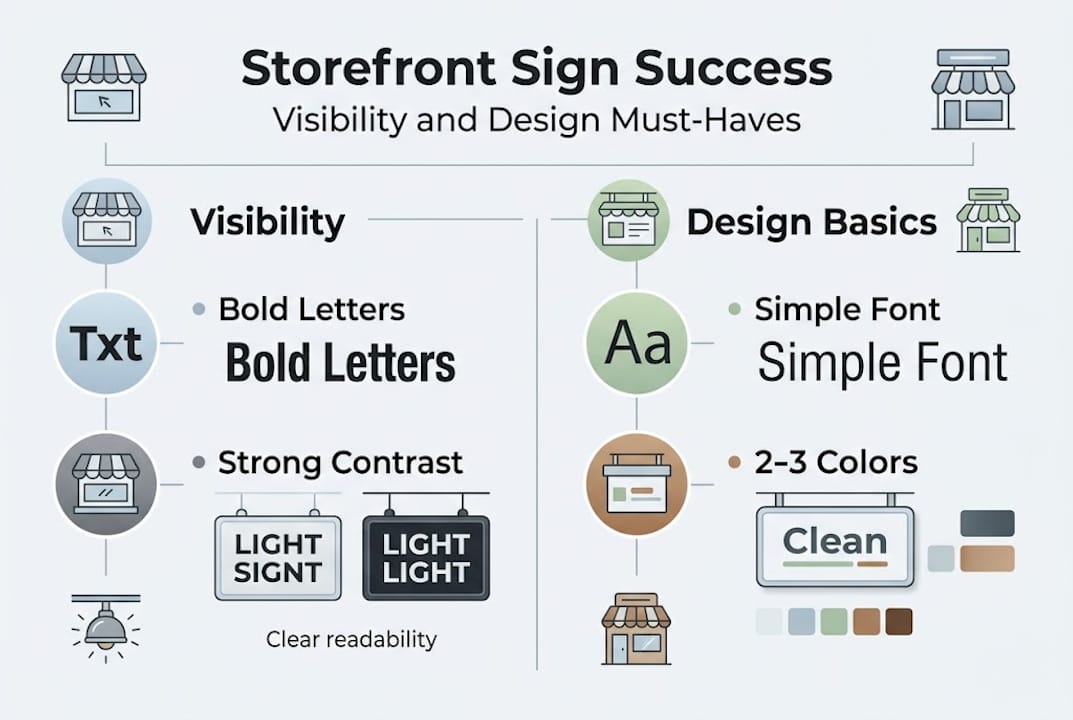
Pro Tip: Stand at the exact point where your target customer will first see your sign. Take a photo. If you cannot read the key information clearly on your phone screen, your font is too small or your contrast is too low.
Illumination is worth the investment for most businesses. LED-lit signs cost roughly $5 per month to operate and dramatically extend your sign’s effective hours into evenings and early mornings. For restaurants, retail shops, and service businesses with evening hours, this alone can justify the upgrade cost within months.
Placement strategy matters as much as design. Signs positioned at eye level, perpendicular to foot traffic, and free from visual obstructions consistently outperform signs placed flat against a building wall. If your storefront is set back from the street, a sidewalk sign or monument sign at the curb can capture traffic that would otherwise miss you entirely.
Permitting is a step many business owners skip until it causes a problem. Most municipalities regulate sign size, illumination, and placement. Check with your local zoning office before ordering. The property signage design tips resource covers the basics for real estate applications, while signage design tips addresses broader business signage compliance considerations. Businesses in the construction and development space can also find that construction visualization tools help reduce costly errors before installation.
Measuring ROI: track the results of your signage investment
Installing a sign is a business decision. Like any business decision, it deserves a measurement framework so you know whether it is working.
The simplest approach is a before-and-after comparison. Record your average daily foot traffic and weekly sales for four weeks before your new sign goes up. Then track the same metrics for four weeks after installation. Even a rough comparison gives you a baseline to work from.
For more precise tracking:
- Add a QR code to your sign that links to a landing page with a UTM parameter so you can track sign-driven traffic in Google Analytics
- Use a unique promo code on your sign to measure sign-driven purchases
- Ask new customers how they found you, and track “saw your sign” as a specific source
- Monitor Google Business Profile views and direction requests, which often spike after signage upgrades
- For real estate agents, track how many listing inquiries reference the yard sign specifically
Buying a sign resources note that professional signage enhances property value and tenant appeal for real estate applications, and that tracking ROI with A/B tests and QR codes is a practical approach for both SMBs and agents. This is especially relevant for agents managing multiple listings who want to know which sign designs generate the most calls.
Pro Tip: Run a simple A/B test by using two different sign designs at two comparable locations for 30 days. Track inquiries or sales tied to each. The results will tell you more than any focus group.
A realistic ROI benchmark for a quality storefront sign is 12 to 18 months to full payback, assuming a modest 5% sales increase. Many businesses see payback in under six months after a major upgrade. Warning signs of underperformance include no measurable change in foot traffic after 60 days, no new customer mentions of the sign, and no uptick in direction requests or website visits from local searches. If you see these signals, revisit your design, placement, or both.
The retail sign placement guide offers specific placement strategies tied to measurable outcomes, which is a useful next step once you have your baseline metrics in place.
The hidden benefits most businesses overlook
Most signage guides focus on the immediate: foot traffic, sales lift, and brand recognition. Those outcomes are real and worth pursuing. But after working with businesses across a wide range of industries, we have observed something that rarely makes it into the standard ROI conversation.
The compounding effect of consistent signage is almost always undervalued. A well-designed sign does not just attract customers on day one. It builds familiarity over months and years. The person who drives past your business five days a week for two years without ever stopping is still absorbing your brand. When they finally need what you offer, or when a friend asks for a recommendation, your business surfaces first. That latent awareness is nearly impossible to measure, but it is very real.
Signs also function as silent salespeople after hours. A lit storefront sign at 10 PM is still communicating your name, your category, and your professionalism to anyone who passes. No ad campaign does that without a recurring cost.
Here is a perspective that challenges conventional thinking: underperforming locations benefit more from signage upgrades than thriving ones. A business that is already busy has momentum. A business that is struggling often has a visibility problem masquerading as a product or pricing problem. Before assuming the issue is your offer, ask whether the right people even know you exist.
We also push back on the idea that digital signage is automatically the best ROI choice for every business. Digital signs are powerful tools, but they require content management, occasional technical maintenance, and a higher upfront investment. For many small businesses, a beautifully crafted static sign with strong branding delivers better long-term value than a digital display running generic promotions. The creative signage ideas resource explores options across both categories, which can help you make a more informed comparison based on your specific situation.
The businesses that get the most from their signage are the ones that treat it as a long-term brand asset, not a one-time purchase. They update their signs when their brand evolves, maintain them so they always look sharp, and think strategically about placement as their customer base grows.
Bring your storefront to life with custom signage
Your sign is often the first conversation your business has with a potential customer. It should say exactly what you want it to say, in a way that reflects your brand and stops people in their tracks.
At Custom Signs Today, we design and produce custom signs for businesses of every size and industry, from retail storefronts to real estate listings. Whether you need a bold exterior sign, a refined interior display, or a complete brand refresh, we work with you to find the right materials, design, and placement for your goals. Explore our face change storefront signs for a fast, cost-effective upgrade, browse our full range of custom sign solutions, or learn how custom sign quotes work so you can plan your budget with confidence.
Frequently asked questions
How much can a new storefront sign increase sales?
On average, a new or updated storefront sign can increase sales by 4.75% to 10%, with some businesses reporting foot traffic jumps of 20 to 22% after a major signage upgrade.
What are the most important design factors for storefront signs?
High-contrast colors, bold fonts, proper illumination, and sizing for a three-second read from the street are the most critical design factors for effective storefront signage.
How do signs affect customer perceptions?
68% of consumers say signs reflect business quality, and 76% have entered a store they had never visited simply because the signage caught their attention.
How can I track the ROI of my signage investment?
Track changes in foot traffic, sales, and direction requests before and after installation, and use QR codes with UTM tracking to measure sign-driven digital engagement from specific campaigns.