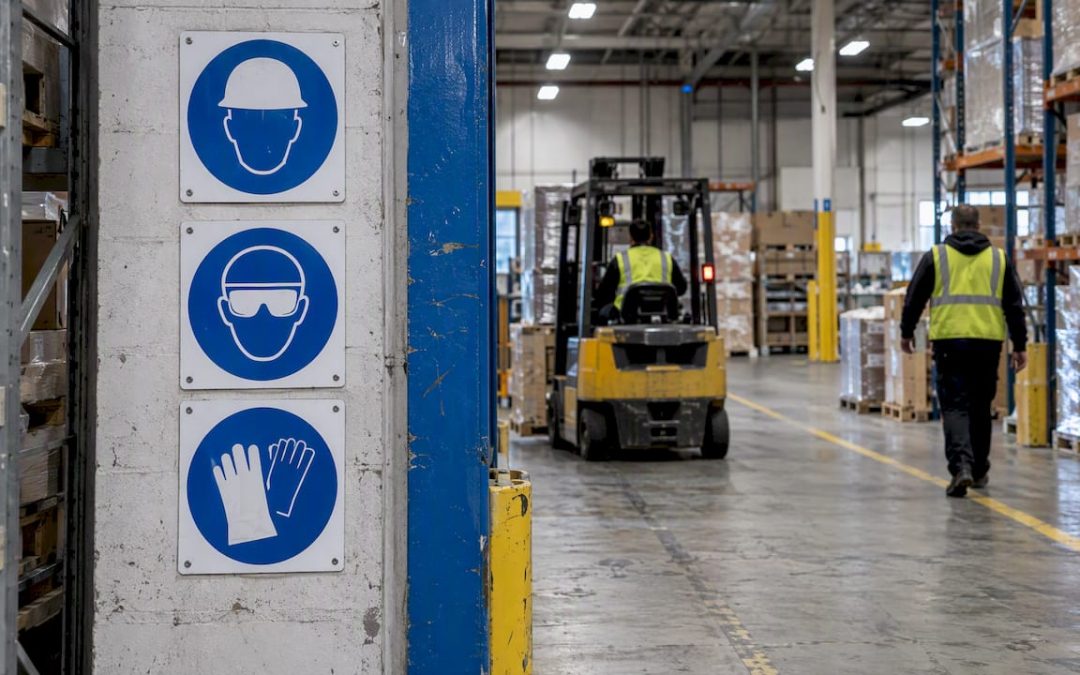
OSHA sets the baseline for mandatory workplace safety signs. 29 CFR 1910.145 governs required sign types, colors, and wording, with mandatory signs identified by a blue background and white pictogram covering PPE requirements, authorized personnel zones, and similar instructions. Start by checking that CFR section against your current signage, then run a facility-wide audit using the checklist below.
TL;DR:
- Exit route signs need letters at least 6 inches high, strokes at least 3/4 inch wide, and illumination of 5 foot candles when needed.
- Chemical container labels need a signal word, a hazard statement, and a pictogram inside a diamond with a red frame; facility signs mark fixed locations.
- Permanent room identification signs must meet ADA tactile, braille, and mounting height rules; post separate hazard or exit signs for OSHA functions.
- Place mandatory signs where workers must act, such as PPE notices at entrances and eyewash signs directly beside the emergency fixture.
- Photograph each sign with a ruler visible, record its CFR or ANSI reference, and keep dated audit photos while replacing faded or blocked signs.
Table of Contents
- What mandatory signs are and how they differ from other safety signs
- OSHA and ANSI: the key regulations facility managers must follow
- Common mandatory sign types, colors, and pictograms
- Compliance checklist: what to post, where, and how to document it
- Chemical labeling vs. workplace signs: Hazard Communication essentials
- ADA vs OSHA signage: meeting accessibility without compromising safety messaging
- How a compliance-minded sign provider implements the rules
- Typical penalties and fines for non-compliance with mandatory signage regulations
- Guidance on selecting durable materials suitable for mandatory health and safety signs
- Author’s operational view: common pitfalls and a simple maintenance habit
- Client services: request a compliance sign audit or custom quote
- FAQ
- Sources
What mandatory signs are and how they differ from other safety signs
A mandatory sign tells a worker what they must do before entering an area or performing a task: wear eye protection, use a handrail, keep a door closed. The format is consistent wherever you see it: a blue circle or blue panel with a white pictogram, sometimes paired with short text confirming the action required.
This differs from other categories in the same family:
- Danger signs use red, black, and white to flag an immediate, serious hazard.
- Caution signs use yellow and black for a hazard that is real but less severe.
- Prohibitory signs use a red circle with a diagonal slash to show what workers must not do.
- Notice or informational signs use blue or green for general guidance with no direct hazard attached.
Mixing these up creates confusion at the exact moment a worker needs a clear instruction, which is why the color and pictogram conventions are not optional style choices.
OSHA and ANSI: the key regulations facility managers must follow
Three federal standards do most of the work here, and a facility manager should be able to name all three from memory.
- 29 CFR 1910.145 sets out Danger, Caution, and Safety Instruction sign formats, specifies required colors, and incorporates ANSI tables by reference for exact design details.
- 29 CFR 1910.37 covers exit routes: every exit must carry a sign with letters at least 6 inches high and strokes at least 3/4 inch wide, and the standard requires illumination to at least 5 foot-candles (54 lux) where lighting is needed for visibility.
- 29 CFR 1910.1200 (Hazard Communication) governs chemical container labels rather than facility wall signage, and requires signal words, hazard statements, and standardized pictograms.
ANSI Z535 sits alongside these rules as a consensus standard. OSHA does not always write out full design specifications in its own text, and when it doesn’t, it frequently points to ANSI for the pictogram library, color tolerances, and sign geometry that make a sign legally defensible. Treat ANSI as the technical appendix to OSHA’s legal requirement, not as an optional extra.
Common mandatory sign types, colors, and pictograms
Facility managers encounter the same handful of mandatory signs across almost every industry. Recognizing them quickly helps you specify correct artwork instead of guessing at a vendor’s catalog.
- PPE required signs at entrances to areas needing hard hats, eye protection, or hearing protection.
- Authorized personnel only signs at restricted equipment rooms, electrical panels, or mechanical spaces.
- Eyewash and safety shower signs marking emergency equipment near chemical handling areas.
- Assembly point signs indicating where staff gather during an evacuation.
- Equipment operation signs instructing workers to lock out machinery or follow a specific startup sequence.
Readability matters as much as content. A white pictogram on a solid blue field needs enough contrast to be read from a normal walking distance, and signs mounted in dim corridors or near glare-heavy windows need placement adjustments, not just bigger graphics. Match the sign to the location: eyewash signage belongs at the fixture itself, not down the hall, and PPE signage belongs at the point of entry, not buried inside a room.
Compliance checklist: what to post, where, and how to document it
A workable compliance checklist covers three things: placement, legibility, and recordkeeping.
Placement
- Post hazard and mandatory signs at the point of decision, meaning right where the worker needs to act, not nearby.
- Mark every exit and change of direction along an exit route so the path to safety is obvious without guesswork.
- Add directional arrows wherever the route to an exit is not immediately clear from a given vantage point.
Legibility
- Confirm exit sign lettering meets the 6-inch minimum height required under 1910.37.
- Verify illumination levels, particularly in stairwells and back-of-house corridors where lighting is often weaker than in public areas.
- Check pictogram size and contrast against the mounting surface, especially on painted concrete or textured walls.
Maintenance and records
- Replace signs that are faded, cracked, or partially obscured; a sign nobody can read offers no legal or practical protection.
- Keep dated photos of each sign location as part of your audit trail.
- Train new staff on what each color and pictogram means during onboarding, not as an afterthought.
Pro Tip: Photograph each sign with a tape measure or ruler in frame during audits, and note the CFR or ANSI reference it satisfies. That pairing turns a photo folder into a defensible compliance record.
A mandatory signs checklist built around these three categories makes seasonal re-audits far faster than starting from scratch each time.
Chemical labeling vs. workplace signs: Hazard Communication essentials
Chemical container labels and facility wall signs follow different rulebooks, even though both fall under OSHA’s umbrella. The Hazard Communication Standard requires container labels to carry:
- A signal word (“Danger” or “Warning”) matching the hazard’s severity.
- A hazard statement describing the specific risk.
- A pictogram set within a red-framed diamond, following the format OSHA specifies under HCS 2012.
Container labels travel with the product itself, while facility signage marks fixed locations like storage rooms or emergency equipment. OSHA interpretation letters add a practical detail here: a blank red frame with no pictogram inside is not acceptable, and pictogram stickers are allowed only when they remain clearly visible on the container.
ADA vs OSHA signage: meeting accessibility without compromising safety messaging
ADA signage and OSHA signage solve different problems, and conflating them creates compliance gaps on both sides.
- The 2010 ADA Standards require tactile characters, braille, and specific mounting heights for permanent room identification, a spec that has nothing to do with hazard communication.
- A single doorway often needs both: an accessible room ID sign at ADA mounting height and a separate hazard or exit sign positioned for maximum visibility at eye level or above.
- Avoid stacking or replacing one sign type with the other. Use separate panels, or stack them vertically, so neither function is compromised.
How a compliance-minded sign provider implements the rules
A useful vendor process looks like this: audit current signage against OSHA and ANSI references, produce artwork specified to those citations, select materials rated for the environment, then document installation with photos.
When briefing a supplier, include:
- The specific CFR or ANSI reference each sign needs to satisfy.
- Mounting height and location photos for ADA-adjacent spaces.
- Illumination conditions at each sign location.
Our team builds compliance signage around exactly this workflow, and resources like our guide to identifying mandatory signs for business and event safety walk through the same vendor-brief approach in more detail.
Typical penalties and fines for non-compliance with mandatory signage regulations
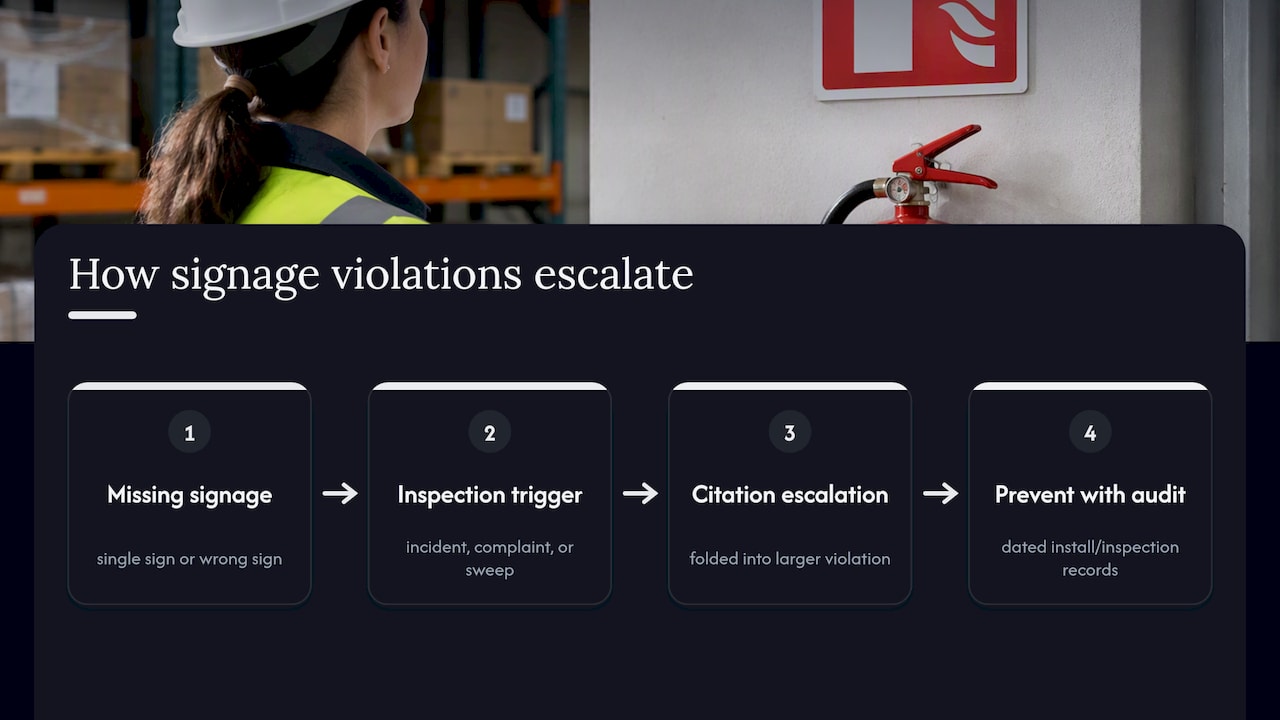
Missing or incorrect signage rarely stands alone as a citation. It usually surfaces during a broader inspection, often triggered by an incident, a complaint, or a programmed sweep of a high-hazard industry. When inspectors find signage gaps alongside other hazard communication or exit-route violations, the signage issue gets folded into a larger citation for the underlying standard, such as 1910.145, 1910.37, or 1910.1200.
Penalty amounts depend on the violation’s classification: serious, willful, repeat, or other-than-serious, and OSHA adjusts its maximum penalty figures periodically. Rather than quoting a figure that may already be outdated by the time you read this, the practical point is more useful: signage violations are inexpensive to fix and expensive to ignore, since a single missing exit sign or an unmarked chemical storage area can escalate a routine walkthrough into a full citation review.
The more durable protection is a documented, dated audit trail showing when each sign was installed, inspected, and replaced. Inspectors respond to evidence of an active compliance program far better than they respond to a single compliant sign found during a walkthrough. Facilities that treat signage as a recurring maintenance item, rather than a one-time install, consistently avoid the kind of neglect that turns into a citation.
Guidance on selecting durable materials suitable for mandatory health and safety signs
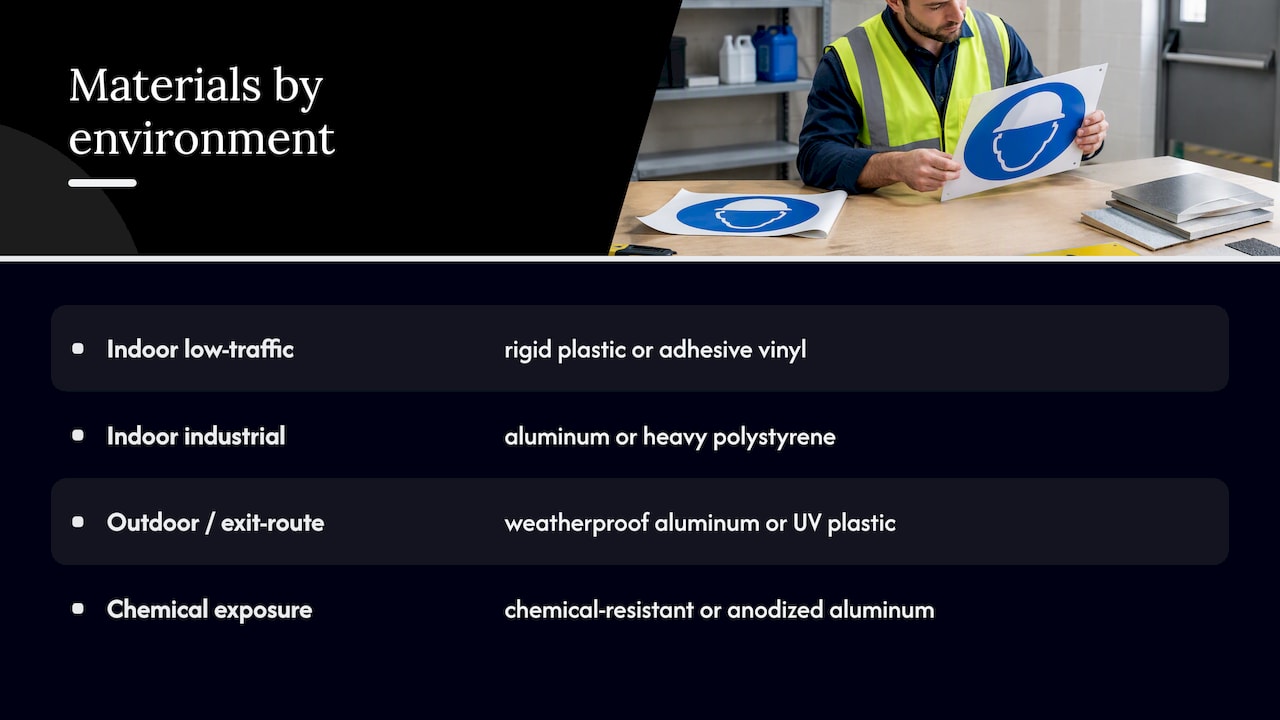
Material choice depends almost entirely on where a sign lives and what it’s exposed to.
Indoor, low-traffic areas like office corridors or administrative spaces can use economical rigid plastic or adhesive vinyl on smooth walls, since exposure to moisture, UV, and physical contact is minimal.
Indoor industrial areas, such as warehouses or production floors, benefit from aluminum or heavy-duty polystyrene signs that resist dents, forklift contact, and the grime that accumulates near machinery. A laminated or UV-coated finish keeps pictograms legible despite frequent cleaning.
Outdoor and exit-route signage needs weatherproof aluminum or UV-stabilized plastic that won’t fade, warp, or crack under sun and temperature swings. Illuminated exit signs intended for outdoor stairwells or covered walkways should carry a weatherproof housing rated for the specific climate.
Chemical exposure areas, including labs and storage rooms, call for chemical-resistant coatings or materials like anodized aluminum that won’t degrade from fumes or splash contact. A sign that corrodes or peels near a chemical storage area stops communicating the hazard it was installed to flag.
Matching material to environment up front avoids the more common failure mode: a sign that looked fine on install day but faded or cracked within a year, quietly becoming a compliance gap nobody noticed until an inspection flagged it.
Author’s operational view: common pitfalls and a simple maintenance habit
The most common failure isn’t missing signage, it’s signage that degraded quietly: a faded pictogram, a sign half-blocked by a relocated shelf, a burned-out exit light nobody reported. Folding a five-minute sign check into existing monthly EHS rounds catches these before an inspector does.
— Yossi
Client services: request a compliance sign audit or custom quote
A sign that’s technically compliant on paper but illegible on the wall doesn’t protect anyone, which is why we build every compliance sign around the exact CFR and ANSI references it needs to satisfy, not just a generic template. Our process covers custom artwork, material selection suited to your environment, and installation documentation you can hand to an inspector without scrambling.

Whether you need illuminated exit signage for a stairwell, interior PPE and authorized-personnel signs, or a full facility signage audit, custom signs services cover the design, fabrication, and installation steps in one request. Facilities needing weatherproof exit or perimeter signage can also review exterior signs options built for outdoor exposure. Request a quote today and tell us which CFR sections your current signage needs to match.
FAQ
What are the OSHA requirements for safety signage?
OSHA’s core requirement sits in 29 CFR 1910.145, which specifies sign categories, colors, and wording for Danger, Caution, and Safety Instruction signs. Exit routes carry separate requirements under 29 CFR 1910.37, including a 6-inch minimum letter height and illumination to at least 5 foot-candles.
What are mandatory signs and give some examples?
Mandatory signs instruct workers on an action they must take before proceeding, shown with a white pictogram on a blue background. Common examples include PPE-required signs, authorized-personnel-only notices, and signs marking eyewash or safety shower stations.
What are symbolic mandatory safety signs?
Symbolic mandatory signs use a pictogram, rather than text alone, to show the required action, such as a helmet icon for hard-hat zones or a goggles icon for eye protection. The blue circular or panel format with a white symbol lets workers who don’t share a common language still understand the instruction.
What is the difference between mandatory, prohibitory, and warning signs?
Mandatory signs (blue, white pictogram) tell a worker what to do, while prohibitory signs (red circle with a diagonal slash) show what not to do. Warning signs typically use yellow and black to flag a hazard that requires caution rather than a specific required action.
Sources
- 1910.145 – Specifications for accident prevention signs and tags.
- 1910.37 – Exit routes and emergency planning (exit sign requirements).
- 2010 ADA Standards for Accessible Design.