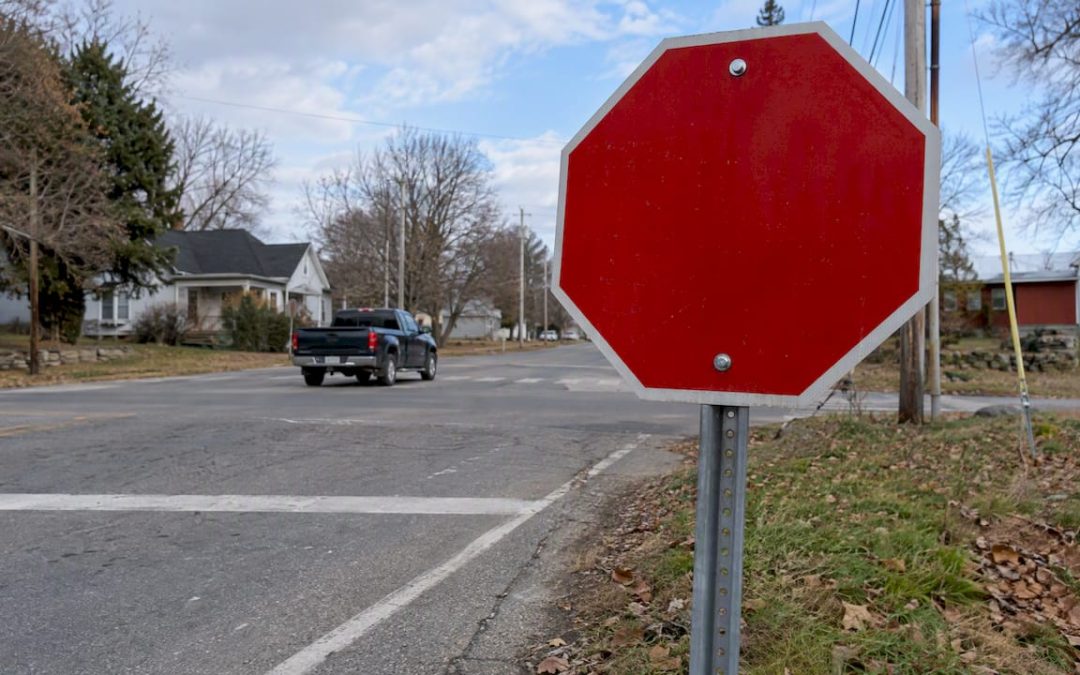
A stop sign tells drivers that they must come to a full stop and give way before entering an intersection. Its job is to assign right-of-way, so that traffic moves in a predictable order and road users cross paths one at a time instead of at once. It is not a speed-control device, and that misunderstanding explains most of the arguments people have about where stop signs belong.
This guide covers what a stop sign legally means, why it looks the way it does, what it can and cannot fix, and what property managers and business owners should know before putting one on private land.
TL;DR
- A stop sign assigns right-of-way. Drivers must stop completely at the sign, then proceed only when it is safe and their turn.
- It is a regulatory sign, so it carries legal force. Under the federal standard it is a red octagon with a white legend and border.
- Stop signs are a poor tool for slowing traffic. Engineers install them where a study supports it, not to calm a street.
- On private property, a sign that copies the standard look but is badly placed or not visible can create confusion and liability.
- Design, size, reflectivity and placement matter as much as the message on the face.
Table of Contents
- What a stop sign actually does
- Why a stop sign looks the way it does
- Where stop signs fit among road signs
- What stop signs cannot do
- Stop signs on private property
- Placement and visibility decide whether a sign works
- Our perspective on stop signs
- Need signs for your property or business?
- FAQ
- Sources
What a stop sign actually does
When a full stop is always required on an approach to an intersection, the national standard says a STOP (R1-1) sign shall be used. That wording comes from the 11th Edition of the MUTCD, Chapter 2B, the manual that sets how traffic signs look and where they go.
In plain terms, a stop sign does three things:
- It breaks a conflict into turns. Two vehicles that would otherwise arrive at the same point at the same moment are separated in time. One waits, the other goes.
- It makes behavior predictable. A driver who has never seen the intersection still knows what the red octagon demands.
- It protects people outside vehicles. Stopping gives drivers time to see pedestrians and cyclists before entering the crossing.
The U.S. Department of Transportation frames signs like this as part of its Safe System Approach, where signing and markings are one layer among several, alongside physical design changes such as traffic calming and pedestrian infrastructure.
What drivers must do
The stop sign is not a suggestion to slow down. The driver stops completely, at the stop line if there is one, otherwise before the crosswalk, otherwise at the point with the best view of cross traffic. Then the driver yields to pedestrians and to vehicles already in or approaching the intersection, and goes when it is safe. State driver handbooks word the details slightly differently, so check your own state’s rules. The California DMV’s rules of the road section is one example of how a state spells it out.
At an all-way stop, every approach has a sign. The federal standard requires an ALL-WAY plaque mounted below each STOP sign at those intersections, so drivers know that everyone else is stopping too.
Why a stop sign looks the way it does
The design is not decoration. The MUTCD requires the sign to be an octagon with a white legend and border on a red background, and regulatory signs of this kind must be retroreflective or illuminated so they stay legible at night. The same section says secondary legends are not allowed on a stop sign face. That means no slogans, no advertising and no extra messages on the sign itself.
Size is specified too. According to the research behind this guide, standard stop signs run from a 30 x 30 inch minimum on conventional single-lane roads up to 48 x 48 inches for oversized applications, per the MUTCD Chapter 2B.
A short history of the shape
The first stop signs were square. The octagon was adopted for visibility and shape recognition, so a driver can identify the sign from the back or when it is partly covered in snow. Red with white lettering became the U.S. standard in 1954, after fade-resistant red coatings and reflective materials became available, according to a history of the stop sign shape. Before that, many signs were yellow with black text.
| Feature | Standard requirement | Why it matters |
|---|---|---|
| Shape | Octagon | Recognizable even from behind or when obscured |
| Colors | White legend and border on red | Immediate association with “stop” |
| Visibility | Retroreflective or illuminated | Readable day and night |
| Message | STOP only, no secondary legends | Nothing competes with the command |
| Typical size | 30 x 30 in. minimum on conventional single-lane roads; 48 x 48 in. for oversized uses | Larger faces are read from farther away |
If you want to know how these signs are physically built, we cover that in what stop signs are made of.
Where stop signs fit among road signs
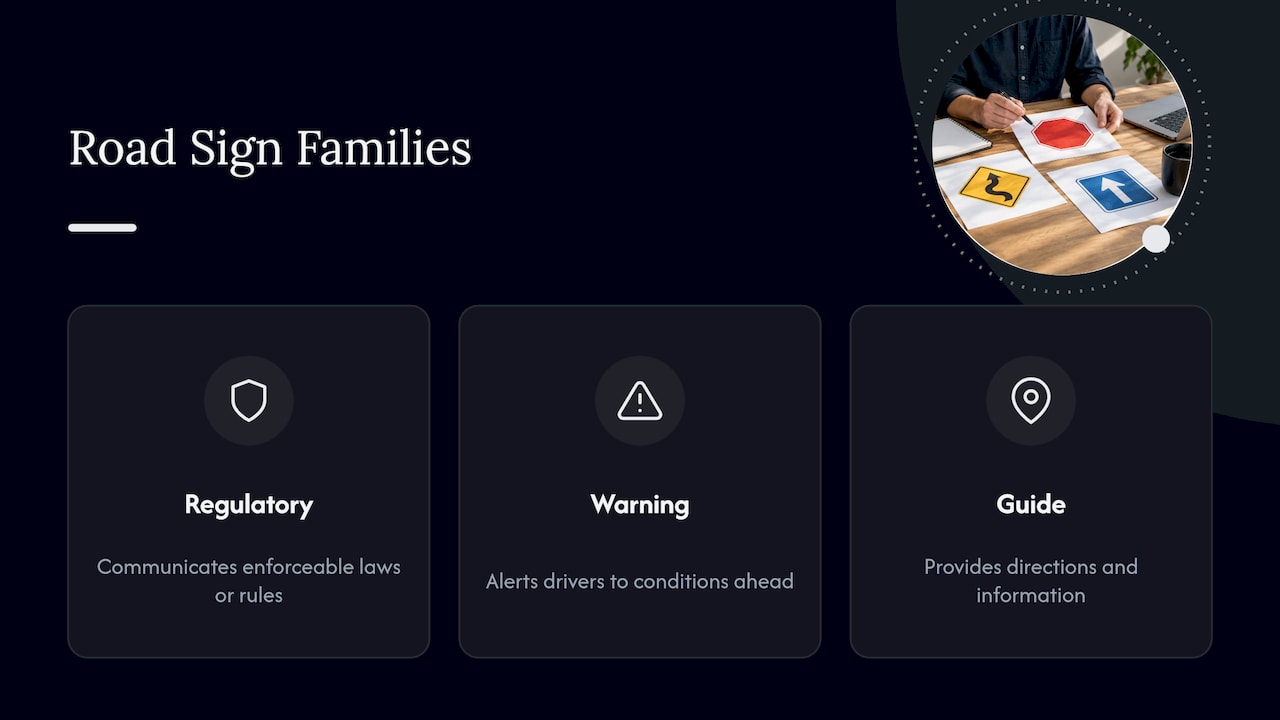
Road signs fall into three broad families: regulatory, warning and guide. A stop sign is regulatory. Regulatory signs communicate laws or rules that can be enforced, which is why ignoring one can mean a citation, not just a risk. Warning signs alert drivers to conditions ahead, and guide signs give directions and information.
That distinction is useful when you are choosing signage for a site. A “Caution: wet floor” or “Speed bump ahead” sign warns. A stop sign orders. If you want the full breakdown, see our guides on the three types of traffic signs and what sign controls traffic.
What stop signs cannot do
This is where most neighborhood requests go wrong. Residents often ask for a stop sign to slow cars on their street. City traffic pages commonly say the purpose of stop signs is right-of-way assignment, not speed control. Drivers who feel a stop was unnecessary tend to roll through it, then speed up to make up the time.
The federal manual warns against this. Traffic control devices are not a cure for every problem, and installing them where an engineering study does not support them can lead to more disobedience. It can also create new hazards such as rear-end crashes, or push drivers onto faster, less suitable routes to avoid the stops, according to MUTCD Chapter 2B.
Engineers look for specific conditions before choosing a stop sign over other options:
- Vehicle and pedestrian volumes on each approach
- Crash history at the intersection
- Sight distance and visibility problems
- Whether a signal, roundabout or a simple yield sign would work better
Signals are not an automatic upgrade either. They can increase rear-end collisions, so the right control depends on the site. When speed is the real problem, the better tools are usually physical: narrower lanes, curb extensions, speed humps, crossing islands. Those belong to the road authority, not to a sign order.
Stop signs on private property
The MUTCD applies to public roads and to private roads open to public travel, as the Department of Transportation’s rule announcement describes it. A private parking lot or industrial yard is often outside that definition, and state law and local enforcement vary. If you manage such a site, confirm with your local authority or a qualified traffic engineer how your state treats private-property signs.
Even where the legal weight is unclear, copying the standard design is smart. Drivers already know what the red octagon means. A homemade or off-standard version invites doubt, and a sign that mimics the official one but is poorly placed, faded or blocked can cause confusion and liability if something goes wrong. If you are unsure whether your situation needs a sign at all, we explain the private-lot picture in what is a regulatory sign in driving on private property.
Where private sites actually use them
- Exits from parking lots onto a public street
- Crossings of internal drive aisles in large lots
- Loading docks and delivery lanes where trucks cross pedestrian paths
- Gated community entrances and apartment complex driveways
- Event parking areas where temporary traffic flows are set up
In each case the question is the same: where must a driver stop, and can they see the sign in time to do so?
Placement and visibility decide whether a sign works
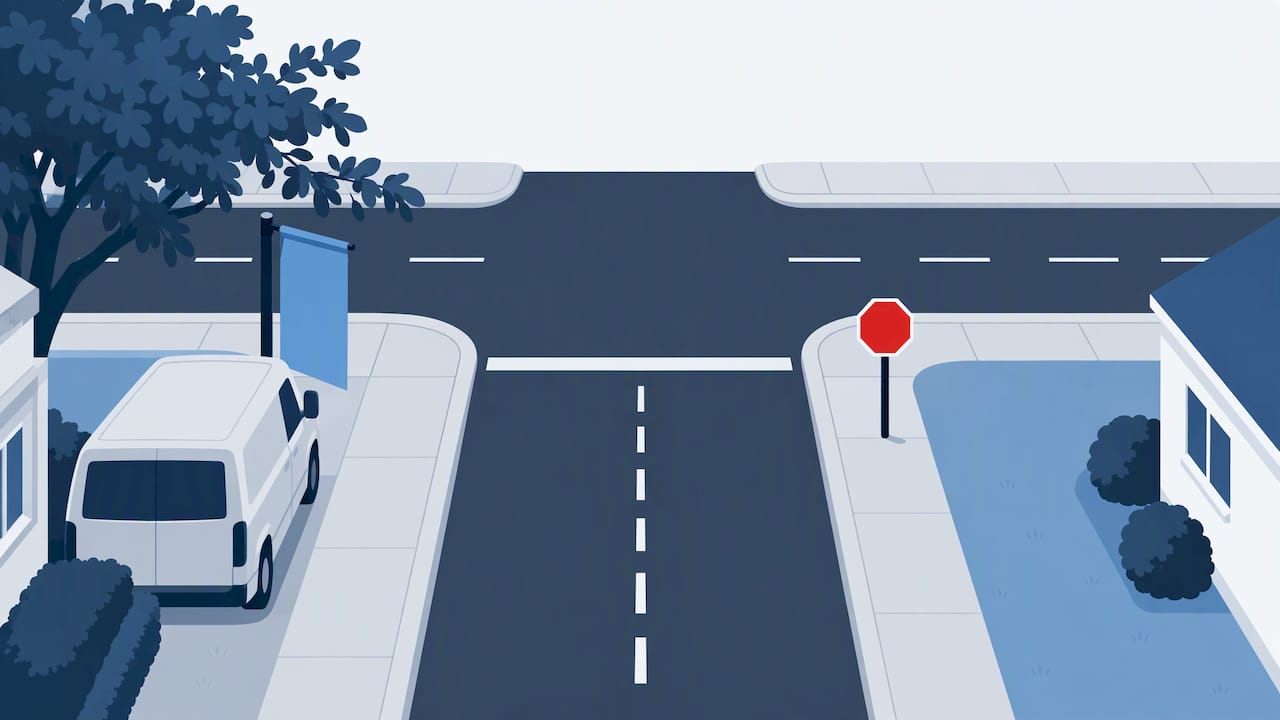
A stop sign has to be installed at or near the point where the rule applies. That sounds obvious, but a correct sign in the wrong place fails. The manual calls for adequate legibility, which in practice means specific horizontal offsets from the roadway and vertical clearances from the ground, plus clear sightlines. A branch, a parked van or a banner stuck to the same post can undo the whole sign.
The human factor matters just as much. Traffic engineers design for the full range of behavior, including drivers who are tired, distracted or unfamiliar with the area. Consistent, standard design and sensible placement are how signs earn compliance from those drivers. The same principle applies to temporary roadside hazards, and a fleet repair shop’s explanation of warning triangle placement for trucks shows how distance and visibility drive safe behavior around stopped vehicles.
A practical checklist for a site manager:
- Walk the approach as a driver would, at the speed they will actually travel.
- Check that nothing blocks the sign: foliage, parked vehicles, other signs.
- Confirm the sign face is reflective and in good condition. Faded red and peeling sheeting should be replaced.
- Pair the sign with a painted stop line where it makes sense.
- Inspect at night, since reflectivity matters most when headlights are the only light.
More on this in our tips for effective sign placement.
Our perspective on stop signs
People rarely call a sign shop to ask what a stop sign means. They call because a lot has near misses, a delivery lane crosses a walkway, or a tenant complained about an exit. In those conversations, the sign is almost never the whole answer.
We start with the site. Where do drivers come from, how fast are they going, what blocks the view, and who is walking through? Sometimes the right answer is a stop sign. Sometimes it is a stop sign plus a painted bar and a pedestrian crossing sign. Sometimes it is a speed limit sign or a directional sign that sends traffic to a safer route. Our approach covers the whole chain: consultation, compliance questions, material choice, fabrication and certified installation guidance, so the sign matches the environment it stands in.
Two things we tell clients repeatedly. First, do not decorate a regulatory sign. A stop sign that tries to be on brand stops being a stop sign. Keep the standard shape and color and put your branding on the post, the building or the surrounding wayfinding. Second, a sign is only as good as its visibility. Good materials and correct mounting cost little compared with the cost of a crash on your property.
— Yossi
Need signs for your property or business?
If you manage a lot, a campus, a job site or a retail center, we can help you work out which signs the site needs and produce them in durable materials for indoor or outdoor use. See our custom signs and exterior signs pages, or send a quote request from the Custom Signs Today homepage. We can talk through sizing, materials, mounting and compliance questions before anything is produced. For wayfinding inside buildings, take a look at our interior signs.
FAQ
What is the use of a stop sign?
A stop sign assigns right-of-way at an intersection. Drivers must stop completely, yield to pedestrians and cross traffic, and proceed only when it is safe. It exists to make traffic flow in an orderly, predictable way and to reduce conflicts between road users.
Are stop signs meant to slow drivers down?
Not primarily. Their purpose is to decide who goes first, and the federal manual cautions that installing them without an engineering basis can cause disobedience and new hazards such as rear-end crashes. For speeding problems, traffic calming measures designed by the road authority generally work better.
What are the three purposes of signs?
Road signs fall into three categories: regulatory signs state enforceable rules, warning signs alert drivers to hazards or changing conditions, and guide signs provide directions and information. A stop sign is regulatory. Our guide to road safety signs and their meanings covers the rest.
Why is a stop sign an octagon?
The octagon gives the sign a unique silhouette, so drivers recognize it from a distance, from behind, or when it is partly covered. Early signs were square. The red and white color scheme became the U.S. standard in 1954.
Can I put a stop sign on my private parking lot?
Often yes, but legal enforceability depends on your state and local rules, and on whether the lot counts as open to public travel. Use the standard design, place it where drivers can see it in time, and ask your local authority or a traffic engineer before relying on it for enforcement.
Sources
- MUTCD 11th Edition, Chapter 2B: Regulatory Signs, Barricades, and Gates (FHWA)
- National Standards for Traffic Control Devices; MUTCD revision (U.S. Department of Transportation)
- Road Safety Momentum Toolkit (U.S. Department of Transportation)
- The History of the Stop Sign Shape
- Place Warning Triangles 10 ft & 100–500 ft: Truck Rules for U.S. Fleets