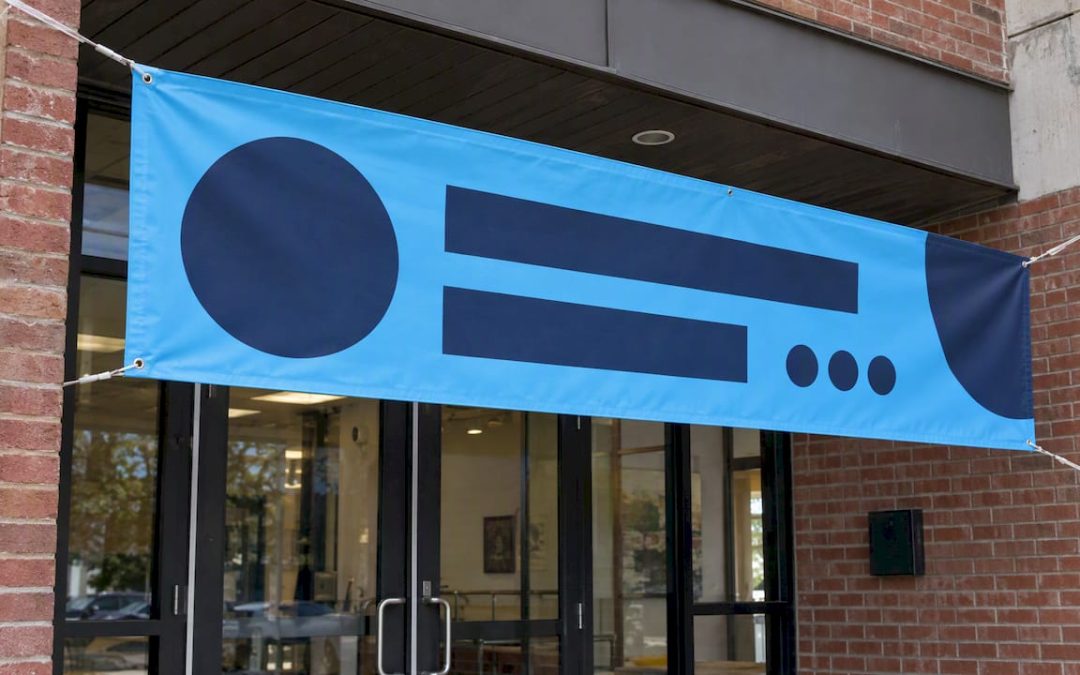
The best sample event banners share one trait: a single message that people can read while walking past. Below are eight banner samples for common events (grand openings, trade shows, fundraisers, sports days, open houses and more), each with sample wording, a suggested size and a material that fits. After that come the rules that make any of them work: letter height, contrast, file prep and mounting.
TL;DR
- Design for viewing distance first. A common sign-industry rule of thumb is about 1 inch of letter height for every 10 feet of reading distance.
- One headline, one supporting line, one action. Cut everything else.
- Use vinyl for smooth, detailed graphics and mesh for windy outdoor spots. Ask for hems and grommets so the banner can be tied down.
- Send vector logos and print-ready PDFs at the finished size, with fonts outlined or embedded.
- Keep key words above head height so crowds do not block them.
Table of Contents
- Eight sample event banners you can adapt
- What are pop-up banners called?
- Start with viewing distance, not the design
- Layout rules that survive a crowded venue
- Creative design ideas for event banners
- Materials for indoor and outdoor events
- Finishing and mounting
- Prepare your file for print
- Our perspective
- Get your event banner made
- FAQ
- Sources
Eight sample event banners you can adapt
These are layouts, not templates to copy word for word. Swap in your own name, date and call to action. Sizes are typical starting points. We confirm the final dimensions against your space before anything is printed.
1. Grand opening banner
Sample wording: GRAND OPENING / Saturday 10 AM / Free coffee for the first 100 guests
Size: 3 x 8 ft or 4 x 10 ft, hung above the entrance or along the building front.
Why it works: The event name is the largest element. The day and the offer sit on a second line in a smaller size. Your logo goes in a corner and does not compete with the headline. Use a bright background and a dark headline, or the reverse.
2. Trade show backdrop or booth banner
Sample wording: Your company name and one promise, for example “Signage that ships in days.” Add a short web address underneath.
Size: A wide banner behind the booth, plus one or two retractable stands at the sides.
Why it works: Attendees decide in a few seconds whether to stop. Put the promise at eye level or above and keep detail for the brochure. We go deeper on this format in our trade show banner examples.
3. Charity run or fundraiser banner
Sample wording: 5K FUN RUN / Register today / Every step supports local families
Size: 3 x 10 ft at the start line, plus 2 x 6 ft banners on fences along the route.
Why it works: Runners and spectators see it from a distance, so the letters are tall and the colors high in contrast. A single sponsor strip at the bottom keeps sponsors visible without crowding the message.
4. Sponsor thank-you banner
Sample wording: Thank you to our sponsors, followed by 6 to 10 logos in a clean grid.
Size: 4 x 8 ft, hung near the stage or the registration table.
Why it works: Logos need equal space and consistent spacing. Ask each sponsor for a vector logo (more on files below) so none of them prints soft.
5. Outdoor festival or fairground banner
Sample wording: SPRING FOOD FESTIVAL / Live music / Sat and Sun / Free entry
Size: 4 x 12 ft or larger along a fence or at the entrance.
Why it works: Large banners catch wind. Mesh lets some air pass through, which reduces strain on the banner and what it is tied to. Our banner team prints both, and we explain the differences in the materials section below.
6. Open house or real estate event banner
Sample wording: OPEN HOUSE / Sunday 1 to 4 PM / Walk right in
Size: 2 x 4 ft or 3 x 6 ft at the curb, with an A-frame or directional sign at the corner.
Why it works: Drivers get a second or two. Four words and a time is all they will read. Real estate agents often pair one banner with directional signs so visitors can find the property.
7. School or sports banner
Sample wording: HOME OF THE EAGLES / Homecoming game Friday 7 PM
Size: 3 x 8 ft at the field, 2 x 6 ft for hallways or the gym.
Why it works: Team colors do the heavy lifting, so keep supporting text minimal. Reinforced edges and grommets help, because banners at fields are taken down and reused each season.
8. Pop-up and retractable banner for lobbies and registration
Sample wording: Welcome / Check in here / Event name and date
Size: A standard retractable banner stand, usually around 33 in wide and 80 in tall.
Why it works: It is portable, stands on its own and sets up in under a minute. Place it near the entrance, not behind a table where it will be hidden.
What are pop-up banners called?
People search for these under several names. The common ones are retractable banners, roll-up banners, pull-up banners and banner stands. They all describe a printed panel that rolls into a base and pulls up on a pole. Feather banners, also called flag banners or teardrop banners, are a different format: a tall, curved fabric flag on a pole in the ground, best for curbside and outdoor attention. Flat vinyl or mesh banners hang from walls, fences and frames. We produce all three: banners, retractable banners, feather banners and mesh banners.
A simple way to choose:
| Format | Best for | Setup |
|---|---|---|
| Flat vinyl banner | Entrances, walls, fences, stages | Grommets and ties or hooks |
| Mesh banner | Windy outdoor fences and large spans | Grommets and ties |
| Retractable banner | Lobbies, registration, trade shows | Stands on its own |
| Feather banner | Curbside, parking lots, festivals | Pole with ground stake or base |
Start with viewing distance, not the design
Most banners fail for one reason: the words are too small for where people actually stand. Decide how far away your audience will be, then size the text to match.
A widely used rule of thumb in the sign trade is 1 inch of letter height for every 10 feet of reading distance. A headline with 6 inch letters then reads comfortably from around 60 feet. Treat that as a guide, not a guarantee, since lighting, font style and contrast all change legibility.
To put that into practice:
- Walk the space and mark where people will first see the banner.
- Measure the distance from that spot to the banner.
- Divide by 10 to get a minimum headline letter height in inches.
- Pick a banner size that fits the headline at that height on one or two lines.
A 12-foot-wide banner with two lines of text can carry letters far larger than a 2-foot one, so the format and the wording have to match. This is why a short headline beats a long one every time.
Layout rules that survive a crowded venue
Event spaces are busy. People are talking, moving and looking at phones. A banner that needs thought will be skipped.
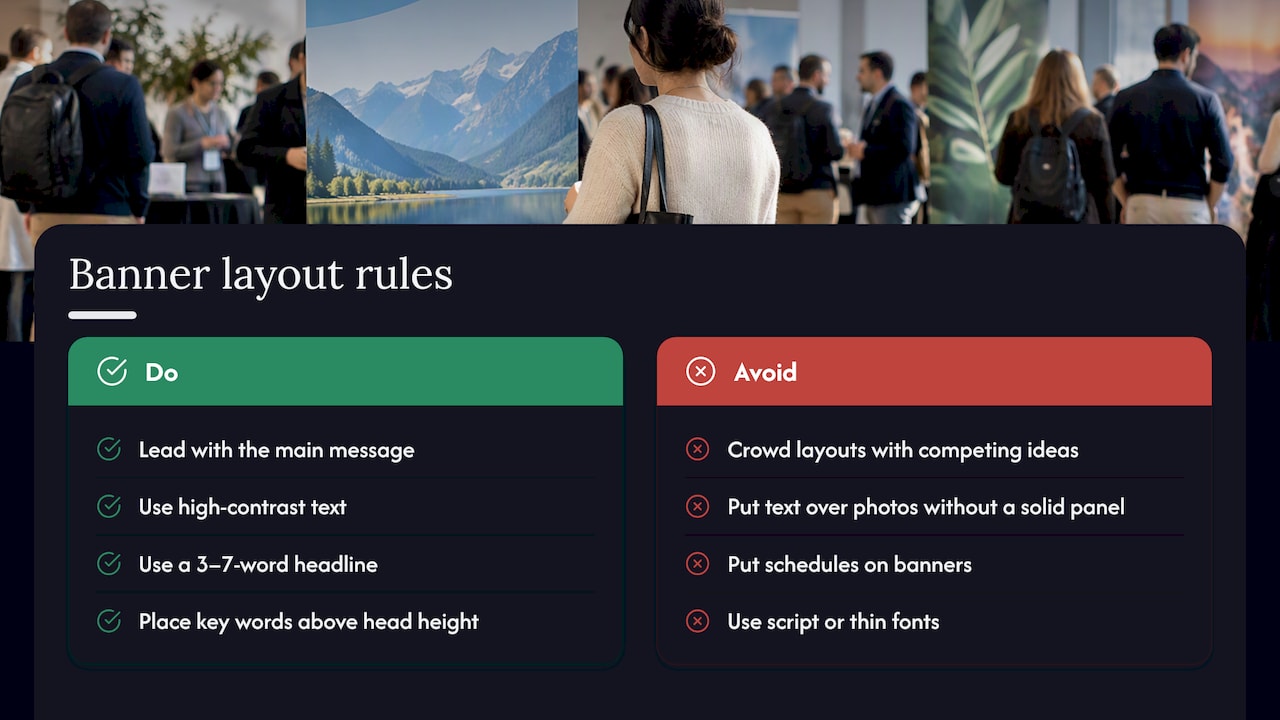
Put the main message first. Readable signage leads with the main message and then adds supporting details, and it avoids crowded layouts with competing ideas, according to venue advertising readability guidance.
Use high contrast. The same guidance recommends dark text on a light background or light text on a dark background, and no busy overlays or translucent color washes behind the words. In practice that means skipping text over a photo unless you add a solid panel behind it.
Limit the text. For a banner, aim for a headline of about 3 to 7 words, a single line of detail and one call to action such as a web address or QR code. If you need a schedule, print a flyer or brochure instead.
Keep key words high. Crowds hide the lower part of any banner. Event signage standards published by a UK transport authority state that primary messages should sit above head height so they stay visible in crowded environments. That is a UK document, but the logic holds anywhere people stand shoulder to shoulder: hang the headline high, and put fine print where only people nearby will read it.
Choose two fonts at most. One bold sans serif for the headline and one plain font for details is enough. Script fonts and thin weights blur at distance.
Creative design ideas for event banners
Plain does not have to mean dull. A few directions that suit different events:
- Oversized type only. A banner with only the event name and date in huge letters can be more striking than any illustration.
- Photo with a solid color panel. Use a strong crowd or product photo, then place the text on a flat block of color for readability.
- Handmade look. Some festival brands lean into a raw, photocopied style with handwritten notes and typewriter fonts. One festival identity inspired by 1980s punk zines did exactly this. It suits music and art events, not corporate ones, and still needs readable contrast.
- One system, many sizes. Design a set of variations from a single style so the same look can run on banners, posters and signs. An art fair’s 2025 design system used ten poster variations as a low-cost response to a tight schedule, and reused them on applications that included outdoor banners.
- Color-coded zones. At larger events, give each zone its own color so banners double as wayfinding.
For more structure on the design process, see our guide to creating event banners for maximum impact.
Materials for indoor and outdoor events
The material decides how long the banner lasts and how it behaves in weather.
Vinyl. The standard choice. It gives smooth, vivid printing and holds fine detail, so it suits logos and photographs. Heavier weights add strength for repeated use. It is solid, so in strong wind a large vinyl banner acts like a sail.
Mesh. A perforated vinyl that lets wind pass through. It is the usual answer for big outdoor spans on fences, scaffolds and stadium rails. Images look slightly softer up close, which is rarely a problem from a distance.
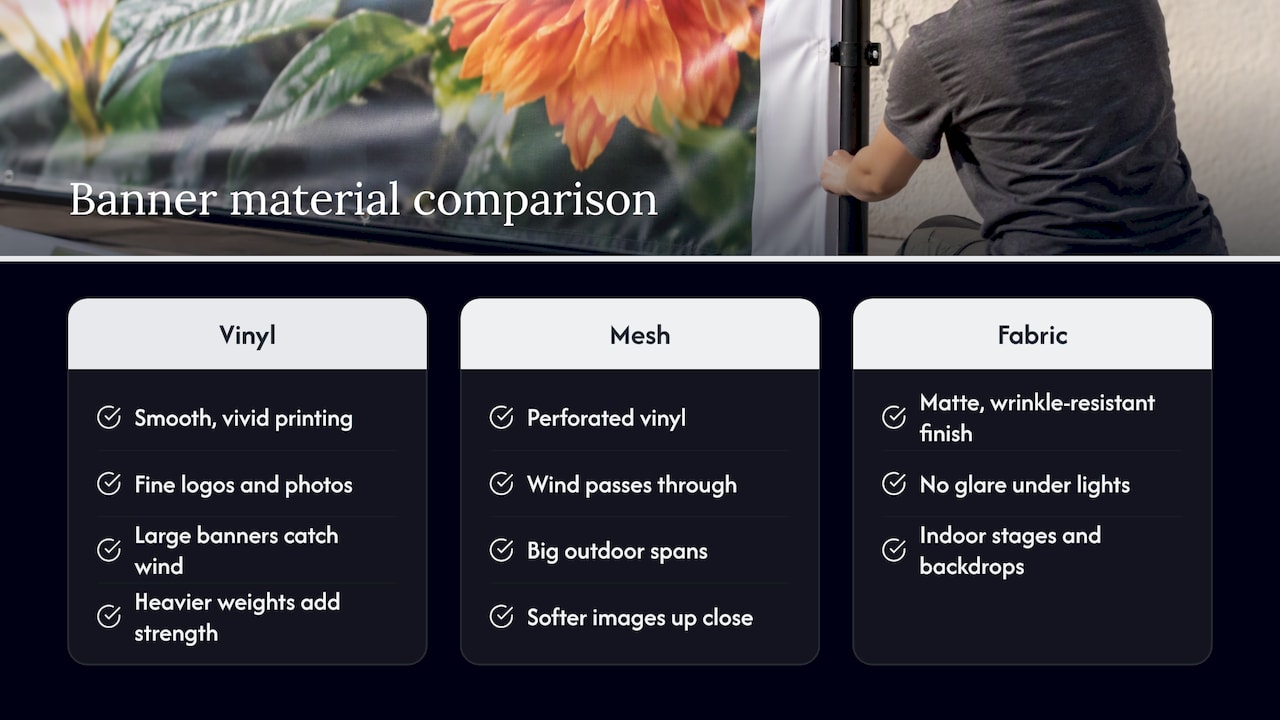
Fabric. A matte, wrinkle-resistant finish that suits indoor events, stages and photo backdrops, with no glare under lights.
Outdoor care. Sun and rain fade and wear materials over time. If your outdoor setup also includes powered lighting or screens, the cabling faces the same exposure, and UV-resistant outdoor installations deserve the same attention as the banner itself.
For deeper comparisons, read our guides to banner materials for local event organizers and what banners are made of.
Finishing and mounting
Finishing is where cheap banners fail first. Common options include grommets (metal rings along the edge for rope or ties), pole pockets (sleeves for hanging from a pole) and reinforced edges, as described in this banner guide. Ask for them when you order.
Mounting tips:
- Tie at every grommet, not only the corners. Loose spots flap and tear.
- Leave a few inches of slack in the ties so the banner does not strain in gusts.
- For fences, use zip ties or bungees and check the attachment point can take the load.
- Indoors, use hooks, tension rods or ceiling hangers rather than tape.
- Check venue rules before hanging. Some venues and municipalities limit temporary signs, and we can advise on compliance for your location.
Prepare your file for print
A good design can still print badly from a poor file. A print-ready banner guide recommends setting up files at the correct finished dimensions, using vector logos, using raster photos at 300 DPI at full size, and exporting a print-ready PDF or high-quality JPEG with fonts embedded or outlined.
A quick checklist:
- Set the file at the finished size, or a proportional scale if the file would be huge.
- Use vector logos (AI, EPS or SVG, or a PDF with vector artwork).
- Keep photos high resolution at the size they will print.
- Outline fonts or embed them.
- Keep important text away from the edges, since hems and grommets cover part of it.
- Approve a proof before printing, and check names, dates and spelling twice.
Our perspective
Most of the event banners that reach us have the same problem: too many ideas on one panel. A client sends a logo, a slogan, a schedule, three sponsors and a social handle, and wants it all visible from the parking lot. We usually start by asking one question: what is the one thing a stranger should know after two seconds?
Our process covers the whole job: consultation, design, fabrication and installation guidance, with certified installation available when a banner needs more than a few zip ties. We also pay attention to the environment. A banner for a breezy outdoor festival, a hotel ballroom and a school gym are three different products, even if the artwork is the same. That is why we ask where the banner will hang, how far away viewers will be and how many times you plan to reuse it before we recommend vinyl, mesh or fabric.
If you are comparing options, trust the simple test: print your design at a small scale, tape it to a wall, walk back to the real viewing distance and see whether you can still read it.
— Yossi
Get your event banner made
If you already know your event, size and date, send us the details and we will recommend the format, material and finishing. We produce custom banners, retractable stands, feather banners and mesh banners for businesses, real estate agents, event organizers and property managers, with design help included. Request a quote for event banners and tell us where it will hang. If you need directional or A-frame signs to go with it, see our custom signs.
FAQ
What size should an event banner be?
It depends on where people will stand. Measure the viewing distance, divide by 10 for a rough minimum headline letter height in inches, then choose a banner wide enough for your wording at that size. Common sizes are 3 x 8 ft and 4 x 10 ft for entrances and 2 x 6 ft for fences and indoor spaces.
Should I use vinyl or mesh for an outdoor event?
Choose vinyl when you want crisp graphics and the banner is in a sheltered or moderate spot. Choose mesh for large banners in open, windy areas, because air passes through it. Either way, ask for hems and grommets so the banner can be tied at multiple points.
Can I reuse an event banner?
Yes, if you leave off the date or print it so it can be covered, and you store the banner rolled or folded loosely in a dry place. A generic message such as the event name, your logo and a web address gives the most reuse. Reinforced edges help it survive repeated setup and takedown.
What can I use instead of a banner?
Options include A-frame signs, feather flags, retractable stands, window graphics, floor decals and posters. Banners are usually the best value for large, temporary messages. Smaller formats work better for directions, check-in points and indoor spaces.
Sources
- Venue ad readability: contrast, type size and distance
- Events signage standards
- Up To Date Festival 2019 identity
- Open M Art Fair 2025 design systems
- Banner finishing options
- How to make a banner: print and digital guide
- UV-resistant outdoor installations