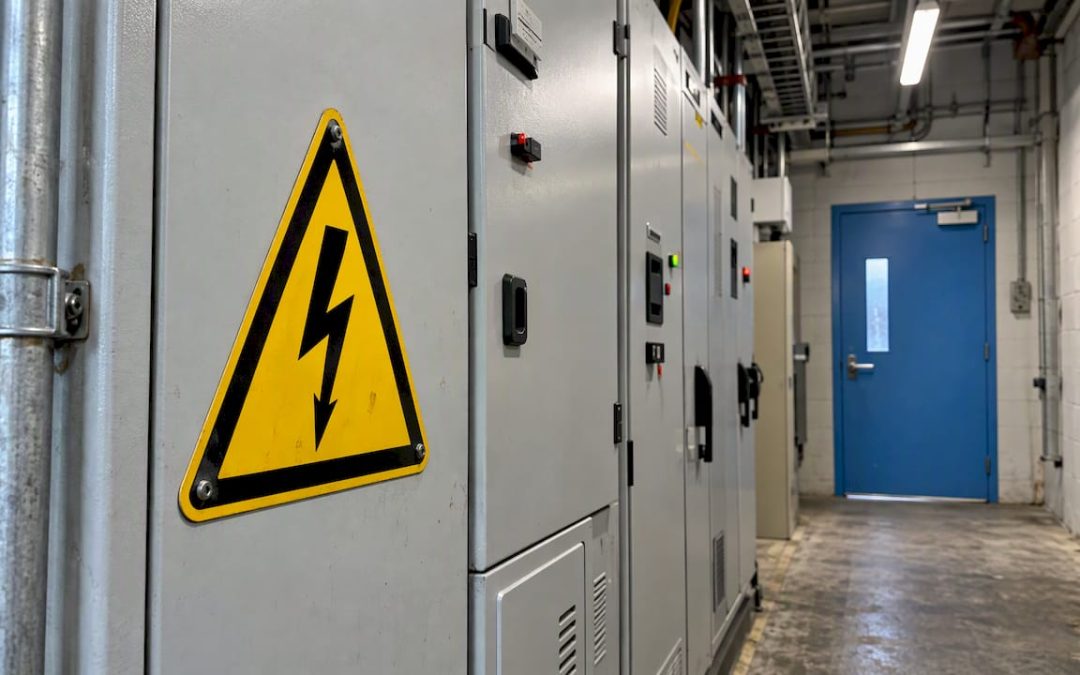
A yellow triangle with a black symbol is a warning sign. It tells people that a hazard is close, such as electricity, a chemical, a moving forklift or a drop, and that they should slow down, look and take precautions before going further. It does not forbid anything and it does not order anyone to do something. It says: be careful here, and here is why.
This guide explains what the shape and color mean, which hazards the sign typically names, what to do when you meet one, and where a business should post them. It also covers where US practice differs from the international triangle, because a sign that is correct in one country is not always the one an inspector expects in another.
TL;DR
- A yellow triangle with a black pictogram is a warning sign: it marks a hazard nearby and asks for caution, not a ban or an order.
- The triangle plus yellow plus a symbol work together. Read the pictogram or the words, not the color alone.
- Typical subjects include electricity, chemicals, radiation, overhead loads, vehicles, obstacles, drops and general danger.
- Signs cover leftover risk. They never replace guarding, safer design or training.
- In the US, OSHA’s caution signs are yellow, and ANSI’s safety alert symbol is a triangle with an exclamation mark, so check which standard your site follows.
Table of Contents
- What a yellow triangle tells you
- The US picture: triangles, rectangles and the word CAUTION
- What hazards yellow triangular signs identify
- What to do when you see one
- When a sign is the right control, and when it is not
- Where and how to post them
- A quick reference to the four color families
- Not to be confused with road signs
- Do meanings differ by country?
- Our perspective
- Need warning signs made for your site?
- FAQ
- Sources
What a yellow triangle tells you
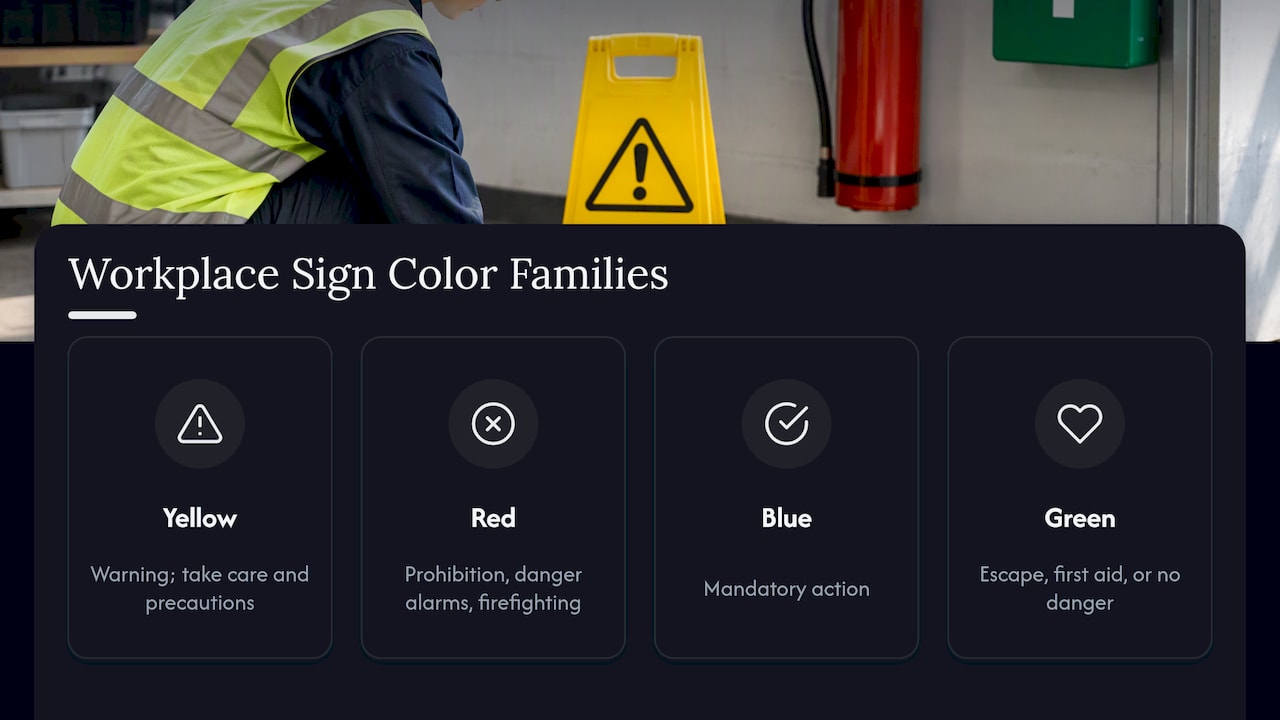
The standard color-and-shape language used in workplaces separates signs into families. In the guidance that the UK government publishes on the EU-derived rules, yellow or amber is the warning color, meaning people should be careful, take precautions and examine the situation. The same annex describes the other three colors: red for prohibition, danger alarms and firefighting equipment, blue for mandatory action, and green for emergency escape, first aid or no danger.
Shape carries meaning too. Ireland’s Health and Safety Authority summarizes the system as discs for prohibitions and instructions, triangles for warnings, and squares or rectangles for emergency and information signs. So a yellow triangle is read as “warning” twice over, by its color and by its outline.
The symbol inside it then names the hazard. A lightning bolt means electrical danger. A flame means flammable material. A skull and crossbones means toxic substances. The Irish authority presents color, shape and intended action as one coordinated visual language, so a reader should take in the whole sign rather than guessing from yellow alone.
How the sign is built
Under the UK government’s annex on signboard requirements, a warning sign is triangular, with a black pictogram on a yellow background and black edging, and yellow must cover at least 50% of the sign’s area. The UK Health and Safety Executive repeats that description: a warning of hazard or danger, in triangular form, with a black picture on a yellow background.
The annex also asks for simplicity. Pictograms should be as plain as possible and carry only essential detail. A variation is acceptable only when it conveys the same meaning without obscuring it. That is a useful test if you commission a custom sign: if a drawing of a machine looks impressive but takes three seconds to decode, it is the wrong drawing.
The US picture: triangles, rectangles and the word CAUTION
Here is where many American readers get confused. The triangle is the international standard shape for warning. In the United States, the older and still widely enforced OSHA rule for accident prevention signs looks different.
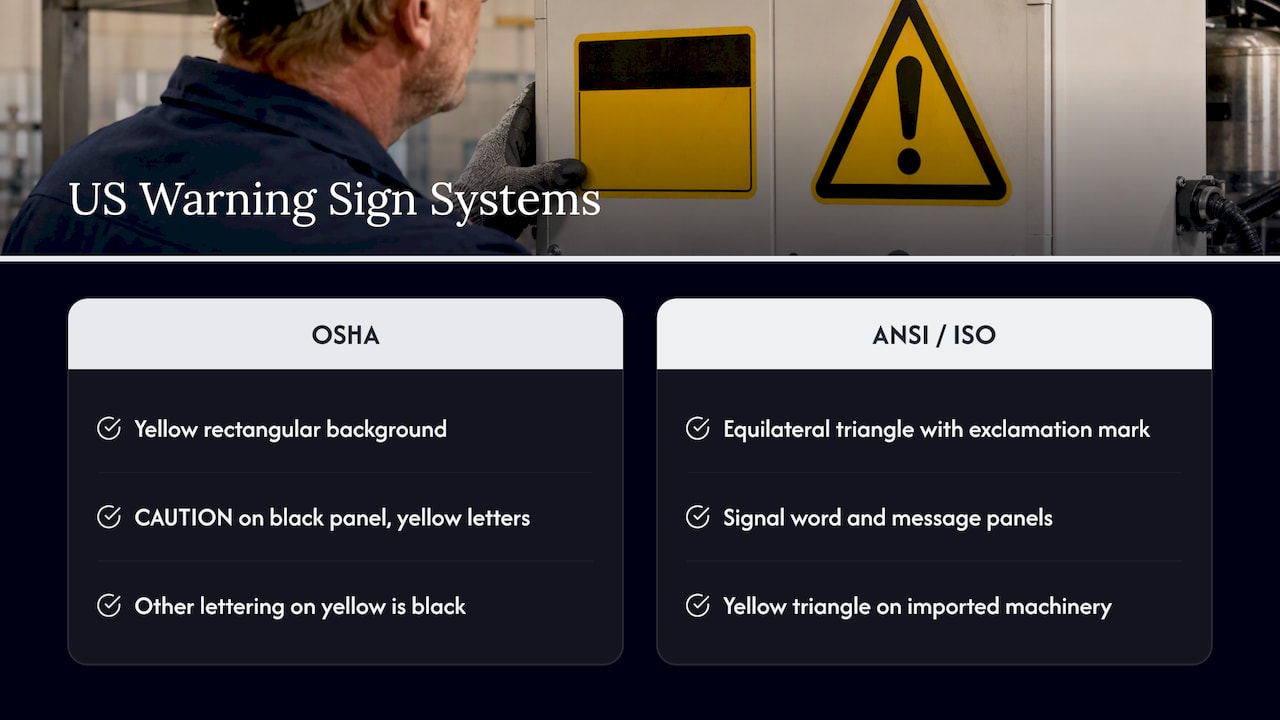
OSHA’s standard 1910.145 says that caution signs use a yellow background with a black panel and yellow letters for the signal word, and any other lettering on the yellow must be black. In practice that means the familiar rectangular yellow sign with the word CAUTION across the top. The same rule says employees must be instructed that danger signs indicate immediate danger and that special precautions are necessary.
The triangle shows up in US practice through ANSI. The ANSI Z535 family uses a safety alert symbol, and the ANSI blog describes it as an equilateral triangle with an exclamation mark used with a signal word panel and a message panel on product safety signs and labels. You will also see a yellow triangle with a black pictogram on imported machinery and on sites that follow ISO 7010 because they run international operations.
What this means for a facility manager: you may legitimately have several styles on the same property. Pick one system per area, keep it consistent, and confirm with your safety officer which standard your insurer, customers or corporate parent expects.
What hazards yellow triangular signs identify
The UK annex lists the subjects a warning sign is commonly used for. In plain terms, the list is:
- Flammable, explosive and oxidizing materials
- Toxic, corrosive, radioactive and biological substances
- Electricity
- Laser beams and other radiation, and strong magnetic fields
- Low temperatures
- Overhead and suspended loads
- Industrial vehicles
- Obstacles and drops
- General danger, shown as an exclamation mark
Source for the list: the UK government’s signboard annex.
The same annex adds a limit worth knowing. The general-danger symbol must not be used to flag hazardous chemicals or mixtures, except under the specific exception in the chemical-labeling rules. For chemicals, use the proper hazard communication labels and a specific pictogram, not a generic exclamation mark.
Everyday examples
Outside heavy industry, the same sign family covers things you see daily:
- Wet floor: a figure slipping, usually placed on a temporary stand after mopping.
- High voltage: a lightning bolt on electrical rooms, panels and transformers.
- Forklift traffic: a truck pictogram at warehouse aisle crossings and loading docks.
- Overhead hazard: a suspended load symbol under cranes and hoists.
- Step or drop: a falling figure at a mezzanine edge, loading dock or open pit.
- Cold storage: a snowflake at freezer doors.
A wet floor stand is a temporary warning. A high-voltage plate on an electrical cabinet is permanent. Both are yellow triangles in the international system, and the difference is how long the hazard lasts.
What to do when you see one
The sign is shorthand for a decision you need to make in a few seconds. A practical routine:
- Stop and read. Identify the pictogram and any text. If you cannot tell what it means, ask before entering.
- Look for the hazard. The sign points at something real nearby. Find it: the wet patch, the panel, the vehicle route.
- Slow down and adjust. Walk, don’t rush. Keep your distance from the hazard, and keep your hands and tools clear.
- Check for companion signs. A blue sign nearby may require protective equipment. A red sign may prohibit entry.
- Report problems. If a sign is faded, blocked or contradicts what you see, tell a supervisor. A missing or unreadable sign leaves people with no warning at all.
The EU-OSHA summary of Directive 92/58/EEC makes the training side clear: employers must inform and instruct workers about the meaning of the signs and the behavior they require. A sign nobody has been taught to read only works for people who already know the symbol. In the US, OSHA’s rule has the same logic for danger signs, as quoted above.
When a sign is the right control, and when it is not
A yellow triangle is the last layer, not the first. The UK HSE’s guidance on safety signs states that signs are not substitutes for engineering controls, safe systems of work or other risk-control measures. They warn about the risk that remains, or tell people what measures that risk requires.
The same guidance says an employer must provide and maintain signs where a significant risk remains after other controls and where a sign can reduce it further. It also says the workplace risk assessment should drive when and where signs go. And the EU-OSHA summary says employers must provide signs where significant hazards remain despite preventive measures.
The sensible order is:
- Eliminate the hazard if you can.
- Guard, isolate or redesign if you cannot.
- Train and set safe procedures.
- Post a sign for what is left.
If a dock edge has no rail and the answer is a yellow triangle, the answer is wrong. Build the rail, then add the sign.
Where and how to post them
Placement determines whether the sign works. The UK annex gives requirements that translate well to any facility:
- Height and position: put the sign at a suitable height and position for the line of sight, allowing for obstacles.
- Location: mark general hazards at the access points to an area, or close to the hazardous object.
- Visibility: the sign must be clearly visible and understandable, and lit if natural light is poor.
- Durability: use materials that suit the environment and the conditions.
- Removal: take the sign down when the situation it addresses no longer exists.
All of these come from the UK government’s signboard requirements. The last point is the one most often missed. A sign for a hazard that has gone teaches people to ignore signs.
Material choices for indoor and outdoor use
A freezer door, a loading dock and a warehouse aisle all age signs differently. Sun fades yellow quickly, forklifts scratch low signs, and washdowns lift weak adhesives. When you order, tell the maker where the sign will live: indoors or out, wet or dry, how close to traffic, how far people must read it from. Those answers decide the substrate, the print method and the laminate. Our guides on workplace safety signs for compliance and the sign types facilities need go deeper on the full set.
A quick reference to the four color families
| Color | Typical shape | Meaning | Example |
|---|---|---|---|
| Red | Circle with slash, or fire equipment | Prohibition, danger alarm, firefighting | No smoking |
| Yellow or amber | Triangle | Warning, take care | Electrical hazard |
| Blue | Circle | Mandatory action | Wear eye protection |
| Green | Square or rectangle | Escape route, first aid, safe condition | Exit |
The colors and meanings follow the UK government’s color definitions and the Irish authority’s shape summary. For the green family, see our page on safe condition signs. For red hazard styling, see how a hazard sign looks.
Not to be confused with road signs
A yellow sign on the road is a different system. US drivers’ manuals describe roadway warning signs as usually diamond-shaped with black symbols or words on yellow. Pennsylvania’s official manual says they are posted before a condition so drivers can respond, slow down or change path. A triangle on the road means something else entirely: Georgia’s driver guidance says a triangle sign means yield, so drivers slow, stop if necessary and give right-of-way.
So if your property has a private road, parking lot or yard, do not borrow workplace triangles for traffic control. Use signs that match the road conventions your drivers already know.
Do meanings differ by country?
The core idea is shared: yellow means caution. The details are not. EU-OSHA says Directive 92/58/EEC sets minimum workplace requirements and notes that the European Commission issued non-binding guidance in January 2022 on how the directive relates to EN ISO 7010. The UK and Ireland publish their own versions of the rules. The US relies on OSHA’s rule and ANSI’s voluntary standards.
If you run a multi-country operation, or ship equipment abroad, ask which standard applies where the sign will hang. When in doubt, a sign that carries both a pictogram and a short text message in the local language is the safest bet.
Our perspective
We see the same mistake across many facilities: signs are treated as decoration or as a box to tick. A manager orders a stack of yellow signs, hangs them where there is wall space and considers the job done. Then a visitor walks past a pallet jack lane that was never marked, because the sign sits by the break room.
Our approach starts with the walk-through. We look at where people enter an area, where they pause, what they can see from there and what lighting and surfaces are around. Then we choose the sign to match: the standard, the size, the material and the mounting. A warning sign on a freezer door, a chemical store and a loading dock should not be the same sign in three places.
We also push back on too many signs. Twenty yellow triangles in one corridor teach nobody anything. We would rather you post fewer signs, in the right spots, each with a clear pictogram, and keep them clean and current. If your risk assessment changes, the signs should change with it.
For managers building a plan, we have laid out the mandatory signs checklist and the OSHA rules facility managers should check, so you can see what your site needs before you order.
— Yossi
Need warning signs made for your site?
We design and fabricate custom signs for businesses, property managers and facility teams, with control over size, materials and design, plus installation guidance and compliance consulting for indoor and outdoor needs. If you need warning signs that fit your building and survive its conditions, start with our custom signs page and send a quote request. For signs inside buildings, see our interior signs, and for weather-exposed locations, our exterior signs.

Bring your floor plan or a few photos of the areas in question, and tell us what hazards you need to mark. We will talk through sizes, materials and placement with you before anything is produced.
FAQ
What are yellow triangular safety signs used for?
They warn people of a hazard nearby, such as electricity, chemicals, moving vehicles, overhead loads or a drop. The yellow color asks for caution and the black pictogram names the danger. They are used where a risk remains after other controls have been applied.
What does the yellow color mean on a safety sign?
Yellow or amber is the warning color. It means be careful, take precautions and examine the situation. It is different from red, which prohibits or marks danger and fire equipment, from blue, which requires an action, and from green, which marks exits, first aid and safe conditions.
Are yellow triangle signs required by OSHA?
OSHA’s rule 1910.145 specifies yellow caution signs with black and yellow lettering, usually rectangular with a signal word. The triangle with a pictogram comes from international (ISO and EU-style) practice, and ANSI uses a triangular safety alert symbol on product safety signs. Which one your site needs depends on your standards, your equipment and your safety officer’s advice.
Can a sign replace a guard or a safety procedure?
No. Official UK guidance says signs are not substitutes for engineering controls or safe systems of work. A sign covers what remains after those measures, and workers need to be trained on what it means.
How many yellow signs should a facility post?
Only as many as the risk assessment calls for. Post signs at access points or next to the hazard, keep them readable, and remove them when the hazard is gone. Too many signs weaken each one.
Sources
- Directive 92/58/EEC, safety and/or health signs (EU-OSHA)
- Safety signs and signals guidance L64 (UK HSE)
- Annex 1 to Council Directive 92/58/EC (UK government)
- Annex 2: minimum requirements for signboards (UK government)
- Safety signs (UK HSE)
- Safety Signs (Health and Safety Authority, Ireland)
- OSHA 1910.145, specifications for accident prevention signs and tags
- ANSI Z535.4-2023 product safety signs and labels (ANSI Blog)
- Pennsylvania Driver’s Manual, Chapter 2: Signs
- Georgia Department of Driver Services, Section 7