For most couples, ordering a small set of custom directional signs is the fastest way to guarantee legibility, weather durability, and a look that matches the rest of the day. Ready-made packs work in a pinch, but a custom order gets you the exact wording, size, and finish your venue needs. Start now: count your venue’s decision points (parking, forks, entrances, restrooms), then pick materials based on indoor versus outdoor exposure. Do this early because legibility problems and flimsy anchoring are the two most common wedding-day sign failures.
Key Takeaways
Directional wedding signage works best when couples pick materials for their venue’s weather exposure, order 5 to 10 signs placed at every decision point, and hand vendors a complete brief with wording, sizes, and color codes locked in early.
| Point | Details |
|---|---|
| Choose your route | Pick custom signs for cohesive style and durability; use ready-made packs only for tight timelines or budgets. |
| Follow the ten-foot rule | Size letters at roughly one inch per ten feet of viewing distance so signs read from a distance. |
| Order the right count | Plan for 5 to 10 signs total, with 8 to 12 for larger or multi-building venues. |
| Place signs at decision points | Put arrows at curbs, road forks, and interior splits, never after a guest has already turned. |
| Work with Customsignstoday | Get durable outdoor materials, custom sizing, and a digital proof through one vendor before production starts. |
Table of Contents
- Ready-Made Packs vs. Custom Directional Signs
- What Should a Directional Sign Actually Say?
- Which Materials Hold Up Outdoors and Indoors?
- How Many Directional Signs Do You Actually Need?
- What to Tell Your Sign Vendor Before You Order
- Popular Styles That Match Your Wedding Decor
- Coordinating Directional Signs With Your Other Signage
- What Can You Actually Customize When Ordering?
- How to Pick the Right Sign Vendor
- Return, Cancellation, and Revision Policies to Check
- A Planner’s Take on Signage and Guest Experience
- Let Custom Signs Today Handle Your Wedding Signage
- Frequently Asked Questions
- Sources
Ready-Made Packs vs. Custom Directional Signs
Ready-made means pre-printed “This Way” arrows you order online and receive within days. Custom means you specify size, font, color, and material, and a sign shop builds it to match your day. Both routes solve the same problem: pre-printed packs are fast and cheap but limited in material and finish choices.
Ready-made packs:
- Lower upfront cost, often ready to ship same week
- Fixed wording and generic fonts, little to no color matching
- Usually thin cardstock or basic acrylic, not built for wind or rain
- Minimal mounting hardware included, often just an easel back
Custom directional signs:
- Higher cost but full control over size, shape, and finish
- Matches invitation fonts, wedding colors, and venue style
- Built from durable, often weatherproof materials
- Mounting options tailored to your ground type and wind exposure
Choose ready-made when your timeline is under two weeks or your budget is tight. Choose custom when you want a cohesive look, have an outdoor venue with real weather risk, or want to keep the signs as a keepsake afterward.
Pro Tip: If you’re torn, order one custom “hero” sign for the entrance and fill in secondary directional needs with simpler ready-made arrows. Nobody photographs the parking sign.
What Should a Directional Sign Actually Say?
Keep wording blunt. Standard messages that cover almost every venue: Ceremony, Reception, Parking, Restrooms, Shuttle Pickup, Bar, and Gift Drop. One arrow, one destination. Do not combine “Reception & Restrooms” on a single sign with two arrows pointing different directions. Guests read signs at a glance, often while walking or driving, so clutter defeats the purpose.
Design rules that matter more than aesthetics:
- One message per sign, one arrow per message
- High contrast text (dark ink on light background, or reverse)
- Arrows sized large enough to see from a car window
- Simple, bold fonts, no thin script for anything read at a distance
- Minimal words: “Reception →” beats “Please continue to the reception this way”
For sizing, the ten-foot rule is your baseline: about one inch of letter height for every ten feet of viewing distance. A sign read from a car needs much bigger lettering than a table card read from three feet away.
Pro Tip: Print a full-size paper mockup and tape it up at the actual viewing distance, then check it again at dusk. Text that looks fine on a screen often disappears in low light.
Which Materials Hold Up Outdoors and Indoors?
Material choice depends almost entirely on where the sign lives and for how long. A sign propped in a lobby for six hours has different needs than one staked into a lawn from noon through sunset.
Material options:
- Sealed wood — classic look, good for rustic or garden weddings, needs a weather sealant if left outside past a few hours
- Acrylic — clean and modern, holds color well, resists moisture better than wood or paper
- Laminated prints — budget-friendly, works for short outdoor exposure with a laminate layer against light rain
- Coroplast — lightweight corrugated plastic, common for lawn signs, holds up in wind when properly staked
- PVC — rigid and fully weatherproof, best for all-day outdoor use in unpredictable climates
Steps for outdoor-proofing any sign:
- Seal wood or paper surfaces before the event, not the morning of
- Use UV-stable inks so colors don’t fade in direct sun over a multi-hour event
- Laminate or coat any paper element exposed to dew or rain
- Reinforce edges and corners, which are the first place wind damage shows up
For mounting, match the anchor to the ground. Stakes work in soft lawn, weighted bases or sandbags handle patios and hard surfaces, and easels suit indoor or covered spaces. On windy sites, skip lightweight easels entirely. For evening signage, battery-powered LED spotlights or fairy lights strung around a frame keep signs readable well after sunset, a detail couples frequently forget until it’s dark and guests are squinting at a reception sign. Check weatherproofing techniques before finalizing your material list, especially for outdoor ceremonies in humid or coastal climates.
How Many Directional Signs Do You Actually Need?
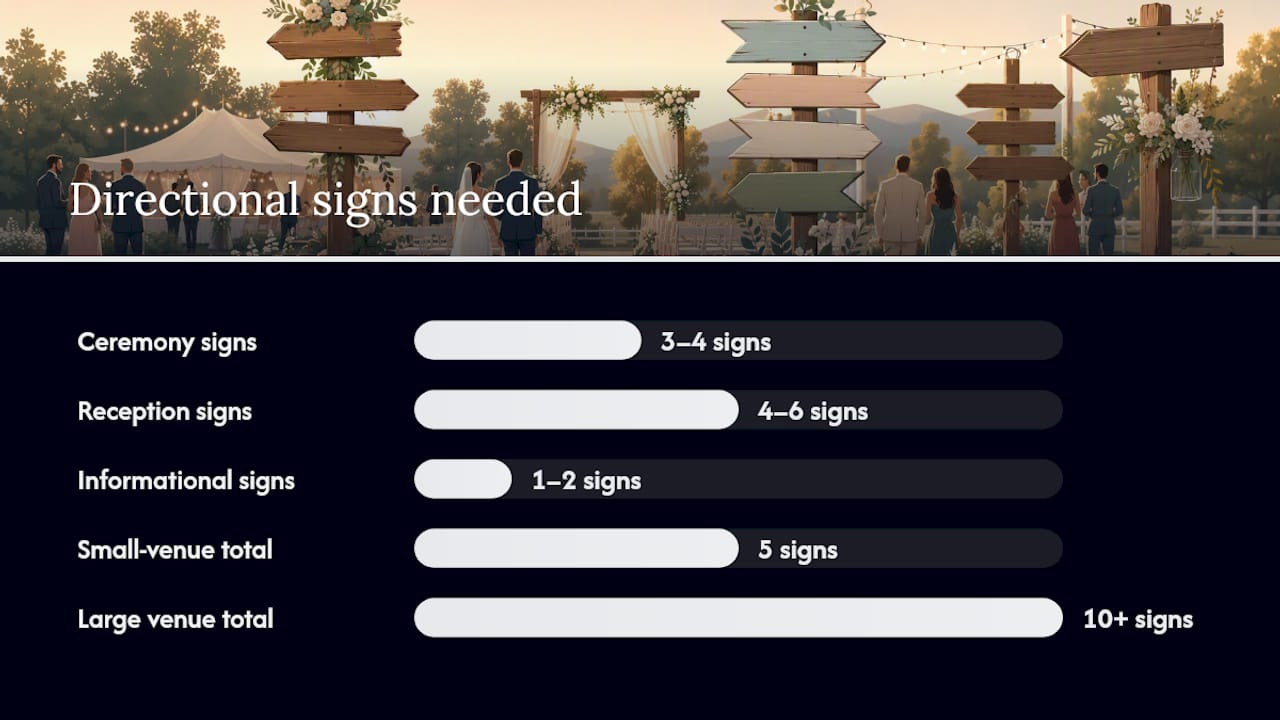
Most weddings need 5 to 10 signs total, with larger venues or multi-building layouts often requiring 8 to 12. The typical breakdown runs 3 to 4 signs for the ceremony area, 4 to 6 for the reception, and 1 to 2 purely informational signs like restrooms or coat check. If your venue spans a long driveway or multiple structures, lean toward the higher end.
Wayfinding should start at the curb, not at the reception hall. Guests get lost before they ever park, so the first sign belongs at the road fork where guests would otherwise guess which way to turn.
Walk your venue in this order:
- Road entrance or fork where guests could take a wrong turn
- Parking area, clearly marked separate from vendor or staff parking
- Drop-off zone for guests being dropped off rather than parking themselves
- Shuttle pickup or drop-off point, if applicable
- Main building entrance or ceremony arrival point
- Any fork inside the venue: hallway splits, multiple doors, or stairwells
- Restroom locations, especially if tucked down a side hallway
- Bar and gift drop, usually near the reception entrance
- Shuttle return or after-party departure point, if guests need direction leaving
Placement rules matter as much as the count. Signs belong at decision points, not after them — a sign placed after a guest has already turned the wrong way is useless. Keep signs out of direct glare where sun or stage lighting washes out the text, and put welcome signs and seating charts where guests can pause and read without blocking the flow of foot traffic behind them.
By the numbers: a venue hosting under 100 guests in a single building typically needs the lower end of that 5 to 10 range, while a property with separate ceremony and reception spaces, on-site parking, and a shuttle service should plan for 10 or more. Bar signs, parking signs, and directional arrows are consistently rated as highly recommended rather than optional once guest count or venue footprint grows.
Checklist to walk before ordering: entrance and road fork, parking and drop-off, building entrance, interior forks, restrooms, bar, gift table, shuttle points, and exit or after-party direction. Miss one of these and you’ll be answering the same question from six different guests during cocktail hour.
What to Tell Your Sign Vendor Before You Order
A clean brief saves a revision round. Give your vendor these details up front rather than waiting for them to ask:
- Final wording for every sign, confirmed and spell-checked
- Font choice or files, matched to your invitation suite if possible
- Exact color codes (HEX or Pantone), not just “sage green”
- Precise sizes for each sign, based on your viewing-distance calculations
- Mounting notes: stake, easel, weighted base, or wall-mount
- Site photos so the vendor understands installation context, especially for uneven ground or tight corners
Work backward from your wedding date. Finalize your sign list 3 to 4 months out, place the order around the two-month mark, lock in any seating-related signs 3 to 4 weeks before, and do a final proof review one week out. Hand-lettered or specialty-finish signs need more lead time than standard printed ones, so flag that early if you’re going that route.
Before committing to a vendor, ask about their proof policy, shipping and installation support, and what happens if you need a revision after approval. Watch for red flags: no digital proof offered before production, vague answers about material specs, missing or suspiciously thin reviews, or a lead time that sounds too fast to be real for custom work.
Pro Tip: Ask for a digital proof at actual scale, not just a thumbnail. A sign that looks perfect at 4 inches on your phone can read completely differently at 24 inches on an easel.
Popular Styles That Match Your Wedding Decor
Directional signs read as decor whether you plan for it or not, so matching them to your theme pays off. Rustic weddings lean on sealed wood with painted or burned lettering and simple arrow icons. Modern or minimalist weddings favor acrylic with clean sans-serif type and monochrome color schemes, often just black or white ink on a clear panel.
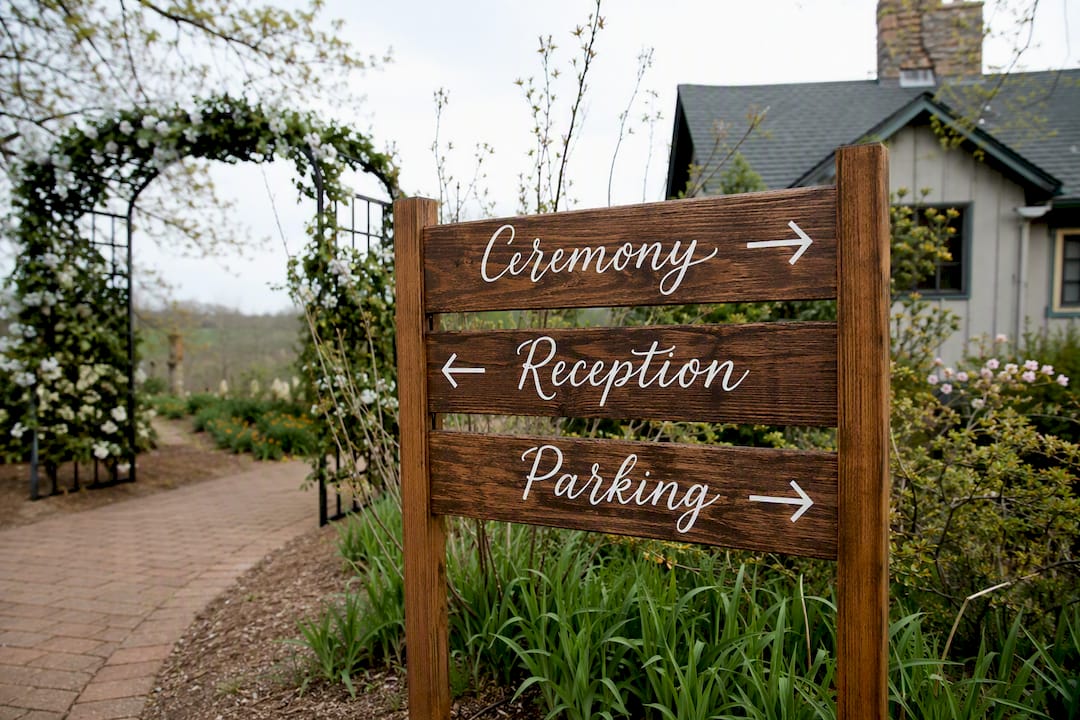
Garden and outdoor weddings often use vintage directional signs as a design choice, not just a practical one: aged wood, hand-painted arrows, and mismatched finials on wooden stakes give a wandering-path feel that suits a vineyard or backyard setting. Coastal or beach weddings tend toward whitewashed wood or PVC in soft blues and sandy neutrals, built to survive humidity and salt air.
Formal or black-tie weddings usually go with acrylic or laminated signs in gold or silver foil lettering, mounted on slim metal stakes or freestanding frames rather than rustic easels. Bohemian weddings mix materials freely: macrame-wrapped stands, dried florals attached to sign frames, and hand-lettered calligraphy on mixed wood tones.
Whatever the theme, the goal is consistency across every sign a guest sees that day, not just the one at the entrance. A gold-foil welcome sign next to a cardboard “Parking This Way” arrow looks like an afterthought, even if the wording is perfectly clear. Pick one material family and one type style, then apply it across the full set.
Coordinating Directional Signs With Your Other Signage
Directional signs shouldn’t look like they came from a different order than your welcome sign or seating chart, even when they technically serve a different function. Guests notice visual inconsistency more than they notice good design, so mismatched signage stands out in a bad way.
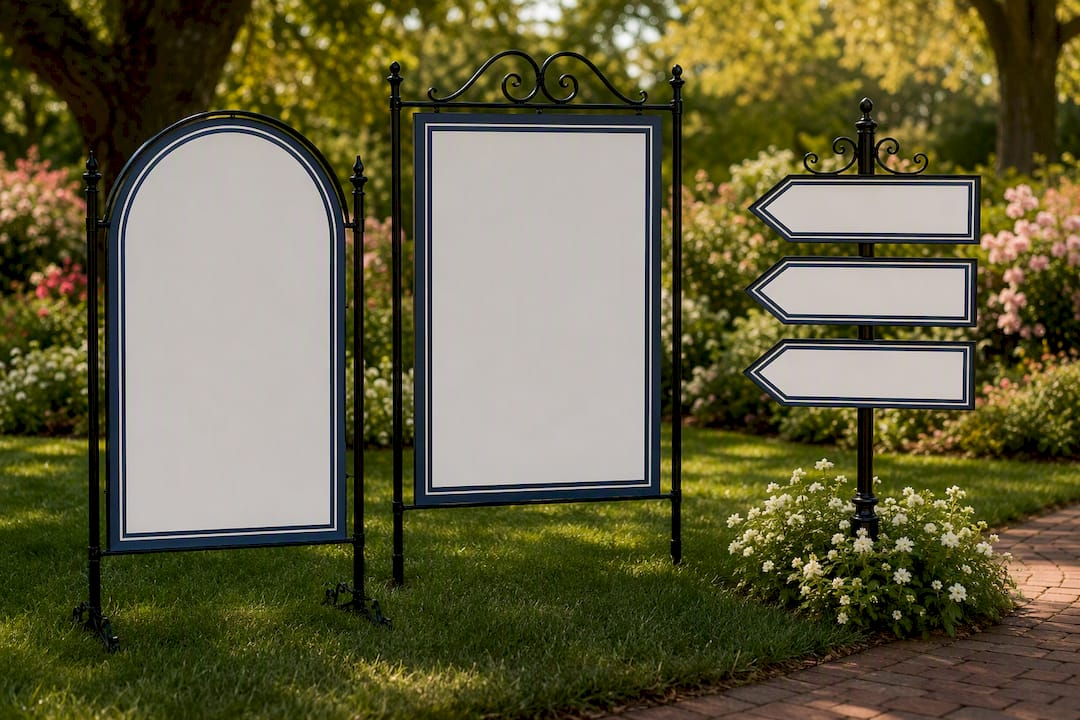
Start with a shared type system. Use the same one or two fonts across your welcome sign, seating chart, menu cards, and directional arrows. If your welcome sign uses a serif script for the headline, carry that same script into directional headers, even if the body text underneath switches to a simpler sans-serif for legibility.
Color consistency matters just as much. Pick a base palette, usually two to three colors pulled from your invitations or florals, and apply it uniformly. A navy and gold welcome sign paired with black-and-white parking arrows breaks the visual thread the moment a guest walks from the entrance to the lot.
Material matching helps too, though it’s less strict than font and color. You don’t need every sign built from identical acrylic, but keeping a consistent finish, matte versus glossy, wood-toned versus painted white, ties the set together even when sizes vary. A sign shop working from one brief across your full order, rather than piecing together signs from multiple vendors, makes this consistency far easier to pull off, since the same fonts and color files carry through every piece.
What Can You Actually Customize When Ordering?
Custom sign vendors typically offer more flexibility than most couples expect going in. Font choice is usually open-ended: many shops can match a specific typeface from your invitation suite or suggest a close alternative if the exact font isn’t licensed for print.
Color customization runs on HEX or Pantone codes rather than vague descriptions, which matters because “blush pink” means something different to every printer. Locking in a code before you order removes that guesswork entirely.
Material and finish options usually include the choices already covered: sealed wood, acrylic, coroplast, PVC, and laminated prints, each available in different thicknesses and edge finishes. Some vendors also offer specialty touches like foil lettering, engraved wood, or frosted acrylic panels for a higher-end look.
Size customization is where custom orders earn their cost over ready-made packs. You’re not stuck with a generic 11×14 arrow; you can size each sign to its actual viewing distance, which ties directly back to the ten-foot rule for legibility. A directional door sign at an interior hallway fork needs different proportions than a parking sign read from a moving car, and a vendor working from your full brief can size each one correctly rather than forcing one dimension to fit every use case.
How to Pick the Right Sign Vendor
Reviews tell you more than a portfolio does. A vendor with a large body of five-star photos but thin or generic reviews often means the photography is stronger than the follow-through. Look for reviews that mention specific things: on-time delivery, accurate color matching, and responsiveness when a couple needed a last-minute change.
Turnaround time needs to be realistic, not just fast. A vendor promising a fully custom, multi-sign order in 72 hours is either padding their timeline claims or cutting corners on proofing. Cross-reference their stated turnaround against the 3 to 4 month planning window recommended for signage generally; a legitimate custom order usually needs weeks, not days, once you include proofing and revisions.
Pricing structure matters as much as the final number. Ask whether quotes include proofs, revisions, and shipping, or whether those are billed separately after the fact. A transparent quoting process that spells out what’s included upfront saves you from surprise add-on charges two weeks before your wedding.
Material specs should be spelled out clearly, not described in marketing language. “Weatherproof” without a material name attached tells you nothing; “sealed birch plywood” or “3mm PVC with UV-stable ink” tells you exactly what you’re getting. If a vendor can’t name their materials specifically when asked, that’s worth treating as a warning sign rather than an oversight.
Return, Cancellation, and Revision Policies to Check
Custom signs are, by definition, made specifically for your order, which changes how returns typically work compared to off-the-shelf products. Most custom sign vendors don’t offer full refunds once production starts, since the materials are already cut and printed to your exact specs.
What you should confirm before ordering is the revision policy, not the return policy. Ask how many rounds of proof revisions are included before extra charges kick in, and get a clear answer on turnaround time for each revision round. A vendor who allows unlimited revisions but takes a week to turn around each one isn’t actually offering flexibility.
Cancellation terms usually hinge on timing. Canceling before a proof is approved and production begins is far more likely to get you a partial or full refund than canceling after the sign has been printed and cut. Get this in writing, ideally in an email or order confirmation, rather than relying on a verbal promise.
If a mistake happens on the vendor’s end, misspelled wording, wrong color, wrong size, a reputable shop will typically reprint at no charge rather than debate the error. If the mistake originated from information you provided (a typo in your approved proof, for example), expect to pay for the reprint. This is exactly why a careful, detailed vendor brief matters so much before production starts: it protects both sides and keeps the process moving instead of stalling in a dispute over who approved what.
A Planner’s Take on Signage and Guest Experience
Good directional signage is one of the few wedding details that actively prevents problems instead of just looking nice, since clear wayfinding measurably reduces guest confusion and cuts down on staff interruptions during a day when nobody wants to be answering “where’s parking” for the tenth time. Test every sign at its real viewing distance and in evening light, and assign one person, not the couple, to handle setup so it’s done before guests arrive.
Let Custom Signs Today Handle Your Wedding Signage
Ordering directional signs shouldn’t mean juggling three different vendors for wood, acrylic, and printing. Customsignstoday builds custom sizing, durable outdoor materials, and digital proofs into one order, so your parking arrow, ceremony sign, and reception marker all come from the same brief and match each other exactly.
Requesting a quote is straightforward: send your wording, preferred sizes, color codes, and a few site photos of your venue, and you’ll get a proof to review before anything goes into production. Our directional signs page walks through sizing and material options, and our quote guide explains exactly what to include so your first proof is close to final. Lead times run in line with standard custom sign production, and every order includes a proof review before printing starts, so there are no surprises when your signs arrive. Ready to start? Request your quote today and get your wedding signage locked in well before your final walkthrough.
Frequently Asked Questions
How many directional signs do I need for a wedding?
Most weddings need 5 to 10 signs total, broken down roughly as 3 to 4 for the ceremony, 4 to 6 for the reception, and 1 to 2 informational signs like restrooms. Larger venues with separate buildings or on-site parking often need 8 to 12.
What’s the best material for outdoor wedding directional signs?
PVC and acrylic hold up best across a full day of sun and possible rain, while sealed wood works well for shorter exposure with proper weatherproofing. Coroplast is a solid budget option for lawn signs staked into soft ground.
Should I buy pre-made signs or order custom ones?
Order custom if you want matched fonts, colors, and durable materials, or if your venue has unusual layout needs. Pre-made packs make sense only when your timeline is under two weeks or your budget is very tight.
How far in advance should I order wedding directional signs?
Finalize your sign list 3 to 4 months before the wedding and place your order around the two-month mark, giving room for proofing and any revisions before your final walkthrough.
What should I tell a sign vendor when placing an order?
Give them final wording, font preference, exact color codes, precise sizes based on viewing distance, mounting notes, and site photos so they understand your venue’s layout before installation.
Sources
- Wedding Signs – The Knot
- How to Choose Wedding Signage: A Practical Guide for Style, Readability, and Guest Flow – Sortra
- Wedding Signage Checklist: Every Sign You Need and Exactly Where to Put It – Love & Lavender
- Wedding Calligraphy & Signage: A Complete Planning Guide | Plan A Wedding
- Wedding Signs: The Complete Guide to Every Type and Display Option – Paperlust