TL;DR:
- Effective trade show signage enhances visibility, clarity, and interactivity to attract foot traffic.
- Sign types like banner stands, digital displays, and logo mats are proven to increase engagement and leads.
- Strategic planning, measurement, and brand consistency are essential for maximizing signage impact and ROI.
Trade shows pack dozens or even hundreds of competing booths into a single space, and every exhibitor wants the same thing: foot traffic. The difference between a crowded booth and an empty one often comes down to one factor you can control before the event even starts: your signage. Eye-catching displays drive traffic, with 48% of exhibitors agreeing that visual impact is their top tool, and experiential or digital signage consistently boosts engagement beyond static alternatives. This guide walks you through how to evaluate, choose, compare, and plan trade show signs that actually move the needle on leads and visibility.
Table of Contents
- How to assess effective trade show signage
- Top types of trade show signs that deliver results
- Comparing signage options: What suits your booth best?
- Tailoring your signage strategy for maximum impact
- Our perspective: The real secret to trade show signage success
- Discover custom signage solutions for your next trade show
- Frequently asked questions
Key Takeaways
| Point | Details |
|---|---|
| Criteria matter most | Evaluate signs based on visibility, messaging, interactivity, budget, and measurable ROI. |
| Proven sign types | Banner stands, digital displays, and logo mats consistently drive trade show success. |
| Plan for results | Allocating 18% of marketing spend and using QR tracking increases engagement and leads. |
| Comparison enables clarity | Summarizing features and performance helps pick the best signage for each booth. |
| Custom solutions win | Tailored signage strategies and smart combinations deliver maximum impact. |
How to assess effective trade show signage
Now that you know signage makes a critical difference, here’s what makes a trade show sign truly effective. Not all signs are created equal. You need a clear framework for judging which options will perform before you spend a single dollar.
Visibility is the starting point. A sign that blends into the background is useless, no matter how beautiful the design. Consider placement at multiple heights, use of high-contrast color combinations, and supplemental lighting to make your booth unmissable from 30 feet away. Warm or cool accent lighting on a banner can increase viewing distance by a significant margin.
Messaging clarity and brand alignment come next. Your sign should communicate your core value proposition in five seconds or less. That means a clear headline, minimal copy, and visuals that reinforce your brand identity. A cluttered sign is a missed opportunity. Every element should serve a purpose, and everything else should be cut.
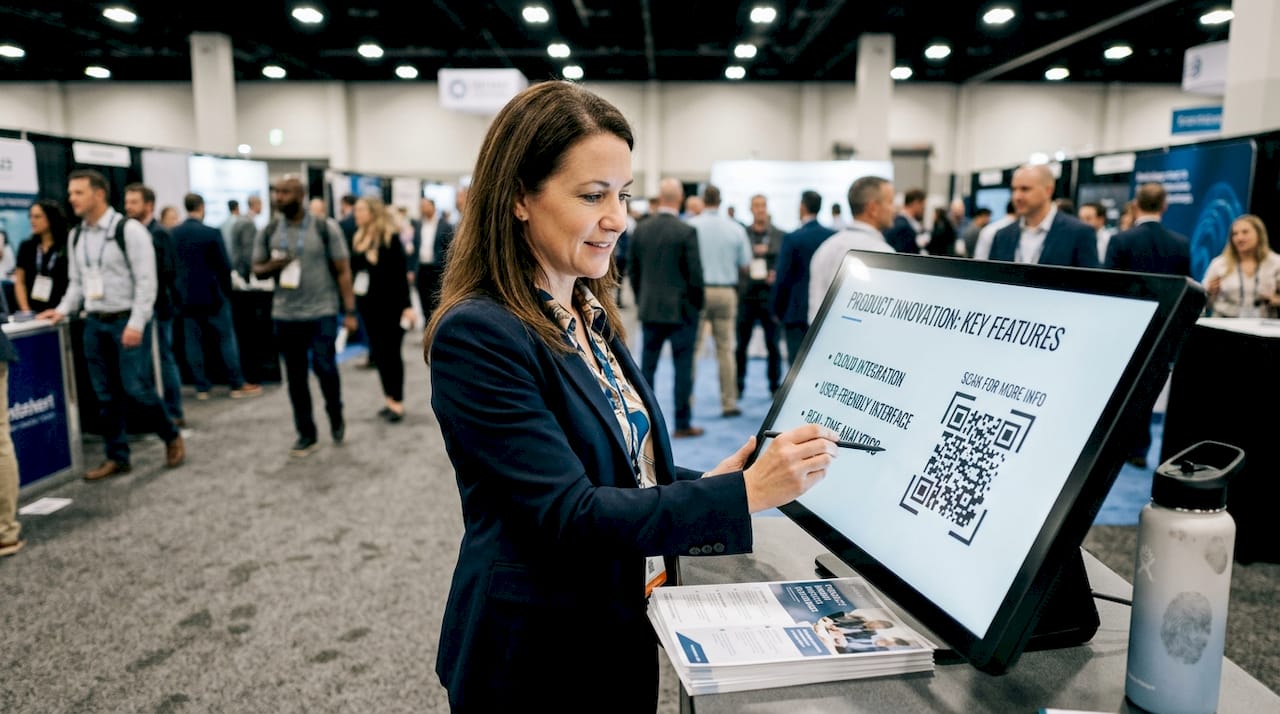
Interactivity is the newer dimension most exhibitors underestimate. Digital screens with rotating content and QR codes tied to landing pages let you track exactly who engaged and when. This turns a passive display into an active data source.
Budgeting and ROI measurement tie everything together. Following the guidance in this event signage design guide can help you allocate resources strategically. Industry benchmarks show that experiential signage at 35% of your booth budget yields measurably higher engagement, and pairing that investment with QR tracking lets you measure dwell time, lead volume, and post-event conversion.
Here’s a quick checklist of what to evaluate before committing to any sign:
- Visibility: Can it be seen from at least 20 to 30 feet away?
- Clarity: Does it communicate one main idea instantly?
- Brand fit: Does it match your colors, fonts, and tone?
- Interactivity: Does it include a trackable element like a QR code?
- Durability: Is it built for repeated use and transport?
- ROI mechanism: How will you measure its performance?
Pro Tip: Set up a QR code that points to a unique landing page for each event. This makes it simple to isolate which show drove the most traffic and leads without guessing.
“The best trade show signs don’t just look good. They do a job: attract, communicate, and convert. Measure each one of those outcomes.”
Pairing your evaluation process with these business signage design tips ensures you’re not just picking what looks impressive but what performs under real show-floor conditions.
Top types of trade show signs that deliver results
With criteria in mind, let’s look at which specific sign types consistently produce results for exhibitors. Knowing your options in detail helps you pick the right tools for your booth size, audience, and goals.
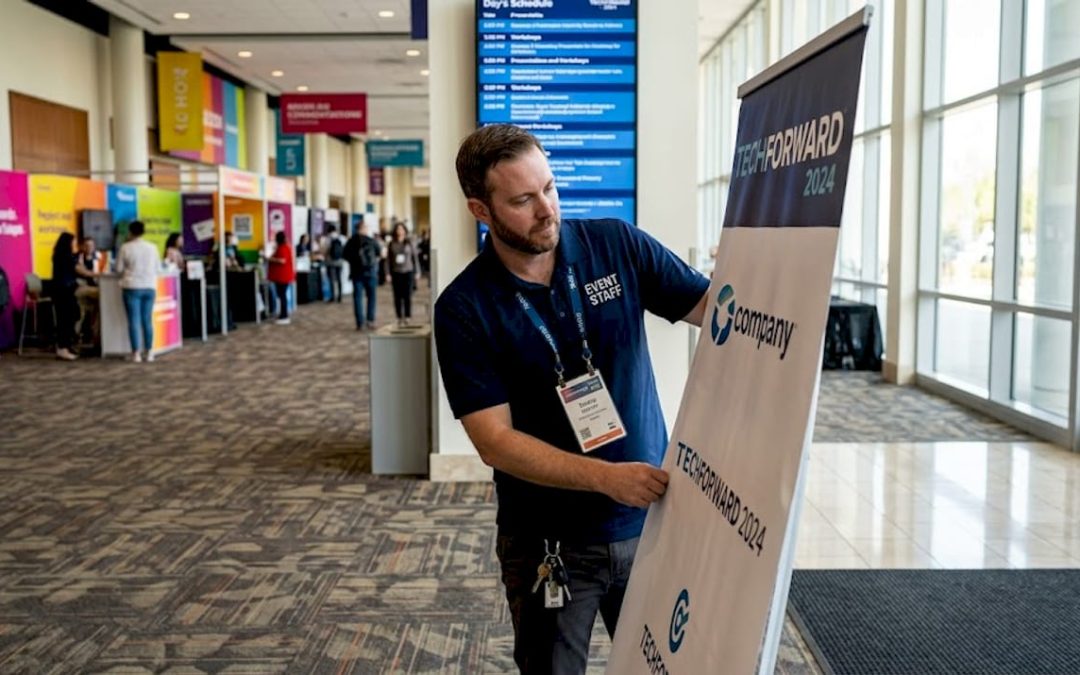
Banner stands are the workhorse of trade show signage. They’re lightweight, portable, and available in retractable formats that set up in under two minutes. Place them at booth entrances or at the end of aisles to pull in traffic from multiple directions. Double-sided retractable banners extend your messaging reach without taking up extra floor space.
Digital displays are the power play. Rotating slides, short product videos, and live social feeds make your booth feel dynamic. Visitors are naturally drawn to movement, and a well-placed screen can hold attention long enough for a staff member to start a conversation.
Logo mats are the most underestimated tool in the exhibitor’s kit. According to one documented case, adding a branded logo mat to a booth produced a 30% increase in traffic, an 89% boost in dwell time, and a 45% increase in leads. A floor element invites people to step in, and once they’re standing on your brand, they’re already engaged.
Directional signs guide visitor flow through your booth and toward key stations like demo areas, giveaway tables, or product displays. They eliminate confusion and keep the experience moving. When visitors know where to go, they stay longer.
Wall graphics create an immersive branded environment that signals professionalism and scale. Even a modest booth can feel like a premium experience with a full-bleed graphic covering the back wall. Explore real-world event signage examples to see how top exhibitors use wall space strategically.
Here’s a quick summary of each sign type’s primary strengths:
- Banner stands: Portability, fast setup, high visibility
- Digital displays: Dynamic content, interactivity, lead capture
- Logo mats: Floor-level engagement, dwell time, brand immersion
- Directional signs: Visitor flow, reduced confusion, longer stays
- Wall graphics: Full-booth branding, premium appearance
| Sign type | Primary benefit | Best for |
|---|---|---|
| Banner stands | Visibility and portability | Any booth size |
| Digital displays | Engagement and tracking | Mid to large booths |
| Logo mats | Dwell time and lead gen | All booth sizes |
| Directional signs | Visitor flow | Complex or large booths |
| Wall graphics | Immersive branding | Inline or island booths |
Pro Tip: If you’re working with a compact booth, an outdoor event signage comparison can help you identify which formats adapt well to tight spaces without losing visual impact.
For outdoor or hybrid events, check this outdoor event signage guide for material and format recommendations specific to those environments.
Comparing signage options: What suits your booth best?
Now, with knowledge of the main sign types, let’s compare their performance to find what fits your specific booth needs. Not every sign works for every situation. The right choice depends on your booth size, your audience’s expectations, and what you want visitors to do.
Experiential and digital signage boosts engagement by 41% and improves lead quality by 28% compared to static alternatives. That’s a significant gap. But digital also comes with a higher upfront cost and more setup complexity. Static signs still outperform when the goal is pure brand awareness or when budget is the primary constraint.
Here’s how the major options stack up across key performance dimensions:
| Sign type | Traffic boost | Dwell time | Lead quality | Relative cost |
|---|---|---|---|---|
| Banner stands | Moderate | Low | Moderate | Low |
| Digital displays | High | High | High | High |
| Logo mats | High | Very high | High | Moderate |
| Directional signs | Low | Moderate | Low | Low |
| Wall graphics | Moderate | Moderate | Moderate | Moderate |
For booth sizing context:
- Small booths (10×10): Banner stands and logo mats offer the highest return per square foot. Skip digital if setup space is tight.
- Mid-size booths (10×20): Combine a digital display with a logo mat and one or two banner stands for a layered approach.
- Large or island booths: Wall graphics plus digital plus directional signage creates a complete visitor journey.
The goal of customizing event signs is to match format to function. A high-energy product launch booth needs something very different from a professional services firm looking to build trust and schedule consultations.
Statistic callout: Digital and experiential signage improve lead quality by 28% over static signs, which means the sales conversations you have are not just more frequent but more qualified.
This custom signage step-by-step resource walks you through the design and production process so your choices translate into polished, professional results on the show floor.
Tailoring your signage strategy for maximum impact
Once you’ve compared options, here’s how to build a focused signage plan that translates into trade show results. Strategy matters as much as execution. A well-planned signage setup is built in layers, each element supporting the next.
Follow this step-by-step planning process:
- Define your booth goal first. Are you generating leads, launching a product, or building brand awareness? Your goal determines which sign types take priority.
- Map your booth layout. Sketch where visitors enter, where your staff will stand, and where the natural focal points are. Place your highest-impact signs at those focal points.
- Allocate budget by impact. Pre-plan signage at 18% of your marketing spend and concentrate 35% of your booth budget on experiential elements that drive measurable engagement.
- Customize for brand consistency. Every sign should use the same font family, color palette, and tone. Inconsistency signals a lack of professionalism and confuses visitors.
- Build in a measurement system. Assign a unique QR code to each sign type to track which format drives the most scans, visits, and conversions.
- Test before the event. Set up your full signage layout in advance and photograph it from multiple angles and distances. What looks great up close may be hard to read from the aisle.
Pro Tip: Don’t wait until the week before the show to finalize designs. Production lead times for quality custom signs can run 7 to 14 business days. Build that buffer into your planning calendar.
For inspiration on creative approaches, these creative signage ideas are worth reviewing before your next design brief. And if you want practical guidance on execution, these signage tips for small business apply directly to trade show contexts.
“A signage strategy without a measurement plan is just decoration. Build the tracking in from the start, not as an afterthought.”
The best exhibitors treat their signage as a system, not a collection of individual pieces. Each element feeds the next: a banner draws attention, a logo mat keeps visitors in place, a digital screen delivers the pitch, and a QR code captures the lead.
Our perspective: The real secret to trade show signage success
Having mapped out options and planning steps, let’s share a candid perspective on what really works and what most exhibitors overlook.
Here’s the truth: flashy signs alone don’t win trade shows. We’ve seen beautiful, expensive booths sit empty while simpler setups across the aisle drew steady crowds. The difference is almost always strategic placement and an understanding of how visitors actually move through a show floor.
Most exhibitors think about their booth from the inside out. They stand at the back and design for the view from within. The visitors you need to attract are walking past at an angle, distracted, and moving fast. Your signage needs to stop them in their tracks from 20 to 30 feet away, not impress them once they’ve already walked in.
The other overlooked factor is measurement. Most exhibitors leave a show with a stack of business cards and a rough sense of how it went. That’s not data. Boosting brand visibility with custom signage is only half the job. The other half is knowing what worked so you improve at every show. Blend physical signs with digital tracking elements, and you’ll learn more from one event than most exhibitors learn in a decade.
Discover custom signage solutions for your next trade show
Inspired to upgrade your trade show presence? The right signs can completely change how visitors experience your booth, and you don’t have to figure it out alone.
At Custom Signs Today, we specialize in producing high-quality custom signs built for performance at trade shows, expos, and live events. From bold banners and branded mats to face change signs and site signs that command attention, we cover every format your booth needs. Browse our full range of custom sign services to find the right solution for your next event. Request a free quote today and let our team help you build a signage system that drives traffic, builds your brand, and generates real leads.
Frequently asked questions
What signage types are proven to boost trade show booth traffic?
Banner stands, digital displays, logo mats, and directional signs consistently increase booth traffic and engagement. In one documented case, a logo mat alone produced a 30% traffic increase alongside dramatic improvements in dwell time and leads.
How much should I budget for trade show signage?
Effective exhibitors allocate roughly 18% of marketing spend to signage overall and dedicate about 35% of the booth budget specifically to experiential elements that drive engagement.
What’s the best way to measure the ROI of trade show signs?
Use unique QR codes assigned to each sign type to track scans, page visits, and conversions. Combine that with dwell time tracking and post-event lead quality scores to get a full picture of performance.
Are digital signs more effective than traditional signs?
Digital and experiential signage boosts engagement by 41% and improves lead quality by 28% over static alternatives, making them a strong investment when budget allows.
What can I do if my trade show booth is small?
Vertical retractable banner stands, logo mats, and back-wall graphics maximize visual impact within a small footprint without requiring extra floor space or complex setup.