
TL;DR:
- Proper apartment signage is essential for safety, compliance, and first responder efficiency, requiring careful material, design, and installation choices. Bold contrast, correct mounting heights, durable materials, and adherence to ADA and fire codes ensure signs remain effective and legally compliant. Budgeting for high-quality signs and involving vendors early prevents costly replacements and enhances overall property management.
Apartment signage does more than label a door. It directs first responders, guides new residents, communicates rules, and shapes the first impression every visitor gets of your property. Get it wrong and you risk ADA violations, fire code failures, and confused tenants filing maintenance requests about missing unit numbers. Get it right and your property runs quieter, safer, and more professionally. This guide walks you through the essentials for apartment signage, from material selection and design standards to installation and compliance, so you can make decisions that hold up for years.
Table of Contents
- Key takeaways
- 1. The essentials for apartment signage: selection criteria
- 2. Essential types of apartment signage
- 3. Comparing materials and design options
- 4. Installation best practices for compliance and longevity
- My take on what apartment managers consistently get wrong
- How Customsignstoday can handle your apartment signage needs
- FAQ
Key takeaways
| Point | Details |
|---|---|
| Compliance is non-negotiable | NFPA 101 and ADA standards set minimum size, contrast, and mounting requirements for apartment signs. |
| Material choice drives lifespan | Cast acrylic and stainless steel outperform cheaper alternatives significantly over a 10-year ownership period. |
| Contrast ratio determines legibility | A contrast ratio below 3:1 fails ADA standards; aim for 12:1 wherever possible. |
| Illumination adds safety value | LED-backlit signs improve visibility in dim corridors and parking areas without creating glare problems. |
| Separate unit and mailbox numbers | Using dedicated unit signs apart from mailbox labels improves emergency responder efficiency and code compliance. |
1. The essentials for apartment signage: selection criteria
Before you order a single sign, you need a clear picture of what makes signage work in a multifamily setting. Four factors drive almost every good decision here.
Visibility. NFPA 101 requires unit numbers to be at least 4 inches high with a minimum half-inch stroke width, contrasting sharply against the background. That standard exists specifically so firefighters and paramedics can read a door number in low light, under stress. A decorative font with thin strokes might look attractive, but it can cost critical seconds in an emergency. Stick to sans-serif typefaces with consistent stroke weight.
Contrast. This one surprises most managers. White on dark green achieves a contrast ratio of 12:1, which is excellent. Light gray on beige produces only 2.3:1 and fails ADA standards outright. The difference between those two combinations looks subtle on a screen. On a wall at dusk, it is the difference between readable and invisible. Always verify contrast ratios before finalizing color choices, especially for outdoor sign ideas where sunlight will bleach colors over time.
Durability. Coastal properties face salt air and humidity. Desert climates punish signs with UV intensity and temperature swings. Urban settings deal with vandalism and airborne grime. Your material choice has to match your climate, not just your budget.
Code compliance. ADA accessibility standards cover mounting height, Braille requirements, and non-glare finishes. NFPA fire codes govern unit number specifications and exit signage. You need to satisfy both simultaneously, which means generic off-the-shelf signs often fall short.
- Choose sans-serif fonts with consistent stroke widths for all unit numbers
- Verify contrast ratios against ADA minimums before ordering
- Match material selection to your local climate conditions
- Check both ADA and NFPA requirements before finalizing any sign specification
Pro Tip: When reviewing apartment sign design options with a vendor, ask for the contrast ratio data in writing. Any reputable supplier can provide it.
2. Essential types of apartment signage
Not all signs serve the same purpose, and a well-run property needs several distinct categories working together. Think of it as a system rather than individual pieces.
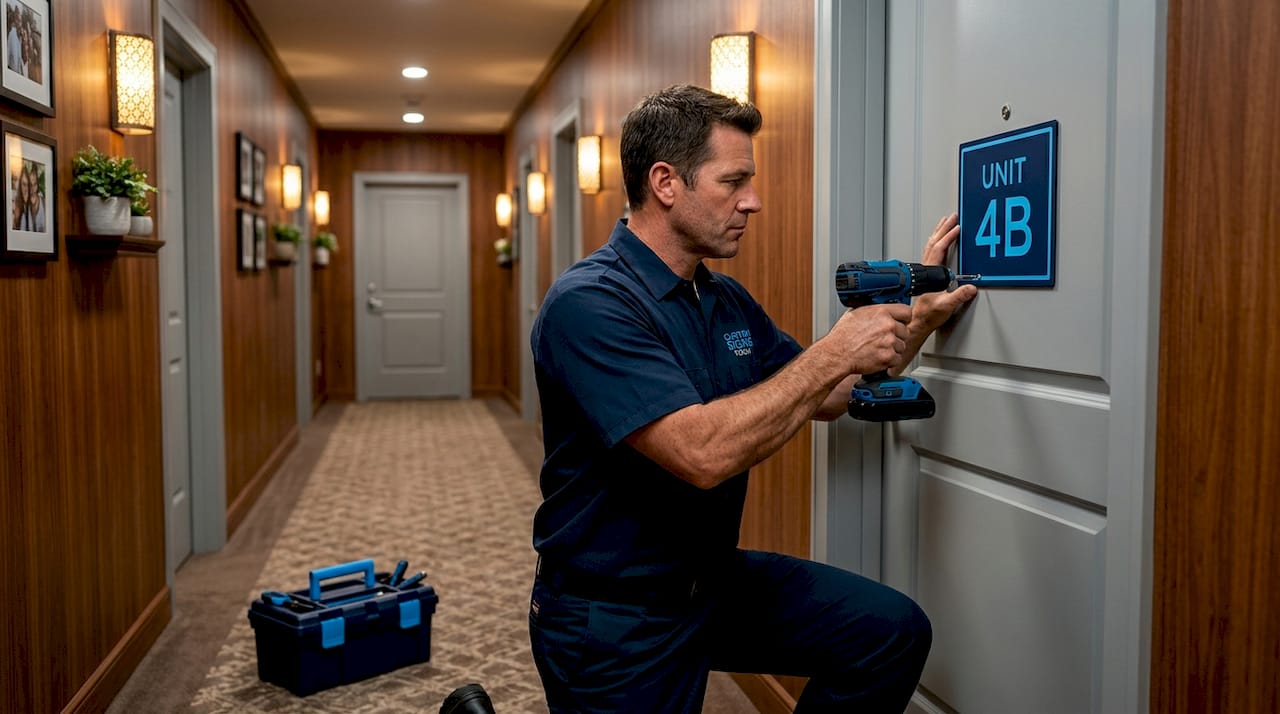
Unit number signs are the backbone of the entire system. They must be mounted at a consistent, readable height on every door and cannot be delegated to a mailbox cluster across the parking lot. Mailbox numbers frequently lack proper stroke width and mounting height, and objects nearby often obscure them, causing delays for emergency responders. Dedicated door signs are a separate requirement.
Directional and wayfinding signs handle parking lot flow, leasing office locations, gym and pool access, and building letter identification. Residents learn a property quickly, but visitors and delivery drivers never do. Good wayfinding sign placement reduces phone calls to the office and prevents the parking lot frustration that generates negative reviews.
Building identification and monument signs create the property’s street presence. These are your outdoor sign ideas at their most visible, and they carry both branding and address identification functions. Emergency services use them to locate the correct building from the street.
Regulatory and safety signs cover fire exits, stairwell access, no-smoking zones, pool rules, and no-trespassing notices. Many of these are legally required under fire code compliance standards, not optional improvements.
Indoor apartment signage covers leasing offices, mail rooms, laundry facilities, utility rooms, and elevator lobbies. These signs serve a quieter but constant function: reducing confusion and preventing tenants from wandering into restricted areas.
- Unit door signs: dedicated, code-compliant, and mounted at consistent heights
- Directional signs: parking, entrances, amenity locations, and building letters
- Monument and building ID signs: street-facing identification for emergency and branding purposes
- Safety signs: fire exits, extinguisher locations, and no-smoking zones
- Indoor signs: common area identification and restricted access notices
3. Comparing materials and design options
Choosing between materials is where most property managers either spend too little or get overwhelmed by options. Here is a direct comparison of the most common choices.
| Material | Lifespan | Best climate | Key advantage | Key limitation |
|---|---|---|---|---|
| Cast acrylic | 12 to 15 years | Most climates | UV-resistant, ADA non-glare finish | Scratches more easily than metal |
| Stainless steel | 20-plus years | Coastal and humid areas | Corrosion-resistant, very durable | Higher upfront cost |
| Aluminum | 10 to 15 years | Desert and urban | Lightweight, cost-effective | Prone to denting on impact |
| Brass | 15-plus years | Low humidity | Premium appearance | Tarnishes without maintenance |
| PVC foam board | 3 to 5 years | Indoor use only | Very affordable | Poor UV and weather resistance |
Cast acrylic and stainless steel both satisfy ADA non-glare finish requirements, which matters for indoor corridor signs where overhead lighting creates reflection. For coastal Florida or Gulf Coast properties, stainless steel’s corrosion resistance makes it worth the premium. For inland properties with strong sun, cast acrylic with UV stabilization handles the exposure well.
On illumination, the options have improved considerably. LED-backlit acrylic signs produce a uniform glow and carry a rated lifespan of roughly 50,000 hours of continuous use. Solar LED works well for monument signs and parking lot directories where running conduit is impractical. For residential environments, keep your color temperature at or below 3000K, which minimizes glare and keeps you on the right side of dark-sky ordinances many municipalities have adopted.
The cost argument for better materials is straightforward. Cheap signs without UV stabilization carry total ownership costs 3.2 times higher over 10 years compared to compliant alternatives that run $85 to $140 per unit upfront. You will replace low-quality signs repeatedly, each time paying for the sign, the labor, and the downtime. Choosing durable signage materials from the start is the more economical path.
Pro Tip: For properties in humid or coastal areas, request a marine-grade finish on any stainless steel components. It costs marginally more and can add years to the sign’s service life.
4. Installation best practices for compliance and longevity
Good signs installed incorrectly become a liability. Here is a practical sequence for getting installation right the first time.
-
Set mounting height before anything else. ADA eye-level guidelines place the ideal mounting range at 58 to 66 inches from the floor for unit number signs. Deviating from that range reduces compliance and readability simultaneously. Mark all mounting heights with a template before drilling to keep every sign consistent across the property.
-
Use mechanical fasteners on masonry surfaces. Adhesive-backed signs on stucco, brick, or concrete fail faster than people expect, particularly in heat or humidity. Stainless steel screws with wall anchors provide secure, code-compliant mounting that stays put for the life of the sign. This applies to unit doors, stairwell signage, and exterior building signs.
-
Position signs away from obstructions. A sign mounted behind a door swing or next to a light fixture loses half its value. Signs should be readable from at least 10 feet away under normal lighting conditions, without anything blocking the sightline.
-
Follow a documented inspection schedule. Set a calendar reminder twice a year to walk the property and check every sign for fading, damage, or displacement. Document what you find. If you ever face a code inspection or liability claim, that paper trail matters more than you might expect.
-
Coordinate with your HOA or property committee early. Bringing detailed technical specs and code references to an HOA approval meeting works far better than presenting design preferences. Committees respond to compliance data. Learn more about the business signage installation process before your next renovation cycle.
My take on what apartment managers consistently get wrong
I’ve spent years working with property managers on signage projects, and the same mistakes keep appearing. The most common one is treating unit number signs as decorative rather than functional. A manager will choose a sign based on how it looks in a photo and discover later it fails contrast requirements or uses a font that’s illegible past 6 feet.
The second issue I see constantly is ignoring indoor apartment signage until a problem forces the conversation. Leasing office signs get replaced when they wear out. Common area signage gets skipped entirely because no one budgets for it. Then an incident happens in a utility room or a new tenant cannot find the mail room, and suddenly signage becomes urgent.
The third thing I’d push back on is the assumption that cheap and compliant are compatible. In my experience, they almost never are. The property entrance signs that last and perform are the ones specified correctly from the start. The ones that generate callbacks, replacements, and complaints are almost always the result of cutting the materials budget.
My honest advice is this: treat signage as infrastructure, not decoration. Budget for it accordingly, involve your vendor in the specification process, and document everything. The properties that do this well simply run better.
— Yossi
How Customsignstoday can handle your apartment signage needs
If you manage an apartment complex and need signs that satisfy ADA requirements, NFPA fire codes, and HOA aesthetic standards all at once, Customsignstoday builds exactly that. The team specializes in custom apartment signs using cast acrylic, stainless steel, aluminum, and PVC materials selected for your specific climate and application.
From face change signs that let you update unit numbers without replacing the full fixture, to durable site signs for property entrances and parking areas, Customsignstoday covers the full range of apartment signage categories. You can also explore the full custom sign catalog or request a quote to get exact pricing for your property’s scope. Every project includes design support to confirm contrast ratios, font legibility, and code compliance before anything goes to production.
FAQ
What size do apartment unit numbers need to be?
NFPA 101 requires unit numbers to be at least 4 inches high with a minimum stroke width of half an inch. These dimensions apply specifically to support emergency responder access.
What height should apartment signs be mounted at?
Mount unit number signs between 58 and 66 inches from the floor to meet ADA eye-level reach guidelines. Mounting outside that range reduces both compliance and readability.
Which material works best for outdoor apartment signs?
Stainless steel is the most durable choice for coastal and humid climates, lasting 20 or more years. Cast acrylic with UV stabilization performs well in most other climates and lasts 12 to 15 years.
Do apartment signs need to meet ADA standards?
Yes. ADA standards apply to font legibility, contrast ratios, non-glare finishes, mounting height, and Braille requirements for many sign types. Non-compliance can result in code violations and liability exposure.
Can I use adhesive signs on a brick or stucco façade?
Adhesive-backed signs are not recommended for masonry surfaces. Use stainless steel screws with wall anchors instead, which provide secure and code-compliant mounting that holds up against weather and temperature changes.