
Most American companies report that clear, branded signage leads to a significant increase in brand recall during sponsored events. In a crowded marketing world, standing out is tougher than ever for ambitious American organizations who want to attract attention and make the most of sponsorship opportunities. Understanding the different types of sponsorship signage and learning how to avoid common mistakes will help you boost brand presence and create lasting partnerships.
Table of Contents
- Signage In Sponsorship Defined And Explained
- Types Of Sponsor Signage And Applications
- Branding Strategies For Effective Signage
- Legal Framework For Sponsorship Signage
- Common Signage Mistakes And How To Avoid
Key Takeaways
| Point | Details |
|---|---|
| Strategic Design is Essential | Effective sponsorship signage requires careful design that integrates sponsor branding while aligning with organizational standards. |
| Informed Placement Matters | The visibility and impact of signage are enhanced by strategic placement that considers audience flow and engagement. |
| Legal Compliance is Crucial | Organizations must navigate local regulations and legal frameworks to ensure sponsorship signage meets all necessary guidelines. |
| Avoid Common Mistakes | Prioritizing clarity and accessibility in signage design can prevent common pitfalls that diminish communication effectiveness. |
Signage in Sponsorship Defined and Explained
Signage in sponsorship represents a strategic visual communication tool that enables organizations to acknowledge and highlight financial supporters across various events and facilities. University campus signage standards define sponsorship signage as purposeful visual displays that identify and recognize organizational contributors, creating a mutually beneficial branding opportunity.
At its core, sponsorship signage serves multiple critical functions beyond simple recognition. These visual elements provide sponsors tangible brand exposure while simultaneously offering event organizers a mechanism to demonstrate appreciation for financial support. Organizations leverage these displays to create professional, structured environments that communicate institutional relationships and partnership values. By carefully designing signage that integrates sponsor logos, names, and brand elements, businesses transform standard acknowledgment into sophisticated marketing real estate.
The effectiveness of sponsorship signage depends on strategic placement, design quality, and alignment with both sponsor and host organization objectives. Event signage design principles emphasize creating displays that are visually compelling, readable from appropriate distances, and contextually appropriate for the specific event or venue. Successful implementations consider factors like audience demographics, venue layout, lighting conditions, and expected viewer engagement duration.
Pro tip: Collaborate closely with sponsors during the initial design phase to ensure signage meets their branding guidelines while maintaining your organization’s visual standards.
Types of Sponsor Signage and Applications
Sponsor signage encompasses a diverse range of visual communication tools designed to maximize brand visibility and recognition across different environments. International sign classifications reveal multiple categories of signage, including building-mounted signs, digital displays, and banner systems that serve unique promotional purposes.
Traditional sponsor signage typically includes several key formats: building-mounted signs like awnings, canopy signs, and projecting signs that create permanent brand presence; banner signs that offer flexible, temporary branding solutions; and increasingly sophisticated digital signage that provides dynamic brand exposure. Digital sponsor markers have emerged as particularly powerful tools, enabling real-time logo detection and precise measurement of brand visibility, especially in sports broadcasting and live event environments.
The strategic selection of sponsor signage depends on multiple factors including venue characteristics, target audience, event duration, and specific marketing objectives. Sports venues, conference centers, academic institutions, and corporate environments each require tailored signage approaches. For instance, a university might utilize building-mounted plaques acknowledging major donors, while a sports stadium could integrate sophisticated digital displays that rotate sponsor logos and provide interactive brand experiences.
Here’s a comparison of common sponsor signage types and their typical business impact:
| Signage Type | Best Use Case | Key Benefit | Consideration |
|---|---|---|---|
| Building-Mounted | Permanent venues | Long-term brand exposure | Requires structural permits |
| Banner Signs | Temporary events | Flexible placement | Limited durability |
| Digital Displays | High-traffic, dynamic events | Real-time content updates | Requires power source |
| Plaques | Donor recognition areas | Prestige and legacy creation | Fixed location needed |
Pro tip: Conduct a comprehensive venue site survey before designing sponsor signage to understand spatial constraints, audience traffic patterns, and optimal visual engagement points.
Branding Strategies for Effective Signage
Effective signage branding transcends mere visual decoration, functioning as a critical communication platform that transforms organizational identity into tangible visual experiences. Signage as marketing communication represents a sophisticated strategic approach that integrates subjective perceptions with precise brand messaging to create meaningful audience connections.
Successful branding strategies demand consistent design elements that reinforce organizational identity across different platforms. Library signage refresh techniques demonstrate how strategic design can integrate logos, color schemes, typography, and messaging to create a unified visual language. This approach ensures that every sign becomes an extension of the brand, communicating not just information but the organization’s core values and personality.
The most impactful signage branding strategies focus on creating multi-sensory experiences that go beyond visual aesthetics. This involves carefully considering placement, readability, contextual relevance, and emotional resonance. Whether in a corporate environment, educational institution, or public space, signage should communicate a narrative that connects with the target audience, transforming passive visual information into an engaging brand interaction.
Pro tip: Develop a comprehensive brand style guide specifically for signage to ensure consistent visual communication across all organizational touchpoints.
Legal Framework for Sponsorship Signage
Navigating the complex legal landscape of sponsorship signage requires a nuanced understanding of constitutional protections and local regulatory frameworks. Sign regulation guidelines from U.S. Supreme Court rulings have established critical precedents that balance free speech rights with municipal control, particularly through landmark decisions like Reed v. Gilbert and City of Austin v. Reagan National Advertising.

Corporate sponsorship agreements must carefully comply with multiple legal dimensions, including content neutrality, municipal codes, and ethical standards. Corporate sponsorship policies for public facilities outline specific requirements for sponsorship signage, addressing critical elements such as acknowledgment rights, revenue generation through naming rights, and adherence to local government regulations.
The legal framework surrounding sponsorship signage involves intricate considerations of intellectual property, trademark usage, and contractual obligations. Organizations must develop robust agreements that clearly define sign placement, size, duration, and permissible branding elements while maintaining compliance with local zoning laws, First Amendment protections, and potential content restrictions. This requires a strategic approach that balances marketing objectives with legal constraints and community standards.
Pro tip: Consult a local legal professional specialized in municipal code and First Amendment regulations to review sponsorship signage contracts before final implementation.
Common Signage Mistakes and How to Avoid
Navigating signage design requires understanding and avoiding critical pitfalls that can undermine communication effectiveness. Wayfinding design challenges reveal numerous systemic mistakes organizations frequently encounter, including complex designs that confuse users, poor accessibility considerations, and ineffective placement strategies.
The most prevalent signage errors stem from neglecting fundamental design principles. Signage best practices highlight key challenges such as inadequate legibility, inappropriate scale, insufficient contrast, and poor font selection. These technical shortcomings can dramatically reduce a sign’s ability to communicate effectively, ultimately diminishing its intended purpose and potential economic impact.
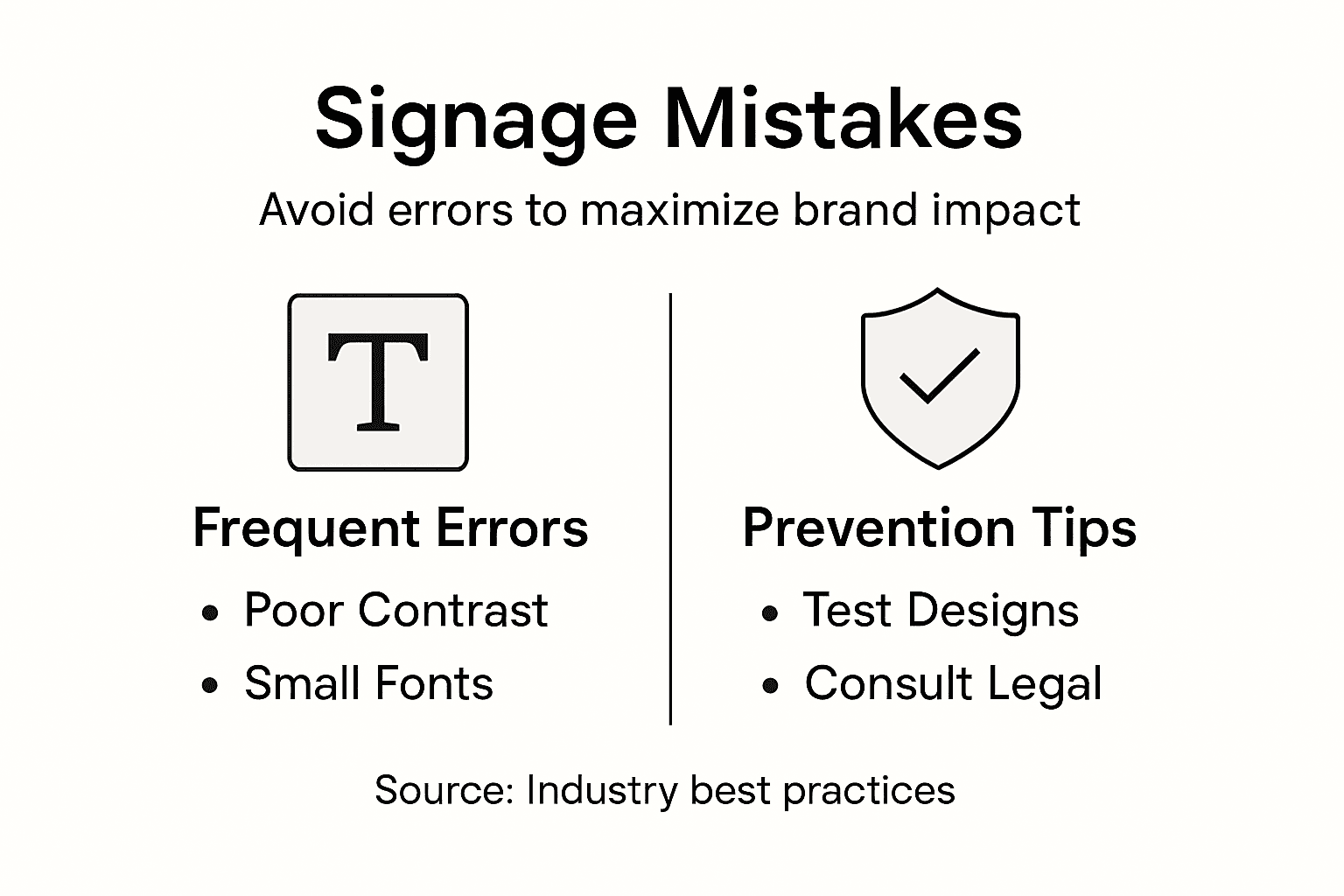
Successful signage design demands a holistic approach that integrates user experience, visual communication, and strategic placement. Organizations must prioritize clarity, readability, and contextual relevance. This involves conducting thorough research, testing design prototypes, and continuously refining visual communication strategies. Critical considerations include understanding audience demographics, analyzing viewing distances, ensuring appropriate color contrast, and maintaining consistent branding elements across different sign types and environments.
Below is a summary of frequent signage design mistakes alongside recommended prevention strategies:
| Mistake | Common Cause | Prevention Tip |
|---|---|---|
| Low Legibility | Poor font or contrast | Use high-contrast, clear fonts |
| Overly Complex Design | Excessive graphics | Aim for simple, focused visuals |
| Inadequate Placement | Ignoring audience sightlines | Assess traffic flow before mounting |
| Lack of Accessibility | Failing to consider all users | Incorporate ADA-compliant features |
Pro tip: Conduct user testing with diverse participants to validate signage design before final implementation, ensuring maximum comprehension and accessibility.
Elevate Your Sponsorship Signage for Maximum Brand Impact
Sponsorship signage plays a crucial role in showcasing your brand and honoring your partners. The article highlights challenges such as strategic placement, design quality, and aligning signage with sponsor goals to create lasting impressions. If you are looking to avoid common pitfalls like poor legibility or ineffective placement while creating visually compelling, durable signage that truly connects with your audience, professional custom solutions are essential.
At Custom Signs Today, we specialize in crafting tailor-made signage that transforms sponsorship recognition into powerful brand experiences. From vibrant banners and building-mounted signs to dynamic vehicle wraps and decals, our expert team uses high-quality materials designed to withstand both indoor and outdoor environments. Our client-focused approach ensures your sponsor signage complies with branding standards and legal frameworks while captivating your target audience.
Ready to maximize your sponsorship visibility with custom signage solutions that deliver real value? Visit our Uncategorized category for inspiration and detailed service descriptions. Take the first step toward creating impactful, high-quality sponsorship signage by requesting your free quote today at Custom Signs Today. Your brand deserves the best representation—don’t wait to make a lasting impression.
Frequently Asked Questions
What is sponsorship signage and why is it important?
Sponsorship signage is a visual communication tool used by organizations to acknowledge and showcase financial supporters at events and facilities. It is important because it provides brands with exposure, enhances event credibility, and demonstrates appreciation for sponsorship.
What types of signage are commonly used in sponsorship?
Common types of sponsorship signage include building-mounted signs, banner signs, digital displays, and plaques. Each type serves different purposes, such as permanent branding, temporary promotions, or interactive experiences.
How can I ensure my sponsorship signage effectively promotes brand visibility?
To maximize brand visibility, consider factors like strategic placement, high-quality design, and alignment with both sponsor and event objectives. Audience demographics and venue characteristics also play crucial roles in determining effectiveness.
What are some common mistakes to avoid when designing sponsorship signage?
Common mistakes include low legibility due to poor font choices, overly complex designs that confuse viewers, inadequate placement ignoring traffic flow, and lack of accessibility for diverse audiences. Prioritizing clarity and conducting user testing can help avoid these pitfalls.
Recommended
- Why Branding Starts With Signage Impact –
- Understanding Types of Promotional Signage for Businesses –
- Why Signage Matters for Successful Events –
- Branding With Custom Signage: Boost Your Business Impact –
- Mats4EU | Logo Mats Making a Lasting Impression – Mats4U USA
- How to Build Brand Awareness for Your Business in the USA – seo analytic