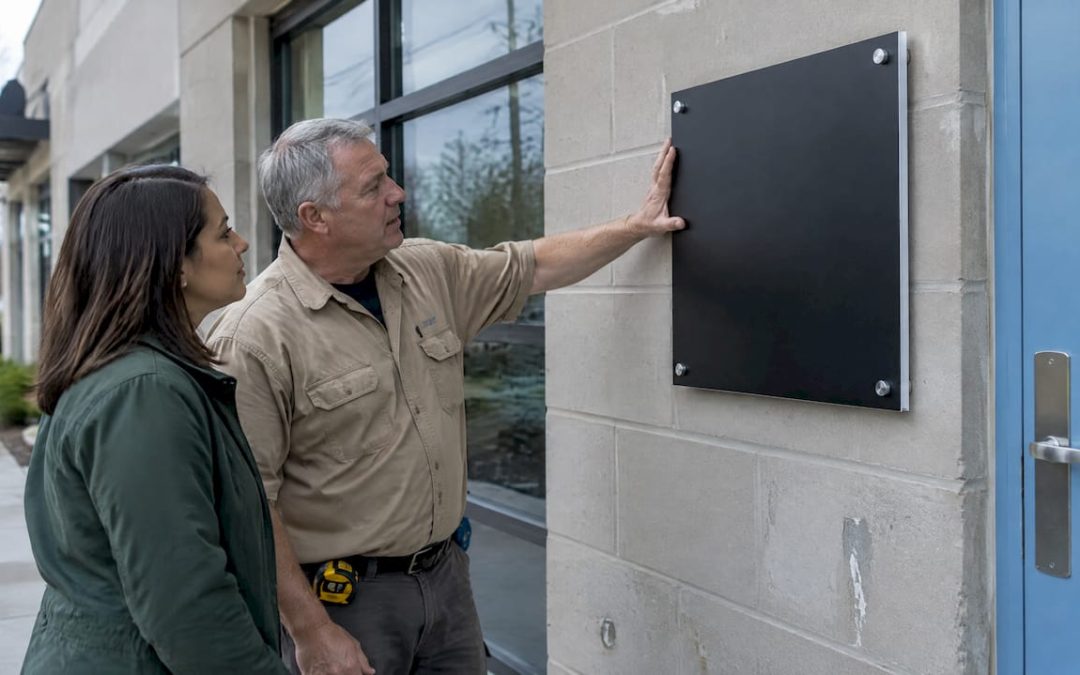
Signs and displays are the visual tools a business uses to be found, understood and trusted: a storefront sign that says who you are, a banner that announces a sale, a wall graphic that reinforces your brand, a directional sign that stops customers from getting lost. The right choice depends on three things: where the sign lives (indoors or outdoors), what it must do (attract, inform or direct) and how far away it will be read. This guide walks through each, with practical rules you can apply before you order.
TL;DR
- Match the sign to its job: attract attention (exterior signs, banners, vehicle graphics), inform (menus, promotions, interior signs) or direct (wayfinding and directional signs).
- Outdoor signs need weather-ready materials and often a permit. Indoor signs can use lighter materials but still need to be readable and, in many cases, accessible.
- Size for distance: a common guideline is at least one inch of letter height for every 25 feet of viewing distance.
- Strong contrast and a consistent look across every sign do more for recognition than extra decoration.
- Tell us the location, the viewing distance and the goal, and we will recommend the format and materials.
Table of Contents
- What signs and displays do for a business
- The main types of signs and displays
- Indoor vs. outdoor signs: what actually changes
- How to choose the right sign for your location and purpose
- Accessibility: signs people must be able to use
- Using signs consistently to build your brand
- Who uses which sign: quick matches
- Our perspective
- Get your signs and displays made to fit your site
- FAQ
- Sources
What signs and displays do for a business
A sign is never just decoration. It works at three moments in a customer’s day: before they arrive (can they find you?), at the door (do they know they are in the right place?) and inside (do they know where to go and what to buy?).
The International Sign Association (ISA) points to measurable effects on the inside of a building. It notes that dynamic digital signage in grocery stores shows a 33% increase in additional sales for the advertised product, and that digital displays in lobby areas can noticeably reduce perceived wait time. Those figures describe digital displays specifically, but the principle carries over to printed signs: a message placed where the customer is already looking gets read.
For the businesses we work with, the uses usually fall into four groups:
- Identification: your name and logo on the building, the door, the window or the vehicle.
- Promotion: banners, feather flags, A-frames and window graphics for sales, openings and events.
- Direction: parking, entrances, suite numbers, event routes.
- Information and compliance: hours, safety messages, room labels and required notices.
The main types of signs and displays
It helps to sort signs by where they go and how long they stay. Here is the landscape in plain terms.
Building-mounted exterior signs
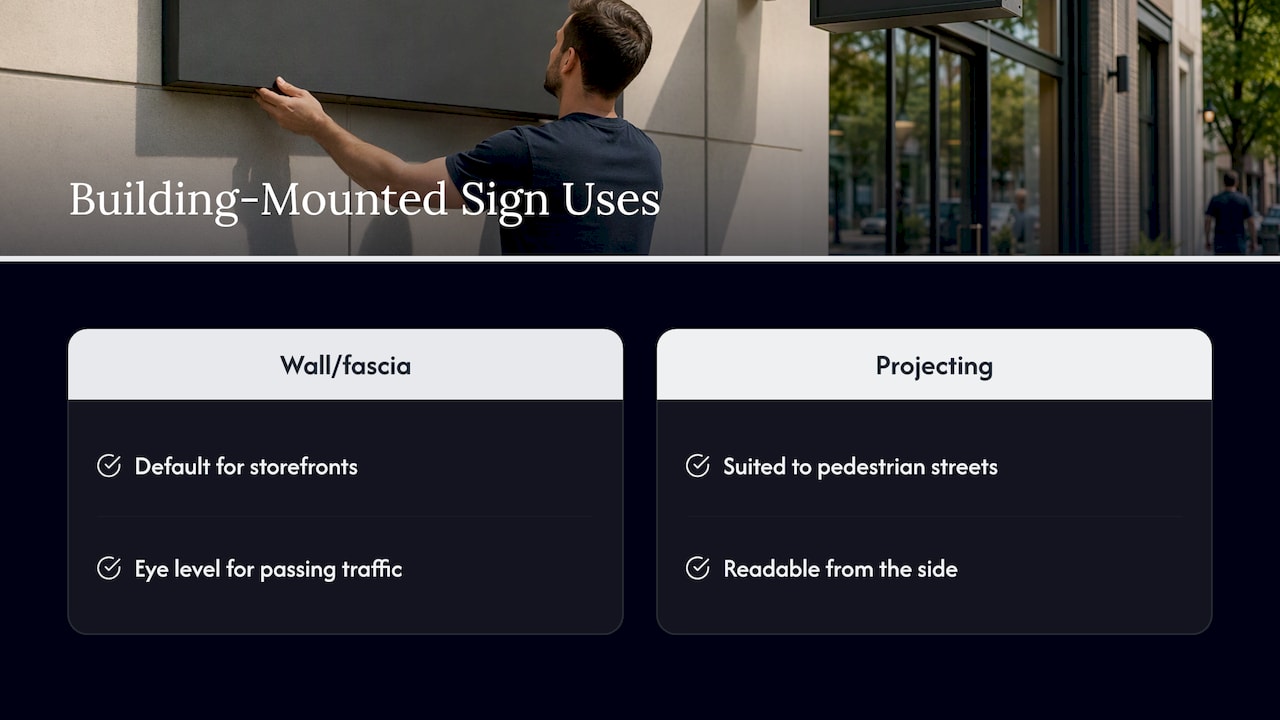
The ISA groups building-mounted signs by where they sit on the exterior: awnings, canopy signs, parapet signs, projecting signs, roof signs, sign bands, wall or fascia signs and window signs. Wall (fascia) signs are the default for storefronts because they sit at eye level for passing traffic. Projecting signs suit pedestrian streets because they can be read from the side as people walk along the sidewalk. If you are weighing options for your building, see our exterior signs page.
Freestanding and site signs
Post and panel signs, monument signs and site signs mark the property itself. They matter most for real estate, construction, medical offices and any business set back from the road. For property work, our guide to designing property signage covers layout and message hierarchy.
Banners and flags
Banners are the fastest way to announce something temporary. Standard vinyl banners suit fences and storefronts, mesh banners let wind pass through on exposed sites, retractable banners work indoors at events and lobbies, and feather banners catch the eye along roads and parking lots. See our range of banners.
Portable signs
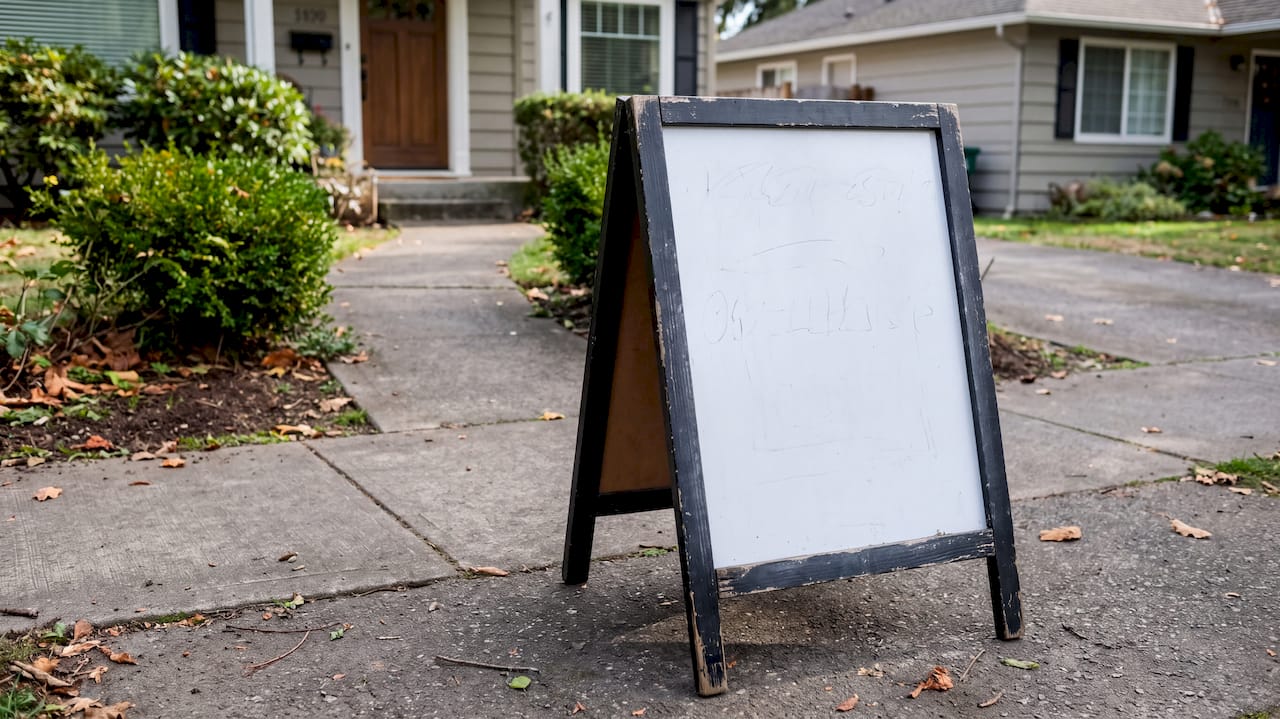
A-frame (sidewalk) signs are inexpensive, easy to move and ideal for daily specials or foot-traffic messages. They also work for open houses and event check-in points. Browse custom signs and A-frames.
Vehicle graphics
Your van or car is a sign that moves through every neighborhood you serve. Options run from magnets (removable, good for part-time use) to lettering (permanent, cost-effective) to full wraps (maximum impact). Details are on our vehicle lettering and magnets page and our vinyl and wrap services.
Interior signs and displays
Reception signs, wall graphics, window graphics, menu boards, room identification, retractable stands and digital screens all live here. They set the tone of the space and guide people through it. Our interior signs page shows the formats we produce.
Indoor vs. outdoor signs: what actually changes
The message can be identical, but the construction usually cannot. Here is a quick comparison.
| Factor | Indoor signs | Outdoor signs |
|---|---|---|
| Exposure | Stable temperature, no rain, little UV | Sun, rain, wind, heat, cold, salt air in coastal areas |
| Typical materials | Acrylic, foamboard, lightweight PVC, paper-based prints, fabric | Aluminum, composite panels, polycarbonate, heavy-duty vinyl, mesh |
| Viewing distance | Usually a few feet to a room’s length | Often 50 feet to several hundred feet |
| Lighting | Controlled, but varies by room | Full daylight to night; may need illumination |
| Rules | Accessibility rules for room signs, fire and safety codes | Zoning, permits, size and placement limits, plus accessibility rules in some cases |
| Lifespan concern | Scratches, fingerprints, fading near windows | Fading, warping, corrosion, wind load |
Material choice is where mistakes are most expensive. One plastics supplier notes that some plastics such as acrylic and styrene scratch easily and are best kept in protected indoor spaces, while polycarbonate is a better choice outdoors. The same source points out that PVC works in both settings but is not durable enough for long-term outdoor use.
For road-facing signs, federal guidance is a useful benchmark. The Federal Highway Administration says sign backing can be aluminum, wood or composite plastic, with aluminum the most common and plywood sometimes used for temporary signs. It also explains that sun and weather can fade colors and degrade reflective qualities until a sign can no longer be read at the distance drivers need. That is the practical reason outdoor signs should be specified for UV and weather resistance from the start. We cover this in more detail in how to weatherproof outdoor signs, and our sign materials comparison lays out the options side by side.
Lighting and electrical parts
Illuminated signs add another layer. Whatever the lighting, check how it handles sun exposure: guides such as this one on UV resistance in outdoor lighting specifications show which specification details to look at for lamps that live outside all year. The same logic applies to power connections, and this overview of choosing UV-resistant cables for outdoor installations explains why exposed cabling should be rated for sunlight. For a permanent illuminated sign, the electrical work is part of the installation plan we help coordinate.
How to choose the right sign for your location and purpose
Work through these five questions in order. Most bad signs fail at question one or two.
1. What is the one job of this sign?
A sign that tries to identify, advertise and give directions at once usually does none of them well. Pick the primary job. Identification signs need your name and a simple mark. Promotional signs need one offer and one action. Directional signs need an arrow and a destination.
2. How far away will it be read, and how fast is the viewer moving?
A pedestrian reads a sign differently from a driver at 40 mph. The ISA’s design guidance recommends letters at least one inch tall for every 25 feet of viewing distance, which keeps them readable for all legal drivers. A sign meant to be read from 100 feet therefore needs letters of at least 4 inches, and more is better. The same ISA page notes that effectiveness also depends on lighting and illumination, not only on size. Our guides on selecting sign size for maximum visibility walk through the calculation with examples.
3. Is the contrast strong enough?
Color combinations that look elegant on a screen can disappear on a sunlit wall. Dark on light or light on dark, with a clear gap in brightness, reads best at distance. Our article on the role of contrast in signage explains how to test your palette. Keep the font simple and the letter spacing open, and let the logo carry the personality.
4. What will the sign face every day?
A banner on a windy corner, a sign facing afternoon sun and a wrap on a delivery van that goes through car washes each week all need different materials and finishes. Tell your sign provider about the exposure so that substrate, inks, laminate and mounting hardware are chosen to match.
5. What are the local rules?
Many commercial signs need a zoning review and a building permit before installation, and illuminated signs often need electrical sign-off as well. Requirements differ by city, zoning district, lease terms and sign size, so check with your local planning or building department before you finalize a design. Our guide to permitted signage rules for business owners explains what to ask. We also offer compliance consulting as part of the process, so a design is not finished before the rules are considered.
Accessibility: signs people must be able to use
If your sign identifies a permanent room or space, accessibility rules may apply. Under the ADA standards, the U.S. Access Board explains that tactile signs need raised characters repeated in Grade 2 braille, plus a non-glare finish and color contrast. It also states that these requirements apply to both interior and exterior signs labeling permanent rooms and spaces, such as restrooms, conference rooms and room numbers. Temporary and promotional signs are treated differently, so ask for guidance on which of your signs fall under the rule. For a specific building, your architect or a certified accessibility specialist can confirm the details.
Using signs consistently to build your brand
A business with ten well-made signs that look unrelated has less brand recognition than one with three that clearly belong together. Consistency comes from a small set of decisions repeated everywhere:
- One or two brand colors with a tested contrast pair.
- One primary typeface for signs, chosen for legibility at distance.
- A fixed logo placement and clear space.
- A matching material family, such as brushed aluminum for permanent signs and the same color values on vinyl for temporary ones.
One design firm describes this as a “visual kit of parts” and stresses that legibility should take priority over aesthetics, even under strict brand guidelines. We agree. If a brand color fails the contrast test on a wall, adjust the sign’s application of it rather than sacrificing readability. For more ideas, see our signage design tips and our guide to branding with decals.
Who uses which sign: quick matches
| If you are… | Start with | Add later |
|---|---|---|
| A retail or restaurant owner | Wall or projecting sign, window graphics | A-frame, interior menu or promo displays |
| A real estate agent | Real estate signs, riders, open house directionals | Banners for listings, vehicle magnets |
| An event organizer | Feather banners, directional signs, retractable banners | Floor and wall graphics, branded printing |
| A property manager | Site and post-and-panel signs, interior room signs | Parking and safety signage |
| A service contractor | Vehicle lettering or magnets, yard signs | Full wrap, business cards and brochures |
If you work in real estate, our guide to the types of real estate signs helps you choose between them.
Our perspective
Most customers come to us asking for a sign. What they really need is an answer to a question: how do I get the right person to notice, understand and act?
We start with the place, not the product. Where does the sign go, who reads it, from how far, and in what light? Once those are clear, the size, material and finish nearly choose themselves. That is why we handle consultation, design, fabrication and installation guidance together, and why compliance is part of the conversation from day one.
We would rather build one sign that is readable from the street than three that look good only on a proof. Durable materials, strong contrast and a consistent look across your banners, vehicle graphics and interior signs are what turn a collection of signs into a brand.
Yossi
Get your signs and displays made to fit your site
Custom Signs Today produces banners, storefront and exterior signs, interior signs, vehicle lettering and wraps, decals, wall and window graphics, and printed materials such as business cards and brochures. Each project can be customized in size, materials and design, and we advise on installation and compliance for indoor and outdoor needs. We serve local and nationwide clients.
To get started, send us the location, the viewing distance and what you want the sign to do. Request a free quote at Custom Signs Today and we will recommend the format, material and layout that fit.
FAQ
What is the difference between a sign and a display?
A sign mainly communicates a fixed message, such as a name, direction or warning. A display is usually a structure or system that presents products or messages, such as a retractable banner stand, a trade show backdrop or a digital screen. In practice the two overlap, and many projects combine both.
How big should my sign be?
Start from the viewing distance. A widely used guideline from the International Sign Association is at least one inch of letter height for every 25 feet. Add extra size for fast traffic, busy backgrounds or poor lighting. Our team can check your measurements before production.
Do I need a permit for a business sign?
Often yes, especially for permanent exterior and illuminated signs. Rules depend on your city, zoning district, sign size and lease. Contact your local planning or building department, and ask your landlord or property manager about their own sign criteria.
Which materials last longest outdoors?
Aluminum and composite panels are the usual choices for permanent outdoor signs, paired with UV-resistant inks and laminates. Mesh suits windy locations for banners. Plain acrylic and lightweight foam are better kept indoors.
Can one provider handle design, printing and installation?
Yes. We handle consultation, design, fabrication and installation guidance together, so your banners, vehicle graphics and interior signs share one look and one point of contact.
Sources
- Identification of Sign Types, International Sign Association
- Design and Placement of Signs, International Sign Association
- Sign Materials, Federal Highway Administration
- Signs: ADA technical guide, U.S. Access Board
- How to Choose the Right Plastic for Indoor vs. Outdoor Signage, Acme Plastics
- Wayfinding Signage: Branded Design Guide, Brand Husl