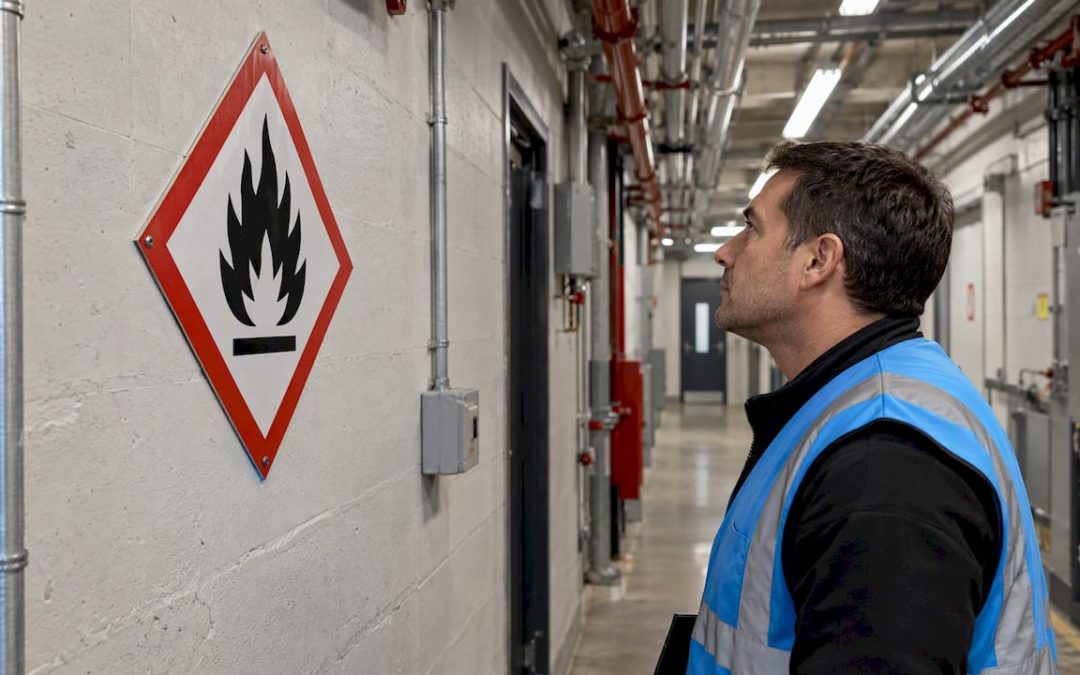
A chemical hazard pictogram is a black symbol on a white background framed by a red diamond, the square set on its point as required under the OSHA pictogram quick card. Workplace signage follows a separate color and shape code: yellow triangles flag general hazards, blue circles mark mandatory actions, red circles with a diagonal slash mean prohibition, and green rectangles indicate safe conditions. On a compliant label, the pictogram never stands alone. It appears next to a signal word and short statements that tell you what the hazard is and what to do about it.
TL;DR:
- OSHA pictograms use a fixed red diamond frame with a black hazard symbol on a white background, and an empty frame is not compliant.
- The eight standard hazard symbols cover flammability, toxicity, corrosion, pressure, health effects, and mild irritants, each with distinct, recognizable shapes.
- Workplace signs follow ANSI and ISO standards with color-coded shapes, such as yellow triangles for hazards or blue circles for mandatory actions, separate from chemical pictograms.
- Full hazard labels must include product name, signal word, hazard and precautionary statements, pictogram(s), and contact info, not just the symbol.
- When ordering hazard signs, ensure correct artwork, shape, color, and wording per the relevant standard, with size and materials suited to the sign’s location.
Table of Contents
- How GHS and OSHA pictograms are built
- What each pictogram looks like and where you’ll see it
- ANSI and ISO rules for workplace signs
- How to read a full hazardous chemical label
- Why transport placards look different from workplace labels
- Ordering hazard signs that actually meet the standard
- A note on getting the visual cues right
- Getting compliant hazard signage made for your facility
- FAQ
- Sources
How GHS and OSHA pictograms are built
The red diamond is not decoration. Under OSHA’s Hazard Communication Standard Appendix C, a compliant pictogram is a square rotated 45 degrees so it reads as a diamond, with a black hazard symbol centered on a white background. The frame itself must stay red, and Appendix C specifically states that an empty red frame with no symbol inside is not permitted. If you see a red diamond with nothing in it, the label is not compliant.
There are eight standard symbols recognized under GHS and adopted into OSHA’s rule, each tied to a type of hazard:
- Flame: flammable materials, including gases, aerosols, liquids, and solids that ignite easily.
- Flame over circle: oxidizers that can intensify a fire even without their own ignition source.
- Exploding bomb: explosives, self-reactive chemicals, and organic peroxides.
- Skull and crossbones: acute toxicity that can cause serious injury or death in small amounts.
- Corrosion: substances that destroy metal or cause severe skin and eye damage.
- Gas cylinder: gases stored under pressure, including compressed, liquefied, and refrigerated gases.
- Health hazard: a silhouette of a person with a starburst on the chest, used for carcinogens, respiratory sensitizers, and reproductive toxins.
- Exclamation mark: milder hazards such as skin or eye irritation, or narcotic effects from inhalation.
The OSHA pictogram quick card lays out all eight symbols side by side, which makes it the fastest reference if you need to confirm a symbol before ordering a sign or checking a label.
What each pictogram looks like and where you’ll see it
Matching a symbol to a hazard is easier once you know the visual shorthand each one uses. Classes are standardized through GHS and OSHA, though how a facility displays them on equipment or storage areas can vary.
- Flame: a simple fire icon, black lines on white. Common on aerosol cans, solvents, and fuel containers.
- Flame over circle: a flame sitting above a ring shape. Found on pool chemicals and some bleach products that act as oxidizers.
- Exploding bomb: a round burst with radiating lines, resembling a cartoon explosion. Seen on fireworks, some aerosols under pressure, and certain lab reagents.
- Skull and crossbones: a classic skull over two crossed bones. Appears on pesticides and concentrated cleaning agents.
- Corrosion: two test tubes pouring liquid onto a surface and a hand, both shown dissolving. Typical on drain cleaners and battery acid.
- Gas cylinder: a cylindrical tank outline. Used on propane tanks and compressed air canisters.
- Health hazard: a human outline with a starburst over the torso. Found on products linked to long-term health effects, including some paints and adhesives.
- Exclamation mark: a bold “!” inside the diamond. Common on mild irritants like certain detergents or aerosol deodorants.
ANSI and ISO rules for workplace signs
Chemical pictograms cover container labels, but a facility also needs signage for hazards, equipment, and routes that GHS pictograms don’t address. That’s where ANSI Z535 and ISO 3864 conventions take over, using color and shape instead of a single regulated symbol set.
- Yellow triangle with a black symbol: general hazard alerting, used for caution and warning conditions.
- Blue circle with a white symbol: mandatory action, such as “wear eye protection” or “hard hats required.”
- Red circle with a diagonal slash: prohibition, marking what’s not allowed in an area.
- Green rectangle or square with a white symbol: safe-condition signage, including exits, first aid stations, and eyewash locations.
Facilities use these signs on walls, near equipment, and along routes where a container label wouldn’t make sense, while GHS pictograms stay tied to the product itself; for detailed guidance on storage and site marking responsibilities, see the OSHA Diesel Storage Checklist for Site Managers. A warehouse might post a yellow forklift-hazard triangle near a loading dock and a blue mandatory sign requiring hearing protection next to a compressor, both separate from any chemical drum sitting in the same room.
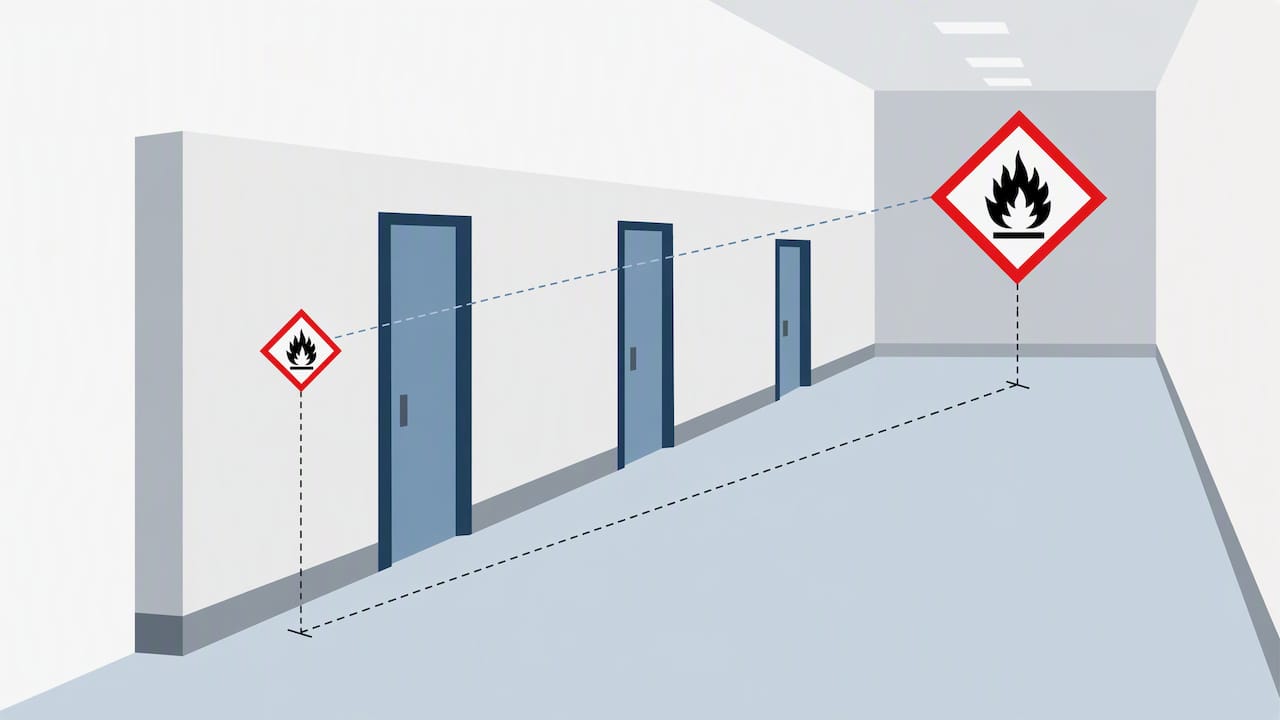
Pro Tip: Letter height and sign size should scale with viewing distance; a sign meant to be read from 50 feet needs noticeably larger text than one mounted at eye level in a hallway.
How to read a full hazardous chemical label
The pictogram is the fastest thing to notice on a label, but OSHA’s 1910.1200 standard requires several elements to appear together on a shipped container.
- Product identifier: the chemical or trade name.
- Signal word: either “Danger” for more severe hazards or “Warning” for less severe ones.
- Hazard statement: a short phrase describing the nature of the risk, such as “causes severe skin burns.”
- Pictogram: one or more of the eight standard symbols.
- Precautionary statement: instructions like “wear protective gloves” or “store in a well-ventilated place.”
- Responsible party contact information: the name, address, and phone number of the manufacturer or supplier.
Picture a label with the corrosion pictogram, the signal word “Danger,” the hazard statement “causes severe skin burns and eye damage,” and the precaution “wear protective gloves and eye protection.” The pictogram tells you to pay attention immediately. The words tell you exactly why and exactly what to do.
Why transport placards look different from workplace labels
A tanker truck carrying flammable liquid displays a large diamond placard with a class number, bold color, and minimal text, built for visibility from a distance under transport rules rather than GHS workplace labeling. A bottle of the same liquid sitting on a shelf carries the smaller GHS pictogram with the full label elements described above.
- Transport systems such as UNECE and DOT use their own placard formats and class numbers, which don’t map one-to-one onto GHS pictograms, according to a hazard resource summary from Utah State University.
- If you’re arranging a shipment, consult transport documentation and placarding rules rather than relying on a product’s workplace pictogram.
- For day-to-day handling inside a facility, the pictogram plus label statements are what matter, not the placard that might appear on the truck that delivered it.
Ordering hazard signs that actually meet the standard
Stock signs cover common cases, but custom work often makes more sense for multilingual facilities, multi-panel layouts combining several hazard types, or unusual mounting surfaces like curved tanks or narrow doorframes. Material choice matters too: indoor signage can use lighter laminates, while outdoor hazard signs need UV-resistant finishes that won’t fade or crack after a season of sun exposure.
Before placing an order, request confirmation on a short checklist:
- Correct pictogram artwork pulled from the standard symbol set, not a redrawn approximation.
- Proper surround shape and color, including the red diamond frame where required.
- All required wording: signal word, hazard statement, and precautionary statement.
- A note on which standard the design follows, ANSI, ISO, or GHS, since facility signage and chemical labels aren’t interchangeable.
ANSI Z535 and ISO 3864 guidance covers letter height, contrast, and recommended viewing distance for safety symbols, which is why a vendor should be able to tell you the right sign size for where it will hang, not just print whatever size you ask for.
Our guide on workshop safety signs walks through which signs a facility typically needs to post, and our piece on common health and safety sign types breaks down when stock designs are enough versus when custom artwork pays off.
A note on getting the visual cues right
The most common signage mistake we see is treating the pictogram as decoration rather than a cue, so people glance past a red diamond without reading the hazard statement next to it. A clear symbol only works if someone stops to read the words that explain the actual risk and the precaution that follows. Use the pictogram to get your attention, then read the label before you act on it.
— Yossi
Getting compliant hazard signage made for your facility
We offer custom safety and compliance signage with the appropriate pictogram artwork, surround shape and color, and materials suited to the sign’s location, indoors or out. We can handle the layout against ANSI and GHS conventions based on the hazard class and mounting location provided.

Before you order, it helps to request the same checklist we use internally:
- Pictogram artwork matched to the standard symbol, not a redrawn version.
- Correct frame shape and color for the hazard class.
- Required wording confirmed against the signal word and precautionary statement you need.
- Material suited to the mounting surface and weather exposure.
Our custom signs page covers sizing and material options, and our guide to identifying mandatory signs is useful if you’re also posting PPE or procedural signage alongside hazard warnings. When you’re ready, request a quote through our custom signs page and we’ll confirm the design before anything goes to print.
FAQ
What do hazard symbols look like?
A hazard symbol under GHS and OSHA rules is a black icon, such as a flame or skull and crossbones, centered on a white background inside a red diamond frame, as specified in OSHA’s Appendix C. Workplace signs use different visuals, including yellow triangles and blue circles, depending on whether the sign flags a hazard or a mandatory action.
What are the main hazard categories?
There’s no single official “9 hazards” list; GHS and OSHA define a set of standard pictogram symbols covering categories like flammability, toxicity, corrosion, and health hazards, detailed on the OSHA pictogram quick card. Definitions of hazard groupings can vary by context, so it’s worth checking the specific standard you’re working against.
What are the main hazardous substance classes?
GHS and OSHA do not specify a fixed number of hazardous substances; instead, chemicals are sorted into hazard classes represented by various pictogram symbols, including flammables, oxidizers, corrosives, and acute toxins. The Hazard Communication Standard classifies substances by hazard class rather than a fixed count.
What are the 4 color hazard signs?
Workplace signage commonly uses four color and shape pairings: yellow triangles for general hazard alerts, blue circles for mandatory actions, red circles with a slash for prohibition, and green rectangles for safe-condition signs like exits or first aid stations. These conventions come from ANSI Z535 and ISO 3864 guidance on sign design, separate from the red-diamond chemical pictograms used on product labels.