TL;DR:
- Roll up banners are portable, quick to set up, and highly effective for brand visibility.
- Different types and materials suit various indoor and outdoor event needs for maximum durability.
- They outperform many signage options in cost, reusability, and anchoring brand presence at events.
Roll up banners have a reputation problem. Some marketers write them off as relics from the pre-digital era, something you’d see at a 2005 county fair and nowhere else. That assumption is costing businesses real visibility. At trade shows, corporate conferences, and retail pop-ups, roll up banners consistently outperform flashier alternatives in cost, setup speed, and brand recall. This guide breaks down exactly what a roll up banner is, how the types differ, how they stack up against other event signage, and how to use them strategically so your brand gets noticed in the right rooms.
Table of Contents
- What is a roll up banner?
- Types of roll up banners and key features
- Roll up banners vs. other event signage
- When and how to use roll up banners for maximum impact
- A fresh perspective on roll up banners: overlooked power in modern events
- How Custom Signs Today can help supercharge your events
- Frequently asked questions
Key Takeaways
| Point | Details |
|---|---|
| Portable event signage | Roll up banners let you showcase your brand anywhere quickly and professionally. |
| Customizable features | Choose from various sizes, materials, and styles to match your event needs perfectly. |
| Cost-effective impact | Reusable banners deliver strong marketing presence without ongoing costs. |
| Quick setup and takedown | Effortlessly assemble and disassemble banners, saving critical time at every event. |
What is a roll up banner?
A roll up banner, sometimes called a retractable banner stand, is a freestanding display unit built for fast deployment and easy transport. The structure is straightforward: a weighted base houses a spring-loaded mechanism that holds the printed banner in a rolled position. When you’re ready to display it, you pull the banner upward, extend a support pole, and attach it at the top. The whole process takes under two minutes. When the event ends, the banner retracts back into the base, and the unit slides into a carry bag.
Self-standing displays made for portability and quick setup are the defining characteristics that separate roll up banners from fixed or semi-permanent signage. That portability is not a minor convenience. For marketing managers juggling three events in one week, it’s the difference between a smooth setup and a stressful scramble.
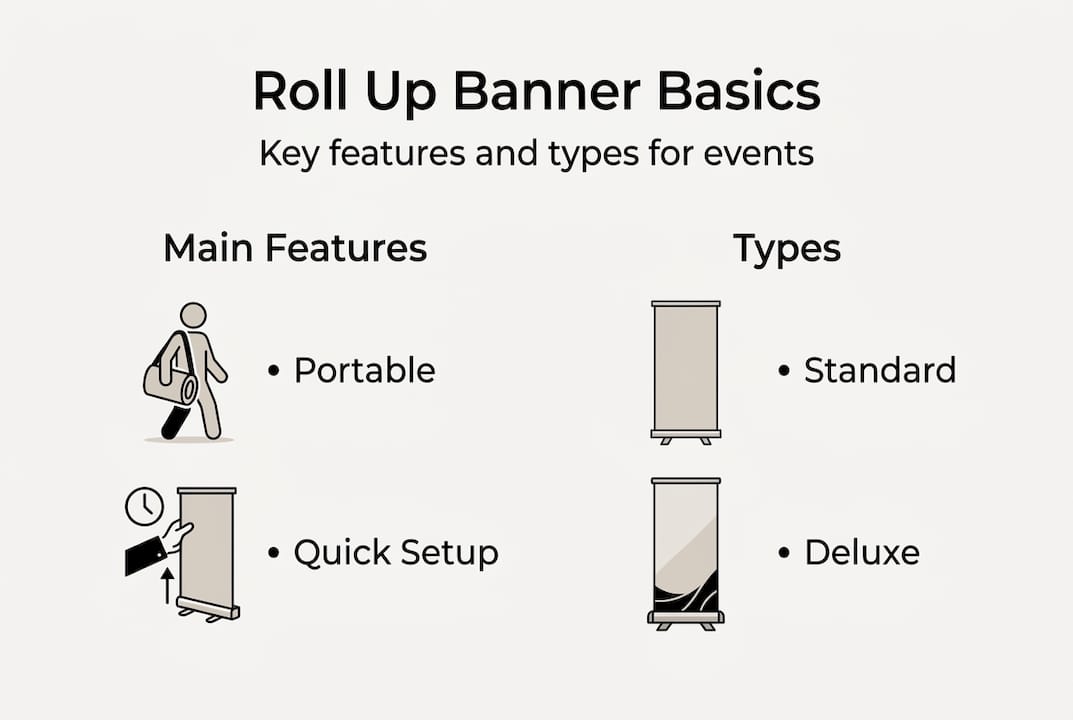
Standard roll up banners typically measure 33 inches wide by 80 inches tall, though sizes range from compact 24-inch tabletop versions to wider 48-inch floor displays. The print surface is usually made from polyester fabric, vinyl, or polypropylene film, each offering different levels of color vibrancy and durability. Understanding event signage basics helps you see where roll up banners sit in the broader signage ecosystem: they’re classified as temporary indoor displays, though weather-resistant versions exist for outdoor use.
Here’s what makes roll up banners a foundational tool rather than a niche product:
- Instant brand presence at any venue without requiring wall space or hanging hardware
- Reusable construction that survives dozens of events with proper care
- Consistent print quality that keeps your brand looking sharp under event lighting
- Compact storage that fits in a standard car trunk or checked luggage
Pro Tip: Always request a carry bag with padding when ordering. A basic bag protects the base mechanism from impact during transport, which is the most common cause of early wear.
Types of roll up banners and key features
Not all roll up banners are built the same, and the difference between a standard unit and a deluxe model becomes obvious after a few events. Choosing the wrong type means either overspending on features you don’t need or buying a unit that fails at the worst possible moment.
Standard roll up banners use a basic spring-loaded cassette mechanism. They’re lightweight, affordable, and perfectly suited for short-term campaigns or one-time events. The trade-off is that the mechanism can wear out faster under heavy repeated use.
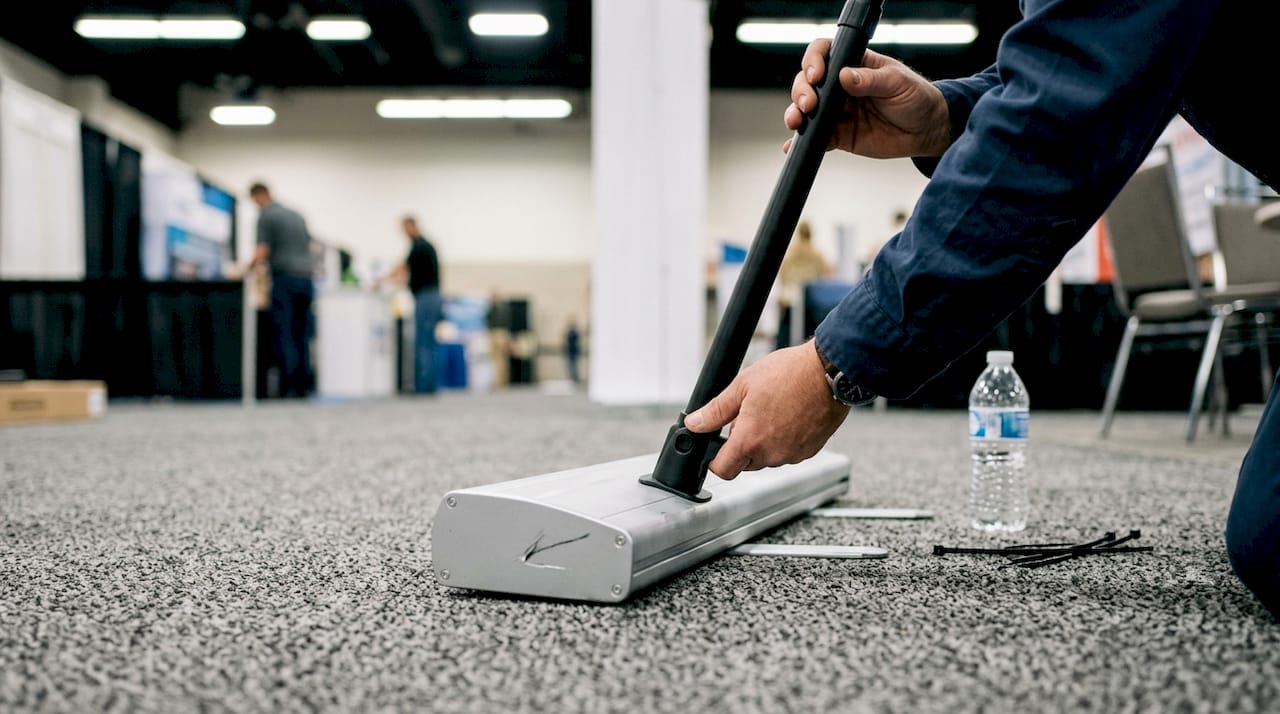
Deluxe or professional roll up banners feature reinforced cassette systems, heavier bases for better stability, and smoother retraction. Some include tension-adjustment features that prevent the banner from curling at the edges after extended display periods.
Single-sided vs. double-sided is another key decision. Single-sided banners work in most settings. Double-sided units are worth the extra cost when your banner will be visible from both directions, such as in the center of a trade show floor or at the end of a conference aisle.
Different materials and mechanisms suit different deployment environments, which is why reviewing banner material types before ordering matters. For indoor events with controlled lighting, polyester fabric produces rich, matte colors. For outdoor or high-traffic settings, vinyl banners offer superior durability and weather resistance.
| Type | Durability | Weight | Relative cost | Print quality |
|---|---|---|---|---|
| Standard roll up | Moderate | Light | Low | Good |
| Deluxe roll up | High | Medium | Medium | Excellent |
| Double-sided roll up | High | Medium-heavy | High | Excellent |
| Fabric roll up | Moderate | Light | Medium | Premium matte |
| Outdoor vinyl roll up | Very high | Heavy | Medium-high | Good |
Key features to evaluate before purchase:
- Base weight and footprint for stability in open or drafty venues
- Cassette mechanism quality for smooth retraction over many uses
- Print surface material matched to your lighting and display environment
- Pole adjustability for venues with varying ceiling heights or display preferences
Roll up banners vs. other event signage
Knowing the types of roll up banners leads naturally to choosing among broader signage solutions. Every event coordinator eventually faces the same question: should I use roll up banners, or would something else work better here?
Roll up banners outperform many forms of temporary signage in portability and setup time, but the right choice depends on your specific event context. Here’s a direct comparison across the factors that matter most to event decision-makers.
| Signage type | Visibility | Portability | Cost | Reusability | Weather resistance |
|---|---|---|---|---|---|
| Roll up banner | High | Excellent | Low-medium | High | Moderate-high |
| X-stand banner | Medium | Excellent | Very low | Medium | Low |
| Foam board | Medium | Good | Very low | Low | Very low |
| Fabric display | Very high | Good | High | High | Low |
| Wall graphic | High | None | Medium | None | High |
| Digital signage | Very high | Poor | Very high | High | Varies |
Here’s how to think through the decision:
- Budget is tight and you need multiple units. Roll up banners win. You can outfit an entire booth for the price of one fabric display system.
- You need maximum visual impact in a large space. Fabric displays or digital signage may justify the cost for flagship events.
- You’re setting up and tearing down alone. Roll up banners are the only format you can realistically manage solo in under ten minutes.
- The event is outdoors in unpredictable weather. Choose outdoor-rated roll up banners or purpose-built outdoor signage.
- You want something permanent. Wall graphics or mounted signs are the right category entirely.
The portable signage comparison data consistently shows that for SME marketing teams running 5 to 20 events per year, roll up banners deliver the strongest return on investment when you factor in reuse across multiple events. A quality unit used 15 times costs a fraction of renting temporary displays each time.
When and how to use roll up banners for maximum impact
Comparing signage options sets the stage to deploy roll up banners with strategy and creativity. Owning a great banner is only half the equation. Where you place it and how you design it determines whether it actually drives results.
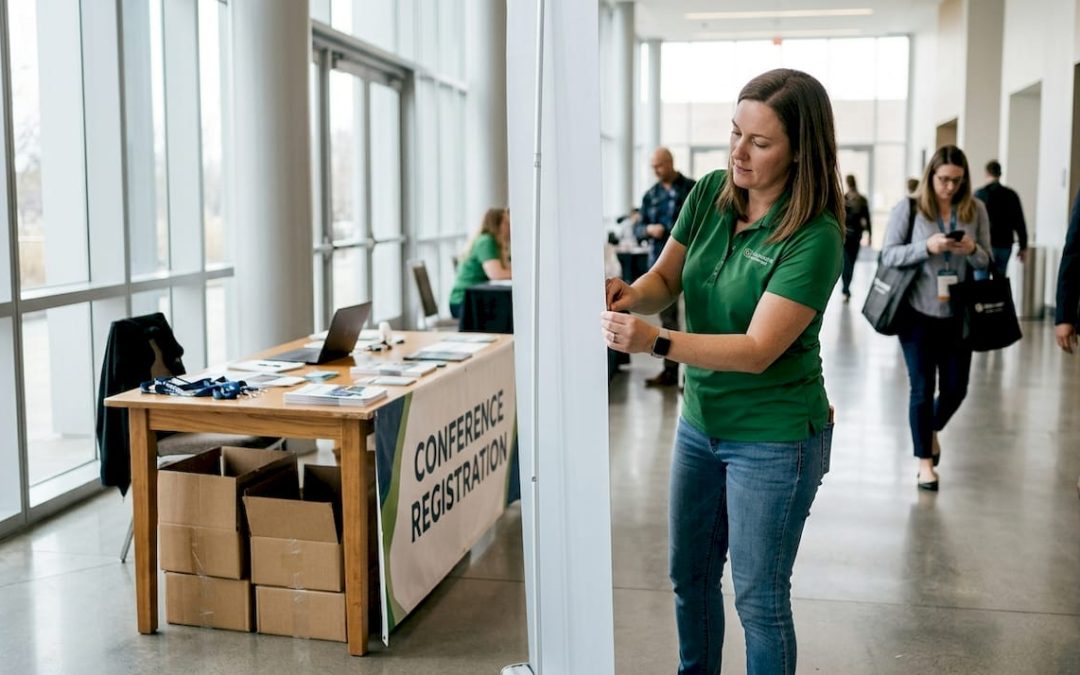
Top event use cases include trade show booths, conference registration areas, corporate lobby displays, retail pop-up activations, and product launch events. In each context, the banner serves a different purpose: attracting foot traffic, reinforcing brand identity, or directing attendees to a specific location.
Strategic placement and visual design make banners significantly more effective at capturing event traffic. Position your banners at venue entrances, beside registration desks, and at the edges of your booth space to create a visual perimeter that draws people in. Avoid placing banners behind tables where they get blocked by staff or furniture.
For design, follow these principles: use no more than three lines of text, make your logo visible from 15 feet away, and choose a background color that contrasts sharply with your font. Bold, simple graphics outperform detailed illustrations every time in a busy event environment. Review signage design tips to align your banner layout with proven visual hierarchy principles.
“Your banner has about three seconds to communicate who you are and why someone should stop walking. Design for that moment, not for a brochure.”
Common mistakes to avoid:
- Overloading text with product features instead of a single clear message
- Using low-resolution images that look blurry when printed at full size
- Placing banners in low-traffic corners where foot traffic is minimal
- Ignoring banner height relative to the average sightline in the venue
- Skipping a call to action such as a website, QR code, or booth number
Pro Tip: Roll the banner loosely when storing it and never leave it fully extended for weeks at a time. Prolonged tension weakens the spring mechanism and causes the banner material to develop permanent creases.
A fresh perspective on roll up banners: overlooked power in modern events
Here’s something the marketing industry rarely admits: digital-first strategies often underperform at in-person events. Screens compete with each other. Attendees scroll past digital displays the same way they scroll past ads on their phones. Physical signage doesn’t have that problem.
A well-placed roll up banner does something a screen cannot: it anchors your brand to a physical space. It creates a visual landmark that attendees subconsciously associate with your company’s location on the floor. That spatial memory is powerful. People remember where they saw your banner, which means they remember where to find you.
The case for investing in quality, reusable banners in 2026 is stronger than it looks on a spreadsheet. When you calculate cost per impression across 15 or 20 events, a $300 banner competes favorably with almost any digital alternative. Explore banner investment insights to see how the math plays out for businesses at different event volumes. The brands that show up consistently with polished, professional physical signage build recognition that no algorithm can replicate.
How Custom Signs Today can help supercharge your events
Ready to elevate your next event? Our team at Custom Signs Today specializes in custom roll up banners built for real-world marketing demands, not just catalog photos.
We offer a wide selection of materials, sizes, and base options so you get exactly the right banner for your venue and audience. From face change signs to full custom sign options, our production team handles everything from design guidance to fast turnaround. Whether you need one banner for a local pop-up or twenty units for a national trade show circuit, we make the process straightforward. Learn about banner stands and request a free quote to get started with signage that actually performs.
Frequently asked questions
What is the typical size of a roll up banner?
Most roll up banners are 33" x 80" standard size, but sizes range from tabletop 24" x 60" options to larger 48" x 80" floor displays depending on your venue and visibility needs.
Are roll up banners suitable for outdoor use?
Many roll up banners use weather-resistant materials designed for outdoor conditions, but you should always confirm that both the base and the print surface are rated for outdoor exposure before purchasing.
How do I design an effective roll up banner?
Keep your message to three lines or fewer, use bold graphics, and make your call to action prominent so attendees know exactly what to do next after reading your banner.
Can roll up banners be reused for multiple events?
Yes, roll up banners are built for repeated use across events as long as you store them properly, keep the mechanism clean, and avoid leaving the banner extended under tension for extended periods.
How quickly can I set up a roll up banner?
Most roll up banners set up in under two minutes without any tools, making them the fastest freestanding display option available for event marketing teams.