TL;DR:
- Effective signage significantly increases customer visibility, foot traffic, and sales.
- Professional sign design accounts for viewing distance, contrast, and environment for maximum impact.
- Poorly designed signs lead to missed customers and can harm brand perception and credibility.
Most businesses assume that having a sign is enough. Put your name on the building, maybe add a phone number, and customers will find you. But that assumption is quietly costing thousands of businesses real revenue every single day. Sign Research Foundation data reveals that 75% of consumers notice signage before anything else, yet poor design causes 61% of potential customers to miss a business entirely. Your sign may be visible. The question is whether it actually works.
Table of Contents
- The crucial role of professional sign design
- How professional signage drives visibility and sales
- Common mistakes with non-professional signage
- Making the most of your investment: Choosing a professional sign designer
- Perspective: Why professional sign design is more than aesthetics
- Ready to elevate your brand? Get professional sign design today
- Frequently asked questions
Key Takeaways
| Point | Details |
|---|---|
| First impressions matter | Professional signage captures attention and builds credibility faster than DIY alternatives. |
| Boost to sales and traffic | Expert sign design leads to measurable increases in customer visits and revenue. |
| Avoid costly mistakes | Skimping on sign quality or layout often results in lost visibility and missed opportunities. |
| Strategy trumps looks | Effective signs are planned for real-world conditions, not just aesthetics. |
The crucial role of professional sign design
There is a big difference between a sign that exists and a sign that performs. Professional sign design starts with a question most business owners never think to ask: “Who is reading this, from where, and at what speed?” The answer changes everything about how a sign should look.
A pedestrian reading your storefront from 10 feet away has a completely different visual experience than a driver passing at 35 miles per hour. Expert designers account for viewing distance with rules like 1 inch of letter height per 10 feet of viewing distance, a standard that ensures readability from streets or at driving speeds. DIY sign makers almost never apply this rule. The result is lettering that looks fine up close but disappears into noise the moment someone is 50 feet away.
Professional designers also think about:
- Contrast ratios between text and background so letters pop in any light condition
- Font selection based on legibility at distance, not just visual style
- Information hierarchy so the most critical message is processed first
- Viewing angles especially for signs mounted high or at an angle to foot traffic
Following effective sign design principles is not optional if you want results. Amateur mistakes compound quickly. A trendy thin font in a pale color on a light background looks stylish in a design mockup. In real-world conditions, on a busy street, in afternoon sunlight, that same sign becomes completely invisible.
“Your sign is often the first thing a potential customer judges your business by. Bad design doesn’t just fail to attract. It actively repels.”
The process of designing custom signs for a business involves field testing, material knowledge, and understanding of local environments that only comes with experience. A professional brings all three.
Pro Tip: Before you approve any sign design, ask your provider to explain their readability methodology. If they can’t answer, that tells you everything you need to know about the quality of their process.
How professional signage drives visibility and sales
Understanding the mechanics of good design is one thing. Seeing the impact in real business numbers is another level entirely.
The connection between professional signage and revenue is well documented. Empirical data shows that professional signage increases foot traffic and sales significantly: 60% of businesses report a 10% or greater sales increase after updating their signage, with some locations seeing up to a 50% boost in foot traffic and a 16% rise in weekly sales. Those are not marginal gains. For a retail store doing $500,000 in annual revenue, a 10% sales increase is an additional $50,000 per year.
Here is a summary of the business impact data:
| Signage outcome | Reported result |
|---|---|
| Businesses reporting 10%+ sales increase | 60% after signage update |
| Foot traffic improvement | Up to 50% increase |
| Weekly sales rise | Up to 16% gain |
| First impression made by signage | 75% of consumers |
The reasons behind these numbers are logical once you understand how customers actually make decisions. Most purchasing decisions, especially for local businesses, are made on impulse. Someone drives by, notices your sign, and decides to stop. If your sign communicates clearly and professionally in less than three seconds, you win that customer. If it confuses them or fails to register, they keep driving and likely never return.
Well-designed signs attract customers in ways that are both immediate and cumulative. Every day your sign is visible to commuters, pedestrians, and residents is another day of free advertising. Unlike digital ads that stop the moment you stop paying, a well-made sign keeps working for years.
The long-term credibility benefit is just as significant. A polished, professional sign tells customers that you take your business seriously. It signals stability, attention to detail, and investment in quality. Branding with custom signage builds that trust over time, turning casual observers into loyal customers who associate your visual identity with reliability.
Key business outcomes of professional signage include:
- Immediate increases in walk-in traffic from street-level visibility
- Stronger brand recall from consistent visual identity
- Higher perceived value of your products or services
- Reduced marketing spend by maximizing passive advertising exposure
- Long-term customer trust built through a professional appearance
Common mistakes with non-professional signage
Knowing the benefits is half the equation. Understanding what goes wrong without professional guidance is the other half. The mistakes made in DIY and budget sign production are predictable, repeated constantly, and expensive to fix.
Here are the most common problems that undermine non-professional sign design:
-
Undersized lettering. Business owners often size text based on how it looks on screen or paper. On a building facade or a vehicle, that same text becomes unreadable from the street. Remember, viewing distance rules such as 1 inch of letter height per 10 feet exist for a reason. Ignoring them is the single most common DIY failure.
-
Poor color contrast. Light yellow text on a white background. Dark navy on black. These combinations seem subtle in a design file and catastrophic in practice. High contrast is not just about aesthetics. It is about making your message physically readable.
-
Too much information. Business owners want to include everything: the name, tagline, phone number, website, hours, social handles, and a list of services. Professional designers know the brain can only process so much in a glance. More content means less retention.
-
Decorative fonts. Script fonts and stylized lettering may reflect your brand personality. They are almost always a readability disaster on exterior signs. Clarity beats personality every time.
-
Ignoring the environment. A sign designed without accounting for where it will live, near other signage, under certain lighting conditions, next to competing colors in the surrounding environment, often disappears or clashes unexpectedly.
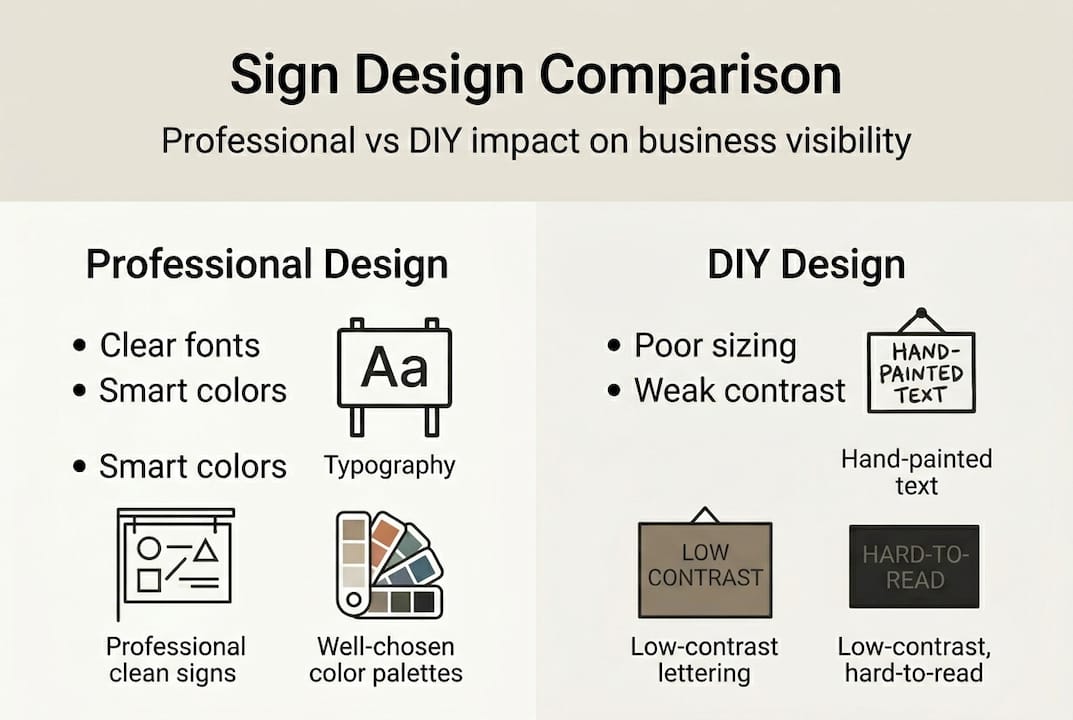
Here is a direct comparison of what you get with professional versus non-professional sign design:
| Factor | Professional design | DIY or budget design |
|---|---|---|
| Letter sizing | Calculated for viewing distance | Estimated by eye |
| Color contrast | Tested for visibility | Chosen for looks |
| Font selection | Legibility-first approach | Style-first approach |
| Information density | Optimized for quick reading | Often overcrowded |
| Material knowledge | Matched to environment | Frequently mismatched |
| Regulatory compliance | Verified for local codes | Often overlooked |
| Long-term durability | Built into material selection | Rarely considered |
One underrated mistake is failing to account for local sign regulations. Many municipalities have rules about sign dimensions, lighting, placement, and content. Non-professional sign buyers often discover these limitations after installation, resulting in costly redesigns, fines, or removal orders.
Considering custom messages on signs also requires strategic thinking about what your audience needs to know versus what you want to say. That distinction is something a seasoned sign designer helps you navigate clearly.
Pro Tip: Before finalizing your sign design, physically test it. Print a scaled version, stand at your intended viewing distance, and assess what registers in under three seconds. What you see will likely surprise you.
Making the most of your investment: Choosing a professional sign designer
Armed with a clear picture of what works and what fails, the next step is choosing the right professional to get the job done. Not all sign companies operate at the same level of expertise, and the selection process matters as much as the design itself.
Follow this practical step-by-step approach to vet your options:
-
Request a portfolio of comparable work. Look for examples that match your environment: exterior storefront signs, vehicle graphics, interior wayfinding, or whatever you need. Generic portfolios are a red flag.
-
Ask about their design process. A professional will describe how they assess your location, audience, and goals before touching a design file. If the answer is “we’ll send you a mockup,” that’s not a process. That’s guesswork.
-
Verify local regulation experience. Your sign provider should know the permit requirements in your city or county. If they shrug at this question, you will be managing compliance problems on your own.
-
Check for proof of results. Ask if they can share client outcomes or case studies. It does not have to be elaborate. Even a single example of how their work improved a client’s visibility or sales is meaningful.
-
Understand material recommendations. A good sign company matches material to environment. Outdoor vinyl behaves differently from aluminum composite, and channel letters serve a different purpose than illuminated panels. Your provider should explain these distinctions clearly and recommend accordingly.
-
Evaluate their brand alignment process. Your sign needs to reflect your specific brand. Ask how they incorporate your existing colors, fonts, and identity standards. A provider who ignores these details will produce something generic, not something powerful.
The Sign Research Foundation confirms that signage is the top first impression driver for consumers, with 75% noticing it before anything else. That fact places enormous responsibility on whoever is designing and producing your signs. Choosing someone without the right credentials and process is not a budget decision. It is a risk to your brand.
A helpful checklist when evaluating sign designers:
- Do they ask about your target customer and traffic patterns?
- Do they provide a proofing and approval process before production?
- Are they familiar with ADA compliance for interior signs?
- Do they offer installation guidance or full installation services?
- Can they explain how the design will perform in low-light or nighttime conditions?
Your office signage design is not a one-and-done transaction. It is an ongoing brand investment. Choosing a partner who treats it that way will save you time, money, and the frustration of signage that simply does not perform.
Perspective: Why professional sign design is more than aesthetics
Here is the uncomfortable reality most businesses avoid: they treat their sign budget the same way they treat office supplies. Something to minimize. Something to get done cheaply and forget about.
That mindset is backward, and it costs more in the long run than it saves upfront.
We have seen businesses spend thousands on digital advertising while putting up a hand-lettered banner on their front window. The banner faces thousands of commuters every single day. The digital ad appears to a fraction of that audience at a much higher cost per impression. The math is not close. Signage, done professionally, delivers some of the lowest cost-per-impression numbers of any advertising medium you can buy.
The deeper issue is that many business owners think of signage as decorative. Something that tells people the name of the place. Professional sign design is not decoration. It is communication strategy executed in physical form. Every color choice, every font decision, every sizing call is a message to your customer about who you are, what you offer, and whether you are worth their time and money.
Branding with custom signage builds the kind of credibility that advertising copy can’t fake. When someone sees your sign consistently over weeks and months, recognition builds. Trust builds. And when they finally need what you offer, your name is the one they think of first.
Cutting corners on sign design is the equivalent of wearing a wrinkled, ill-fitting suit to a job interview and hoping your resume carries the day. The resume might be excellent. But the first impression already did its damage. Your sign is always your first impression, running 24 hours a day, seven days a week. Make it count.
Ready to elevate your brand? Get professional sign design today
Everything covered in this article points to one clear conclusion: professional sign design is not a luxury. It is a direct driver of visibility, customer trust, and revenue growth.
At Custom Signs Today, we specialize in turning your brand identity into high-performance signage that works hard every day. Whether you need exterior lightbox signs that stop traffic at night or a complete visual identity across your location, we bring the expertise, materials, and process that produce real results. Our custom signage process is built around your specific goals, location, and audience so nothing is left to chance. Explore our full range of custom sign solutions and request a free quote today. Your next customer is already driving past. Make sure they stop.
Frequently asked questions
How does professional sign design impact my brand image?
Professional sign design ensures your brand appears polished and trustworthy. Research shows 75% of consumers notice signage first, making it your most consistent brand impression tool.
How quickly can I expect results from new professional signage?
Most businesses see measurable changes within weeks of installation. Data confirms that 60% of businesses report a 10% or greater sales increase after updating to professional signage.
Why are many DIY signs ineffective?
DIY signs typically ignore critical visibility rules. Letter sizing standards like 1 inch per 10 feet of viewing distance are almost always missed, making signs unreadable from the street.
What factors do professionals consider that amateurs often miss?
Professionals evaluate local permit codes, lighting conditions, customer flow patterns, material durability, brand consistency, and readability at multiple viewing distances before finalizing any design.
Is professional sign design worth the investment for small businesses?
Absolutely. Even small businesses report significant gains after upgrading their signage. Empirical evidence shows up to 50% more foot traffic and a 16% weekly sales rise following professional signage updates.